


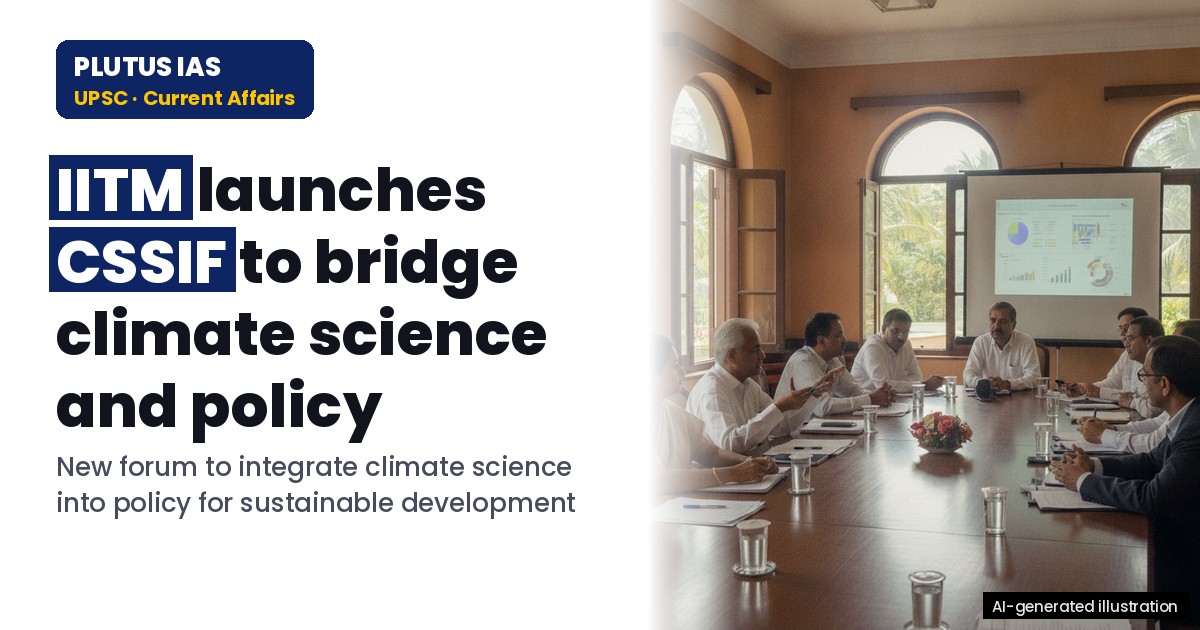
17 Oct IITM Launches CSSIF for Climate Science Integration in India
✎ CSSIF is a MoES-led initiative to convert climate science into sector-specific services, enhancing India’s resilience to climate change through stakeholder-driven, evidence-based policy and action.
Subject Relevance — Where This Topic Fits
- GS Paper III — Environment, Climate Change and Disaster Management | GS Paper II — Governance, Transparency and Institutional Mechanisms
- Prelims: National Mission for Sustaining the Himalayan Ecosystem (NMSHE), Climate Services for Agriculture (CSA), Earth System Science Organisation (ESSO), National Action Plan on Climate Change (NAPCC), India Meteorological Department (IMD), Indian Institute of Tropical Meteorology (IITM)
- Essay: Climate Change: Challenges and Opportunities for India, From Data to Action: The Role of Science in Policy and Governance
Quick Revision: CSSIF is a MoES-led initiative to convert climate science into sector-specific services, enhancing India’s resilience to climate change through stakeholder-driven, evidence-based policy and action.
Why is this in the news?
This initiative marks a critical step toward bridging the gap between climate science research and its practical application in policy, agriculture, disaster management, and public services, aligning with India’s commitments under international climate frameworks and national climate action plans.
Background
- Climate change poses significant risks to India’s socio-economic fabric, including agriculture, water security, public health, and infrastructure, necessitating evidence-based policy responses.
- The Ministry of Earth Sciences (MoES) is the nodal agency responsible for providing weather, climate, ocean, and seismological services in India, with IITM as its premier research institution for climate science.
- India’s National Action Plan on Climate Change (NAPCC), launched in 2008, outlines eight missions to address climate change, including the National Mission for Sustaining the Himalayan Ecosystem (NMSHE) and the National Mission on Strategic Knowledge for Climate Change (NMSKCC).
- The Earth System Science Organisation (ESSO), under MoES, coordinates multi-institutional research on climate variability, monsoon dynamics, and extreme weather events.
- The Intergovernmental Panel on Climate Change (IPCC) reports highlight the need for region-specific climate services to support adaptation and mitigation strategies in vulnerable regions like South Asia.
- India’s G20 Presidency in 2023 emphasized the importance of climate-resilient infrastructure and sustainable development, reinforcing the need for robust climate service frameworks.
What is the Climate Science into Services for India Forum (CSSIF)?
- CSSIF is a multi-stakeholder platform conceptualised by the Ministry of Earth Sciences (MoES) to translate climate science research into actionable services for diverse sectors such as agriculture, water resources, health, and disaster management.
- The forum aims to enhance the usability of climate data, models, and forecasts by integrating inputs from scientists, policymakers, industry representatives, and civil society organisations.
- CSSIF seeks to operationalise the findings of the National Mission on Strategic Knowledge for Climate Change (NMSKCC), which focuses on improving climate prediction models and early warning systems.
- The initiative aligns with India’s commitment to the Paris Agreement and the Sendai Framework for Disaster Risk Reduction, fostering resilience through evidence-based decision-making.
- Stakeholder consultations, such as the recent meeting hosted by IITM, are critical for identifying sector-specific needs, gaps in service delivery, and opportunities for collaboration between research institutions and end-users.
- CSSIF will facilitate the development of climate services tailored to India’s regional diversity, including the Himalayas, coastal zones, and arid regions, which face distinct climate vulnerabilities.
- The forum will leverage India’s existing meteorological and oceanographic infrastructure, including the IMD, IITM, and the National Centre for Medium Range Weather Forecasting (NCMRWF), to deliver reliable and timely climate information.
- Long-term objectives include improving agricultural productivity through climate-smart practices, enhancing water resource management, and reducing the socio-economic impact of extreme weather events.
Key Features
| Feature | Significance |
|---|---|
| Stakeholder Consultation Meeting | Institutionalises multi-stakeholder engagement for translating climate science into actionable services for India. |
| Hosted by IITM (Indian Institute of Tropical Meteorology) | Leverages India’s premier institution for atmospheric and oceanic research to anchor climate service development. |
| CSSIF Framework | Establishes a structured platform for integrating climate data, forecasts, and sector-specific applications across ministries and agencies. |
| First Meeting Focus | Identifies priority sectors (agriculture, water, health, energy) for climate service integration and user requirements. |
Why it Matters
Scientific and Institutional
- Advances India’s transition from climate data generation to climate-informed decision-making by operationalising climate services.
- Strengthens the role of IITM as a nodal agency for climate science translation, aligning with the National Mission for Sustaining the Himalayan Ecosystem (NMSHE) and National Action Plan on Climate Change (NAPCC).
- Facilitates inter-ministerial coordination under the aegis of the Ministry of Earth Sciences (MoES), ensuring policy-relevant climate information.
Economic and Sectoral
- Enhances climate resilience in climate-sensitive sectors such as agriculture (e.g., kharif/rabi crop advisory), water resource management, and public health (e.g., heatwave alerts).
- Supports climate-smart infrastructure planning, reducing economic losses from extreme weather events estimated at 2–5% of GDP annually (World Bank, 2022).
- Enables private sector participation in climate services, fostering innovation in risk modelling and adaptation technologies.
Global and Policy Alignment
- Contributes to India’s commitments under the Paris Agreement by improving climate information services for mitigation and adaptation.
- Aligns with the Global Framework for Climate Services (GFCS) of the World Meteorological Organization (WMO), of which India is a member.
- Supports the implementation of the Sendai Framework for Disaster Risk Reduction (2015–2030) through early warning systems.
Challenges
1. Data-User Interface Gaps
- Ensuring seamless translation of complex climate models into user-friendly formats for non-technical stakeholders (e.g., farmers, urban planners).
- Addressing latency in data dissemination to enable real-time decision-making in disaster-prone regions.
UPSC Link: GS-III: Disaster Management
2. Resource and Capacity Constraints
- Limited computational infrastructure at the sub-national level to run high-resolution climate models and sector-specific applications.
- Need for upskilling meteorological and sectoral officials in climate service utilisation and interpretation.
UPSC Link: GS-III: Science & Technology
3. Inter-Ministerial Coordination
- Bridging silos between ministries (e.g., agriculture, water, health) to integrate climate services into sectoral policies and programmes.
- Establishing standardised protocols for data sharing and service delivery across agencies.
UPSC Link: GS-II: Governance
4. Climate Model Uncertainty
- Managing inherent uncertainties in long-term climate projections to maintain credibility with end-users.
- Balancing the need for actionable information with the scientific rigour required for policy formulation.
UPSC Link: GS-III: Environment
Challenges — UPSC Perspective
| Issue | Concern |
|---|---|
| Data Latency | Delays in processing and disseminating climate information hinder timely decision-making. |
| Sectoral Silos | Lack of integration between climate data providers and end-users across ministries. |
| Infrastructure Gaps | Inadequate computational resources at state/district levels for high-resolution modelling. |
| User Awareness | Limited understanding among stakeholders of how to utilise climate services effectively. |
| Funding Constraints | Sustained financial support required for long-term operationalisation of climate services. |
Way Forward
- Finalise sector-specific climate service products (e.g., agricultural advisories, urban heat island maps) through iterative stakeholder feedback.
- Establish a dedicated Climate Services Division within MoES to oversee implementation and monitoring of CSSIF.
- Develop a national training programme for meteorological and sectoral officials on climate service utilisation.
- Invest in state-of-the-art supercomputing infrastructure to enhance the resolution and accuracy of climate models.
- Institutionalise public-private partnerships for developing climate risk insurance and adaptation technologies.
- Integrate CSSIF outputs into existing flagship schemes such as Pradhan Mantri Krishi Sinchayee Yojana (PMKSY) and Jal Jeevan Mission (JJM).
- Publish an annual ‘Climate Services Report’ to track progress and identify gaps in service delivery.
UPSC Value Addition
Keywords for Mains Answer-Writing
Climate Services for India Forum (CSIF) · Institution of Eminence (IoE) status · Indian Institute of Tropical Meteorology (IITM) · Ministry of Earth Sciences (MoES) · Climate Science to Services · Stakeholder Consultation · Climate Action Plan · Sustainable Development Goals (SDGs) · Climate Resilience · National Mission for Sustaining the Himalayan Ecosystem (NMSHE) · National Action Plan on Climate Change (NAPCC) · Climate Data Policy · Multi-hazard Early Warning Systems · Green India Mission · Climate Adaptation Strategies
Concept Flow
Climate Science Research (IITM, MoES) → Generation of Climate Data & Models → Stakeholder Consultation (CSSIF) → Identification of Sectoral Needs & User Requirements → Translation of Data into Services → Development of Sector-Specific Products (e.g., crop advisories, heatwave alerts) → Integration into Governance Frameworks → Alignment with NAPCC, Sendai Framework, and Paris Agreement Commitments → Operationalisation & Capacity Building → Training, Infrastructure, and Inter-Ministerial Coordination → Monitoring & Feedback Loop → Continuous Improvement through User Engagement and Data Refinement
Prelims Practice Questions
Q1. Consider the following statements regarding the Climate Science into Services for India Forum (CSIF):
1. CSIF is an initiative led by the Indian Institute of Tropical Meteorology (IITM), Pune.
2. The forum aims to integrate climate science into actionable services for various sectors.
3. CSIF was launched under the aegis of the Ministry of Environment, Forest and Climate Change.
4. The primary objective of CSIF is to develop climate models exclusively for agricultural planning.
How many of the above statements are correct?
- Only one
- Only two
- Only three
- All four
Answer: Only three — Statements 1 and 2 are correct as CSIF is indeed led by IITM and focuses on integrating climate science into services. Statement 3 is incorrect because CSIF operates under the Ministry of Earth Sciences, not the Ministry of Environment. Statement 4 is incorrect as CSIF addresses climate services across multiple sectors, not agriculture alone.
Q2. Assertion (A): The Ministry of Earth Sciences (MoES) plays a pivotal role in India’s climate services by providing weather and climate forecasts.
Reason (R): The MoES operates under the administrative control of the Prime Minister’s Office, ensuring high-priority governance for climate-related initiatives.
Options:
A. Both A and R are true, and R is the correct explanation of A.
B. Both A and R are true, but R is not the correct explanation of A.
C. A is true, but R is false.
D. A is false, but R is true.
Answer: ? — Assertion (A) is correct as MoES is indeed responsible for weather and climate services in India. However, Reason (R) is false because MoES functions under the Ministry of Science and Technology, not directly under the PMO.
Q3. Match the following initiatives with their respective objectives:
Column I (Initiative)
A. National Action Plan on Climate Change (NAPCC)
B. National Mission for Sustaining the Himalayan Ecosystem (NMSHE)
C. Climate Science into Services for India Forum (CSIF)
D. Green India Mission
Column II (Objective)
1. Enhancing climate resilience in the Himalayan region
2. Integrating climate science into actionable services for sectors
3. Promoting afforestation and ecosystem restoration
4. Providing a comprehensive framework for climate change mitigation and adaptation
Options:
A. A-4, B-1, C-2, D-3
B. A-1, B-4, C-2, D-3
C. A-3, B-1, C-4, D-2
D. A-2, B-3, C-1, D-4
Answer: ? — The correct pairing is: A-4 (NAPCC provides a framework for climate change mitigation and adaptation), B-1 (NMSHE focuses on Himalayan ecosystem sustainability), C-2 (CSIF integrates climate science into services), and D-3 (Green India Mission promotes afforestation).
Mains Practice Question
✍ The Climate Science into Services for India Forum (CSIF) represents a paradigm shift in India’s approach to climate governance by institutionalising climate science into actionable services. Critically analyse the institutional, technological, and governance dimensions of CSIF within the broader framework of India’s climate action strategy, with reference to the National Action Plan on Climate Change (NAPCC) and the Sustainable Development Goals (SDGs). Also, examine the potential challenges in operationalising CSIF’s objectives at the sub-national level. (15 Marks)
Approach: MODEL-ANSWER SKELETON:
1. **Institutional Dimensions (4 Marks)**
– Role of the Indian Institute of Tropical Meteorology (IITM) as the nodal agency for CSIF.
– Collaboration with the Ministry of Earth Sciences (MoES) and other stakeholders (e.g., IMD, NRSC, state agencies).
– Alignment with the National Action Plan on Climate Change (NAPCC) and its eight missions (e.g., National Mission for Sustaining the Himalayan Ecosystem, National Mission on Strategic Knowledge for Climate Change).
– Comparison with global models (e.g., UK’s Met Office, NOAA’s Climate Services) to highlight institutional strengths/weaknesses.
2. **Technological Dimensions (4 Marks)**
– Integration of climate models, data assimilation, and high-performance computing (HPC) infrastructure.
– Use of satellite data (e.g., INSAT-3D, INSAT-3DR) and ground-based observations for accurate climate predictions.
– Development of sector-specific climate services (e.g., agriculture, water resources, health, energy) under CSIF.
– Challenges: Data gaps, inter-agency coordination, and capacity-building at the grassroots level.
3. **Governance Dimensions (4 Marks)**
– CSIF’s role in fulfilling India’s commitments under the Paris Agreement and SDGs (e.g., SDG 13 on Climate Action, SDG 2 on Zero Hunger, SDG 6 on Clean Water and Sanitation).
– Multi-level governance: Centre-state collaboration, integration with District Disaster Management Plans (DDMPs), and local self-government institutions.
– Policy instruments: Climate Data Policy, National Disaster Management Plan (NDMP), and State Action Plans on Climate Change (SAPCCs).
– Challenges: Fiscal federalism, bureaucratic silos, and political prioritisation of short-term goals over long-term climate resilience.
4. **Challenges at Sub-National Level (3 Marks)**
– Limited institutional capacity in states/UTs to utilise climate services effectively.
– Data asymmetry between central agencies and state departments.
– Lack of standardised protocols for climate risk assessments at the district level.
– Need for capacity-building programmes (e.g., training for state meteorological departments, integration with agricultural extension services).
Balance of Views:
– Optimistic view: CSIF can enhance climate resilience by bridging the science-policy gap.
– Critical view: Institutional inertia, funding constraints, and lack of political will may hinder implementation.
Source: PIB (Press Information Bureau)
Generated by AanyaAi for educational purpose.
Related guides on our sites
- Anthropology VS PSIR
- Best PSIR optional coaching
- Best PSIR optional coaching online
- Best geography optional coaching

- 2030 तक 250 बिलियन डॉलर इंजीनियरिंग निर्यात: नीति निर्माताओं की रणनीति - October 24, 2026
- बस्तर दशहरा में राष्ट्रपति मुर्मु: जनजातीय समाज और विकास के पथ पर नया अध्याय - October 24, 2026
- अटल वयो अभ्युदय योजना: वरिष्ठ नागरिकों के लिए एकीकृत देखभाल व्यवस्था - October 24, 2026

No Comments