


24 Sep IIWW 2026: AI & Climate-Resilient Water Solutions for UPSC Mains

✎ Climate-resilient water governance requires a synergy of political will, community ownership, scientific planning, accountable institutions, and digital innovation to ensure sustainable WASH services under changing climate…
Subject Relevance — Where This Topic Fits
- GS Paper II — International Relations (Water Diplomacy, Bilateral Cooperation) | GS Paper III — Environment, Disaster Management, Science and Technology
- Prelims: Jal Jeevan Mission, Greywater Management, Water-Use Efficiency, Climate-Resilient Infrastructure, Digital Public Infrastructure for Water, Nature-Based Solutions, Swachh Bharat Mission (Gramin), Decentralised Wastewater Treatment, Sustainable Development Goal 6 (SDG 6), Water Governance
- Essay: Climate Change and Water Security: A Governance Imperative, Technology and Inclusion: The Future of Sustainable Development
Quick Revision: Climate-resilient water governance requires a synergy of political will, community ownership, scientific planning, accountable institutions, and digital innovation to ensure sustainable WASH services under changing climate conditions.
Why is this in the news?
The second day of the 9th India International Water Week (IIWW 2026), organised by the Ministry of Jal Shakti in New Delhi, focused on the theme of climate-resilient water management. The event brought together global stakeholders to deliberate on sustainable water governance, grey water management, and resilient WASH (Water, Sanitation, and Hygiene) services, highlighting India’s evolving policy frameworks, technological innovations, and international collaborations in addressing water security under climate change.
Background
- The India International Water Week (IIWW) is a biennial event initiated in 2012 by the Ministry of Jal Shakti to foster global dialogue on water governance and sustainable development.
- The 9th edition of IIWW 2026 is being held in New Delhi from 22–26 September 2026, with the central theme of ‘Climate-Resistant Water Management’.
- The Jal Jeevan Mission (JJM), launched in 2019, aims to provide functional household tap connections to all rural households by 2024, with a renewed focus on sustainability, service delivery, and community ownership.
- India and the Netherlands have a long-standing partnership in water management, including joint initiatives under the India-Netherlands Joint Working Group on Water.
- The Swachh Bharat Mission (Gramin) Phase II (2020–2025) emphasises ODF+ (Open Defecation Free Plus) status, solid and liquid waste management, and sustainable sanitation.
- The event coincided with the second International WASH Conference 2026, which focused on six technical themes: digital technology, governance, climate resilience, water quality, financing, and institutional strengthening.
What is Climate-Resilient Water Governance and Sustainable WASH?
- Climate-resilient water governance refers to the institutional, policy, and technological frameworks designed to ensure water security in the face of climate variability and extreme events such as floods, droughts, and cyclones.
- Sustainable WASH services integrate water supply, sanitation, and hygiene with environmental sustainability, community participation, and long-term service delivery models to prevent degradation of water resources.
- Greywater management involves the treatment and reuse of wastewater generated from domestic activities (excluding toilet waste), which can significantly reduce water demand and improve resource efficiency in rural and urban settings.
- Digital Public Infrastructure (DPI) for water, such as the ‘Sujalam Bharat Digital Public Infrastructure’ initiative, enables data-driven planning, asset management, and risk-informed decision-making by integrating geospatial data, IoT sensors, and AI-driven analytics.
- Nature-based solutions (NbS) for water management utilise natural or modified ecosystems (e.g., wetlands, mangroves, and sponge cities) to enhance water retention, reduce flood risks, and improve water quality while supporting biodiversity.
- Decentralised wastewater treatment systems (DEWATS) and reuse models are critical for rural areas where centralised infrastructure is economically unviable, ensuring localised treatment and reuse of greywater.
- The integration of WASH services with climate adaptation strategies, such as flood-resistant infrastructure and drought-proof water supply systems, is essential for building resilience in vulnerable communities.
- Institutional strengthening and community engagement are pivotal for the sustainability of WASH services, ensuring ownership, accountability, and adaptive management in response to local needs and climate stressors.
Key Features
| Feature | Significance |
|---|---|
| Jal Jeevan Mission (JJM) | Demonstrates the integration of political will, community ownership, scientific planning, accountable institutions, and digital innovation for universal water security. |
| Sujalam Bharat Digital Public Infrastructure | Facilitates data-driven planning, asset management, and risk-informed decision-making for sustainable water systems. |
| Decision Support System for Source Sustainability | Enables evidence-based governance by integrating hydro-meteorological data, asset tracking, and climate risk assessments. |
| AI-enabled Water Management Solutions | Enhances real-time monitoring, predictive maintenance, and adaptive responses to water scarcity and contamination. |
| Decentralised Greywater Management Models | Promotes localised treatment and reuse, reducing pressure on freshwater sources and improving rural sanitation outcomes. |
Why it Matters
Technological Advancement
- Integration of AI and digital tools in water governance enhances precision, scalability, and adaptive management of WASH services.
- Data-driven decision systems improve resource allocation, asset longevity, and climate resilience in water infrastructure.
- Innovative greywater management models address water scarcity while aligning with circular economy principles.
Institutional Collaboration
- India-Netherlands partnership underscores the importance of cross-border knowledge exchange in climate-resilient water governance.
- Multi-stakeholder forums (thematic, country-specific, and technical) foster collective problem-solving and best-practice dissemination.
- Strengthening of local governance (e.g., Gram Panchayats) through capacity-building and participatory planning.
Sustainability and Equity
- Shift from infrastructure-centric to service-centric and sustainability-focused water management models.
- Community engagement ensures equitable access and long-term ownership of water and sanitation systems.
- Nature-based solutions and climate-resilient designs mitigate vulnerabilities in vulnerable regions.
Policy and Governance
- Emphasis on accountable institutions and transparent monitoring mechanisms to ensure service delivery quality.
- Integration of WASH priorities into broader development plans (e.g., Gram Panchayat Development Plans) ensures coherence.
- Focus on source sustainability and greywater management aligns with SDG 6 (Clean Water and Sanitation) targets.
Challenges
1. Climate Resilience in Water Systems
- Increasing frequency of extreme weather events (droughts, floods) strains existing water infrastructure.
- Adaptation requires significant investment in resilient designs and redundant systems.
- Climate projections must inform long-term planning to avoid maladaptation.
UPSC Link: GS3: Disaster Management
2. Greywater Management in Rural Areas
- Limited awareness and technical capacity for decentralised greywater treatment systems.
- High upfront costs and maintenance challenges deter adoption in resource-constrained settings.
- Lack of standardised guidelines for greywater reuse in agricultural and domestic contexts.
UPSC Link: GS3: Water Resources
3. Digital Divide in Water Governance
- Rural areas often lack reliable internet connectivity and digital literacy for AI-enabled solutions.
- Data privacy and security concerns may hinder adoption of digital monitoring systems.
- Interoperability issues between legacy systems and modern digital platforms.
UPSC Link: GS3: Science & Technology
4. Institutional Fragmentation
- Overlapping mandates among central, state, and local agencies create governance gaps.
- Weak coordination between water, sanitation, and public health departments.
- Limited accountability mechanisms for service delivery failures.
UPSC Link: GS2: Governance
5. Financing Sustainable Water Systems
- High capital expenditure for climate-resilient infrastructure strains public budgets.
- Limited private sector participation due to low perceived returns on investment.
- Need for innovative financing models (e.g., blended finance, outcome-based funding).
UPSC Link: GS3: Economic Development
Challenges — UPSC Perspective
| Issue | Concern |
|---|---|
| Extreme Weather Events | Disrupts water supply chains and damages infrastructure, necessitating adaptive design. |
| Decentralised Solutions Adoption | Localised greywater systems face technical and socio-economic barriers in rural areas. |
| Digital Infrastructure Gaps | Rural regions lack connectivity and skills to deploy AI-enabled monitoring tools. |
| Policy Coherence | Fragmented governance across sectors and levels undermines integrated water management. |
| Sustainable Financing | High costs of resilient systems require innovative funding mechanisms and public-private partnerships. |
Government Initiatives — Must-Memorise for Prelims
- Jal Jeevan Mission (JJM)
- Swachh Bharat Mission (Gramin)
Way Forward
- Strengthen climate-resilient design standards for water infrastructure through updated guidelines and capacity-building programmes.
- Expand pilot projects for decentralised greywater management, with a focus on rural and peri-urban areas.
- Develop a national digital public infrastructure roadmap for WASH services, ensuring interoperability and data security.
- Establish a multi-stakeholder platform for knowledge exchange between India and international partners (e.g., Netherlands).
- Integrate WASH priorities into Gram Panchayat Development Plans (GPDP) with measurable outcomes and accountability mechanisms.
- Promote public-private partnerships to mobilise sustainable financing for climate-resilient water systems.
- Enhance community engagement through participatory monitoring and grievance redressal systems.
- Invest in research and innovation for low-cost, scalable greywater treatment technologies.
UPSC Value Addition
Keywords for Mains Answer-Writing
Water Security · WASH Services · Climate-Resilient Water Management · Greywater Management · Digital Public Infrastructure for Water · Community Participation in Water Governance · India International Water Week (IIWW) 2026 · Sustainable Water Supply · Nature-Based Solutions for Water · Water Quality and Emerging Pollutants
Concept Flow
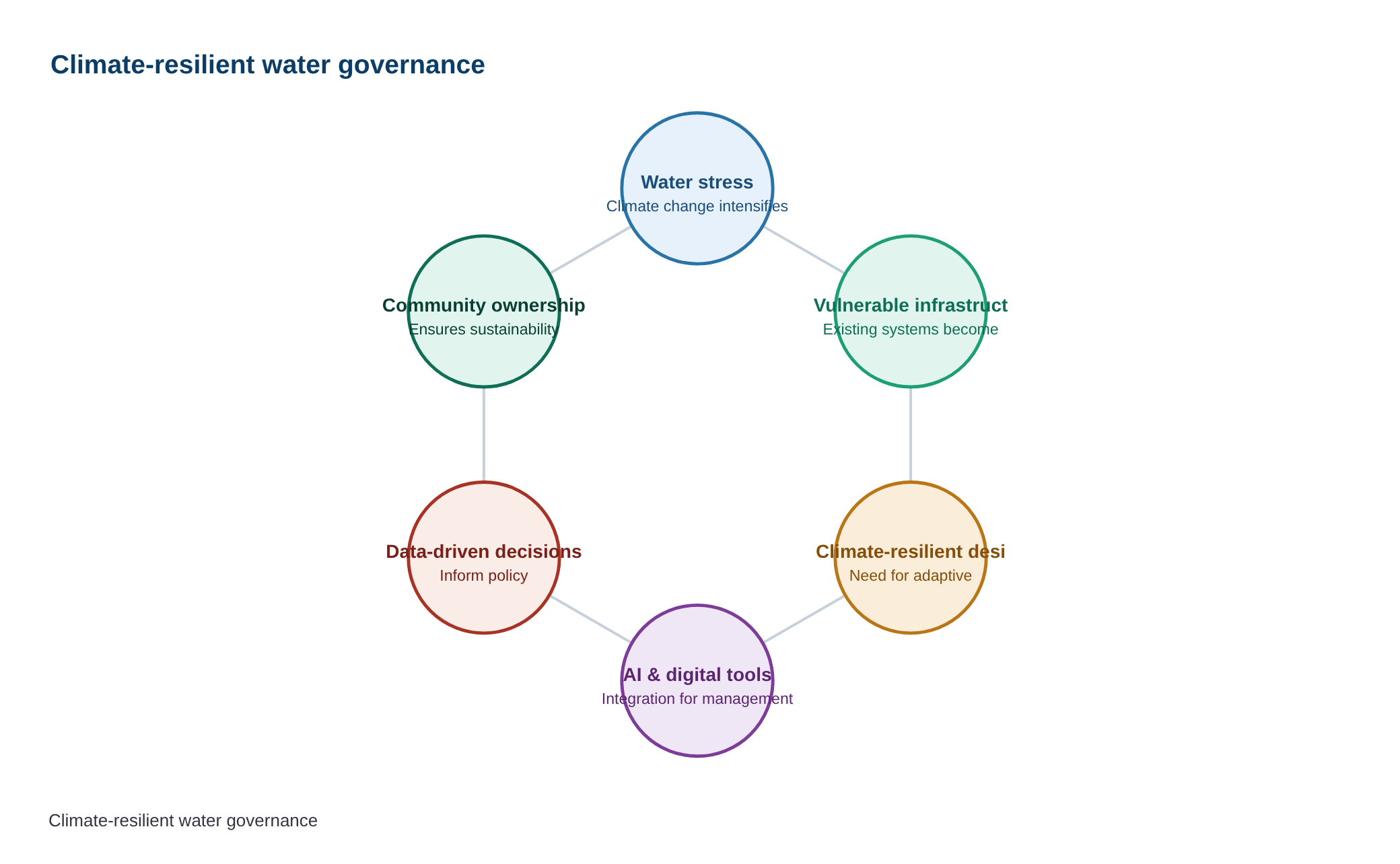
Climate change intensifies water stress → Existing infrastructure becomes vulnerable → Need for climate-resilient designs → Integration of AI and digital tools for adaptive management → Data-driven decision systems inform policy → Community ownership ensures sustainability → Institutional collaboration (e.g., India-Netherlands) accelerates knowledge transfer → Policy coherence strengthens governance → Sustainable financing models enable implementation → Equitable access to water and sanitation is achieved.
Prelims Practice Questions
Q1. Consider the following statements regarding the India International Water Week (IIWW) 2026 held in New Delhi:
1. The theme of the event was ‘Climate-Resilient Water Management’.
2. The event was inaugurated by the Prime Minister of India.
3. The event included a parallel International WASH Conference.
4. The focus of the event was solely on large-scale water infrastructure projects.
How many of the above statements are correct?
- Only one
- Only two
- Only three
- All
Answer: Only three — Statements 1 and 3 are correct. Statement 2 is incorrect as the event was organized by the Ministry of Jal Shakti, not inaugurated by the Prime Minister. Statement 4 is incorrect as the event emphasized sustainability, service quality, and long-term water security rather than solely infrastructure.
Q2. Assertion (A): The ‘Sujalam Bharat Digital Public Infrastructure’ initiative aims to enhance data-driven planning and asset management for water security.
Reason (R): The initiative integrates digital technologies to support decision-making in water governance.
Options:
A. Both A and R are true, and R is the correct explanation of A.
B. Both A and R are true, but R is NOT the correct explanation of A.
C. A is true, but R is false.
D. A is false, but R is true.
Answer: ? — Assertion (A) is true as ‘Sujalam Bharat Digital Public Infrastructure’ is designed for data-driven planning and asset management. Reason (R) is also true and directly explains (A), as the initiative uses digital technologies to support decision-making in water governance.
Q3. Match the following initiatives with their respective objectives:
Initiative:
1. Sujalam Bharat Digital Public Infrastructure
2. Swachh Bharat Mission (Gramin)
3. Jal Jeevan Mission
4. Grey Water Management
Objective:
A. Ensuring piped water supply to all rural households
B. Data-driven planning and asset management for water security
C. Promoting rural sanitation and open defecation-free status
D. Managing and reusing wastewater from households
Select the correct match:
- 1-A, 2-B, 3-C, 4-D; 1-B, 2-C, 3-A, 4-D; 1-C, 2-A, 3-B, 4-D; 1-D, 2-B, 3-A, 4-C
Answer: — 1-B: Sujalam Bharat Digital Public Infrastructure is focused on data-driven planning and asset management. 2-C: Swachh Bharat Mission (Gramin) aims to promote rural sanitation and achieve open defecation-free status. 3-A: Jal Jeevan Mission ensures piped water supply to all rural households. 4-D: Grey Water Management involves managing and reusing wastewater from households.
Mains Practice Question
✍ The integration of climate-resilient, sustainable, and community-driven approaches is essential for achieving long-term water security in India. Critically examine this statement with reference to the initiatives discussed during the India International Water Week (IIWW) 2026. (15 Marks)
Approach: MODEL-ANSWER SKELETON:
1. **Introduction (2 Marks)**
– Define water security and its criticality for India’s socio-economic development.
– Highlight the challenges posed by climate change, population growth, and resource depletion.
2. **Climate-Resilient Water Management (3 Marks)**
– Explain the concept of climate-resilient water management and its importance in mitigating the impacts of climate variability.
– Reference: India International Water Week (IIWW) 2026’s focus on climate-resilient water systems.
– Cite examples of nature-based solutions (e.g., sponge cities, watershed management) and their role in enhancing resilience.
3. **Sustainability in Water Governance (3 Marks)**
– Discuss the shift from infrastructure-centric to sustainability-focused water governance.
– Reference: Jal Jeevan Mission’s emphasis on service quality and long-term security.
– Highlight the role of digital public infrastructure (e.g., Sujalam Bharat) in enabling data-driven decision-making.
4. **Community Participation and Local Governance (3 Marks)**
– Explain the importance of community ownership and decentralized governance in water management.
– Reference: Grey water management practices in states like Andhra Pradesh, Sikkim, and Bihar.
– Discuss the integration of water management into Gram Panchayat Development Plans (GPDP).
5. **Challenges and Way Forward (4 Marks)**
– Identify challenges: fragmented governance, lack of awareness, financial constraints.
– Suggest measures: strengthening institutional frameworks, capacity building, and multi-stakeholder collaboration.
– Conclude with a balanced view on the feasibility and necessity of integrating these approaches for India’s water security.
Source: PIB (Press Information Bureau)
Generated by AanyaAi for educational purpose.
Related guides on our sites
- How to prepare for GS paper 1 for UPSC CSE mains exam
- Best UPSC coaching for IFOS exam
- Best geography optional coaching
- Best geography optional coaching

- IIWW 2026: AI & Climate-Resilient Water Solutions for UPSC Mains - September 24, 2026
- राजस्थान पंचायत चुनाव 2026: सरपंच-वार्ड पदों की आरक्षण लॉटरी आज, जानिए आरक्षण तय करने की प्रक्रिया - September 24, 2026
- Rajasthan Panchayat Polls 2026: Reservation Lottery for Sarpanch & Ward Panch Seats Today - September 24, 2026

No Comments