


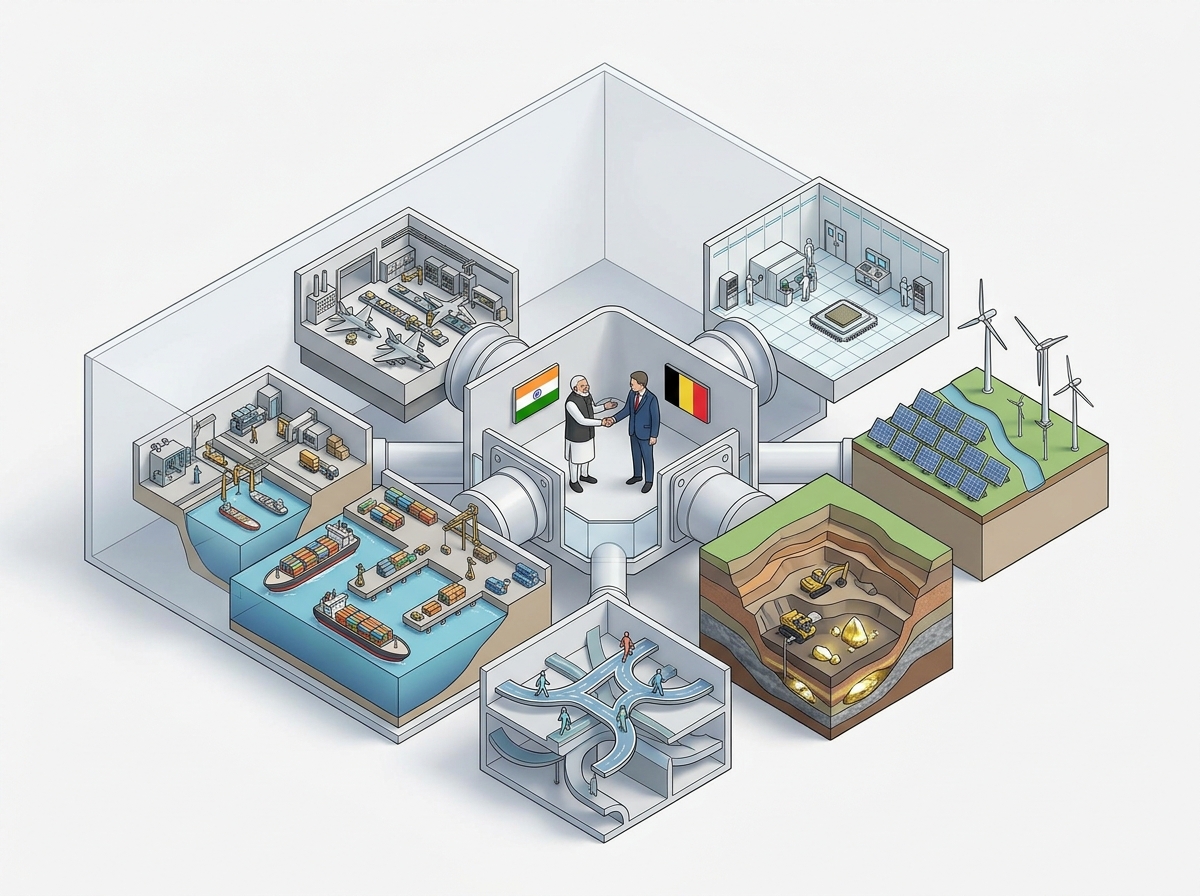
03 Sep India-Belgium Defence & Critical Minerals Pact Boosts UPSC Exam Prep
✎ India-Belgium strategic partnership in 2026 focuses on diversifying trade, deepening defence co-production, securing critical mineral supply chains, and accelerating clean energy transitions, with the Migration and Mobility…
Subject Relevance — Where This Topic Fits
- GS Paper II — International Relations: Bilateral, Regional and Global Groupings and Agreements involving India and/or affecting India’s interests | GS Paper III — Economy: Foreign Trade, Investment Flows, Technology Transfers, and Supply Chain Resilience | GS Paper III — Science and Technology: Critical Minerals, Semiconductors, and Clean Energy Technologies
- Prelims: Bilateral Investment Treaty (BIT), India-EU Free Trade Agreement (FTA), Critical Mineral Policy 2023, Semiconductor Mission, Migration and Mobility Partnership Agreement, Indo-Belgian Defence Cooperation Framework, Clean Energy Partnership, India’s 7.8% GDP growth (Q1 2026-27), EU-India Trade and Technology Council (TTC), Strategic Partnership Model
- Essay: Global Supply Chain Resilience and the Role of Strategic Alliances, The Imperative of Clean Energy Transitions in Geopolitical Realignment
Quick Revision: India-Belgium strategic partnership in 2026 focuses on diversifying trade, deepening defence co-production, securing critical mineral supply chains, and accelerating clean energy transitions, with the Migration and Mobility Partnership Agreement and India-EU FTA serving as key enablers.
Why is this in the news?
The bilateral meeting between Prime Minister Narendra Modi and Belgian Prime Minister Bart De Wever in September 2026 underscores the strategic reinforcement of India-Belgium ties across trade, defence, critical minerals, clean energy, and technology, reflecting both nations’ commitment to diversifying partnerships amid global geopolitical and economic uncertainties. The discussions highlight India’s economic resilience and Belgium’s role as a gateway to the European Union, with tangible outcomes such as the proposed Migration and Mobility Partnership Agreement and renewed focus on co-development in defence and semiconductor ecosystems.
Background
- India and Belgium share a long-standing relationship rooted in historical trade ties, with Belgium being one of India’s key European partners in sectors such as pharmaceuticals, chemicals, and engineering goods.
- Belgium, as a founding member of the EU, acts as a strategic conduit for India’s engagement with the European bloc, facilitating investment flows and technology transfers.
- Critical minerals—essential for electronics, defence, and clean energy technologies—have emerged as a focal point of bilateral cooperation, aligning with India’s Critical Mineral Policy 2023 and the Semiconductor Mission.
- The global supply chain disruptions post-2020, exacerbated by conflicts in Ukraine and West Asia, have intensified the need for resilient and diversified supply chains, prompting nations to seek strategic partnerships.
Key Dimensions of India-Belgium Strategic Cooperation
- Trade and Economic Engagement: The bilateral relationship is anchored in robust trade, with Belgium being a significant investor in India’s pharmaceutical, automotive, and engineering sectors. The impending India-EU FTA is expected to further liberalise trade in goods and services, enhancing market access for Indian exporters.
- Defence and Security Cooperation: Defence ties have evolved from buyer-seller relationships to co-development and co-production, with a focus on military exchanges, joint exercises, and intelligence sharing. This aligns with India’s ‘Make in India’ initiative and its broader goal of achieving self-reliance in defence manufacturing.
- Critical Minerals and Semiconductors: Critical minerals such as lithium, cobalt, and rare earth elements are vital for India’s transition to clean energy and semiconductor manufacturing. Belgium’s expertise in mineral processing and recycling complements India’s scale in manufacturing, offering opportunities for joint ventures and technology transfers.
- Clean Energy and Sustainability: The Memorandum of Understanding (MoU) on renewable energy signifies a commitment to accelerating the deployment of solar, wind, and green hydrogen technologies. Both nations aim to leverage their respective strengths—Belgium in offshore wind and hydrogen, and India in solar and biomass—to achieve net-zero targets.
- Technology and Innovation: Collaboration in high-technology sectors, including semiconductors, artificial intelligence, and quantum computing, is poised to strengthen through joint research initiatives and talent mobility frameworks.
- Migration and Mobility: The proposed Migration and Mobility Partnership Agreement aims to facilitate the movement of skilled professionals, students, and researchers, fostering people-to-people ties and addressing labour market demands in both countries.
- People-to-People Ties: Cultural and academic exchanges, including university collaborations and start-up linkages, are identified as key enablers of long-term strategic partnership, with a focus on capacity building in the maritime sector.
- Geopolitical Alignment: Both nations reaffirmed their commitment to multilateralism, rule-based international order, and peaceful resolution of conflicts, particularly in Ukraine and West Asia, through dialogue and diplomacy.
Key Features
| Feature | Significance |
|---|---|
| Trade and Investment Cooperation | Enhances bilateral economic engagement, diversifies trade partners, and supports India’s export-led growth strategy under the Atmanirbhar Bharat initiative. |
| Defence and Security Partnership | Strengthens military exchanges, joint training, and intelligence sharing, aligning with India’s SAGAR doctrine and Belgium’s role in EU defence cooperation. |
| Critical Minerals and Semiconductors | Facilitates access to critical mineral supply chains and semiconductor expertise, crucial for India’s green energy transition and digital sovereignty. |
| Clean Energy and Renewable Technologies | Promotes collaboration in renewable energy, aligning with India’s climate commitments under the Paris Agreement and its 2070 net-zero target. |
| People-to-People and Academic Ties | Expands migration pathways, research cooperation, and start-up linkages, fostering long-term strategic partnerships beyond government-to-government engagements. |
Why it Matters
Economic Significance
- Bilateral trade and investment expansion supports India’s economic diplomacy, particularly in high-growth sectors like clean energy and critical minerals.
- Enhanced trade cooperation with Belgium, an EU member, provides India with greater access to European markets and supply chains.
- Strengthening of semiconductor and critical mineral supply chains addresses India’s strategic dependencies in high-technology industries.
Strategic and Security Significance
- Defence cooperation, including co-development and co-production, aligns with India’s goal of indigenisation under the ‘Make in India’ defence initiative.
- Intelligence sharing and military exchanges enhance counter-terrorism and maritime security efforts, particularly in the Indian Ocean region.
- Belgium’s role in EU defence frameworks provides India with an additional strategic partner in Europe.
Geopolitical Significance
- Cooperation in clean energy and critical minerals supports India’s leadership in global climate action and energy transition initiatives.
- Joint stance on resolving conflicts through diplomacy (e.g., Ukraine, West Asia) reinforces India’s non-aligned foreign policy and multilateral engagement.
- Strengthened ties with Belgium complement India’s broader engagement with the EU, enhancing strategic autonomy in international relations.
Institutional and Governance Significance
- The proposed Migration and Mobility Partnership Agreement facilitates legal migration pathways, addressing demographic and skill gaps in both nations.
- University and research cooperation fosters innovation and capacity building, aligning with India’s National Education Policy (NEP) 2020.
Challenges
1. Geopolitical Fragmentation and Supply Chain Disruptions
- Ongoing global conflicts (e.g., Ukraine, West Asia) continue to disrupt food, fuel, and supply chains, impacting trade and energy security.
- Fluctuations in global commodity prices for critical minerals and semiconductors pose risks to long-term cooperation.
UPSC Link: GS Paper 2: Effect of Policies and Politics of Developed and Developing Countries on India’s interests
2. Regulatory and Bureaucratic Hurdles
- Differences in regulatory frameworks between India and Belgium may delay implementation of joint ventures in defence and critical minerals.
- Complexity in intellectual property rights and technology transfer agreements could hinder co-development projects.
UPSC Link: GS Paper 2: Bilateral, Regional and Global Groupings and Agreements involving India and/or affecting India’s interests
3. Competition for Critical Minerals and Semiconductors
- Global competition for critical minerals (e.g., lithium, cobalt) and semiconductor supply chains may limit India’s bargaining power.
- Belgium’s existing partnerships with other EU nations could create rivalries in accessing these resources.
UPSC Link: GS Paper 3: Infrastructure: Energy, Ports, Roads, Airports, Railways etc.
4. Climate and Sustainability Challenges
- Balancing economic growth with climate commitments requires significant investment in clean energy infrastructure.
- Ensuring sustainable mining and processing of critical minerals remains a challenge for both nations.
UPSC Link: GS Paper 3: Conservation, Environmental Pollution and Degradation, Environmental Impact Assessment
5. People-to-People and Academic Mobility
- Visa and immigration policies may restrict the flow of students, researchers, and professionals between the two countries.
- Differences in academic standards and recognition of qualifications could impede research collaborations.
UPSC Link: GS Paper 2: Issues relating to development and management of Social Sector/Services relating to Health, Education, Human Resources
Challenges — UPSC Perspective
| Issue | Concern |
|---|---|
| Global Supply Chain Disruptions | Persistent geopolitical conflicts may disrupt trade flows and energy supplies, affecting economic cooperation. |
| Regulatory Divergence | Differences in trade, defence, and environmental regulations could delay project implementation. |
| Technology Transfer Barriers | Intellectual property rights and export controls may hinder joint defence and semiconductor projects. |
| Critical Mineral Price Volatility | Fluctuations in global prices for lithium, cobalt, and rare earths could impact investment decisions. |
| Climate Action Alignment | Balancing economic growth with decarbonisation goals requires coordinated policy frameworks. |
| Migration Policy Constraints | Strict visa and immigration rules may limit the effectiveness of the proposed Mobility Partnership Agreement. |
Way Forward
- Establish a joint working group to fast-track the implementation of defence co-development and co-production agreements.
- Formulate a bilateral framework for critical mineral supply chain resilience, including joint exploration and recycling initiatives.
- Develop a clean energy roadmap with clear milestones for renewable energy deployment and technology transfer.
- Streamline regulatory approvals for joint ventures in high-technology sectors to reduce bureaucratic delays.
- Enhance academic and research collaborations through joint funding programmes and student exchange schemes.
- Strengthen maritime security cooperation by expanding joint exercises and port infrastructure development.
- Negotiate a comprehensive Migration and Mobility Partnership Agreement with simplified visa processes for professionals and students.
- Promote start-up linkages through dedicated innovation hubs and funding mechanisms to foster entrepreneurship.
UPSC Value Addition
Keywords for Mains Answer-Writing
Indo-Belgian strategic partnership · critical minerals diplomacy · defence industrial cooperation · clean energy transition · India-EU Free Trade Agreement · migration and mobility partnerships · renewable energy MoUs · semiconductor supply chains · rule of law in international relations · terrorism financing and intelligence sharing · people-to-people ties in diplomacy · maritime capacity building · high-technology collaboration
Concept Flow
Global Geopolitical Instability (e.g., Ukraine War, West Asia Conflicts) → Disruptions in Supply Chains and Energy Markets → India’s Economic Growth (7.8% Q1 2026) as a Stabilising Factor → Bilateral Engagement with Belgium to Diversify Trade and Strategic Partnerships → Focus on Critical Minerals, Semiconductors, and Clean Energy → Long-Term Strategic Autonomy and Climate Commitments → Institutional Frameworks (e.g., Migration Agreement, Research Cooperation) → People-to-People Ties and Academic Mobility → Sustained Economic and Security Cooperation
Prelims Practice Questions
Q1. Consider the following statements regarding the India-European Union Free Trade Agreement (FTA):
1. The FTA aims to reduce tariffs on at least 75% of global trade between India and the EU.
2. The agreement is expected to enhance market access for Indian pharmaceuticals and engineering goods.
3. The FTA negotiations were concluded during the visit of the Belgian Prime Minister to India in September 2026.
How many of the above statements are correct?
- Only one
- Only two
- All three
- None
Answer: Only two — Statement 1 is incorrect as the 75% figure pertains to potential trade coverage, not a guaranteed reduction target. Statement 2 is correct as market access for pharmaceuticals and engineering goods is a key objective of the FTA. Statement 3 is incorrect as the FTA conclusion was mentioned as a milestone, not the conclusion itself, during the visit.
Q2. Assertion (A): India and Belgium have agreed to enhance military exchanges and training cooperation as part of their strategic partnership.
Reason (R): Both countries aim to strengthen intelligence sharing and cooperation in combating transnational crime.
Options:
A. Both A and R are true, and R is the correct explanation of A.
B. Both A and R are true, but R is NOT the correct explanation of A.
C. A is true, but R is false.
D. A is false, but R is true.
Answer: ? — Assertion (A) is true as the joint statement explicitly mentions enhancing military exchanges and training. Reason (R) is also true as intelligence sharing and combating crime are highlighted. However, R does not explain A; both are separate pillars of cooperation.
Q3. Match the following areas of cooperation between India and Belgium with their respective outcomes as discussed in the joint statement:
Column I (Area of Cooperation)
1. Critical minerals
2. Clean energy
3. Defence
4. Migration and mobility
Column II (Outcome)
A. MoU on renewable energy signed
B. Migration and Mobility Partnership Agreement to be concluded
C. Defence co-development and co-production agreements
D. Increased cooperation in processing and recycling
Options:
A. 1-D, 2-A, 3-C, 4-B
B. 1-C, 2-B, 3-A, 4-D
C. 1-B, 2-D, 3-A, 4-C
D. 1-A, 2-C, 3-D, 4-B
Answer: ? — 1-D (Critical minerals: processing and recycling), 2-A (Clean energy: MoU on renewable energy), 3-C (Defence: co-development and co-production), 4-B (Migration and mobility: Partnership Agreement to be concluded).
Mains Practice Question
✍ The India-Belgium strategic partnership reflects a broader shift towards diversified global alliances in India’s foreign policy. Critically examine the significance of this partnership in the context of India’s economic growth, defence industrialisation, and clean energy transition. Also, analyse the role of such bilateral engagements in countering global supply chain disruptions and geopolitical uncertainties. (15 Marks)
Approach: MODEL-ANSWER SKELETON:
1. **Introduction (2 marks)**: Define the India-Belgium strategic partnership and its core pillars (trade, defence, critical minerals, clean energy, migration). Link to India’s broader foreign policy objectives under ‘Vasudhaiva Kutumbakam’ and ‘Atmanirbhar Bharat’.
2. **Economic Growth and Trade (3 marks)**:
– Highlight India’s 7.8% GDP growth (Q1 2026) and its role as a global growth engine.
– Discuss the potential of the India-EU FTA in reducing trade barriers and enhancing market access for Indian goods (e.g., pharmaceuticals, engineering, textiles).
– Mention Belgium’s role as a gateway to the EU market and its expertise in high-technology sectors.
3. **Defence Industrialisation (3 marks)**:
– Analyse the significance of defence co-development and co-production agreements in reducing import dependence (e.g., Make in India initiatives).
– Discuss the strategic importance of military exchanges, training, and intelligence sharing in countering terrorism and transnational crime.
– Reference India’s defence production policy (2020) and the role of DPSUs (e.g., HAL, DRDO) in collaboration with Belgian firms (e.g., FN Herstal, John Cockerill).
4. **Clean Energy and Critical Minerals (3 marks)**:
– Explain the MoU on renewable energy and its alignment with India’s National Hydrogen Mission and RE capacity targets (500 GW by 2030).
– Discuss critical minerals (e.g., lithium, cobalt, rare earths) as essential for clean energy technologies and India’s reliance on imports. Highlight Belgium’s expertise in recycling and processing.
– Link to India’s Critical Minerals Mission (2023) and the need for sustainable supply chains.
5. **Countering Global Supply Chain Disruptions (2 marks)**:
– Discuss how diversified alliances (e.g., with Belgium/EU) mitigate risks from geopolitical conflicts (e.g., Ukraine war, West Asia tensions).
– Reference India’s ‘Global Gateway’ initiative and the EU’s ‘Connectivity Partnership’ as frameworks for resilient supply chains.
6. **Geopolitical Uncertainties and Rule of Law (2 marks)**:
– Analyse the joint commitment to resolving conflicts through dialogue and diplomacy (e.g., Ukraine, West Asia).
– Discuss the role of international institutions (e.g., UN, WTO) in upholding the rule of law and countering unilateral coercive measures.
7. **Conclusion (2 marks)**:
– Summarise the strategic importance of the partnership in achieving India’s economic, defence, and energy goals.
– Highlight the need for sustained diplomatic engagement and implementation of agreements.
Source: orissapost.com
Generated by AanyaAi for educational purpose.
Related guides on our sites
- Current affairs for upsc 2026
- Best PSIR optional coaching for upsc
- Best PSIR optional teacher for upsc
- Best teacher of PSIR optional for upsc

- UPSC Alert: 40-Day ‘Khet Bachao Abhiyan’ Launch by Union Minister - October 22, 2026
- भारत ने बताया UN रिपोर्ट में दाऊद इब्राहिम को ‘भारत-आधारित’ बताना ‘गलत’ - October 22, 2026
- GRAP Stage I activated in Delhi-NCR amid rising AQI: Key actions for aspirants - October 22, 2026

No Comments