


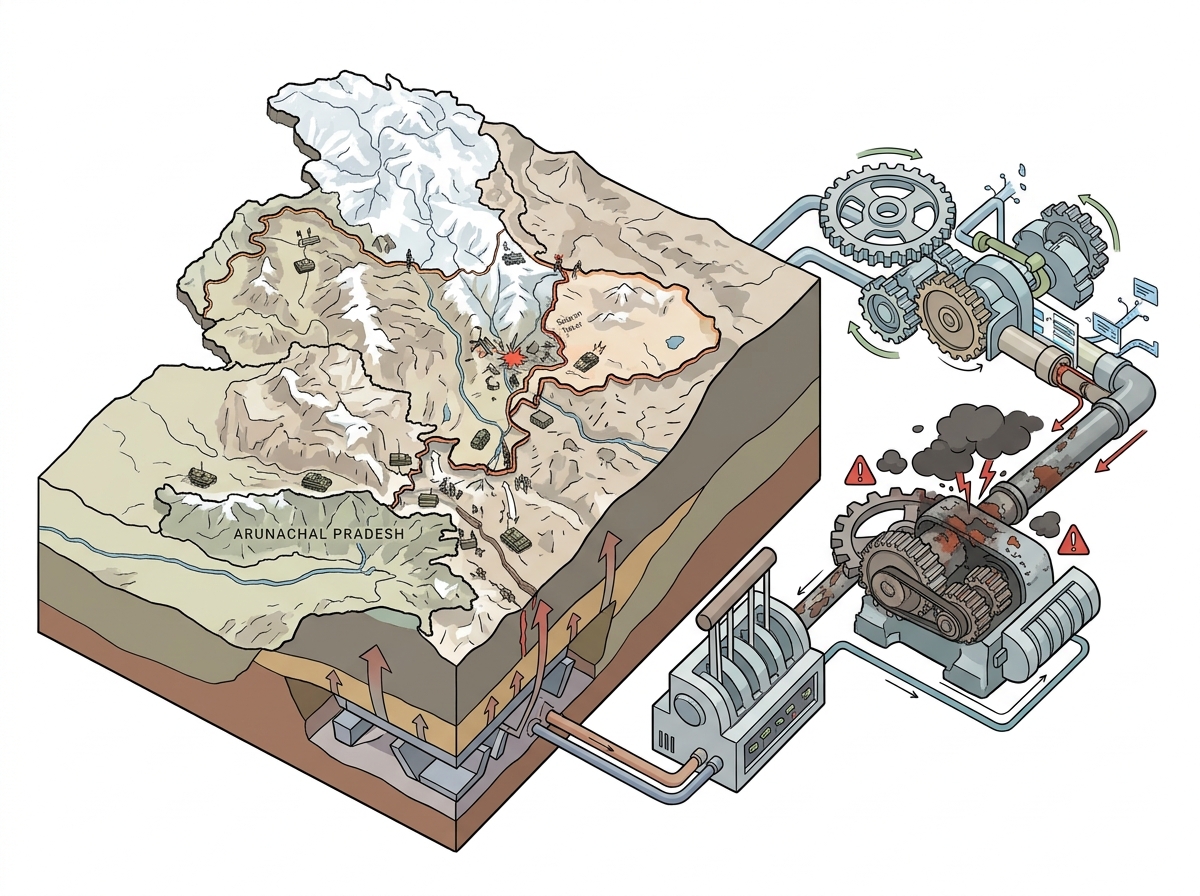
11 Aug India-China Border Tensions: Impact on Bilateral Ties for UPSC 2026
Line of Actual ControlMinistry of External AffairsArunachal PradeshGalwan Valley✎ The Line of Actual Control (LAC) is the de facto border between India and China, and its stability is a prerequisite for sustainable bilateral relations, as reiterated by India’s MEA on 11 August 2026.
Subject Relevance — Where This Topic Fits
- GS Paper II — International Relations: India’s Foreign Policy, Border Management, and Diplomatic Channels | GS Paper II — India and its Neighbourhood: China | GS Paper III — Security Challenges and Border Infrastructure
- Prelims: Line of Actual Control (LAC), Working Mechanism for Consultation and Coordination on India-China Border Affairs (WMCC), Arunachal Pradesh as integral part of India, Galwan Valley clashes (2020), Depsang and Demchok disengagement pact (2024), Shanghai Cooperation Organisation (SCO), PTI news agency
- Essay: The interplay of sovereignty, diplomacy, and national security in India’s foreign policy, The role of border management in shaping bilateral and regional stability
Quick Revision: The Line of Actual Control (LAC) is the de facto border between India and China, and its stability is a prerequisite for sustainable bilateral relations, as reiterated by India’s MEA on 11 August 2026.
Why is this in the news?
On 11 August 2026, the Ministry of External Affairs (MEA) of India articulated that the state of the border with China directly influences the broader bilateral relationship between the two nations. The remarks were made in response to China’s criticism of India’s formal naming of 27 geographical features in Arunachal Pradesh, which India reiterated as an integral part of its sovereign territory. The statement underscored the criticality of maintaining peace and tranquillity along the Line of Actual Control (LAC) for sustainable bilateral engagement.
Background
- The India-China border dispute has persisted since the 1962 war, with unresolved territorial claims across the 3,488 km Line of Actual Control (LAC).
- The Galwan Valley clashes in June 2020 marked a significant deterioration in bilateral relations, leading to a prolonged military standoff in eastern Ladakh that lasted over four years.
- The Working Mechanism for Consultation and Coordination on India-China Border Affairs (WMCC) serves as the primary institutional platform for dialogue on border-related issues.
- The Shanghai Cooperation Organisation (SCO) has emerged as a key multilateral forum for India-China engagement, with regular high-level interactions at summits.
- India’s formal naming of geographical features in Arunachal Pradesh is part of its sovereign assertion over the state, which China disputes as part of South Tibet.
What is the Line of Actual Control (LAC) and its significance in India-China relations?
- The Line of Actual Control (LAC) is the de facto border between India and China, established after the 1962 Sino-Indian War, and remains undemarcated in several sectors.
- The LAC is divided into three sectors: Western (Ladakh), Middle (Uttarakhand and Himachal Pradesh), and Eastern (Sikkim and Arunachal Pradesh), with differing degrees of dispute intensity.
- The LAC is not a legally defined border but a line of control that both sides patrol, leading to frequent face-offs, standoffs, and occasional clashes over perceived incursions.
- The maintenance of peace and tranquillity along the LAC is critical for preventing escalation, as stipulated in multiple bilateral agreements, including the 1993 Agreement on the Maintenance of Peace and Tranquillity along the LAC.
- The LAC’s status is directly linked to the broader bilateral relationship, as disruptions in border areas often spill over into diplomatic and economic engagements.
- The LAC is monitored through a combination of diplomatic channels (WMCC), military-to-military talks (including local commander-level meetings), and confidence-building measures (CBMs).
- The LAC’s undemarcated nature complicates border management, necessitating frequent consultations to avoid misperceptions and miscalculations.
- The LAC’s stability is a prerequisite for India’s Act East Policy and its engagement with regional multilateral frameworks like the SCO and BIMSTEC.
Key Features
| Feature | Significance |
|---|---|
| Line of Actual Control (LAC) | The de facto boundary between India and China, where military and diplomatic tensions often manifest; maintenance of peace here is critical for bilateral stability. |
| Working Mechanism for Consultation and Coordination (WMCC) | A dedicated diplomatic channel established to address border-related issues through structured dialogue and crisis management. |
| Standardisation of place names in Arunachal Pradesh | An assertion of administrative sovereignty and territorial integrity, particularly in response to external disputes over the region’s nomenclature. |
| Disengagement pacts (e.g., Depsang and Demchok) | Formal agreements to reduce military standoffs and restore status quo ante in disputed border areas, facilitating de-escalation. |
| High-level diplomatic engagements (e.g., SCO, bilateral summits) | Mechanisms to rebuild trust and reset bilateral relations after periods of heightened tension. |
Why it Matters
Strategic Security
- The LAC remains a flashpoint for military confrontation, necessitating continuous diplomatic and military engagement to prevent escalation.
- India’s stance on Arunachal Pradesh’s place names underscores its commitment to territorial integrity, a non-negotiable aspect of national security.
- Peace and tranquillity along the LAC are prerequisites for broader bilateral cooperation, including trade and investment flows.
Diplomatic Relations
- The WMCC serves as a structured platform for crisis management, reducing the risk of miscalculation or unintended escalation.
- High-level engagements (e.g., SCO, bilateral talks) provide opportunities to reset relations and address core issues in a neutral setting.
- Rejection of external criticism on place names reinforces India’s sovereignty narrative without escalating rhetoric.
Economic Diplomacy
- Maintaining border stability is essential for attracting foreign investment, particularly from China and other major economies.
- Trade and economic ties are contingent on a stable security environment, as evidenced by recent efforts to rebuild relations post-2020.
Challenges
1. Border Disputes and Military Standoffs
- The unresolved LAC remains a persistent source of tension, with recurring incidents requiring constant diplomatic and military vigilance.
- Disengagement pacts, while necessary, are temporary solutions that do not resolve the underlying territorial claims.
- The risk of miscalculation or accidental escalation persists due to the absence of a clearly demarcated boundary.
UPSC Link: GS II: India and its neighbourhood
2. Sovereignty Assertion vs. External Criticism
- India’s standardisation of place names in Arunachal Pradesh is a sovereign act but risks provoking external criticism and diplomatic friction.
- Balancing assertiveness with diplomacy is critical to avoid undermining broader bilateral relations.
- The challenge lies in framing such actions as administrative necessity rather than provocative measures.
UPSC Link: GS II: India-China relations
3. Trust Deficit and Historical Baggage
- The legacy of the 2020 Galwan Valley clashes continues to shape bilateral relations, creating a trust deficit that is difficult to overcome.
- Past military face-offs and prolonged standoffs have eroded confidence in long-term stability along the LAC.
- Rebuilding trust requires consistent diplomatic efforts and tangible actions to demonstrate commitment to peace.
UPSC Link: GS II: Bilateral groupings and agreements
4. Balancing Strategic Autonomy with Economic Interdependence
- India must navigate its strategic autonomy while engaging with China, a major economic partner, without compromising on core security interests.
- The dual challenge of attracting Chinese investment while maintaining a firm stance on border issues requires nuanced diplomacy.
- Economic interdependence can act as a stabilising factor, but it must not come at the cost of national security.
UPSC Link: GS III: Effects of liberalisation on the economy
5. Institutional Mechanisms and Crisis Management
- While the WMCC and other channels exist, their effectiveness depends on sustained political will and institutional capacity.
- The risk of institutional fatigue or lack of follow-through remains a challenge in managing long-term border issues.
- Ensuring that diplomatic and military channels function seamlessly is critical to preventing crises from spiralling.
UPSC Link: GS II: Structure, organization and functioning of the Executive
Challenges — UPSC Perspective
| Issue | Concern |
|---|---|
| Unresolved LAC demarcation | Persistent risk of military confrontation due to lack of a clearly defined boundary. |
| Trust deficit post-Galwan | Historical baggage complicates efforts to rebuild confidence and restore normalcy. |
| Sovereignty assertions vs. external criticism | Balancing administrative actions with diplomatic sensitivities to avoid escalation. |
| Economic interdependence vs. security concerns | Navigating trade relations without compromising on strategic autonomy. |
| Effectiveness of institutional mechanisms | Ensuring sustained engagement and crisis management without institutional fatigue. |
| Risk of miscalculation or accidental escalation | Absence of clear communication channels increases the likelihood of unintended incidents. |
Way Forward
- Strengthen the WMCC and other diplomatic channels to institutionalise crisis management and reduce the risk of miscalculation.
- Enhance military-to-military communication protocols to ensure real-time information sharing and prevent accidental escalation.
- Pursue confidence-building measures (CBMs) such as joint patrolling and hotline agreements to reduce border tensions.
- Rebuild trust through sustained high-level engagements, including summits and track-II diplomacy, to address core issues.
- Leverage economic diplomacy to create interdependencies that incentivise stability, while maintaining a firm stance on sovereignty.
- Invest in border infrastructure and surveillance to enhance situational awareness and deter provocations.
- Promote Track-II dialogues involving scholars, former diplomats, and military personnel to explore creative solutions.
- Ensure that administrative actions (e.g., place name standardisation) are framed as sovereign necessities rather than provocative measures.
UPSC Value Addition
Keywords for Mains Answer-Writing
Line of Actual Control (LAC) · India-China bilateral relations · Working Mechanism for Consultation and Coordination on India-China Border Affairs (WMCC) · Maintenance of peace and tranquillity along the border · Standardisation of geographical names in Arunachal Pradesh · Inalienable and integral part of India · Diplomatic and military channels for border management · Disengagement agreements in eastern Ladakh · Shanghai Cooperation Organisation (SCO) Summit · Galwan Valley clashes (2020) · Depsang and Demchok friction points · Mutual trust and respect in bilateral diplomacy
Concept Flow
Historical border disputes → 2020 Galwan clashes → Prolonged military standoff → Diplomatic disengagement pacts (Depsang, Demchok) → High-level engagements (SCO, bilateral talks) → Rejection of external criticism on place names → Emphasis on LAC stability as a barometer of bilateral ties → Reinforcement of WMCC and other institutional mechanisms → Need for sustained trust-building and crisis management.
Prelims Practice Questions
Q1. Consider the following statements regarding the Line of Actual Control (LAC) between India and China:
1. The LAC is a clearly demarcated boundary line agreed upon by both countries.
2. The Working Mechanism for Consultation and Coordination on India-China Border Affairs (WMCC) is a diplomatic platform to address border-related issues.
3. The Galwan Valley clashes of 2020 occurred along the LAC.
4. The Depsang and Demchok friction points were resolved through a disengagement pact in 2024.
How many of the above statements are correct?
- Only one
- Only two
- Only three
- All four
Answer: All four — Statements 2, 3, and 4 are correct. Statement 1 is incorrect because the LAC is a de facto boundary line, not a formally demarcated one agreed upon by both countries.
Q2. Assertion (A): The maintenance of peace and tranquillity along the LAC is essential for the overall development of bilateral relations between India and China.
Reason (R): The state of border affairs reflects the state of the larger bilateral ties between the two countries.
Options:
A. Both A and R are true, and R is the correct explanation of A.
B. Both A and R are true, but R is not the correct explanation of A.
C. A is true, but R is false.
D. A is false, but R is true.
Answer: ? — Both Assertion (A) and Reason (R) are true, and R correctly explains A as per the MEA’s emphasis on the interdependence of border stability and bilateral relations.
Q3. Match the following friction points along the India-China border with their respective regions:
Column I (Friction Points) | Column II (Regions)
1. Depsang | A. Eastern Ladakh
2. Demchok | B. Arunachal Pradesh
3. Galwan Valley | C. Sikkim
4. Tawang | D. Western Sector
Options:
A. 1-A, 2-B, 3-C, 4-D
B. 1-D, 2-A, 3-B, 4-C
C. 1-A, 2-A, 3-D, 4-B
D. 1-D, 2-B, 3-A, 4-C
Answer: ? — 1-A (Depsang is in Eastern Ladakh), 2-A (Demchok is in Eastern Ladakh), 3-D (Galwan Valley is in Western Sector), 4-B (Tawang is in Arunachal Pradesh).
Mains Practice Question
✍ The maintenance of peace and tranquillity along the Line of Actual Control (LAC) is often described as the foundation of India-China bilateral relations. Critically examine this proposition with reference to recent diplomatic engagements, institutional mechanisms, and the evolving nature of the border dispute. (15 Marks)
Approach: MODEL-ANSWER SKELETON:
1. **Introduction (2 marks)**: Define the LAC and its significance in India-China relations. Mention the 2020 Galwan Valley clashes as a turning point.
2. **Diplomatic and Institutional Mechanisms (4 marks)**:
– Working Mechanism for Consultation and Coordination on India-China Border Affairs (WMCC): role, objectives, and recent meetings.
– Other channels: local commander-level meetings, SCO engagements, and bilateral summits (e.g., Kazan 2024, Tianjin 2025).
– Disengagement agreements in Depsang and Demchok (2024) as confidence-building measures.
3. **Evolving Nature of the Border Dispute (4 marks)**:
– Standardisation of geographical names in Arunachal Pradesh: legal and political dimensions.
– China’s claims vs. India’s position on the status of Arunachal Pradesh.
– Recent trends: militarisation, infrastructure development, and patrols along the LAC.
4. **Critical Analysis (3 marks)**:
– To what extent does border stability truly reflect the broader bilateral relationship?
– Counterarguments: economic interdependence vs. strategic mistrust.
– Role of third-party actors (e.g., USA, QUAD) in shaping India-China dynamics.
5. **Conclusion (2 marks)**: Summarise the findings and offer a balanced view on the proposition. Highlight the need for sustained dialogue and institutionalised mechanisms to prevent miscalculation.
Source: The Hindu
Generated by AanyaAi for educational purpose.

- लोकसभा में गतिरोध जारी, बिना चर्चा पास हुए दो विधेयक: केरल का नाम ‘केरलम’ हुआ - August 11, 2026
- Lok Sabha Passes Kerala Renaming & Co-operative Bills Without Debate - August 11, 2026
- नासा ने इसरो को चंद्रमा बेस कार्यक्रम में शामिल होने का निमंत्रण दिया - August 11, 2026

No Comments