


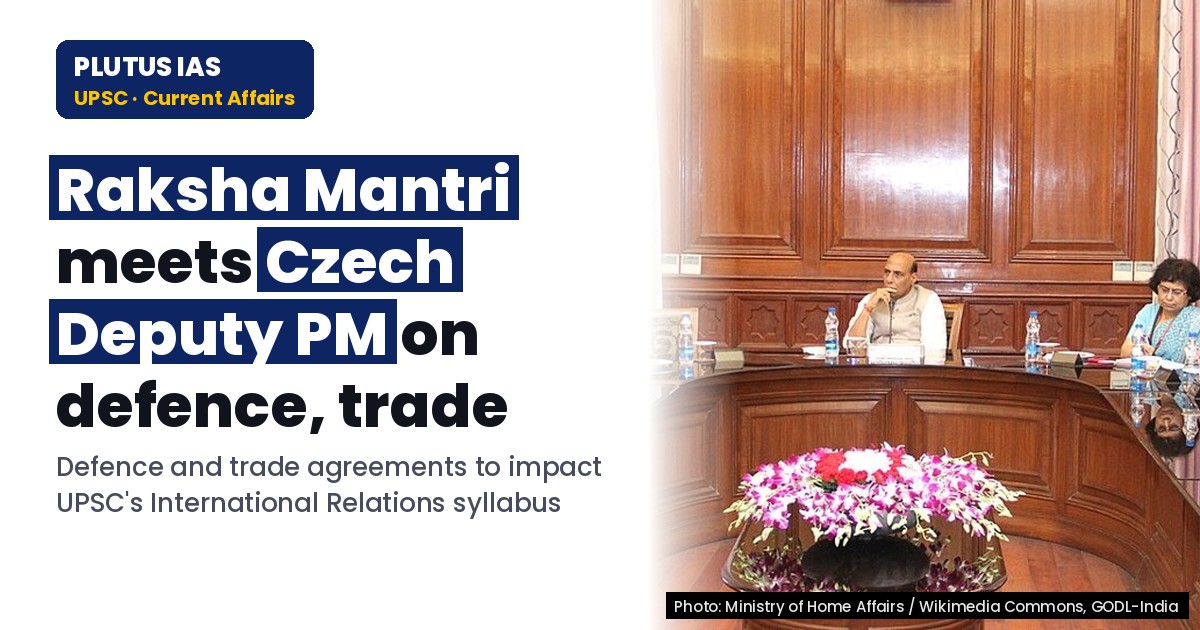
13 Oct India-Czech Republic Bilateral Talks: Key Agreements & Strategic Insights
✎ India-Czech Republic bilateral engagements focus on defence industrial cooperation, technology transfer, and trade diversification under India’s ‘Make in India’ and DAP 2020 frameworks, aiming to enhance strategic autonomy and…
Subject Relevance — Where This Topic Fits
- GS Paper II — International Relations — Bilateral, Regional and Global Groupings and Agreements involving India and/or affecting India’s interests | GS Paper III — Economy — Effects of Liberalisation on the Economy, Changes in Industrial Policy and their Effects on Industrial Growth
- Prelims: Indo-Czech bilateral relations, Defence Industrial Cooperation, Foreign Trade Policy (FTP) 2023, Make in India, Defence Acquisition Procedure (DAP) 2020
- Essay: The Role of Diplomacy in National Security: Balancing Strategic Autonomy and Global Partnerships, Industrialisation and Economic Diplomacy: Catalysts for Sustainable Development
Quick Revision: India-Czech Republic bilateral engagements focus on defence industrial cooperation, technology transfer, and trade diversification under India’s ‘Make in India’ and DAP 2020 frameworks, aiming to enhance strategic autonomy and economic growth.
Why is this in the news?
The bilateral talks between India’s Raksha Mantri (Defence Minister) and the First Deputy Prime Minister and Minister of Industry & Trade of the Czech Republic underscore the strategic importance of India-Czech Republic relations in the domains of defence industrial cooperation and trade. Such engagements are pivotal in enhancing India’s defence manufacturing capabilities, fostering technology transfer, and strengthening economic ties, particularly in the context of India’s self-reliance initiatives and the evolving global defence landscape.
Background
- India and the Czech Republic share historical ties dating back to the Cold War era, with the Czech Republic being a key partner in Central Europe.
- The bilateral relationship has evolved to focus on defence cooperation, trade, and investment.
- Defence industrial cooperation has gained momentum with India’s emphasis on ‘Make in India’ and the Defence Acquisition Procedure (DAP) 2020, which prioritises indigenous manufacturing and technology absorption.
- The Czech Republic is a member of the European Union and NATO, making it a significant partner for India in Europe, especially in the context of defence modernisation and strategic autonomy.
- Recent global geopolitical shifts, including the Russia-Ukraine conflict, have necessitated diversified defence partnerships, with India seeking to reduce dependence on traditional suppliers.
- India’s defence exports have seen a steady rise, with the Czech Republic emerging as a potential partner for co-development and co-production of defence equipment.
What is the significance of India-Czech Republic defence and trade engagement?
- Defence Industrial Cooperation: The engagement aims to leverage the Czech Republic’s expertise in defence manufacturing, particularly in areas such as aerospace, armoured vehicles, and small arms, to augment India’s indigenous defence production under the ‘Make in India’ initiative.
- Technology Transfer and Joint Ventures: Bilateral talks often focus on facilitating technology transfer agreements and joint ventures, enabling India to acquire advanced defence technologies and enhance its R&D capabilities.
- Defence Acquisition Procedure (DAP) 2020: The DAP 2020 prioritises procurement from Indian vendors and encourages foreign direct investment (FDI) in defence manufacturing, making partnerships like the one with the Czech Republic strategically advantageous.
- Economic Partnership: The Czech Republic is a key trade partner in Central Europe, with bilateral trade focusing on machinery, chemicals, and defence equipment. Enhanced trade ties can contribute to India’s economic growth and diversification of export markets.
- Strategic Autonomy: Engagements with the Czech Republic align with India’s goal of achieving strategic autonomy in defence production, reducing reliance on imports, and fostering self-sufficiency in critical sectors.
- Global Defence Landscape: The partnership is situated within the broader context of India’s efforts to diversify its defence partnerships beyond traditional suppliers, particularly in light of geopolitical uncertainties.
- Cultural and Educational Exchange: Beyond defence and trade, the engagement includes cultural and educational collaborations, fostering people-to-people ties and enhancing mutual understanding.
Key Features
| Feature | Significance |
|---|---|
| Bilateral Defence Dialogue | Facilitates structured engagement between India and the Czech Republic to enhance defence cooperation, technology transfer, and strategic alignment. |
| Industry & Trade Focus | Provides a platform to explore synergies in industrial collaboration, trade facilitation, and investment flows between the two nations. |
| Defence Procurement Framework | Opportunity to discuss defence procurement policies, offset mechanisms, and long-term supply chain integration. |
| Technology Transfer Agreements | Potential for collaboration in defence manufacturing, aerospace, and dual-use technologies under existing bilateral agreements. |
| Economic Diplomacy | Strengthens economic ties by addressing trade barriers, market access, and regulatory harmonisation in defence and industrial sectors. |
Why it Matters
Strategic Partnerships
- Enhances India’s defence diplomacy in Central Europe, complementing existing engagements with NATO-aligned nations.
- Facilitates access to advanced defence technologies and manufacturing capabilities from the Czech Republic.
- Supports India’s ‘Make in India’ and ‘Atmanirbhar Bharat’ initiatives through potential joint ventures in defence production.
- Strengthens supply chain resilience in critical defence components by diversifying sourcing partners.
Economic Integration
- Opens avenues for Indian exports to the Czech Republic, particularly in pharmaceuticals, IT services, and engineering goods.
- Encourages Czech investment in India’s defence and industrial corridors, aligning with the ‘Vocal for Local’ initiative.
- Promotes bilateral trade balance through targeted sectoral collaborations in aerospace, automotive, and renewable energy.
- Leverages the EU-India Trade and Technology Council (TTC) framework for regulatory alignment and standardisation.
Geopolitical Alignment
- Reinforces India’s multi-alignment strategy by deepening ties with a Central European nation outside traditional alliances.
- Aligns with India’s Act East Policy and Europe’s Indo-Pacific strategy, fostering stability in the region.
- Provides a counterbalance to over-reliance on defence partnerships with Western nations, diversifying strategic dependencies.
- Supports India’s candidature for permanent membership in the UN Security Council through enhanced global engagement.
Institutional Mechanisms
- Utilises existing bilateral agreements such as the India-Czech Republic Joint Commission for Economic Cooperation (JCEC).
- Leverages the Defence Cooperation Agreement (DCA) signed in 2018 for structured defence engagements.
- Engages with the Czech Republic’s Defence and Security Export Authority (DSEA) for procurement and offset discussions.
- Aligns with India’s ‘SAGAR’ (Security and Growth for All in the Region) doctrine through maritime and aerospace collaborations.
Challenges
1. Regulatory and Compliance Barriers
- Differences in defence procurement regulations between India (DPP 2020) and the Czech Republic (EU Defence Procurement Directive).
- Complexity in offset obligations under India’s Defence Offset Guidelines (2020) and Czech export control laws.
- Need for harmonisation of standards in defence manufacturing, particularly in aerospace and dual-use technologies.
UPSC Link: GS-II: International Relations > Bilateral Agreements > Defence Procurement
2. Geopolitical Constraints
- Czech Republic’s alignment with EU and NATO policies may limit scope for independent defence collaborations with India.
- Potential sensitivities in India’s engagement with Central European nations due to historical geopolitical alignments.
- Risk of over-dependence on defence ties with Western nations, limiting strategic autonomy in procurement decisions.
UPSC Link: GS-II: International Relations > Geopolitics > Central Europe
3. Economic and Market Access Issues
- Limited awareness in the Czech Republic about India’s defence and industrial capabilities, leading to underutilised trade potential.
- Non-tariff barriers such as technical regulations, certification requirements, and customs procedures in both nations.
- Competition from established defence suppliers (e.g., USA, Russia, France) in the Czech market.
UPSC Link: GS-III: Economy > Trade > Bilateral Trade Agreements
4. Technology Transfer and IPR Concerns
- Stringent Intellectual Property Rights (IPR) laws in the EU may restrict technology transfer agreements.
- Risk of reverse engineering or unauthorised use of transferred technologies by third parties.
- Need for robust legal frameworks to protect proprietary defence technologies and manufacturing processes.
UPSC Link: GS-III: Economy > IPR > Technology Transfer Agreements
5. Logistical and Supply Chain Challenges
- Distance and transportation costs between India and the Czech Republic may affect the viability of joint production ventures.
- Dependence on intermediaries in global supply chains, increasing lead times and costs for defence components.
- Need for dedicated logistics corridors or partnerships to streamline defence trade and manufacturing.
UPSC Link: GS-III: Infrastructure > Logistics > Supply Chain Management
Challenges — UPSC Perspective
| Issue | Concern |
|---|---|
| Defence Procurement Regulations | Mismatch between India’s DPP 2020 and Czech Republic’s EU Defence Procurement Directive. |
| Offset Obligations | Complexity in meeting India’s Defence Offset Guidelines (2020) and Czech export control laws. |
| Technology Transfer Agreements | Stringent EU IPR laws and risk of unauthorised technology use. |
| Market Access Barriers | Non-tariff barriers such as technical regulations and customs procedures. |
| Geopolitical Sensitivities | Czech Republic’s alignment with EU/NATO policies limiting independent collaborations. |
| Logistical Costs | High transportation costs and supply chain inefficiencies affecting joint ventures. |
Way Forward
- Establish a joint working group (JWG) under the India-Czech Republic Joint Commission for Economic Cooperation (JCEC) to address regulatory and compliance barriers in defence procurement.
- Harmonise defence manufacturing standards by aligning India’s DPP 2020 with the Czech Republic’s EU Defence Procurement Directive through bilateral negotiations.
- Promote awareness campaigns in the Czech Republic to highlight India’s defence and industrial capabilities, leveraging platforms like the India-Czech Business Forum.
- Facilitate technology transfer agreements with robust IPR protections, including clauses for joint R&D and co-production in aerospace and dual-use technologies.
- Develop dedicated logistics corridors or partnerships to reduce transportation costs and streamline supply chains for defence trade.
- Encourage Czech investment in India’s defence corridors (e.g., Tamil Nadu, Uttar Pradesh) through targeted incentives and ease of doing business reforms.
- Strengthen institutional linkages by leveraging the EU-India Trade and Technology Council (TTC) to address non-tariff barriers and regulatory harmonisation.
- Conduct regular bilateral defence dialogues to review progress, address challenges, and explore new areas of collaboration in emerging technologies (e.g., AI, cybersecurity).
UPSC Value Addition
Keywords for Mains Answer-Writing
India-Czech Republic bilateral relations · Defence industrial cooperation · Make in India in defence sector · Strategic Partnership · Defence exports · Defence Acquisition Procedure 2020 · Defence Production and Export Promotion Policy (DPEPP) 2020 · Indo-Pacific security architecture · Defence Logistics Agreement (LOGISTICS SUPPORT) · Defence Research and Development Organisation (DRDO) · Defence Industrial Base · Export Promotion Council for Defence (EPC Defence) · Foreign Direct Investment in defence sector · Defence offset policy · Strategic autonomy in defence manufacturing
Concept Flow
India’s strategic need for diversified defence partnerships → Bilateral defence dialogue with Czech Republic → Exploration of defence procurement and offset mechanisms → Potential for technology transfer and joint ventures → Enhanced defence manufacturing capabilities → Alignment with ‘Make in India’ and ‘Atmanirbhar Bharat’ initiatives → Strengthened supply chain resilience and strategic autonomy → Reinforcement of India’s multi-alignment foreign policy → Contribution to regional stability and global governance.
Prelims Practice Questions
Q1. Consider the following statements regarding Defence Acquisition Procedure (DAP) 2020:
1. It mandates 50% indigenous content for procurement categories other than Buy (Indian-IDDM).
2. It introduces a new category ‘Buy (Global – Manufacture in India)’ to promote local manufacturing.
3. It allows 74% Foreign Direct Investment under automatic route for defence manufacturing.
4. It requires all defence procurements to compulsorily include an offset clause.
How many of the above statements are correct?
- Only one
- Only two
- Only three
- All four
Answer: Only three — Statements 1, 2, and 3 are correct. Statement 4 is incorrect as offset clauses are not mandatory for all categories under DAP 2020.
Q2. Assertion (A): The Defence Production and Export Promotion Policy (DPEPP) 2020 aims to achieve a turnover of ₹1,75,000 crore in aerospace and defence goods and services by 2025.
Reason (R): The policy seeks to reduce India’s dependence on defence imports and enhance self-reliance through indigenous development and export promotion.
Options:
A. Both A and R are true, and R is the correct explanation of A.
B. Both A and R are true, but R is NOT the correct explanation of A.
C. A is true, but R is false.
D. A is false, but R is true.
Answer: ? — Both A and R are true, and R correctly explains A. The DPEPP 2020 indeed targets ₹1,75,000 crore turnover by 2025 to reduce import dependence and boost exports.
Q3. Match the following Defence Industrial Corridors with their respective states:
Column I (Corridor) Column II (State)
1. Aligarh Node A. Tamil Nadu
2. Kanpur Node B. Uttar Pradesh
3. Chennai Node C. Madhya Pradesh
4. Jhansi Node D. Uttar Pradesh
Options:
A. 1-A, 2-B, 3-C, 4-D
B. 1-B, 2-D, 3-A, 4-C
C. 1-D, 2-B, 3-A, 4-C
D. 1-C, 2-A, 3-D, 4-B
Answer: ? — 1. Aligarh Node is in Uttar Pradesh (B). 2. Kanpur Node is in Uttar Pradesh (D). 3. Chennai Node is in Tamil Nadu (A). 4. Jhansi Node is in Madhya Pradesh (C).
Mains Practice Question
✍ The bilateral defence and strategic partnership between India and the Czech Republic has been expanding in recent years. In this context, critically analyse the significance of such engagements for India’s defence industrial base and strategic autonomy. (15 Marks)
Approach: MODEL-ANSWER SKELETON:
1. **Context Setting**: Briefly outline the nature of India-Czech Republic bilateral engagements in defence (e.g., defence procurements, technology transfer, industrial cooperation) citing recent high-level visits or agreements.
2. **Defence Industrial Base Strengthening**:
– Explain how such engagements contribute to India’s defence industrial base under the ‘Make in India’ initiative.
– Discuss the role of Defence Acquisition Procedure (DAP) 2020 and Defence Production and Export Promotion Policy (DPEPP) 2020 in facilitating such partnerships.
– Highlight specific areas of cooperation (e.g., aerospace, small arms, ammunition, or dual-use technologies).
3. **Strategic Autonomy and Self-Reliance**:
– Define strategic autonomy in the context of defence manufacturing.
– Analyse how partnerships with countries like the Czech Republic help India reduce import dependence (e.g., through technology transfer, joint ventures, or co-development).
– Cite examples of past or ongoing projects (e.g., transfer of technology for small arms, ammunition, or aerospace components).
4. **Challenges and Limitations**:
– Discuss potential challenges such as regulatory hurdles, export controls, or intellectual property rights issues in defence technology transfer.
– Examine the role of the Export Promotion Council for Defence (EPC Defence) in facilitating such engagements.
5. **Broader Geopolitical Implications**:
– Situate the India-Czech Republic partnership within the broader Indo-Pacific security architecture.
– Discuss how such engagements align with India’s Act East Policy and efforts to diversify defence partnerships beyond traditional allies.
6. **Conclusion**:
– Summarise the significance of these engagements for India’s long-term defence industrial and strategic goals.
– Provide a balanced view, acknowledging both the opportunities and the constraints.
Source: PIB (Press Information Bureau)
Generated by AanyaAi for educational purpose.
Related guides on our sites
- Current affairs for upsc 2026
- Best PSIR optional coaching for upsc
- Best PSIR optional teacher for upsc
- Best teacher of PSIR optional for upsc

- NCST Chair Reviews ST Safeguards in Heavy Industries Ministry - October 13, 2026
- महानदी कोलफील्ड्स में ई-कचरा प्रबंधन : छठे विशेष अभियान की प्रमुख पहल - October 13, 2026
- President Appoints Two Additional Judges to Madras High Court - October 13, 2026

No Comments