


15 Jul India-EU Textile Cooperation Boosted by Strategic Partnership
Subject Relevance — Where This Topic Fits
- GS Paper II — International Relations, Bilateral, Regional and Global Groupings and Agreements involving India and/or affecting India’s interests | GS Paper III — Indian Economy and issues relating to Planning, Mobilization of Resources, Growth, Development and Employment; Liberalization; Infrastructure; Investment Models
- Prelims: India-EU Strategic Partnership, Textile Industry, Free Trade Agreement (FTA), Bharat Tex Trade Federation (BTTF), Premier Vision Paris, Global Value Chains (GVCs), MSMEs, Technical Textiles, Sustainable Sourcing
- Essay: The Loom of Diplomacy: Weaving India’s Economic Aspirations into Global Partnerships, Sustainability and Innovation: The Dual Imperatives for India’s Textile Sector in the 21st Century
Quick Revision: The India-EU textile partnership, bolstered by the BTTF-Premier Vision LoI and the impending FTA, is a strategic move to position India as a global textile sourcing hub, driving economic growth, sustainability, and innovation.
Why is this in the news?
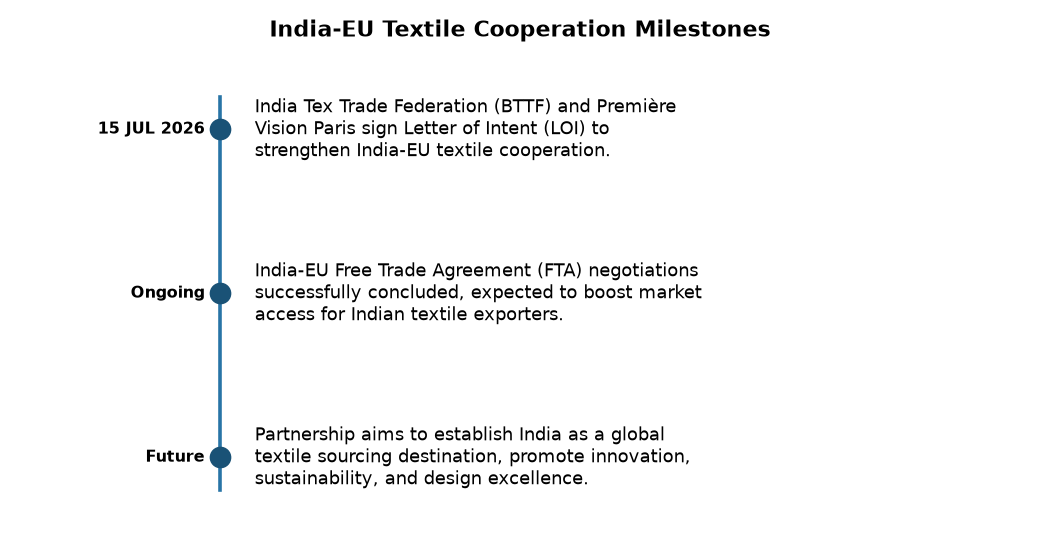
The India-EU textile cooperation has received a significant boost with the signing of a Letter of Intent (LoI) between the Bharat Tex Trade Federation (BTTF) and Premier Vision SA, a leading global fashion and textile sourcing exhibition organiser. This strategic partnership, exchanged in the presence of the Union Minister of Textiles, aims to strengthen bilateral trade, promote innovation, sustainability, and design excellence, and establish India as a premier global textile sourcing destination, particularly in the context of the successfully concluded India-EU Free Trade Agreement negotiations.
Background
- India’s textile sector is one of the oldest and largest industries, contributing significantly to industrial production, employment generation, and export earnings. It is the second-largest employer after agriculture.
- The European Union (EU) is a crucial market for Indian textiles and apparel, representing a significant share of India’s total textile exports. The EU’s stringent quality, sustainability, and design standards often drive innovation in partner countries.
- The ongoing negotiations for an India-EU Free Trade Agreement (FTA) are poised to reduce tariff and non-tariff barriers, enhancing market access and competitiveness for Indian textile products in the EU.
- Global textile value chains are increasingly emphasizing sustainability, traceability, and ethical production practices, driven by consumer demand and regulatory pressures.
- Premier Vision Paris is globally recognised as a premier exhibition for textile and fashion sourcing, known for its trend forecasting, innovation, and design excellence, making it a critical platform for global engagement.
- Bharat Tex 2026, envisioned as a global platform, aims to showcase India’s integrated textile value chain, from fibre to fashion, attracting international buyers and fostering collaborations.
The India-EU Strategic Partnership in Textiles
- The recent LoI formalises a strategic collaboration between the Bharat Tex Trade Federation (BTTF) and Premier Vision SA, a prominent French entity in fashion and textile exhibitions.
- This partnership seeks to enhance institutional cooperation between India and France within the textile and apparel value chain, leveraging Premier Vision’s global network and expertise.
- It aims to establish India as a reliable, innovative, and sustainable global textile sourcing destination, showcasing its diverse and competitive textile industry.
- The collaboration will facilitate greater market access for Indian manufacturers, MSMEs, and emerging brands to connect with major European buyers, designers, and fashion houses.
- Key focus areas include promoting innovation, sustainability, design excellence, trend insights, and global sourcing across the textile value chain.
- The partnership is expected to boost mutual participation in Bharat Tex and Premier Vision Paris, strengthening buyer-seller relationships and facilitating the exchange of trends and design intelligence.
- It aligns with India’s broader economic strategy to integrate more deeply into global value chains and enhance its export competitiveness, especially in high-value segments like technical textiles and sustainable materials.
- The timing of this collaboration is particularly significant, coinciding with the successful conclusion of negotiations for the India-EU Free Trade Agreement (FTA), which is expected to create a more favourable trade environment.
Key Features
| Feature | Significance |
|---|---|
| LoI between BTTF and Premier Vision SA | Formalises institutional cooperation, leveraging global exhibition expertise for Indian textiles. |
| Focus on Innovation and Sustainability | Drives adoption of advanced manufacturing, eco-friendly practices, and circular economy principles in Indian textiles. |
| Enhanced Market Access for MSMEs | Provides a global platform for small and medium enterprises to connect with European buyers, boosting exports and employment. |
| Promotion of Design Excellence and Trend Insights | Facilitates knowledge exchange, helping Indian designers align with global fashion trends and enhance product value. |
| India-EU FTA Context | Maximises benefits from reduced tariffs and non-tariff barriers, making Indian textiles more competitive in the EU market. |
| Showcasing India’s Integrated Value Chain | Positions India as a comprehensive sourcing destination, from raw materials to finished products, including technical textiles. |
Why it Matters
Economic Significance
- Boosts India’s textile and apparel exports to the EU, a critical market, thereby contributing to foreign exchange earnings and reducing trade deficits.
- Generates employment, particularly in the MSME sector, which is a major employer in the textile industry, fostering inclusive growth.
- Attracts foreign investment into the Indian textile sector, facilitating technology transfer and modernisation of manufacturing processes.
- Enhances the competitiveness of Indian textiles globally by promoting quality, design, and adherence to international sustainability standards.
- Diversifies India’s export basket within textiles, with a focus on high-value products like technical textiles and sustainable fashion.
Strategic Significance
- Strengthens India’s ‘Make in India’ and ‘Atmanirbhar Bharat’ initiatives by integrating Indian manufacturing into global value chains.
- Reinforces India’s strategic partnership with the EU, a key geopolitical and economic bloc, fostering deeper bilateral ties.
- Positions India as a reliable and responsible global sourcing hub, enhancing its soft power and diplomatic influence.
- Contributes to India’s goal of becoming a USD 5 trillion economy by leveraging its strengths in traditional and modern manufacturing sectors.
- Facilitates India’s leadership in promoting sustainable and ethical practices within the global textile industry, aligning with global climate goals.
Social Significance
- Empowers rural and semi-urban populations, especially women, who form a significant part of the textile workforce, leading to improved livelihoods.
- Promotes skill development and capacity building within the textile sector, preparing the workforce for future industry demands.
- Encourages the adoption of environmentally friendly production methods, contributing to better working conditions and community health.
- Supports the preservation and promotion of India’s rich handloom and handicraft heritage by integrating traditional skills with modern market demands.
Challenges
1. Compliance with EU Regulations
- Meeting stringent EU environmental, social, and governance (ESG) standards, including chemical restrictions (REACH), waste management, and labour laws.
- Ensuring traceability and transparency across the entire supply chain to prove compliance with sustainability norms.
UPSC Link: GS Paper III — Environmental Pollution & Degradation
2. Infrastructure and Logistics Gaps
- Addressing bottlenecks in transportation, port infrastructure, and customs clearance that can increase lead times and costs.
- Improving cold chain logistics for certain textile products and ensuring efficient last-mile delivery to European markets.
UPSC Link: GS Paper III — Infrastructure: Energy, Ports, Roads, Airports, Railways etc.
3. Skill Gap and Technology Adoption
- Bridging the gap between traditional manufacturing skills and the demands of modern, automated, and digitally integrated textile production.
- Encouraging MSMEs to adopt advanced technologies like AI, IoT, and automation to enhance efficiency and product quality.
UPSC Link: GS Paper III — Science and Technology- developments and their applications and effects in everyday life
4. Competition from Other Sourcing Hubs
- Facing intense competition from established textile manufacturing hubs like China, Vietnam, and Bangladesh, which often offer lower costs or specialised production.
- Differentiating Indian products based on quality, sustainability, and unique design rather than solely on price.
UPSC Link: GS Paper III — Liberalization and its effects on the economy
5. Access to Finance for MSMEs
- Ensuring adequate and affordable credit for MSMEs to invest in technology upgrades, capacity expansion, and compliance with international standards.
- Addressing challenges in obtaining working capital for export-oriented production and managing currency fluctuations.
UPSC Link: GS Paper III — Indian Economy and issues relating to Planning, Mobilization of Resources
Challenges — UPSC Perspective
| Issue | Concern |
|---|---|
| Non-Tariff Barriers (NTBs) | Despite FTA, technical regulations, sanitary and phytosanitary measures, and complex customs procedures can impede trade. |
| Sustainability Certifications | High cost and complexity of obtaining international certifications (e.g., GOTS, Oeko-Tex) for smaller manufacturers. |
| Design Piracy and IPR | Protecting original Indian designs and intellectual property rights in a competitive global market. |
| Raw Material Price Volatility | Fluctuations in cotton and other fibre prices impacting production costs and export competitiveness. |
| Lack of Brand Building | Limited global recognition for Indian textile brands, often operating as ‘white label’ manufacturers. |
| Geopolitical Risks | Global trade tensions, supply chain disruptions, and political instability impacting demand and logistics. |
Government Initiatives — Must-Memorise for Prelims
- Production Linked Incentive (PLI) Scheme for Textiles
- PM MITRA (Mega Integrated Textile Region and Apparel) Parks Scheme
- National Technical Textiles Mission (NTTM)
- Samarth (Scheme for Capacity Building in Textile Sector)
- Amended Technology Upgradation Fund Scheme (ATUFS)
- Scheme for Integrated Textile Parks (SITP)
- National Handloom Development Programme
- Integrated Processing Development Scheme (IPDS)
- Startup India Seed Fund Scheme (for textile startups)
- Interest Equalisation Scheme for Exports
Way Forward
- Expedite the full implementation of the India-EU FTA to maximise market access and reduce trade barriers for textile products.
- Invest in modern infrastructure, including dedicated freight corridors, logistics parks, and efficient port facilities, to reduce lead times and costs.
- Promote R&D and innovation in sustainable textiles, technical textiles, and smart textiles through public-private partnerships and academic collaborations.
- Strengthen skill development initiatives, focusing on digital literacy, design innovation, and sustainable manufacturing practices for the textile workforce.
- Provide financial incentives and technical assistance to MSMEs for adopting advanced technologies, obtaining international certifications, and upgrading their production processes.
- Develop a robust brand India strategy for textiles, promoting unique Indian designs, craftsmanship, and sustainable practices on global platforms.
- Enhance regulatory harmonisation with EU standards, particularly in environmental and social compliance, to ensure seamless market entry.
- Foster greater collaboration between Indian designers, fashion institutes, and international counterparts to align with global trends and elevate design excellence.
UPSC Value Addition
Keywords for Mains Answer-Writing
Textile Value Chain · Global Sourcing Hub · Sustainable Textiles · Technical Textiles · India-EU FTA · MSME Empowerment · Export Competitiveness · Innovation Ecosystem · Circular Economy · Supply Chain Resilience · Skill Development · Geoeconomic Strategy
Constitutional & Policy Linkages
- Article 246 — Distribution of legislative powers (Union List, State List, Concurrent List for trade and industry)
- Article 282 — Grants by the Union and States (for promoting industry)
- Foreign Trade (Development and Regulation) Act, 1992 — Governs India’s foreign trade policy
- Textiles (Development and Regulation) Order, 1993 — Regulatory framework for the textile industry
- National Textile Policy, 2000 (and subsequent updates) — Outlines government vision for the sector
- MSMED Act, 2006 — Defines and promotes Micro, Small and Medium Enterprises
Concept Flow
India-EU Strategic Partnership & FTA → BTTF-Premier Vision LoI → Enhanced Market Access for Indian Textiles → Focus on Innovation & Sustainability → Increased Exports & Global Competitiveness → Economic Growth & Employment Generation → India as Global Textile Sourcing Hub
Prelims Practice Questions
Q1. With reference to the recent India-EU textile cooperation, consider the following statements:
1. The Letter of Intent (LoI) was signed between the Bharat Tex Trade Federation (BTTF) and Premier Vision SA.
2. Premier Vision SA is a global leader in textile machinery manufacturing.
3. The cooperation primarily aims to promote traditional handloom products in the European market, excluding technical textiles.
Which of the statements given above is/are correct?
- A. 1 only
- B. 1 and 2 only
- C. 2 and 3 only
- D. 1, 2 and 3
Answer: A. 1 only — Statement 1 is correct as the LoI was indeed signed between BTTF and Premier Vision SA. Statement 2 is incorrect; Premier Vision SA is known for organising global textile and fashion sourcing exhibitions, not primarily textile machinery manufacturing. Statement 3 is incorrect; the cooperation aims to promote a wide range of Indian textiles, including technical textiles and sustainable materials, alongside traditional products.
Q2. Which of the following government schemes is NOT directly aimed at promoting the textile sector in India?
Polymers (PLI) Scheme for Textiles
PM MITRA Parks Scheme
National Technical Textiles Mission
Samarth Scheme
- A. Production Linked Incentive (PLI) Scheme for Textiles
- B. PM MITRA Parks Scheme
- C. National Technical Textiles Mission
- D. None of the above
Answer: D. None of the above — All the listed schemes are directly aimed at promoting various aspects of the textile sector in India. The PLI Scheme incentivises manufacturing, PM MITRA creates integrated textile parks, the National Technical Textiles Mission focuses on high-performance textiles, and Samarth is for capacity building and skill development in the sector. Therefore, ‘None of the above’ is the correct answer as all are relevant.
Mains Practice Question
✍ The recent strategic partnership between India and the EU in the textile sector, coupled with the ongoing FTA negotiations, signifies a pivotal moment for India’s economic aspirations. Analyse the multi-faceted significance of this collaboration for India’s textile industry and economy. What are the key challenges that need to be addressed to fully leverage this partnership, and suggest a comprehensive way forward?
Approach: Begin by introducing the context of the India-EU textile partnership and the FTA. In the first part, elaborate on the economic, strategic, and social significance for India, citing specific benefits like export growth, MSME empowerment, and integration into global value chains. In the second part, identify and explain critical challenges such as compliance with EU regulations, infrastructure gaps, skill development, and competition. Conclude with a comprehensive way forward, offering actionable policy recommendations, technological advancements, and strategic initiatives to maximise the benefits of this collaboration.
Source: PIB (Press Information Bureau)

- Odisha vs Andhra Pradesh: Supreme Court Contempt Over Kotia Polls - October 24, 2026
- आरबीआई द्वारा 91, 182 और 364 दिनीय ट्रेजरी बिलों की नीलामी: प्रमुख तथ्य - October 24, 2026
- Inflation’s Second-Round Effects: RBI Policy & Economic Impact Analysis - October 24, 2026

No Comments