


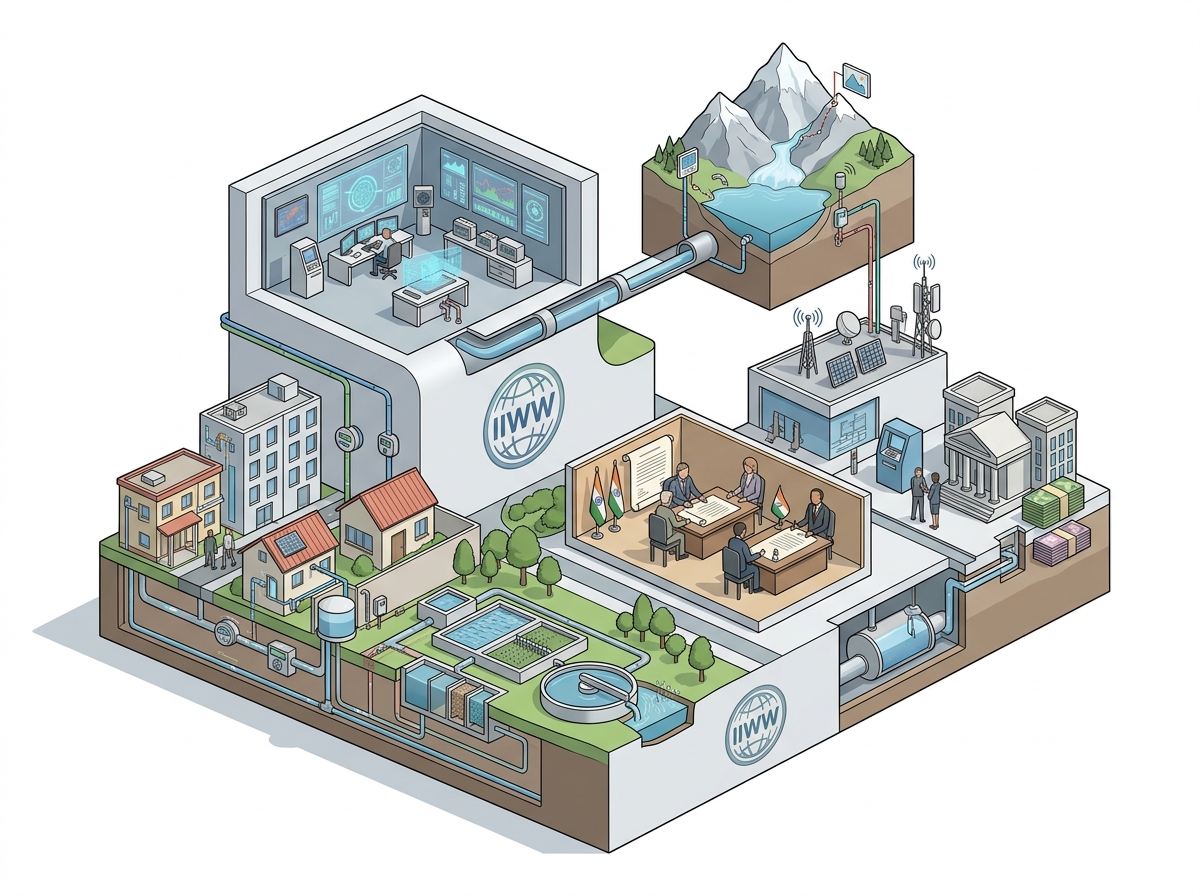
25 Sep India International Water Week 2026 Day 3: Climate Resilience & Water Financing Focus
✎ The India International Water Week (IIWW) is a biennial platform for advancing global water governance through multi-stakeholder dialogue, technological innovation, and climate-resilient water management strategies.
Subject Relevance — Where This Topic Fits
- GS Paper II — International Relations (Water Diplomacy, Bilateral Agreements, Global Water Governance) | GS Paper III — Environment, Ecology, Bio-diversity, Climate Change (Climate Resilience, Early Warning Systems, Glacial Lake Monitoring) | GS Paper III — Economy (Water Financing, Public-Private Partnerships, Innovative Financing Mechanisms) | GS Paper III — Science and Technology (Water Technology, Smart Metering, Monitoring Systems) | GS Paper IV — Ethics, Integrity and Aptitude (Stakeholder Collaboration, Multi-Stakeholder Governance)
- Prelims: India International Water Week (IIWW), Climate Resilience, Early Warning Systems (EWS), Glacial Lake Outburst Floods (GLOFs), Water Financing, Public-Private Partnerships (PPP) in Water Sector, Smart Water Metering, Central Water Commission (CWC), National Institute of Hydrology (NIH), Delta Works (Netherlands), Water Governance Framework, Climate Risk Assessment in Water Planning
- Essay: The Nexus of Climate Change and Water Security: Challenges and Solutions, Innovation and Governance: The Path to Sustainable Water Management
Quick Revision: The India International Water Week (IIWW) is a biennial platform for advancing global water governance through multi-stakeholder dialogue, technological innovation, and climate-resilient water management strategies.
Why is this in the news?
The third day of the 9th India International Water Week (IIWW) 2026, held in New Delhi, focused on critical themes such as climate resilience, water financing, and innovation in water governance. The event facilitated high-level discussions on climate risk assessment, early warning systems, glacial lake monitoring, water-use efficiency, and innovative financing mechanisms. Additionally, two trilateral agreements were signed to deepen India-Netherlands collaboration in water infrastructure development and capacity building, underscoring the event’s role as a platform for multi-stakeholder engagement and technical cooperation in addressing global water challenges.
Background
- The India International Water Week (IIWW) is a biennial event organized by the Ministry of Jal Shakti, Government of India, to foster dialogue and collaboration on water-related issues among policymakers, scientists, technologists, and stakeholders from across the globe.
- Water security is increasingly threatened by climate change, with rising temperatures, altered precipitation patterns, and glacial melt exacerbating risks such as floods, droughts, and water scarcity.
- India, home to 18% of the world’s population but only 4% of its water resources, faces significant water stress, necessitating innovative solutions and robust governance frameworks.
- The Netherlands, a global leader in water management and hydraulic engineering, has a long-standing partnership with India in areas such as flood management, coastal protection, and sustainable urban water systems.
- The event aligns with the United Nations Sustainable Development Goal 6 (Clean Water and Sanitation) and Goal 13 (Climate Action), emphasizing integrated approaches to water and climate resilience.
- Recent initiatives such as the Jal Jeevan Mission, Atal Mission for Rejuvenation and Urban Transformation (AMRUT), and National Mission for Clean Ganga (NMCG) highlight India’s commitment to sustainable water management.
What is the India International Water Week (IIWW)?
- The India International Water Week (IIWW) is a flagship biennial event organized by the Ministry of Jal Shakti, Government of India, to promote knowledge exchange and collaboration on water-related challenges and solutions.
- The event serves as a platform for policymakers, scientists, technologists, startups, academia, and industry stakeholders to deliberate on themes such as water governance, climate resilience, water financing, and technological innovation.
- The event features multiple forums, including the Water Leaders Forum, Country Forum, Practitioners Forum, Thematic Forums, and Start-up Forum, each focusing on distinct aspects of water management.
- Thematic forums address sub-themes such as climate risk assessment, early warning systems, glacial lake monitoring, water-use efficiency, and innovative financing mechanisms.
- The Start-up Forum provides a platform for startups, MSMEs, and academia to showcase solutions for water-related challenges, fostering entrepreneurship and innovation in the sector.
- IIWW facilitates bilateral and multilateral engagements, including the signing of agreements to enhance technical cooperation, capacity building, and investment in water infrastructure.
- The event underscores the importance of multi-stakeholder collaboration, integrating scientific research, policy frameworks, and technological advancements to address global water security.
Key Features
| Feature | Significance |
|---|---|
| Jal Shakti Ministry’s International Water Week 2026 | A multi-stakeholder platform convening global expertise to address water governance, climate resilience, and financing challenges. |
| Climate Resilience in Water Systems | Focus on integrating climate risk assessment, early warning systems, and glacial lake monitoring to mitigate hydro-meteorological disasters. |
| Water Financing Mechanisms | Discussions on innovative financing models, including public-private partnerships, to mobilise resources for water infrastructure and sustainability. |
| India-Netherlands Bilateral Cooperation | Strengthening technical collaboration via tripartite agreements on advanced water engineering, capacity building, and project implementation. |
| Start-up Forum for Water Innovations | Platform for MSMEs and academia to showcase solutions for water efficiency, wastewater management, and irrigation challenges. |
Why it Matters
Water Governance & Policy
- Demonstrates India’s commitment to multi-lateral cooperation in water resource management under the Jal Shakti Ministry’s framework.
- Highlights the integration of climate risk assessment into water governance frameworks, aligning with SDG 6 (Clean Water and Sanitation) and SDG 13 (Climate Action).
- Showcases India’s role in fostering global partnerships for sustainable water infrastructure development.
Technological Innovation
- Promotes adoption of smart metering, monitoring systems, and advanced water technologies to enhance efficiency and resilience.
- Encourages cross-sectoral collaboration between academia, industry, and government for scalable water solutions.
- Facilitates knowledge exchange on glacial lake monitoring and early warning systems to address glacial lake outburst floods (GLOFs).
Economic & Financial Dimensions
- Explores mechanisms to attract private investment in urban water supply, wastewater treatment, and irrigation through policy reforms.
- Discusses innovative financing instruments such as blended finance and green bonds to fund water infrastructure projects.
- Underscores the role of international financial institutions (e.g., World Bank, IFC) in de-risking investments for water sector development.
Institutional Capacity Building
- Strengthens institutional partnerships (e.g., CWC, IISc, TU Delft) to enhance technical expertise and project execution capabilities.
- Promotes capacity development through training programs and knowledge-sharing initiatives in water resource management.
- Supports start-ups and MSMEs in scaling innovative water solutions via dedicated forums and mentorship.
Challenges
1. Climate-Induced Water Stress
- Increasing frequency of extreme weather events disrupts water availability and necessitates adaptive infrastructure.
- Glacial retreat and glacial lake outburst floods (GLOFs) pose existential risks to downstream communities and ecosystems.
- Need for integrated climate risk assessment frameworks to inform long-term water planning and policy.
UPSC Link: GS3: Disaster Management
2. Financing Water Infrastructure
- High capital costs and long gestation periods deter private sector participation in water projects.
- Limited fiscal space in public budgets constrains large-scale water infrastructure development.
- Regulatory and policy uncertainties increase perceived risks for investors in the water sector.
UPSC Link: GS3: Infrastructure Financing
3. Technological Adoption & Scalability
- High upfront costs and lack of awareness hinder the adoption of smart water technologies in rural and peri-urban areas.
- Scalability challenges for innovative solutions due to fragmented market demand and supply chains.
- Need for standardised protocols for data sharing and interoperability among water management systems.
UPSC Link: GS3: Science & Technology
4. Institutional Coordination
- Fragmented governance structures across central, state, and local levels impede cohesive water policy implementation.
- Lack of harmonised data systems and monitoring frameworks across jurisdictions limits evidence-based decision-making.
- Capacity gaps in local institutions to design, implement, and maintain water infrastructure projects.
UPSC Link: GS2: Federalism
5. Public-Private Partnership (PPP) Models
- Designing bankable PPP models that balance risk allocation between public and private stakeholders.
- Ensuring equitable access to water services while maintaining financial viability for private operators.
- Addressing regulatory and contractual ambiguities that deter long-term private sector engagement.
UPSC Link: GS3: PPP Models
Challenges — UPSC Perspective
| Issue | Concern |
|---|---|
| Climate Variability | Increased unpredictability in precipitation patterns exacerbates water scarcity and flood risks. |
| Infrastructure Deficit | Inadequate storage, treatment, and distribution systems limit access to safe water, particularly in urban areas. |
| Policy Fragmentation | Overlapping jurisdictions and lack of coordination between ministries and states hinder integrated water management. |
| Financial Constraints | Limited public funding and high cost of capital constrain investment in water infrastructure and innovation. |
| Technological Lag | Slow adoption of advanced water technologies due to high costs, lack of awareness, and regulatory barriers. |
| Data Gaps | Insufficient hydrological and meteorological data hampers accurate risk assessment and policy formulation. |
Way Forward
- Strengthen multi-lateral and bilateral partnerships (e.g., India-Netherlands) to leverage technical and financial expertise for water infrastructure projects.
- Develop climate-resilient water infrastructure by integrating early warning systems, glacial lake monitoring, and adaptive design standards.
- Design innovative financing mechanisms (e.g., blended finance, green bonds) to mobilise private capital for water sector development.
- Enhance institutional capacity through training programs, knowledge exchange, and collaborative research with international partners (e.g., TU Delft, IISc).
- Promote the adoption of smart water technologies via subsidies, awareness campaigns, and standardised procurement frameworks.
- Establish a unified national water data repository to improve evidence-based policymaking and risk assessment.
- Encourage public-private partnerships (PPPs) by streamlining regulatory frameworks and risk-sharing mechanisms for water projects.
- Foster an ecosystem for start-ups and MSMEs by providing mentorship, funding, and market access for water innovation solutions.
UPSC Value Addition
Keywords for Mains Answer-Writing
International Water Week 2026 · Water resilience · Climate risk assessment · Early warning systems for water disasters · Glacial lake monitoring · Water financing mechanisms · Innovative financing for water infrastructure · India-Netherlands water cooperation · Trilateral agreements on water projects · Water governance frameworks · Climate-resilient water infrastructure · Public-private partnerships in water sector · Smart water metering technologies · National Institute of Hydrology (NIH) · Delta Works Netherlands
Constitutional & Policy Linkages
- Article 21 (Right to Life) — Ensuring access to safe water as part of the right to life and personal liberty.
Concept Flow
Climate change → Increased hydro-meteorological risks (floods, droughts) → Need for resilient water infrastructure → Resilient infrastructure → Requires advanced engineering and early warning systems → Need for technical collaboration → Technical collaboration → Facilitated through international partnerships (e.g., India-Netherlands) → Tripartite agreements → Tripartite agreements → Enhance capacity building and project implementation → Focus on water governance → Water governance → Requires innovative financing and policy reforms → Attract private investment → Private investment → Mobilised via PPP models and blended finance → Supports sustainable water infrastructure → Sustainable infrastructure → Enables equitable access to water → Aligns with constitutional and SDG commitments
Prelims Practice Questions
Q1. Consider the following statements about the India International Water Week (IIWW) 2026:
1. The IIWW 2026 is being held in New Delhi.
2. The focus of the third day included climate resilience, water financing, and innovation.
3. The event is organised by the Ministry of Jal Shakti in collaboration with the World Bank.
4. The Netherlands is the only foreign country participating in the event.
How many of the above statements are correct?
- Only one
- Only two
- Only three
- All
Answer: Only three — Statements 1 and 2 are correct. Statement 3 is incorrect as the World Bank is involved in specific forums but not the organiser. Statement 4 is incorrect as multiple countries participate, including the Netherlands.
Q2. Assertion (A): The India International Water Week 2026 included discussions on early warning systems for water-related disasters.
Reason (R): Early warning systems are critical for mitigating climate-induced water risks and enhancing resilience in water infrastructure.
(a) Both A and R are true, and R is the correct explanation of A.
(b) Both A and R are true, but R is not the correct explanation of A.
(c) A is true, but R is false.
(d) A is false, but R is true.
- a
- b
- c
- d
Answer: a — Assertion (A) is true as early warning systems were discussed. Reason (R) is also true and correctly explains the importance of early warning systems in climate resilience.
Q3. Match the following initiatives discussed during the India International Water Week 2026 with their respective focus areas:
Column I (Initiative) | Column II (Focus Area)
—————————————————|—————————————————
A. Early Warning Systems | 1. Water governance and policy frameworks
B. Glacial Lake Monitoring | 2. Climate risk assessment
C. Smart Metering Technologies | 3. Water use efficiency and infrastructure
D. Water Governance Frameworks | 4. Disaster risk reduction
- A-4, B-2, C-3, D-1; A-1, B-3, C-2, D-4; A-3, B-1, C-4, D-2; A-2, B-4, C-1, D-3
- answer_letter_indexing_ordered_list_indexes_0_based_into_options_array_above_answer_index_0_based_into_options_array_above_answer_0
- answer_list_index_0_based_into_options_array_above_answer_index_0
- A-4, B-2, C-3, D-1
Answer: A-4, B-2, C-3, D-1; A-1, B-3, C-2, D-4; A-3, B-1, C-4, D-2; A-2, B-4, C-1, D-3 — Early Warning Systems focus on disaster risk reduction (A-4). Glacial Lake Monitoring is linked to climate risk assessment (B-2). Smart Metering Technologies aim at water use efficiency (C-3). Water Governance Frameworks address policy and governance (D-1).
Mains Practice Question
✍ The India International Water Week (IIWW) 2026 underscores the critical role of climate-resilient water infrastructure in mitigating the impacts of climate change. In this context, critically examine the challenges and opportunities in integrating climate risk assessment, early warning systems, and innovative financing mechanisms for sustainable water governance in India. (15 Marks)
Approach: MODEL-ANSWER SKELETON:
1. Introduction (2 marks):
– Briefly define climate-resilient water infrastructure and its significance in the context of India’s vulnerability to climate-induced water risks (e.g., floods, droughts, glacial lake outbursts).
– Mention the India International Water Week 2026 as a platform highlighting these themes.
2. Challenges in Integration (5 marks):
– **Data and Monitoring Gaps**: Lack of real-time data for glacial lake monitoring and early warning systems; cite examples from the Himalayan region.
– **Institutional Fragmentation**: Multiple agencies (e.g., CWC, NIH, state governments) with overlapping mandates; refer to the need for a unified governance framework.
– **Financing Constraints**: High capital costs for resilient infrastructure; discuss reliance on public funds vs. innovative financing (e.g., blended finance, green bonds).
– **Technological Barriers**: Limited adoption of smart metering and IoT-based solutions in rural and remote areas.
– **Policy and Regulatory Hurdles**: Absence of a national climate-resilient water policy; cite gaps in the National Water Policy 2020.
3. Opportunities and Solutions (5 marks):
– **Climate Risk Assessment**: Highlight frameworks like the National Hydrology Project (NHP) and collaborations with institutions such as NIH and IISc Bangalore.
– **Early Warning Systems**: Reference India’s efforts under the National Disaster Management Authority (NDMA) and international collaborations (e.g., with the Netherlands).
– **Innovative Financing**: Discuss mechanisms like the Jal Jeevan Mission (JJM) and Atal Mission for Rejuvenation and Urban Transformation (AMRUT) 2.0, which integrate climate resilience.
– **Public-Private Partnerships (PPPs)**: Cite examples from the CII Water Institute’s initiatives and the role of startups in water innovation.
– **International Cooperation**: Emphasise the trilateral agreements signed during IIWW 2026 (e.g., with the Netherlands) for technology transfer and capacity building.
4. Way Forward (3 marks):
– Propose a multi-stakeholder approach involving government, private sector, academia, and civil society.
– Recommend the establishment of a dedicated ‘Climate-Resilient Water Fund’ with contributions from central/state governments and international partners.
– Stress the need for periodic reviews and adaptive management to address emerging challenges.
Source: PIB (Press Information Bureau)
Generated by AanyaAi for educational purpose.
Related guides on our sites
- Best geography optional coaching
- Best geography optional coaching
- Best geography optional teacher
- Best geography optional teacher

- India International Water Week 2026 Day 3: Climate Resilience & Water Financing Focus - September 25, 2026
- महाराष्ट्र में SIR प्रक्रिया पर बॉम्बे हाईकोर्ट में चुनौती, मतदाता सूची में हुई कटौती पर उठे सवाल - September 25, 2026
- Maharashtra SIR in Bombay HC: Voter Deletion Plea Challenges ECI’s Powers - September 25, 2026

No Comments