


28 Jul India leads global tiger conservation with 70% wild tiger population
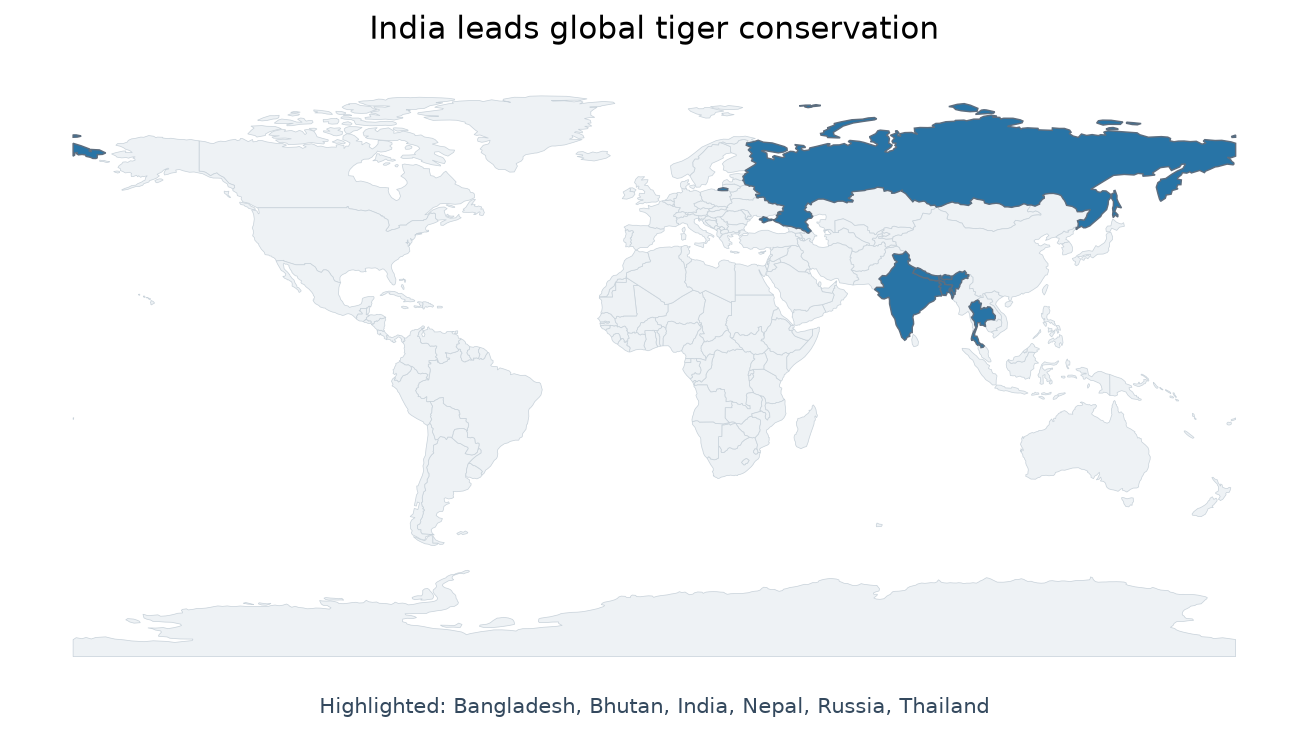
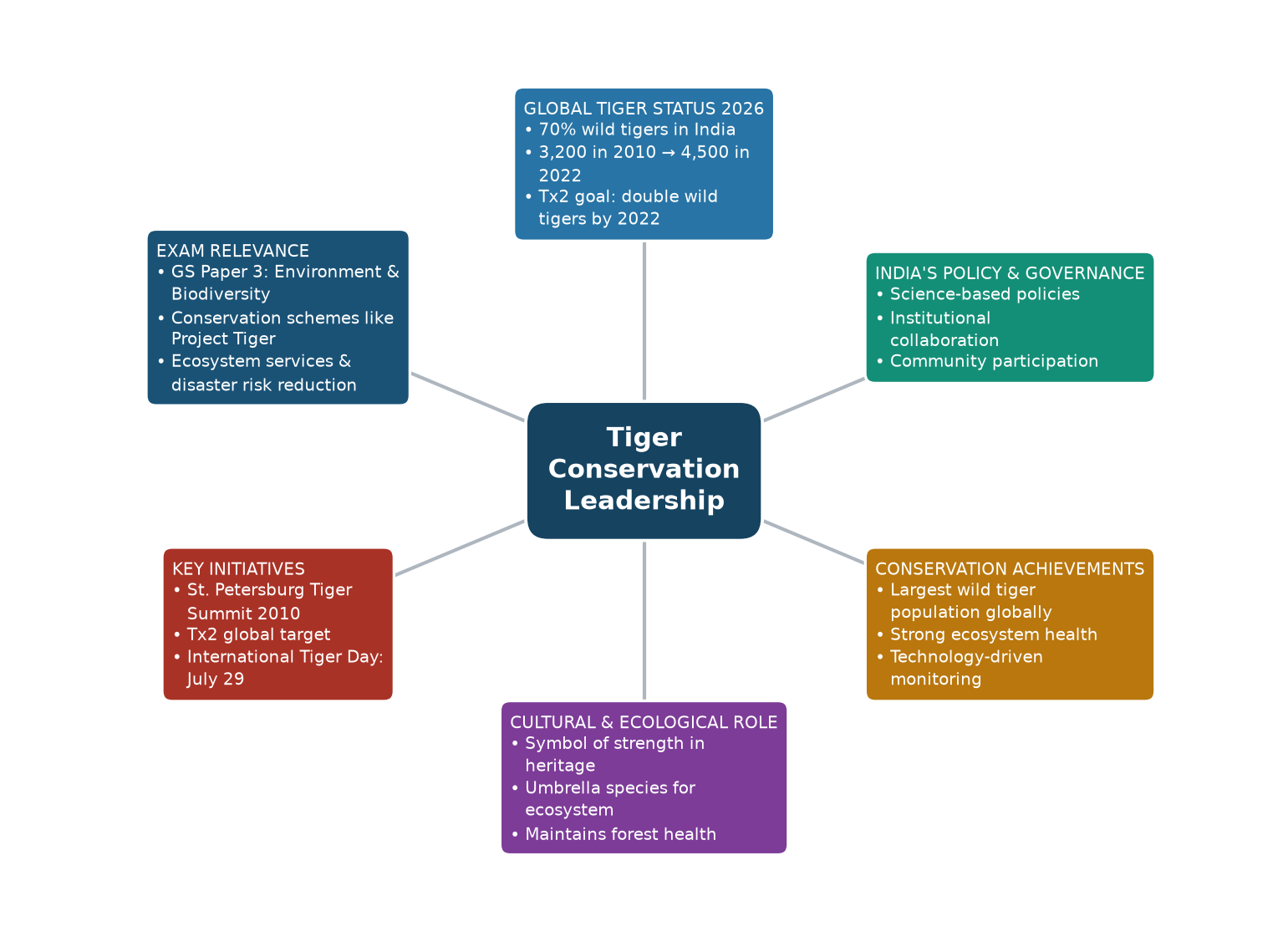
Map & concept mind-map: India leads global tiger conservation
Subject Relevance — Where This Topic Fits
- GS Paper III — Environment, Ecology, Biodiversity and Climate Change | GS Paper III — Science and Technology (Conservation Technologies)
- Prelims: Project Tiger, National Tiger Conservation Authority (NTCA), All India Tiger Estimation (AITE), Royal Bengal Tiger, Umbrella species, CITES, St. Petersburg Tiger Summit (2010), TX2 Goal, Global Tiger Forum, Biodiversity Hotspots, Ecosystem Services, Community-based Conservation, Remote Sensing and GIS in Wildlife Monitoring
- Essay: Conservation as a Moral Imperative: Balancing Development and Ecological Integrity, India’s Role in Global Environmental Governance: From Symbolic Leadership to Systemic Impact
Quick Revision: India’s 2022 All India Tiger Estimation recorded 3,682 tigers, demonstrating a 78% increase since 2010 and positioning the country as the global leader in tiger conservation through science, governance, and community engagement.
Why is this in the news?
On 28 July 2026, the Press Information Bureau (PIB) released a backgrounder highlighting India’s global leadership in tiger conservation, noting that the country now hosts approximately 70% of the world’s wild tiger population. This achievement underscores the integration of science-driven policies, robust institutional frameworks, and community participation in conservation, aligning with the TX2 goal adopted at the St. Petersburg Tiger Summit (2010). The announcement coincides with International Tiger Day (29 July), providing an occasion to reflect on India’s conservation trajectory and its implications for biodiversity governance.
Background
- The global wild tiger population faced severe decline in the 20th century due to habitat loss, poaching, and anthropogenic pressures, with estimates suggesting fewer than 3,200 individuals globally by 2010.
- In response, the St. Petersburg Tiger Summit (November 2010) was convened, where 13 tiger-range countries adopted the ‘TX2’ target: to double the global wild tiger population by 2022.
- India, home to the Royal Bengal Tiger (Panthera tigris tigris), declared it the National Animal in 1972, formalising its cultural and ecological significance.
- The National Tiger Conservation Authority (NTCA) serves as the apex body for tiger conservation in India, implementing the ‘Project Tiger’ scheme since 1973.
- The All India Tiger Estimation (AITE), conducted quadrennially, employs camera traps and field surveys to estimate tiger populations and their habitats.
What is Tiger Conservation in India?
- Tiger conservation in India is a multi-pronged strategy integrating scientific monitoring, habitat restoration, anti-poaching measures, and community engagement to ensure the survival of the Royal Bengal Tiger and its ecosystems.
- The National Tiger Conservation Authority (NTCA) acts as the nodal authority for implementing conservation policies, including the Wildlife (Protection) Act, 1972.
- Project Tiger, launched in 1973, is a centrally sponsored scheme that provides financial and technical support to tiger reserves, ensuring habitat connectivity, prey base management, and ecological monitoring.
- The All India Tiger Estimation (AITE) uses advanced technologies such as camera traps to generate accurate population estimates and assess habitat health.
- India’s tiger reserves are critical biodiversity hotspots that protect not only tigers but also keystone species and ecosystem services, including water regulation, soil conservation, and carbon sequestration.
- Community participation promotes sustainable livelihoods and reduces human-wildlife conflict in buffer zones.
- The ‘TX2’ goal, adopted at the St. Petersburg Summit (2010), aims to double the global tiger population by 2022; India exceeded this target, with its tiger population rising from 1,411 in 2006 to 3,682 in 2022, representing over 70% of the global wild tiger population.
- India’s conservation model is recognised globally for its integration of traditional ecological knowledge with modern science, exemplified by the use of GIS, remote sensing, and participatory monitoring in tiger habitats.
Key Features
| Feature | Significance |
|---|---|
| Global Tiger Population Share | India hosts approximately 70% of the world’s wild tiger population as of 2026, establishing its leadership in tiger conservation. |
| Scientific Monitoring | Deployment of technology-based surveillance (camera traps, GPS collaring, and AI-driven analytics) ensures precise population estimation and real-time threat detection. |
| Institutional Framework | Strengthened institutional mechanisms such as the National Tiger Conservation Authority (NTCA) and Project Tiger provide structured governance and policy implementation. |
| Community Participation | Integration of local communities in conservation efforts through eco-development initiatives, alternative livelihood programs, and conflict mitigation strategies. |
| Ecosystem-Based Approach | Protection of tiger habitats inherently safeguards entire ecosystems, including forests, rivers, and biodiversity hotspots, ensuring ecological resilience. |
Why it Matters
Ecological
- Maintenance of apex predator populations ensures trophic balance and prevents overgrazing, preserving forest structure and biodiversity.
- Tiger habitats act as ‘umbrella species,’ protecting numerous co-dependent species and maintaining ecological integrity.
- Forest cover under tiger reserves contributes to carbon sequestration, mitigating climate change impacts.
Economic
- Conservation of tiger habitats supports eco-tourism, generating revenue for local economies and creating employment in rural areas.
- Sustainable forest management enhances water security, soil fertility, and pollination services, critical for agricultural productivity.
- Investment in wildlife conservation aligns with global biodiversity finance mechanisms, attracting international funding and partnerships.
Cultural
- Tiger symbolizes India’s rich cultural heritage, reflected in art, mythology, and national identity since ancient times.
- Recognition of the tiger as the national animal (1972) underscores its symbolic and ecological importance in India’s biodiversity narrative.
- Conservation efforts reinforce India’s commitment to preserving natural heritage for future generations.
Strategic
- Leadership in tiger conservation enhances India’s global environmental diplomacy and soft power, fostering international cooperation.
- Robust conservation policies serve as a model for other tiger-range countries, particularly in South and Southeast Asia.
- Strengthened ecological security reduces disaster risks (e.g., landslides, floods) and enhances climate resilience.
Challenges
1. Habitat Fragmentation
- Expansion of infrastructure (roads, railways, urbanization) fragments tiger habitats, increasing human-wildlife conflict.
- Isolation of tiger populations reduces genetic diversity, threatening long-term survival.
UPSC Link: GS3 environment
2. Poaching and Illegal Wildlife Trade
- Persistent demand for tiger parts in illegal wildlife trade remains a critical threat to population stability.
- Poaching networks exploit weak enforcement in border regions and remote forests.
UPSC Link: GS3 environment
3. Human-Wildlife Conflict
- Increasing encroachment into tiger habitats leads to livestock predation and retaliatory killings by local communities.
- Lack of effective compensation mechanisms exacerbates tensions between humans and wildlife.
UPSC Link: GS3 environment
4. Climate Change Impacts
- Shifts in temperature and precipitation patterns alter prey availability and vegetation structure in tiger habitats.
- Increased frequency of extreme weather events (droughts, floods) disrupts ecological balance and tiger breeding cycles.
UPSC Link: GS3 environment
5. Funding and Resource Constraints
- Sustained conservation efforts require long-term funding, which is often constrained by competing national priorities.
- Inadequate staffing and technological resources in forest departments limit effective implementation of conservation programs.
UPSC Link: GS3 environment
Challenges — UPSC Perspective
| Issue | Concern |
|---|---|
| Habitat Fragmentation | Isolation of tiger populations reduces genetic flow and increases extinction risk. |
| Poaching | Illegal trade in tiger parts undermines conservation gains and threatens population recovery. |
| Human-Wildlife Conflict | Retaliatory killings and crop damage erode community support for conservation. |
| Climate Variability | Altered monsoon patterns and forest fires degrade tiger habitats and prey base. |
| Institutional Gaps | Weak enforcement of wildlife laws and insufficient monitoring in critical tiger corridors. |
| Eco-Tourism Pressure | Unregulated tourism in tiger reserves disturbs wildlife and degrades habitats. |
Government Initiatives — Must-Memorise for Prelims
- Project Tiger (1973)
Way Forward
- Strengthen habitat connectivity through dedicated tiger corridors and green infrastructure in fragmented landscapes.
- Enhance anti-poaching measures by deploying advanced surveillance technologies and strengthening border coordination with neighboring countries.
- Expand community-based conservation programs, including livelihood diversification and conflict mitigation initiatives.
- Integrate climate resilience into tiger habitat management plans to address shifting ecological conditions.
- Increase funding allocation for tiger conservation, leveraging public-private partnerships and international climate finance mechanisms.
- Promote scientific research on tiger ecology, prey dynamics, and disease surveillance to inform adaptive management strategies.
- Enhance inter-state and inter-agency coordination for seamless implementation of conservation policies across tiger range states.
- Raise public awareness through targeted campaigns to foster a culture of coexistence and support for wildlife conservation.
UPSC Value Addition
Keywords for Mains Answer-Writing
Project Tiger · Royal Bengal Tiger · Biodiversity conservation · Umbrella species · Ecosystem services · National Tiger Conservation Authority (NTCA) · All India Tiger Estimation (AITE) · St. Petersburg Tiger Summit · Tx2 Global Tiger Initiative · Community-based conservation · Ecological security · Sustainable development goals (SDGs) · Cultural heritage of tigers in India · Forest ecosystem services
Concept Flow
Decline in tiger populations (historical poaching, habitat loss) → Policy intervention (Project Tiger, 1973) → Institutional strengthening (NTCA, 2005) → Scientific monitoring (M-STrIPES) → Community engagement (eco-development) → Habitat restoration (corridors, afforestation) → Population recovery (3,682 tigers in 2022) → Global leadership (70% share of wild tigers) → Sustainable development (ecological security, eco-tourism)
Prelims Practice Questions
Q1. Which of the following is NOT a key objective of India’s ‘Project Tiger’ initiative?
- A. To ensure the maintenance of a viable population of Bengal tigers in India
- B. To provide a framework for tiger conservation in India
- C. To promote international trade in tiger parts for revenue generation
- D. To protect tigers from poaching and habitat destruction
Answer: C. To promote international trade in tiger parts for revenue generation — Project Tiger, launched in 1973, aims to ensure viable tiger populations, prevent poaching, and protect habitats. It does not promote trade in tiger parts, which is illegal under the Wildlife Protection Act, 1972.
Q2. The ‘Tx2 Global Tiger Initiative’ aims to:
- A. Double the global wild tiger population by 2022
- B. Establish tiger reserves across all continents
- C. Ban all forms of tiger tourism globally
- D. Introduce captive breeding programs for tigers in zoos
Answer: A. Double the global wild tiger population by 2022 — The Tx2 Global Tiger Initiative, adopted at the St. Petersburg Tiger Summit (2010), set the ambitious goal of doubling the global wild tiger population by 2022.
Q3. Which of the following best describes the role of the ‘Umbrella species’ in ecosystem conservation?
- A. A species whose conservation automatically benefits a wide range of other species
- B. A species that is legally protected under international treaties
- C. A species that is exclusively found in India
- D. A species that is hunted for traditional medicine
Answer: A. A species whose conservation automatically benefits a wide range of other species — An umbrella species is one whose conservation indirectly protects many other species sharing the same habitat, as its requirements encompass those of numerous co-occurring species.
Q4. The ‘All India Tiger Estimation (AITE)’ is conducted by which of the following institutions?
- A. Wildlife Institute of India (WII)
- B. National Tiger Conservation Authority (NTCA)
- C. Both A and B
- D. Ministry of Environment, Forest and Climate Change (MoEFCC) alone
Answer: C. Both A and B — The AITE is a collaborative effort led by the NTCA in partnership with the Wildlife Institute of India (WII) and state forest departments.
Mains Practice Question
✍ Critically evaluate India’s success in tiger conservation, highlighting the role of scientific management, institutional frameworks, and community participation. How does this success contribute to the broader goals of ecological security and sustainable development in the country?
Approach: Begin by outlining India’s tiger conservation journey, emphasizing the launch of Project Tiger (1973) and the evolution of the National Tiger Conservation Authority (NTCA). Discuss the scientific rigor of the All India Tiger Estimation (AITE), which employs camera traps, satellite imagery, and field surveys to estimate tiger populations. Highlight the role of institutional frameworks such as the Wildlife Protection Act, 1972, and international collaborations like the Tx2 Initiative. Examine community participation through initiatives like eco-development and compensation schemes for human-wildlife conflict. Conclude by linking tiger conservation to ecological security—protection of forest ecosystems, water regulation, and climate mitigation—and sustainable development goals, including SDG 13 (Climate Action) and SDG 15 (Life on Land).
Source: PIB (Press Information Bureau)
Generated by AanyaAi for educational purpose.

- यूपीएससी/पीसीएस: उत्तराखंड में एसटी/एससी अत्याचार मामलों पर सीएम धामी के निर्देश, त्वरित न्याय पर जोर - September 22, 2026
- UPSC Alert: CM Dhami’s Strict Action Plan for SC/ST Atrocity Cases in Uttarakhand - September 22, 2026
- हिमाचल में उड़ान योजना का विस्तार: 10 साल के लिए त्रिपक्षीय करार, जानिए पूरी डिटेल्स - September 22, 2026

No Comments