


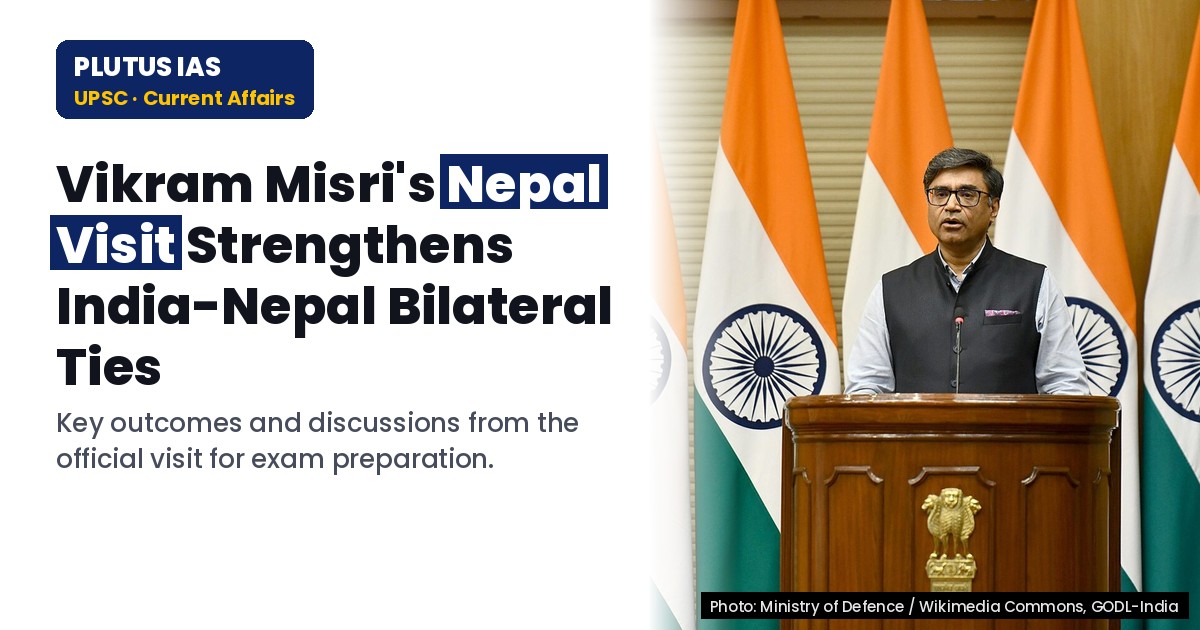
05 Nov India-Nepal Relations: Foreign Secretary Misri’s Visit Analysis
✎ High-level diplomatic visits are pivotal for reviewing, strengthening, and expanding bilateral cooperation across various sectors, aligning with India's 'Neighborhood First Policy' to foster regional stability and mutual…
Subject Relevance — Where This Topic Fits
- GS Paper II — International Relations: India and its neighborhood- relations | GS Paper II — International Relations: Bilateral, regional and global groupings and agreements involving India and/or affecting India’s interests
- Prelims: India-Nepal relations, Foreign Secretary, Bilateral cooperation, Neighborhood First Policy, SAARC, BIMSTEC, Connectivity projects, Hydro-power cooperation
- Essay: India’s Neighborhood First Policy: Challenges and Opportunities, The evolving dynamics of South Asian regional cooperation
Quick Revision: High-level diplomatic visits are pivotal for reviewing, strengthening, and expanding bilateral cooperation across various sectors, aligning with India’s ‘Neighborhood First Policy’ to foster regional stability and mutual prosperity.
Why is this in the news?
The Foreign Secretary of India, Shri Vikram Misri, undertook an official visit to Nepal on 04-05 November 2026. This high-level diplomatic engagement underscores the ongoing commitment of both nations to strengthen their multifaceted bilateral relationship, encompassing various sectors such as connectivity, trade, energy, and people-to-people ties. The visit provided an opportunity for comprehensive discussions on matters of mutual interest and to review the progress of ongoing cooperation initiatives.
Background
- India and Nepal share a unique relationship characterized by open borders and deep-rooted cultural and historical linkages, often referred to as ‘Roti-Beti ka Rishta’.
- The Treaty of Peace and Friendship of 1950 forms the bedrock of India-Nepal relations, facilitating free movement of people and goods, and fostering close cooperation.
- India is Nepal’s largest trading partner and the largest source of foreign investment, playing a crucial role in Nepal’s economic development.
- Connectivity projects, including cross-border railway lines, integrated check posts, and petroleum pipelines, are key areas of bilateral cooperation aimed at enhancing trade and transit.
- Cooperation in the hydropower sector is significant, with India assisting Nepal in various projects and being a major consumer of Nepal’s surplus electricity.
- India’s ‘Neighborhood First Policy’ prioritizes strengthening ties with its immediate neighbors, with Nepal being a vital component of this strategic outreach.
What is the significance of high-level diplomatic visits in bilateral relations?
- High-level diplomatic visits, such as those by Foreign Secretaries, serve as crucial mechanisms for reviewing the entire spectrum of bilateral relations between countries.
- They provide a platform for direct communication and exchange of views on regional and global issues of mutual concern, fostering better understanding and coordination.
- Such visits facilitate the identification of new areas of cooperation and the acceleration of existing projects, ensuring timely implementation and overcoming potential bottlenecks.
- They help in building trust and confidence between nations, which is essential for maintaining stable and productive international relations.
- These engagements often lead to the signing of agreements, Memoranda of Understanding (MoUs), or joint declarations, formalizing commitments and setting future directions for cooperation.
- They reinforce the political will to address challenges and capitalize on opportunities, thereby contributing to the overall stability and prosperity of the region.
- Diplomatic visits also allow for people-to-people exchanges and cultural interactions, further strengthening the bonds between the citizens of the two countries.
- They are instrumental in projecting a nation’s foreign policy objectives and demonstrating its commitment to regional partnerships.
Key Features
| Feature | Significance | |
|---|---|---|
| Official Visit of Foreign Secretary | Underscores the high-level diplomatic engagement between India and Nepal, reflecting the importance of bilateral relations. | |
| Bilateral Consultations | Provides a structured platform for reviewing the entire gamut of bilateral cooperation and addressing mutual concerns. | |
| . | . | . |
| Strengthening of Bilateral Ties | Aims to reinforce the historically close and multi-faceted relationship encompassing political, economic, cultural, and people-to-people linkages. | |
| Regional Stability | Contributes to regional peace and stability through enhanced cooperation between two key South Asian nations. |
Why it Matters
Geopolitical Significance
- Nepal’s strategic location as a buffer state between India and China makes its relationship with India crucial for regional balance.
- Reinforces India’s ‘Neighbourhood First’ policy, prioritising robust engagement with contiguous nations.
Economic Cooperation
- Facilitates discussions on ongoing development projects, trade, and investment, which are vital for Nepal’s economic growth and India’s regional economic integration.
- Explores avenues for enhanced connectivity, including cross-border infrastructure, energy cooperation, and digital linkages.
Cultural and People-to-People Ties
- Strengthens the unique bonds of shared culture, religion, and open borders, which form the bedrock of India-Nepal relations.
- Promotes mutual understanding and goodwill, essential for long-term friendly relations.
Challenges
1. Border Disputes
- Unresolved territorial issues, such as Kalapani, Lipulekh, and Limpiyadhura, periodically strain bilateral relations.
- Requires sustained diplomatic dialogue and technical resolution mechanisms.
UPSC Link: India-Nepal relations, border management
2. Chinese Influence
- Growing Chinese economic and strategic presence in Nepal presents a challenge to India’s traditional influence.
- Necessitates India’s proactive engagement and delivery on commitments to maintain its strategic position.
UPSC Link: India’s foreign policy, regional geopolitics
3. Hydropower Cooperation
- Potential for extensive hydropower projects remains largely untapped due to complex negotiations and implementation challenges.
- Requires a mutually beneficial framework for water resource management and power sharing.
UPSC Link: Bilateral agreements, energy security
4. Implementation Gaps
- Delays in the execution of India-funded projects in Nepal can lead to local discontent and perception issues.
- Demands streamlined project management and timely completion.
UPSC Link: Development cooperation, project management
Challenges — UPSC Perspective
| Issue | Concern |
|---|---|
| Trust Deficit | Historical grievances and occasional political rhetoric can erode mutual trust, impacting cooperation. |
| Security Cooperation | Challenges in coordinating efforts against cross-border crime, human trafficking, and illicit activities. |
| Economic Imbalance | Nepal’s trade deficit with India and dependence on Indian markets can lead to economic vulnerabilities. |
| Infrastructure Development | Pace and quality of jointly undertaken infrastructure projects can be a point of contention. |
Way Forward
- Sustain high-level diplomatic engagements to ensure continuous dialogue and problem-solving.
- Expedite the implementation of ongoing bilateral projects to demonstrate commitment and deliver tangible benefits.
- Enhance cooperation in new and emerging areas such as digital connectivity, space technology, and renewable energy.
- Address border issues through established mechanisms, fostering a spirit of mutual respect and understanding.
- Strengthen people-to-people ties through cultural exchanges, educational programs, and tourism promotion.
- Promote a balanced and equitable economic partnership, focusing on trade facilitation and investment promotion.
- Collaborate on regional and multilateral forums to address common challenges like climate change and disaster management.
- Ensure transparent communication and public diplomacy to counter misinformation and build positive narratives.
UPSC Value Addition
Keywords for Mains Answer-Writing
India-Nepal relations · Foreign Secretary visit · Bilateral cooperation · Neighbourhood First Policy · Connectivity projects · Economic partnership · Cultural ties · Hydropower cooperation · Border management · Regional diplomacy · Strategic convergence · Sub-regional cooperation
Concept Flow
Foreign Secretary’s Visit to Nepal → Bilateral Consultations and Dialogue → Review of Existing Cooperation Areas → Identification of New Avenues for Partnership → Strengthening of India-Nepal Bilateral Relations → Contribution to Regional Stability and Development
Prelims Practice Questions
Q1. Consider the following statements regarding India-Nepal relations:
1. India’s ‘Neighbourhood First Policy’ prioritises strengthening ties with Nepal.
2. The Treaty of Peace and Friendship between India and Nepal was signed in 1950.
3. Both India and Nepal are members of the South Asian Association for Regional Cooperation (SAARC).
How many of the above statements are correct?
- Only one
- Only two
- Only three
- None
Answer: Only three — Statement 1 is correct: The ‘Neighbourhood First Policy’ is a cornerstone of India’s foreign policy, aiming to improve relations with its immediate neighbours, including Nepal. Statement 2 is correct: The Treaty of Peace and Friendship between the Government of India and the Government of Nepal was indeed signed in 1950, establishing a special relationship. Statement 3 is correct: Both India and Nepal are founding members of SAARC, a regional intergovernmental organisation.
Q2. Match the following initiatives/agreements with their primary focus in the context of India-Nepal relations:
List I (Initiative/Agreement)
1. BBIN Motor Vehicle Agreement
2. Pancheshwar Multipurpose Project
3. Buddhist Circuit
List II (Primary Focus)
A. Regional Connectivity
B. Hydropower and Water Resources
C. Cultural and Tourism Promotion
Select the correct matching pair:
- 1-A, 2-B, 3-C
- 1-B, 2-A, 3-C
- 1-C, 2-B, 3-A
- 1-A, 2-C, 3-B
Answer: 1-A, 2-B, 3-C — The BBIN Motor Vehicle Agreement aims to facilitate seamless movement of passenger and cargo vehicles among Bangladesh, Bhutan, India, and Nepal, thus focusing on regional connectivity. The Pancheshwar Multipurpose Project is a joint India-Nepal hydropower project on the Mahakali River, focusing on hydropower generation and water resource management. The Buddhist Circuit is an initiative to promote tourism along sites associated with the life of Buddha, thereby focusing on cultural and tourism promotion.
Mains Practice Question
✍ Examine the significance of high-level diplomatic visits in strengthening bilateral relations, with particular reference to India’s ‘Neighbourhood First Policy’ and its engagement with Nepal. Discuss the key areas of cooperation that such visits typically aim to advance. (15 Marks)
Approach: The answer should begin by defining the ‘Neighbourhood First Policy’ and its strategic importance for India. Subsequently, it must elaborate on the significance of high-level diplomatic visits, such as that of the Foreign Secretary, in operationalising this policy. Key points of significance include fostering trust, resolving outstanding issues, expediting project implementation, and signalling commitment. The second part of the answer should identify and discuss specific areas of cooperation between India and Nepal that are typically advanced during such visits. These areas include, but are not limited to, connectivity (road, rail, inland waterways, digital), energy cooperation (hydropower), trade and economic partnership, cultural and people-to-people exchanges, security cooperation (border management, counter-terrorism), and development assistance. Concrete examples of ongoing projects or agreements (e.g., cross-border railway links, integrated check posts, Pancheshwar project, Buddhist Circuit) should be mentioned to substantiate the discussion. The answer should conclude by summarising the role of sustained diplomatic engagement in maintaining a stable and mutually beneficial relationship.
Source: Ministry of External Affairs
Generated by AanyaAi for educational purpose.
Related guides on our sites
- Current affairs for upsc 2026
- Best PSIR optional coaching for upsc
- Best PSIR optional teacher for upsc
- Best teacher of PSIR optional for upsc

- NAMASTE Scheme: Enhancing Sanitation Workers’ Livelihoods & Safety - November 14, 2026
- एमएसएमई का विशेष अभियान 6.0: स्वच्छता और लंबित मामलों का निपटारा - November 14, 2026
- Sea Vigil-26: Coastal Defence Drills Off Visakhapatnam - November 14, 2026

No Comments