


18 Sep India Rejects Pakistan’s False Claims After Arabian Sea Navy Collision
✎ Naval vessels operating in overlapping or disputed maritime zones must adhere to UNCLOS 1982, bilateral agreements like ANEMM 1991, and COLREGs to prevent collisions and maintain maritime stability.
Subject Relevance — Where This Topic Fits
- GS Paper II — International Relations — India’s maritime diplomacy, bilateral agreements with neighbours, maritime security
- Prelims: Exclusive Economic Zone (EEZ), International Regulations for Preventing Collisions at Sea (COLREGs), Advance Notice Agreement 1991, Charge d’Affaires, UN Convention on the Law of the Sea (UNCLOS) 1982
- Essay: Maritime security and regional stability — the role of diplomacy and deterrence, Sovereignty and cooperation: balancing national security with international obligations
Quick Revision: Naval vessels operating in overlapping or disputed maritime zones must adhere to UNCLOS 1982, bilateral agreements like ANEMM 1991, and COLREGs to prevent collisions and maintain maritime stability.
Why is this in the news?
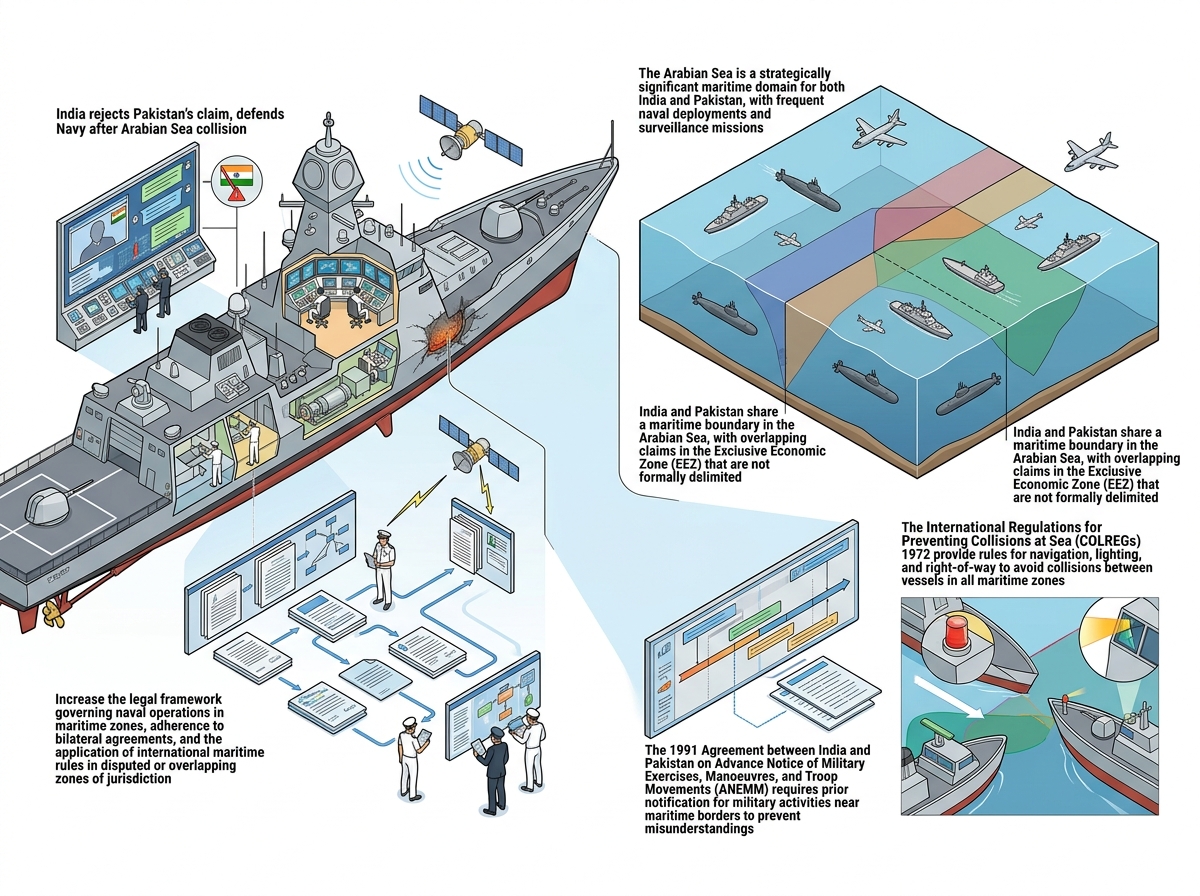
The incident has drawn attention to the legal framework governing naval operations in maritime zones, adherence to bilateral agreements, and the application of international maritime rules in disputed or overlapping zones of jurisdiction.
Background
- The Arabian Sea is a strategically significant maritime domain for both India and Pakistan, with frequent naval deployments and surveillance missions.
- India and Pakistan share a maritime boundary in the Arabian Sea, with overlapping claims in the Exclusive Economic Zone (EEZ) that are not formally delimited.
- The 1991 Agreement between India and Pakistan on Advance Notice of Military Exercises, Manoeuvres, and Troop Movements (ANEMM) requires prior notification for military activities near maritime borders to prevent misunderstandings.
- The International Regulations for Preventing Collisions at Sea (COLREGs), adopted under the International Maritime Organization (IMO), govern safe navigation and collision avoidance at sea.
- The United Nations Convention on the Law of the Sea (UNCLOS) 1982 defines maritime zones such as the Territorial Sea, Contiguous Zone, and Exclusive Economic Zone (EEZ), and establishes navigational rights and duties.
- Incidents at sea between naval vessels of neighbouring states can escalate tensions and require diplomatic clarification to prevent misperceptions and unintended escalation.
What is the legal and procedural framework governing naval encounters in the Arabian Sea?
- Exclusive Economic Zone (EEZ): Under UNCLOS 1982, the EEZ extends up to 200 nautical miles from the baseline, where the coastal state has sovereign rights for resource exploitation but not full sovereignty. Foreign military vessels, including naval ships, retain the right of innocent passage and freedom of navigation, subject to due regard for coastal state interests.
- Advance Notice Agreement (ANEMM) 1991: This bilateral agreement between India and Pakistan mandates prior notification for military exercises, manoeuvres, or troop movements near the maritime boundary to reduce the risk of miscalculation or unintended confrontation. Article 10 specifically addresses naval units at sea, prohibiting close approaches within three nautical miles unless mutually agreed.
- International Regulations for Preventing Collisions at Sea (COLREGs): These rules, established by the IMO, govern safe navigation, collision avoidance, and conduct of vessels at sea. They apply to all ships, including naval vessels, and require adherence to standard manoeuvring and signalling procedures.
- Naval Rules of Engagement (ROE): While not publicly detailed, naval forces operate under ROE that balance operational necessity with risk mitigation, particularly in contested or ambiguous maritime zones. These rules are designed to prevent escalation while ensuring mission success.
- Maritime Boundary and Disputes: The maritime boundary between India and Pakistan in the Arabian Sea is not formally delimited, leading to overlapping EEZ claims. Such ambiguity increases the risk of incidents, especially during routine patrols or surveillance operations.
- Diplomatic Channels: In the event of an incident, diplomatic channels such as the summoning of a Charge d’Affaires are used to register protests, seek clarifications, and prevent escalation. These channels are critical for maintaining stability in sensitive maritime regions.
- Maritime Domain Awareness: Both navies rely on maritime domain awareness systems, including satellite tracking and radar surveillance, to monitor vessel movements and avoid unintended encounters. Enhanced coordination can reduce the likelihood of such incidents.
Key Features
| Feature | Significance |
|---|---|
| Collision incident in the Arabian Sea | Demonstrates the risks of unprofessional naval conduct in congested maritime zones, particularly in areas of strategic interest. |
| Violation of the 1991 India-Pakistan Agreement on Advance Notice | Underscores the importance of adherence to bilateral military confidence-building measures to prevent escalation. |
| Alleged infringement of the International Regulations for Preventing Collisions at Sea (COLREGs) | Highlights the role of international maritime law in regulating naval operations and preventing accidents. |
| India’s rejection of Pakistan’s allegations | Reinforces the principle of sovereign immunity in military operations and the right to self-defence under international law. |
| Summoning of the Pakistani Charge d’Affaires | Illustrates the diplomatic mechanism for protesting violations of bilateral agreements and international norms. |
Why it Matters
Strategic/Maritime Security
- The Arabian Sea is a critical maritime corridor for global trade and energy flows, making naval incidents a matter of international concern.
- Unprofessional naval conduct risks miscalculation, escalation, or unintended conflict, especially in disputed or congested waters.
- India’s defence of its naval operations underscores its commitment to maintaining freedom of navigation and maritime security in the Indian Ocean Region (IOR).
Diplomatic/International Law
- The incident tests the efficacy of bilateral agreements (e.g., 1991 Advance Notice Agreement) in preventing military misadventures.
- Adherence to the International Regulations for Preventing Collisions at Sea (COLREGs) is essential to avoid accidents and legal disputes.
- Diplomatic protests (e.g., summoning Charge d’Affaires) serve as a mechanism to register disapproval without escalating tensions.
Defence Preparedness
- Routine naval deployments, such as surveillance missions, are critical for monitoring maritime threats and ensuring national security.
- The incident highlights the need for robust Rules of Engagement (RoE) and professional training to handle provocative manoeuvres at sea.
- Damage control and operational readiness are vital to maintain naval credibility and deterrence capabilities.
Challenges
1. Maritime Boundary Disputes and Unprofessional Naval Conduct
- Risk of unintended escalation due to aggressive or unprofessional naval manoeuvres in congested waters.
- Challenges in enforcing bilateral agreements (e.g., 1991 Advance Notice Agreement) amid mutual distrust.
- Difficulty in attributing blame in incidents involving non-combatant vessels or ambiguous circumstances.
- Need for real-time communication mechanisms to de-escalate tensions and clarify intentions.
UPSC Link: GS III: Security challenges and their management
2. Adherence to International Maritime Law
- Ensuring compliance with the International Regulations for Preventing Collisions at Sea (COLREGs) by all naval forces.
- Balancing sovereign immunity with accountability for violations of international norms.
- Addressing gaps in maritime domain awareness to prevent miscalculations or misidentifications.
- Harmonising national laws with international maritime conventions to avoid legal ambiguities.
UPSC Link: GS II: International treaties and agreements
3. Diplomatic Crisis Management
- Maintaining diplomatic channels to prevent incidents from spiralling into broader conflicts.
- Balancing firmness in protest with restraint to avoid provoking further aggressive actions.
- Ensuring that bilateral agreements are not undermined by unilateral actions or misinterpretations.
- Building trust through confidence-building measures (CBMs) and joint maritime exercises.
UPSC Link: GS II: India’s foreign policy and diplomatic practices
Challenges — UPSC Perspective
| Issue | Concern |
|---|---|
| Unprofessional naval manoeuvres | Risk of accidents, escalation, or unintended conflict in congested maritime zones. |
| Violation of bilateral agreements (1991 Advance Notice Agreement) | Undermines trust and increases the likelihood of future incidents. |
| Ambiguity in attributing blame | Complicates legal and diplomatic responses, delaying resolution. |
| Lack of real-time communication mechanisms | Hampers de-escalation efforts and increases the risk of miscalculation. |
| Non-compliance with COLREGs | Raises legal and safety risks, potentially leading to accidents or disputes. |
Way Forward
- Strengthen bilateral confidence-building measures (CBMs) with Pakistan to prevent military misadventures, including joint maritime exercises.
- Enhance maritime domain awareness through improved surveillance, satellite monitoring, and real-time communication systems.
- Review and update the 1991 India-Pakistan Agreement on Advance Notice to address gaps in naval operations and manoeuvres.
- Conduct joint investigations with Pakistan to objectively assess the incident and prevent future recurrences.
- Promote adherence to the International Regulations for Preventing Collisions at Sea (COLREGs) through training and awareness programmes.
- Establish a dedicated hotline between naval headquarters to facilitate immediate communication during incidents.
- Incorporate lessons learned from this incident into naval training programmes to improve professional conduct and situational awareness.
- Engage with the United Nations and regional maritime bodies (e.g., Indian Ocean Naval Symposium) to advocate for stricter adherence to international norms.
UPSC Value Addition
Keywords for Mains Answer-Writing
Indian Navy · Pakistan Navy · Arabian Sea incident · Exclusive Economic Zone (EEZ) · International Regulations for Preventing Collisions at Sea (COLREGs) · Agreement on Advance Notice of Military Exercises, Manoeuvres and Troop Movements (1991) · Naval diplomacy · Maritime security · UNCLOS · Maritime boundary disputes · Naval rules of engagement · Maritime safety · Naval professional conduct · Maritime law of the sea
Concept Flow
Routine naval surveillance mission in the Arabian Sea → Pakistani naval vessel conducts unprofessional manoeuvre → Collision occurs → India rejects Pakistan’s allegations → India lodges protest via diplomatic channels → Incident escalates to a diplomatic crisis → Need for de-escalation and adherence to bilateral agreements → Lessons for maritime security and naval conduct.
Prelims Practice Questions
Q1. Consider the following statements regarding the Agreement between India and Pakistan on Advance Notice on Military Exercises, Manoeuvres and Troops Movements (1991):
1. It mandates that naval units at sea must maintain a minimum distance of three nautical miles from each other.
2. The agreement was signed to prevent accidental clashes between the naval forces of both countries.
3. The agreement is registered with the United Nations under Article 102 of the UN Charter.
How many of the above statements are correct?
- Only one
- Only two
- All three
- None
Answer: Only two — Statement 1 is correct as per Article 10 of the 1991 Agreement. Statement 2 is correct as the agreement aims to reduce risks of accidental military encounters. Statement 3 is incorrect as the agreement is not registered under Article 102 of the UN Charter.
Q2. Assertion (A): The International Regulations for Preventing Collisions at Sea (COLREGs) are binding international legal instruments applicable to all vessels, including warships.
Reason (R): Warships are exempt from the provisions of COLREGs as they operate under sovereign immunity and military rules of engagement.
In the context of the above statements, which of the following is correct?
- A. Both A and R are true, and R is the correct explanation of A.
- B. Both A and R are true, but R is not the correct explanation of A.
- C. A is true, but R is false.
- D. A is false, but R is true.
Answer: C. A is true, but R is false. — Assertion (A) is true: COLREGs are binding international instruments applicable to all vessels, including warships. Reason (R) is false: warships are not exempt from COLREGs but are expected to comply with them in a manner consistent with their sovereign immunity and operational requirements.
Q3. Which of the following maritime zones, as defined under the United Nations Convention on the Law of the Sea (UNCLOS), 1982, is NOT claimed by Pakistan in the Arabian Sea incident referred to in the news?
- A. Territorial Sea
- B. Contiguous Zone
- C. Exclusive Economic Zone (EEZ)
- D. Continental Shelf
Answer: D. Continental Shelf — The Exclusive Economic Zone (EEZ) is claimed by Pakistan, as evidenced by the reference to Pakistan’s EEZ in the news. The Territorial Sea, Contiguous Zone, and Continental Shelf are also claimed by coastal states under UNCLOS, but the question pertains to the specific zone mentioned in the incident.
Mains Practice Question
✍ The recent collision between an Indian Navy warship and a Pakistan Navy vessel in the Arabian Sea underscores the criticality of adherence to maritime rules and agreements. In this context, critically examine the role of international maritime law, particularly the International Regulations for Preventing Collisions at Sea (COLREGs) and the Agreement on Advance Notice of Military Exercises, Manoeuvres and Troop Movements (1991), in ensuring maritime safety and preventing naval incidents. Also, analyse the implications of such incidents for bilateral naval diplomacy and regional maritime security architecture. (15 Marks)
Approach: MODEL-ANSWER SKELETON:
1. **Introduction (2 marks)**: Define maritime safety and the context of the Arabian Sea incident. Briefly introduce COLREGs (1972) and the 1991 India-Pakistan Agreement.
2. **COLREGs and their relevance (4 marks)**:
– State the purpose and binding nature of COLREGs under UNCLOS.
– Key rules violated: Rule 8 (safe speed), Rule 9 (narrow channels), Rule 10 (traffic separation schemes), and Rule 13-17 (overtaking, crossing, and head-on situations).
– Role of COLREGs in preventing collisions and ensuring navigational safety.
3. **India-Pakistan Agreement on Advance Notice (1991) (4 marks)**:
– Purpose: To prevent accidental military clashes and build confidence.
– Key provisions: Advance notice of military exercises, manoeuvres, and troop movements.
– Article 10: Minimum distance between naval units at sea (3 nautical miles).
– Violation in the incident: PNS Hunain’s dangerous overtaking manoeuvre.
4. **Implications for bilateral naval diplomacy (3 marks)**:
– Erosion of trust and escalation risks in naval engagements.
– Importance of hotlines, flag meetings, and adherence to confidence-building measures (CBMs).
– Role of regional forums (e.g., Indian Ocean Naval Symposium – IONS) in promoting maritime safety.
5. **Regional maritime security architecture (2 marks)**:
– UNCLOS as the foundational legal framework.
– Role of the International Maritime Organization (IMO) in standardising maritime rules.
– Need for stronger enforcement mechanisms and dispute resolution under UNCLOS Part XV.
Source: orissapost.com
Generated by AanyaAi for educational purpose.
Related guides on our sites
- Current affairs for upsc 2026
- How to prepare for GS paper 1 for UPSC CSE mains exam
- Best UPSC coaching for IFOS exam
- Best mentorship programme for upsc

- India Rejects Pakistan’s False Claims After Arabian Sea Navy Collision - September 18, 2026
- महिलाओं के लिए नीली अर्थव्यवस्था में अवसर: कोच्चि में राष्ट्रीय सम्मेलन - September 18, 2026
- National Fisherwomen Conclave on India’s Blue Economy in Kochi - September 18, 2026

No Comments