


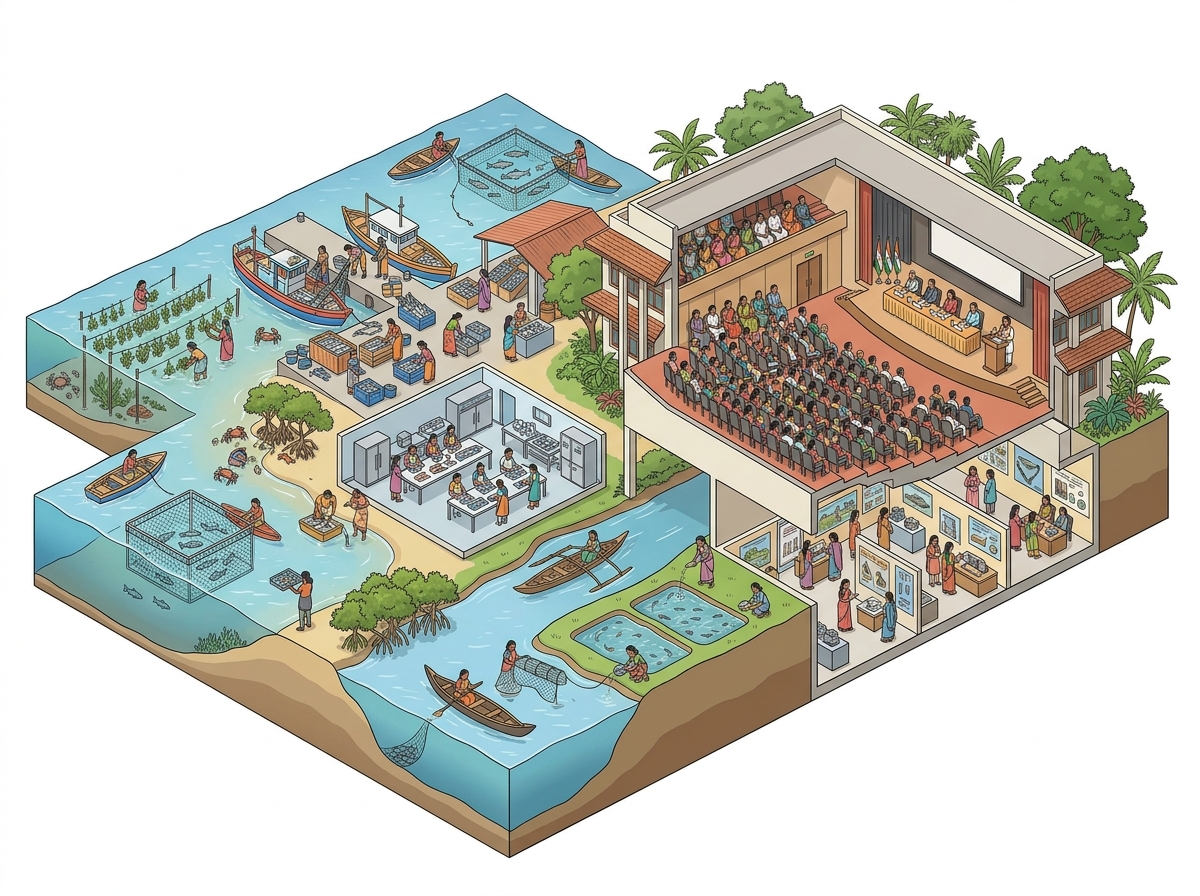
18 Sep National Fisherwomen Conclave on India’s Blue Economy in Kochi
✎ Gender inclusion in India’s blue economy is a multi-dimensional challenge requiring policy interventions in access to credit, technology, training, and decision-making roles, alongside institutional mechanisms like gender…
Subject Relevance — Where This Topic Fits
- GS Paper II — Social Justice and Empowerment | GS Paper III — Environment, Ecology, Bio-diversity and Climate Change | GS Paper III — Economy and Agriculture
- Prelims: Blue Economy, Fisheries Sector, Gender Budgeting, Self-Help Groups (SHGs), Pradhan Mantri Matsya Sampada Yojana (PMMSY), National Fisheries Policy, Maritime State Development Council, Women in Agriculture (WIA) Programme
- Essay: The Role of Women in Sustainable Development: A Case for Inclusive Blue Economy, Gender Equality as a Catalyst for Economic Growth: Lessons from India’s Blue Economy
Quick Revision: Gender inclusion in India’s blue economy is a multi-dimensional challenge requiring policy interventions in access to credit, technology, training, and decision-making roles, alongside institutional mechanisms like gender budgeting and women-centric schemes under PMMSY.
Why is this in the news?
A two-day national conclave on ‘Empowering Women in India’s Blue Economy: Recognition, Inclusion and Partnering’ was inaugurated in Kochi on September 18, 2026, at the Central Institute of Fisheries Technology (CIFT). The event, attended by fisherwomen from multiple coastal and inland states, underscores the critical need for gender-inclusive policies in India’s maritime and fisheries sectors, aligning with national and international commitments to sustainable and equitable development.
Background
- The blue economy, encompassing marine, coastal, and inland water resources, contributes significantly to India’s GDP, food security, and livelihoods, particularly in coastal communities.
- Women constitute a substantial yet underrepresented segment of the workforce in India’s fisheries and allied sectors, performing roles such as fish processing, marketing, and small-scale trading, often informally and without formal recognition.
- The Pradhan Mantri Matsya Sampada Yojana (PMMSY), launched in 2020, aims to enhance fish production, productivity, and profitability while promoting sustainable practices, with provisions for women-centric interventions.
- The National Policy on Marine Fisheries (NPMF), 2017, emphasizes gender mainstreaming, skill development, and access to credit for women in fisheries.
- India is a signatory to the United Nations Sustainable Development Goals (SDGs), including SDG 5 (Gender Equality) and SDG 14 (Life Below Water), necessitating gender-responsive policies in the blue economy.
- The Ministry of Fisheries, Animal Husbandry and Dairying has been progressively integrating gender considerations into its schemes, including the establishment of women’s SHGs under the PMMSY.
What is the Blue Economy and Why Does Gender Inclusion Matter?
- The blue economy refers to the sustainable use of ocean resources for economic growth, improved livelihoods, and jobs while preserving the health of marine ecosystems. It includes fisheries, aquaculture, maritime transport, tourism, and renewable energy.
- Women play a pivotal role in the blue economy, particularly in post-harvest activities such as fish processing, preservation, marketing, and small-scale trading, which account for a significant portion of the sector’s employment.
- Despite their contributions, women in the fisheries sector face systemic barriers, including limited access to credit, technology, training, and decision-making roles, as well as informal employment status and lack of legal protections.
- Gender inclusion in the blue economy is essential for achieving Sustainable Development Goal (SDG) 5 (Gender Equality) and SDG 14 (Life Below Water), as well as for enhancing economic efficiency and social equity.
- Institutional mechanisms such as gender budgeting, women’s SHGs, and gender-responsive policy frameworks are critical to addressing these disparities and unlocking the full potential of the sector.
- The conclave in Kochi highlights the need for multi-stakeholder partnerships among government agencies, research institutions, civil society, and private sector to design and implement gender-inclusive policies in the blue economy.
- Capacity-building initiatives, such as skill development programs and access to financial resources, are necessary to empower women in fisheries and allied sectors, ensuring their economic independence and social mobility.
- The integration of traditional knowledge and modern technology in fisheries management can further enhance the productivity and sustainability of the sector, with women often acting as key knowledge holders.
Key Features
| Feature | Significance |
|---|---|
| National Fisherwomen’s Conclave | A platform for dialogue and collaboration among fisherwomen from diverse coastal and inland states, fostering knowledge-sharing on gender-inclusive practices in the blue economy. |
| Central Institute of Fisheries Technology (CIFT) as host | A premier research institution under the Indian Council of Agricultural Research (ICAR), providing technical and scientific backing to discussions on sustainable fisheries and women’s participation. |
| Multi-state participation (Kerala, Lakshadweep, Tamil Nadu, etc.) | Highlights the geographic diversity of India’s blue economy and the need for inclusive policies that address regional disparities in access and opportunity. |
| Focus on Recognition, Inclusion, and Partnering | Emphasises the triple pillars of gender mainstreaming: acknowledging women’s existing roles, integrating them into decision-making, and forming strategic alliances with institutions and markets. |
| Chief Guest: Former DDG (Fisheries Science), ICAR | Represents institutional recognition of the conclave’s objectives and underscores the role of research and policy in advancing gender equity in fisheries. |
Why it Matters
Economic
- Women constitute a significant portion of the workforce in India’s fisheries sector, particularly in post-harvest activities such as sorting, processing, and marketing, which are critical for value addition and export competitiveness.
- Inclusion of women in the blue economy can enhance productivity, reduce post-harvest losses, and improve household incomes, thereby contributing to rural economic resilience.
- The conclave underscores the potential of women-led enterprises in niche areas like seafood processing, aquaculture, and eco-tourism, which align with global trends in sustainable blue growth.
Social
- The conclave highlights the persistent gender gaps in access to resources, technology, and decision-making within the fisheries sector, despite women’s substantial contributions.
- It serves as a platform to address socio-cultural barriers, such as restricted mobility and traditional gender roles, which limit women’s participation in higher-value segments of the blue economy.
- Empowering fisherwomen can lead to improved nutrition, education, and health outcomes for their families, given the sector’s direct link to food security.
Environmental
- Women in fisheries often employ sustainable practices, such as selective fishing and low-impact processing, which can contribute to biodiversity conservation and climate resilience.
- The conclave’s focus on inclusion aligns with global commitments under the UN Sustainable Development Goal 14 (Life Below Water), particularly targets on gender equality and sustainable resource management.
- Integrating women’s traditional ecological knowledge into fisheries management can enhance adaptive strategies for climate change and overfishing.
Policy and Governance
- The conclave reflects the growing recognition of gender mainstreaming in India’s maritime policies, including the Sagarmala Programme and the Draft National Fisheries Policy 2020.
- It provides inputs for the implementation of the Pradhan Mantri Matsya Sampada Yojana (PMMSY), which includes components for women’s empowerment in fisheries.
- The event can influence the formulation of state-level action plans under the National Policy on Women in Fisheries, ensuring localised and context-specific interventions.
Challenges
1. Limited Access to Resources and Technology
- Women in fisheries often lack ownership of assets such as boats, nets, and cold storage facilities, restricting their ability to scale operations.
- Access to credit, training, and modern technology (e.g., cold chains, processing equipment) is disproportionately low for women, limiting productivity gains.
- Digital literacy gaps hinder women’s participation in e-commerce platforms and market linkages.
UPSC Link: Resource Mobilisation for Fisheries
2. Socio-Cultural Barriers
- Traditional gender roles confine women to low-paying, informal roles in fisheries, with limited mobility and decision-making authority.
- Caste and class intersections further exacerbate exclusion, particularly for women from marginalised communities.
- Social norms often discourage women from engaging in high-risk activities like deep-sea fishing or leadership roles in cooperatives.
UPSC Link: Gender and Social Inclusion
3. Market and Institutional Exclusion
- Women are underrepresented in fisheries cooperatives and federations, which are critical for accessing inputs, credit, and markets.
- Market intermediaries often exploit women’s lack of bargaining power, leading to lower prices for their produce.
- Policy frameworks rarely address the specific needs of women in value chains, such as childcare support or flexible working hours.
UPSC Link: Market Access for Fisheries
4. Climate Vulnerability and Adaptation
- Women in coastal communities are disproportionately affected by climate change impacts such as sea-level rise, cyclones, and ocean acidification.
- Limited access to climate-resilient infrastructure and adaptive technologies restricts their ability to mitigate risks.
- Gender-blind disaster management plans often fail to address the unique vulnerabilities of women in fisheries.
UPSC Link: Climate Change and Fisheries
5. Data and Research Gaps
- Official statistics on women’s participation in fisheries are fragmented and often underreported, obscuring their true economic contribution.
- Research on gender-specific challenges in fisheries is limited, hindering evidence-based policy formulation.
- Lack of disaggregated data by gender, caste, and region limits the design of targeted interventions.
UPSC Link: Data Gaps in Fisheries
Challenges — UPSC Perspective
| Issue | Concern |
|---|---|
| Ownership of assets | Women lack control over productive resources like boats, nets, and land, limiting economic independence. |
| Access to credit | High collateral requirements and lack of financial literacy exclude women from formal credit systems. |
| Training and capacity-building | Gender-biased training programmes and low participation in skill development initiatives. |
| Market linkages | Women face barriers in accessing fair prices, certification, and export markets for their produce. |
| Policy implementation gaps | Existing schemes like PMMSY lack gender-specific targets and monitoring mechanisms. |
| Climate-induced displacement | Women in coastal areas are more vulnerable to displacement due to rising sea levels and extreme weather. |
Government Initiatives — Must-Memorise for Prelims
- Pradhan Mantri Matsya Sampada Yojana (PMMSY)
- Sagarmala Programme
Way Forward
- Strengthen gender-responsive budgeting in fisheries schemes to ensure equitable allocation of resources and monitoring of outcomes.
- Expand access to credit and asset ownership for women through gender-sensitive microfinance models and cooperative structures.
- Integrate gender mainstreaming into the implementation of PMMSY by setting specific targets for women’s participation in aquaculture, processing, and marketing.
- Promote women-led cooperatives and federations to enhance bargaining power and market access, with government support for capacity-building.
- Invest in climate-resilient infrastructure, such as community cold storage and early warning systems, with a focus on women’s needs.
- Conduct gender-disaggregated data collection and research to identify barriers and design targeted interventions.
- Enhance digital literacy and e-commerce training for women in fisheries to improve market linkages and income generation.
- Collaborate with research institutions like CIFT to develop gender-inclusive technologies and best practices for sustainable fisheries.
UPSC Value Addition
Keywords for Mains Answer-Writing
Blue Economy · Gender mainstreaming in maritime sectors · Fisheries Policy Framework · Maritime labour rights · Women in fisheries · Sustainable Development Goal 5 · Coastal livelihoods · National Fisheries Development Board · Central Institute of Fisheries Technology · Maritime labour conventions · Inclusive growth · Gender budgeting in fisheries · Fisheries cooperatives · Maritime governance · Empowerment of women in blue economy · Sustainable livelihoods
Concept Flow
Women’s substantial but informal participation in fisheries (post-harvest processing, marketing) → Recognition of gender gaps in access to resources and decision-making → Conclave on women in blue economy to address inclusion → Policy linkages with PMMSY and Sagarmala → Challenges: socio-cultural barriers, market exclusion, climate vulnerability → Way forward: gender-responsive schemes, capacity-building, and data-driven interventions.
Prelims Practice Questions
Q1. Consider the following statements regarding the Blue Economy in India:
1. The Blue Economy is defined by the Government of India as a subset of the national economy comprising the entire ocean resources system.
2. The Sagarmala Programme is a key initiative under the Blue Economy framework aimed at port-led development.
3. The National Fisheries Policy 2020 explicitly mandates gender-specific quotas in fisheries cooperatives.
How many of the above statements are correct?
- Only one
- Only two
- All three
- None
Answer: Only two — Statement 1 is correct: The Blue Economy is conceptualised as an ocean resources system contributing to national economic growth. Statement 2 is correct: Sagarmala Programme (2015) is a flagship initiative under the Blue Economy umbrella. Statement 3 is incorrect: The National Fisheries Policy 2020 does not mandate gender-specific quotas; it promotes gender inclusion and empowerment.
Q2. Assertion (A): The Central Institute of Fisheries Technology (CIFT) is an autonomous body under the Indian Council of Agricultural Research (ICAR).
Reason (R): CIFT conducts research and development in fisheries technology and post-harvest processing to enhance the blue economy.
Options:
A. Both A and R are true, and R is the correct explanation of A.
B. Both A and R are true, but R is not the correct explanation of A.
C. A is true, but R is false.
D. A is false, but R is true.
Answer: ? — Assertion (A) is true: CIFT is an autonomous body under ICAR. Reason (R) is also true and correctly explains A, as CIFT’s mandate includes R&D in fisheries technology and post-harvest processing to support the blue economy.
Q3. Match the following initiatives with their respective objectives in the context of India’s Blue Economy:
Initiative: 1. Sagarmala Programme 2. Pradhan Mantri Matsya Sampada Yojana (PMMSY) 3. Marine Products Export Development Authority (MPEDA)
Objective:
A. Enhancing fish production and productivity through infrastructure and technology
B. Port-led development and coastal community empowerment
C. Promotion and regulation of marine product exports
Select the correct match:
- 1-B, 2-A, 3-C
- 1-A, 2-B, 3-C
- 1-C, 2-A, 3-B
- 1-B, 2-C, 3-A
Answer: 1-B, 2-A, 3-C — 1-B: Sagarmala Programme focuses on port-led development and coastal community empowerment. 2-A: PMMSY aims to enhance fish production and productivity through infrastructure and technology. 3-C: MPEDA is responsible for the promotion and regulation of marine product exports.
Mains Practice Question
✍ The conclave on women in India’s blue economy underscores the need for gender mainstreaming in maritime livelihoods. Critically examine the institutional and policy frameworks that govern women’s participation in the blue economy, with particular reference to the fisheries sector. Also, assess the challenges in translating policy intent into ground-level empowerment. (15 Marks)
Approach: MODEL-ANSWER SKELETON:
1. **Introduction (2 marks)**
– Define the Blue Economy and its significance for India (e.g., 14% of GDP from marine resources, 90% of India’s trade by volume via sea routes).
– Highlight the gender gap in fisheries: women constitute ~20% of the workforce but face systemic exclusion (FAO 2022).
2. **Institutional Frameworks (4 marks)**
– **National Fisheries Policy 2020**: Emphasises gender inclusion but lacks enforceable quotas or targets.
– **Pradhan Mantri Matsya Sampada Yojana (PMMSY)**: Allocates 30% of funds for women-centric schemes (e.g., fish farmer producer organisations), but implementation gaps persist.
– **Maritime Labour Conventions (MLC 2006)**: Ratified by India, mandates equal rights for women in maritime employment, yet compliance is weak in small-scale fisheries.
– **Central Institute of Fisheries Technology (CIFT)**: Conducts gender-inclusive research (e.g., value addition for women-led enterprises), but lacks scaling mechanisms.
3. **Policy Gaps and Challenges (5 marks)**
– **Legal and Regulatory**: Fisheries are a State subject (Entry 21, State List, 7th Schedule); lack of uniformity in gender policies across states (e.g., Kerala vs. Gujarat).
– **Economic Barriers**: Limited access to credit, technology, and market linkages for women (e.g., only 12% of women in fisheries cooperatives hold leadership roles).
– **Social Norms**: Patriarchal structures in coastal communities restrict mobility, training, and decision-making for women.
– **Data Deficiency**: No disaggregated data on women’s participation in fisheries value chains (pre-harvest, harvest, post-harvest).
4. **Way Forward (4 marks)**
– **Strengthening Institutions**: Establish a dedicated ‘National Fisherwomen’s Authority’ under PMMSY to monitor gender targets.
– **Legal Reforms**: Amend the Fisheries Act (1986) to mandate gender quotas in cooperatives and federations.
– **Capacity Building**: Expand CIFT’s gender-focused R&D and training programmes (e.g., post-harvest processing, entrepreneurship).
– **Multi-Stakeholder Partnerships**: Collaborate with NGOs (e.g., Self-Employed Women’s Association) and international bodies (FAO, ILO) for technical and financial support.
5. **Conclusion (1 mark)**
– Reiterate the need for a rights-based approach to gender mainstreaming in the blue economy, aligning with SDG 5 (Gender Equality) and SDG 14 (Life Below Water).
Source: The Hindu
Kerala PCS (Kerala PSC (KAS)) — State PCS Practice
Prelims: The ‘Conclave on Women in India’s Blue Economy’ held in Kochi in 2024 was organized by which of the following institutions?
- A. Ministry of Ports, Shipping and Waterways
- B. National Centre for Sustainable Coastal Management (NCSCM)
- C. Kerala State Coastal Area Development Corporation (KSCADC)
- D. Indian National Centre for Ocean Information Services (INCOIS)
Answer: B. National Centre for Sustainable Coastal Management (NCSCM) — The conclave was organized by the National Centre for Sustainable Coastal Management (NCSCM) under the Ministry of Environment, Forest and Climate Change.
Mains: Critically analyze the significance of the ‘Conclave on Women in India’s Blue Economy’ held in Kochi for Kerala’s coastal economy and women empowerment. Highlight the key recommendations and their potential impact on Kerala’s marine sector.
Generated by AanyaAi for educational purpose.
Related guides on our sites
- Best economics services coaching
- Best sociology optional coaching
- Best coaching for sociology optional
- Best sociology optional coaching online

- National Fisherwomen Conclave on India’s Blue Economy in Kochi - September 18, 2026
- आंध्र प्रदेश सरकार ने मनाया गुरजाड़ा जयंती को राज्योत्सव के रूप में - September 18, 2026
- Gurajada Jayanti Declared State Festival in Andhra Pradesh: Key Facts for UPSC - September 18, 2026

No Comments