


06 Aug India Rejects US Ethanol Import Concessions in Trade Talks: Key Implications for UPSC
✎ India’s Ethanol Blending Programme (EBP) prioritises domestic production to bolster energy security and farmer incomes, while rejecting US demands for ethanol import concessions in bilateral trade talks.
Subject Relevance — Where This Topic Fits
- GS Paper II — International Relations (Bilateral Relations: India-US) | GS Paper III — Economy (Agriculture, Energy, Trade Policy)
- Prelims: Ethanol Blending Programme (EBP), National Biofuel Policy 2018, Ethanol Blending Target 20% by 2025-26, India-US Trade Agreement, Commerce Ministry, Renewable Energy, Energy Security, Trade Barriers
- Essay: India’s Energy Transition: Balancing Domestic Imperatives and Global Trade Commitments, The Geopolitics of Biofuels: Autonomy vs. Alliances in India’s Energy Policy
Quick Revision: India’s Ethanol Blending Programme (EBP) prioritises domestic production to bolster energy security and farmer incomes, while rejecting US demands for ethanol import concessions in bilateral trade talks.
Why is this in the news?
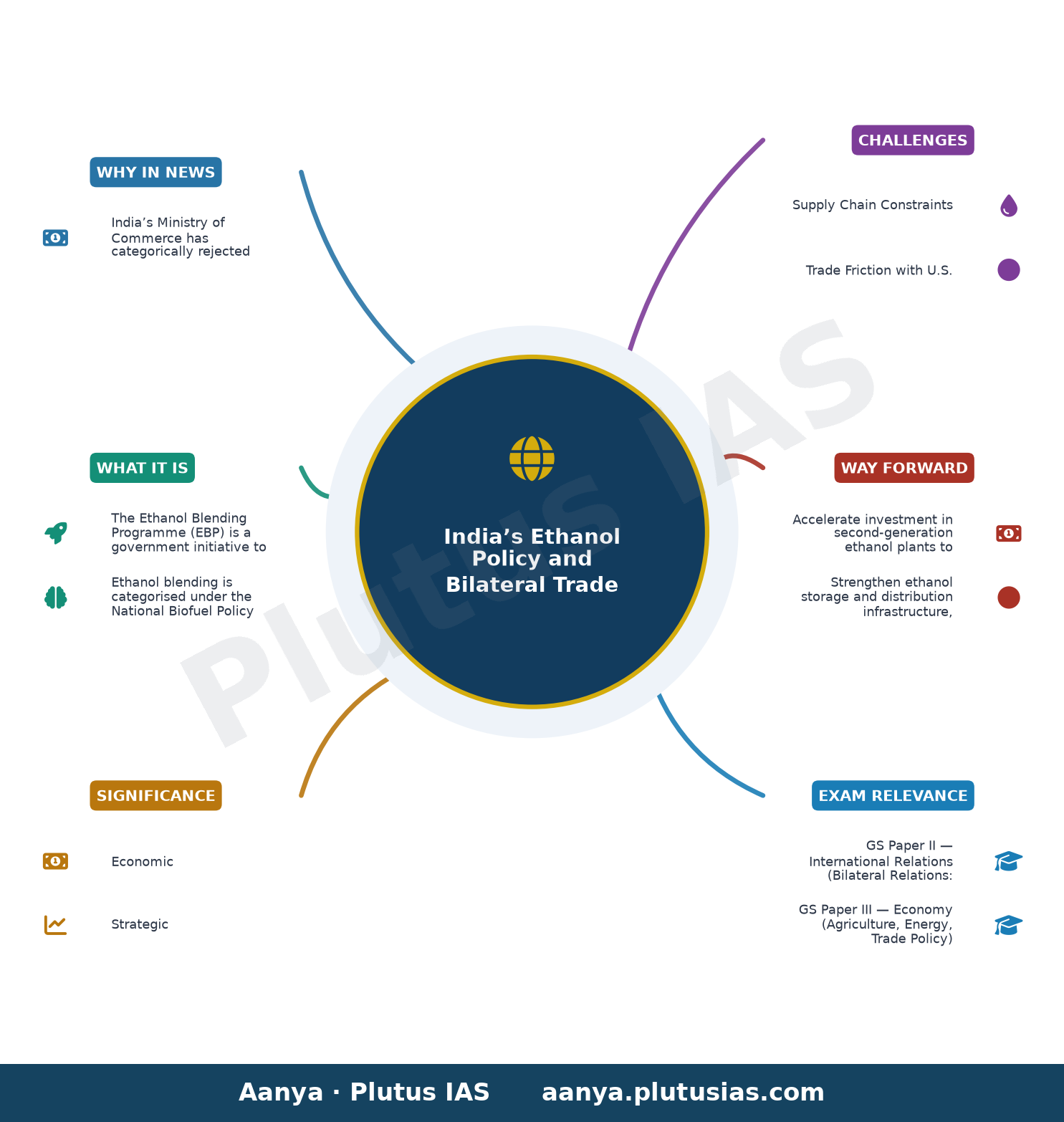
India’s Ministry of Commerce has categorically rejected any concessions on ethanol imports from the United States during ongoing bilateral trade negotiations, affirming that no policy change is envisaged to permit large-scale ethanol imports. This stance underscores India’s strategic prioritisation of domestic ethanol production under the Ethanol Blending Programme (EBP) to meet its energy security and environmental goals, even as trade talks with the US aim to deepen economic engagement.
Background
- India’s Ethanol Blending Programme (EBP), launched in 2013, mandates the blending of ethanol with gasoline to reduce fossil fuel dependence and support farmers by creating a market for surplus sugarcane and agricultural waste.
- Domestic ethanol production has been incentivised through various schemes, including interest subvention for distilleries, viability gap funding, and differential pricing based on feedstock (e.g., sugarcane, maize, rice).
- India’s ethanol production capacity has expanded significantly, reaching approximately 1,000 crore litres in 2025-26, though supply constraints persist due to feedstock availability and seasonal variations.
- The US is the world’s largest ethanol producer and exporter, with a surplus capacity primarily derived from maize, and has sought market access in India as part of trade liberalisation efforts.
- Bilateral trade negotiations between India and the US have intensified in recent years, focusing on reducing tariffs, expanding market access for agricultural and industrial goods, and addressing non-tariff barriers.
What is India’s Ethanol Blending Programme (EBP) and its significance in the context of India-US trade relations?
- The Ethanol Blending Programme (EBP) is a government initiative to blend ethanol with gasoline to reduce crude oil imports, enhance energy security, and mitigate vehicular emissions.
- Ethanol blending is categorised under the National Biofuel Policy 2018, which classifies biofuels into first-generation (1G), second-generation (2G), and third-generation (3G) based on feedstock and technology.
- The EBP operates under the ‘Ethanol Supply Year’ (ESY), which runs from October to September, aligning with the sugarcane crushing season and agricultural cycles.
- Ethanol is procured through a dual pricing mechanism: fixed price for public sector oil marketing companies (OMCs) and market-determined prices for private players, ensuring remunerative prices for farmers and distilleries.
- The programme is implemented by the Ministry of Petroleum and Natural Gas in collaboration with the Ministry of Food Processing Industries, Ministry of Agriculture, and state governments.
- Ethanol blending reduces greenhouse gas emissions by up to 35% compared to gasoline, contributing to India’s climate commitments under the Paris Agreement.
- The EBP has created a secondary market for agricultural commodities, particularly sugarcane, rice, and maize, thereby supporting rural incomes and reducing farm distress.
- India’s refusal to liberalise ethanol imports from the US is rooted in the need to protect domestic ethanol producers, ensure price stability, and maintain control over feedstock supply chains.
Key Features
| Feature | Significance |
|---|---|
| Ethanol Blending Mandate (20%) | India’s legally mandated 20% ethanol-gasoline blend under the Ethanol Blended Petrol (EBP) Programme reduces fossil fuel dependence and supports domestic agricultural surplus, particularly sugarcane and maize. |
| No Import Concessions to U.S. | India’s refusal to liberalise ethanol imports from the U.S. maintains policy autonomy in biofuel regulation, safeguarding domestic ethanol producers and ensuring compliance with the EBP Programme’s local sourcing criteria. |
| Bilateral Trade Negotiations | Ongoing India-U.S. trade talks aim to expand market access and reduce trade barriers, but ethanol remains a non-negotiable sector due to strategic and policy constraints. |
| Domestic Ethanol Production | Government regulations prioritise locally produced ethanol for blending, incentivising sugarcane and grain-based ethanol production under the National Policy on Biofuels (2018). |
| Trade Policy Sovereignty | India’s stance underscores its commitment to self-reliance in biofuels, aligning with the ‘Atmanirbhar Bharat’ initiative while balancing international trade obligations. |
Why it Matters
Economic
- Supports domestic ethanol producers, particularly in sugarcane-growing states like Maharashtra and Uttar Pradesh, by ensuring a guaranteed market under the EBP Programme.
- Reduces India’s crude oil import bill by substituting gasoline with domestically produced ethanol, contributing to energy security.
- Enhances rural incomes through increased demand for agricultural feedstocks, aligning with the government’s focus on doubling farmer incomes.
- Potential to reduce carbon emissions by up to 35% in ethanol-blended fuels compared to pure gasoline, aiding India’s climate commitments.
Strategic
- Demonstrates India’s resolve to protect domestic industries in strategic sectors, such as biofuels, despite pressures in trade negotiations.
- Strengthens India’s position in global biofuel markets by prioritising self-sufficiency over import dependence, particularly vis-à-vis the U.S.
- Aligns with India’s broader energy transition goals, reducing reliance on fossil fuel imports and mitigating geopolitical risks in oil supply chains.
Environmental
- Ethanol blending reduces vehicular emissions of particulate matter and greenhouse gases, contributing to India’s Nationally Determined Contributions (NDCs) under the Paris Agreement.
- Supports circular economy principles by utilising agricultural waste and surplus crops for fuel production, reducing agricultural burning and landfill waste.
Diplomatic
- Reflects India’s pragmatic approach to trade negotiations, balancing economic engagement with the U.S. while safeguarding domestic policy space.
- Signals to other trade partners that India will not compromise on sectors critical to its energy and agricultural policies.
Challenges
1. Supply Chain Constraints
- Inconsistent ethanol supply due to seasonal agricultural cycles and storage challenges, risking compliance with the 20% blending mandate.
- Limited ethanol production capacity in non-sugarcane states, creating regional disparities in ethanol availability.
- Dependence on sugarcane-based ethanol, which competes with food security and water resources in water-stressed regions.
UPSC Link: GS3: Energy Security
2. Trade Friction with U.S.
- Potential for trade disputes under WTO rules if India’s ethanol policies are perceived as discriminatory against U.S. exports.
- Pressure from U.S. ethanol lobby groups to open the Indian market, complicating bilateral trade negotiations.
- Risk of retaliatory measures by the U.S. in other trade sectors if ethanol remains a non-negotiable issue.
UPSC Link: GS2: International Relations
3. Technological and Infrastructure Gaps
- Inadequate ethanol storage and distribution infrastructure, particularly in remote and rural areas.
- Limited adoption of advanced biofuel technologies (e.g., second-generation ethanol from agricultural waste) due to high costs and regulatory hurdles.
- Insufficient blending infrastructure in petrol pumps and refineries, delaying the scale-up of ethanol blending.
UPSC Link: GS3: Science & Technology
4. Policy and Regulatory Challenges
- Need for harmonised regulations across states to ensure uniform ethanol blending standards and avoid market distortions.
- Lack of long-term price signals for ethanol producers, discouraging investment in capacity expansion.
- Overlap and conflicts between central and state policies on ethanol pricing, procurement, and blending mandates.
UPSC Link: GS2: Government Policies
5. Environmental Trade-offs
- Large-scale sugarcane cultivation for ethanol may exacerbate water scarcity and soil degradation in water-stressed regions.
- Increased use of fertilisers and pesticides for sugarcane farming could offset the environmental benefits of ethanol blending.
- Potential for deforestation and land-use change if ethanol production expands into forest or marginal lands.
UPSC Link: GS3: Environment & Ecology
Challenges — UPSC Perspective
| Issue | Concern |
|---|---|
| Seasonal Agricultural Cycles | Inconsistent ethanol supply due to reliance on sugarcane, which has a fixed harvesting period. |
| Regional Disparities in Production | Non-sugarcane states lack ethanol production infrastructure, leading to supply shortages. |
| Food vs. Fuel Debate | Competition between ethanol production and food security, particularly in sugarcane-growing regions. |
| WTO Compliance Risks | Potential discrimination claims if ethanol policies favour domestic producers over imports. |
| Infrastructure Bottlenecks | Inadequate storage, transportation, and blending facilities for ethanol in petrol pumps. |
| High Production Costs | Limited adoption of second-generation ethanol due to high capital and operational costs. |
Way Forward
- Accelerate investment in second-generation ethanol plants to utilise agricultural waste and reduce reliance on sugarcane.
- Strengthen ethanol storage and distribution infrastructure, particularly in non-sugarcane states, to ensure year-round supply.
- Develop a national ethanol pricing policy with long-term price signals to incentivise private sector investment.
- Harmonise state-level ethanol blending mandates and regulations to avoid market distortions and ensure uniformity.
- Promote research and development in biofuel technologies to improve efficiency and reduce production costs.
- Enhance public-private partnerships to scale up ethanol blending infrastructure in petrol pumps and refineries.
- Conduct regular impact assessments of ethanol policies to balance energy security, food security, and environmental goals.
- Engage in diplomatic dialogues with the U.S. to clarify India’s ethanol policy stance and mitigate trade friction.
UPSC Value Addition
Keywords for Mains Answer-Writing
Ethanol blending policy · National Biofuel Policy 2018 · Ethanol Blending Programme (EBP) · Energy security · Renewable energy targets · India-US trade negotiations · Bilateral trade agreements · Sustainable Alternative Towards Affordable Transportation (SATAT) · Ethanol import tariffs · Energy transition in India · Climate change mitigation · Sugar industry and ethanol production · Petroleum and Natural Gas Regulatory Board (PNGRB) · National Policy on Biofuels 2018 · Energy diversification · Trade barriers and concessions
Concept Flow
India’s 20% ethanol-gasoline blending mandate (EBP Programme) → Increased domestic ethanol demand → Expansion of sugarcane and grain-based ethanol production → Reduced fossil fuel imports and carbon emissions. → Bilateral trade negotiations with the U.S. → Pressure to liberalise ethanol imports → India’s refusal to concede → Assertion of policy sovereignty under ‘Atmanirbhar Bharat’. → Domestic ethanol production constraints → Supply chain bottlenecks → Need for infrastructure and technological upgrades → Focus on second-generation ethanol. → Ethanol blending mandate → Environmental benefits (reduced emissions) → Alignment with India’s NDCs under the Paris Agreement. → Trade policy autonomy → Potential WTO disputes → Risk of retaliatory measures → Need for diplomatic engagement and policy clarity. → Ethanol production expansion → Competition with food crops → Food vs. fuel debate → Requires balanced policy interventions. → Infrastructure gaps in ethanol distribution → Delays in achieving blending targets → Urgency for public and private sector investment.
Prelims Practice Questions
Q1. Consider the following statements regarding India’s Ethanol Blending Programme (EBP):
1. The EBP mandates a 20% ethanol blend in gasoline by 2026.
2. The programme is implemented under the National Policy on Biofuels 2018.
3. Ethanol for blending is sourced exclusively from sugarcane molasses.
4. The programme aims to reduce import dependence on crude oil and promote renewable energy.
How many of the above statements are correct?
- Only one
- Only two
- Only three
- All four
Answer: All four — Statements 1, 2, and 4 are correct. Statement 3 is incorrect because ethanol for blending can also be sourced from other feedstocks such as rice, maize, and agricultural residues, in addition to sugarcane molasses.
Q2. Assertion (A): India’s refusal to offer ethanol import concessions to the U.S. aligns with its goal of promoting domestic ethanol production under the EBP.
Reason (R): The EBP prioritises the use of domestically produced ethanol to reduce import dependence and support the sugar industry.
Options:
A. Both A and R are true, and R is the correct explanation of A.
B. Both A and R are true, but R is not the correct explanation of A.
C. A is true, but R is false.
D. A is false, but R is true.
Answer: ? — Both Assertion (A) and Reason (R) are true, and Reason (R) correctly explains Assertion (A). India’s EBP prioritises domestic ethanol production to meet blending targets, thereby reducing the need for imports.
Q3. Match the following columns related to India’s energy policies:
Column I (Policy/Scheme) | Column II (Objective)
————————–|———————–
A. National Policy on Biofuels 2018 | 1. Mandate 20% ethanol blending in gasoline by 2026
B. Ethanol Blending Programme (EBP) | 2. Promote compressed biogas as an alternative fuel
C. SATAT Scheme | 3. Provide a comprehensive framework for biofuel development
D. National Biofuel Coordination Committee | 4. Coordinate and monitor biofuel policies across ministries
Options:
A. A-3, B-1, C-2, D-4
B. A-1, B-3, C-2, D-4
C. A-3, B-2, C-1, D-4
D. A-4, B-1, C-2, D-3
Answer: ? — The correct match is: A-3 (National Policy on Biofuels 2018 provides a comprehensive framework), B-1 (EBP mandates 20% ethanol blending), C-2 (SATAT promotes compressed biogas), and D-4 (National Biofuel Coordination Committee coordinates policies).
Mains Practice Question
✍ India’s refusal to offer ethanol import concessions to the U.S. during bilateral trade talks reflects a broader strategic approach to energy security and domestic industrial policy. Critically examine the rationale behind this stance, with reference to the Ethanol Blending Programme (EBP) and the National Policy on Biofuels 2018. (15 Marks)
Approach: MODEL-ANSWER SKELETON:
1. **Introduction**: Briefly define the Ethanol Blending Programme (EBP) and its targets (20% ethanol blending by 2026) under the National Policy on Biofuels 2018.
2. **Strategic Rationale for Domestic Ethanol Production**:
– Energy security: Reduce import dependence on crude oil and mitigate geopolitical risks.
– Agricultural support: Utilise surplus sugarcane and agricultural residues to benefit farmers and the sugar industry.
– Climate change mitigation: Lower carbon emissions by promoting renewable energy sources.
3. **Economic and Industrial Policy Considerations**:
– Protection of domestic ethanol producers: Avoid competition from cheaper imports that could disrupt local industries.
– Job creation: Support employment in rural areas through ethanol production and blending infrastructure.
– Fiscal incentives: Tax benefits and subsidies under the EBP to incentivise domestic production.
4. **Trade Policy and Bilateral Relations**:
– Non-discriminatory trade practices: India’s stance aligns with WTO principles of non-preferential treatment.
– Long-term energy transition goals: Prioritise domestic capabilities to build a resilient energy sector.
5. **Counter-Arguments and Challenges**:
– Supply constraints: Domestic ethanol production may not meet demand, necessitating imports in the short term.
– Technological and infrastructural gaps: Limited ethanol storage and distribution infrastructure in some regions.
6. **Conclusion**: Weigh the strategic benefits of domestic ethanol production against the potential short-term economic advantages of imports. Emphasise the need for a balanced approach to achieve energy security and sustainable development.
Source: Mint
Generated by AanyaAi for educational purpose.

- महिलाओं के पास डिग्रियाँ, गोल्ड मेडल, फिर भी नौकरी में क्यों नहीं? राष्ट्रपति मुर्मू का सवाल - September 23, 2026
- President Murmu Highlights Women’s Workforce Gap Despite Academic Success - September 23, 2026
- ओडिशा में विवाह रिकॉर्ड में हेराफेरी: निर्माण श्रमिक कल्याण योजना का दुरुपयोग - September 23, 2026

No Comments