


23 Sep President Murmu Highlights Women’s Workforce Gap Despite Academic Success
✎ The disparity between women’s educational attainment and workforce participation in India is a structural governance challenge requiring multi-dimensional policy interventions, including flexible labour markets, affordable…
Subject Relevance — Where This Topic Fits
- GS Paper I — Role of Women and Women’s Organizations | GS Paper III — Issues Relating to Employment and Human Resource Development | GS Paper IV — Ethics and Human Interface: Gender and Inclusion
- Prelims: Female Labour Force Participation (FLFP), Gender Gap Index, National Education Policy 2020, Skill India Mission, Maternity Benefit (Amendment) Act 2017, Periodic Labour Force Survey (PLFS), Gender Budgeting, Women’s Reservation Bill, Mahatma Gandhi National Rural Employment Guarantee Scheme (MGNREGS) for women
- Essay: The paradox of educated women and declining workforce participation: A structural analysis, Women’s empowerment through education and economic participation: Bridging the divide
Quick Revision: The disparity between women’s educational attainment and workforce participation in India is a structural governance challenge requiring multi-dimensional policy interventions, including flexible labour markets, affordable childcare, and gender-sensitive institutional reforms.
Why is this in the news?
President Droupadi Murmu’s address at the 75th convocation of Maharaja Sayajirao University of Baroda highlighted the persistent disparity between women’s academic achievements and their participation in the formal workforce. Her remarks underscore a critical governance challenge: despite significant strides in higher education, structural barriers continue to impede women’s economic engagement, necessitating a re-evaluation of policy frameworks and societal norms to align educational progress with economic inclusion.
Background
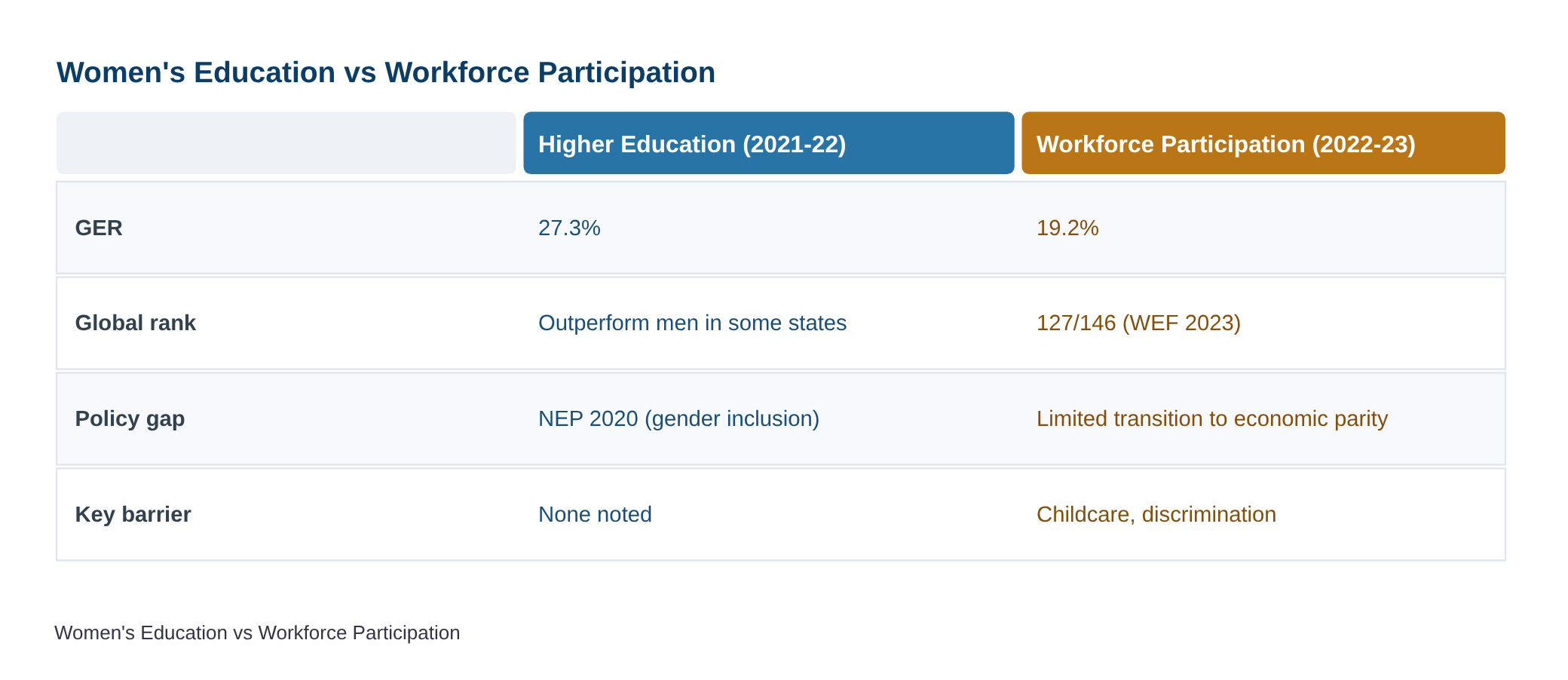
- The Gross Enrolment Ratio (GER) for women in higher education has risen from 20.8% in 2014-15 to 27.3% in 2021-22, with women outnumbering men in enrolment in several states and disciplines, as reflected in the All India Survey on Higher Education (AISHE) 2021-22.
- India’s Female Labour Force Participation (FLFP) rate remains among the lowest globally, at approximately 19.2% in 2022-23, as per the Periodic Labour Force Survey (PLFS), despite women constituting nearly half of the population.
- The World Economic Forum’s Global Gender Gap Report 2023 ranks India 127th out of 146 countries in economic participation and opportunity, indicating systemic barriers to women’s economic engagement.
- Government initiatives such as the Ujjwala Yojana, Stand-Up India, and the Pradhan Mantri Matru Vandana Yojana (PMMVY) aim to address gender disparities but face implementation challenges in rural and semi-urban areas.
- The National Education Policy (NEP) 2020 emphasizes gender inclusion in education but lacks explicit mechanisms to transition educational parity into economic parity.
- Cultural norms, lack of affordable childcare, occupational segregation, and workplace discrimination contribute to the persistent gender gap in workforce participation.
Understanding the Disparity Between Women’s Education and Workforce Participation
- **Educational Attainment vs. Economic Participation**: While women’s enrolment in higher education has surged, their representation in the formal workforce remains disproportionately low, indicating a structural misalignment between educational systems and labour market demands.
- **Cultural and Social Norms**: Traditional gender roles often prioritise domestic responsibilities over professional careers, particularly in child-rearing and household management, which disproportionately affects women’s workforce participation.
- **Structural Barriers in the Labour Market**: Occupational segregation, wage gaps, and lack of flexible work arrangements (e.g., remote work, part-time roles) deter women from entering or remaining in the workforce, despite their qualifications.
- **Economic Costs of Low FLFP**: The International Monetary Fund (IMF) estimates that India’s GDP could grow by up to 27% if women’s workforce participation were to reach global averages, highlighting the macroeconomic imperative of addressing this disparity.
- **Role of Higher Education Institutions**: Universities and colleges must integrate career counselling, skill development, and mentorship programmes tailored to women, particularly in STEM fields, to bridge the transition from academia to employment.
- **Need for Intersectional Approaches**: Policies must account for intersecting identities (e.g., caste, class, region) that compound barriers to women’s economic participation, ensuring inclusivity in both design and implementation.
- **Corporate and Institutional Responsibility**: Private sector entities must adopt gender-inclusive hiring practices, provide safe and supportive work environments, and implement policies such as paternity leave to challenge entrenched gender norms.
Key Features
| Feature | Significance |
|---|---|
| Rising female enrolment in higher education | Demonstrates India’s progress toward gender-inclusive education, as women now outnumber men in degree and gold medal awards across most faculties. |
| Disparity between academic achievement and workforce participation | Highlights a structural gap where women’s educational success does not translate into proportional economic engagement, despite constitutional and policy commitments to gender equality. |
| Recognition of unpaid care work in nation-building | Elevates the socio-economic value of domestic roles, particularly child-rearing and education, as contributions to national development. |
| Sectoral variations in female workforce participation | Shows that while women dominate in fields like Medicine and Science, their representation declines in Engineering, Technology, and Sanskrit studies. |
| Presidential address as a policy signal | Reflects the Head of State’s emphasis on gender equity in education and employment, reinforcing the need for systemic reforms in labour market structures. |
Why it Matters
Economic
- India’s demographic dividend is underutilised due to low female labour force participation (FLFP), which currently stands at approximately 18.6% (Periodic Labour Force Survey 2022-23), far below the global average of 47.3% (World Bank 2023).
- The International Monetary Fund estimates that increasing women’s workforce participation to global averages could boost India’s GDP by up to 27%.
- Women’s economic disengagement results in foregone tax revenues, reduced household incomes, and suboptimal utilisation of human capital in high-growth sectors.
Social
- The President’s remarks underscore the need to redefine ‘work’ beyond formal employment, recognising unpaid domestic labour as a critical component of national productivity.
- Cultural norms and societal expectations often discourage women from pursuing careers post-marriage or childbirth, perpetuating intergenerational cycles of economic dependency.
- The gendered division of labour in child-rearing and household management disproportionately impacts women’s career trajectories, limiting upward mobility in professions.
Policy and Governance
- The address aligns with India’s commitments under the Sustainable Development Goals (SDG 5: Gender Equality) and the National Education Policy 2020, which emphasises equitable access to education and employment.
- It highlights the role of state institutions (e.g., universities, government agencies) in addressing systemic barriers to women’s economic participation through targeted interventions.
- The observation serves as a reminder of the need for gender-responsive budgeting and labour market policies to bridge the chasm between education and employment.
Demographic
- India’s young female population (15-29 years) constitutes over 16% of the global youth demographic, making their economic integration pivotal for long-term growth.
- Delayed workforce entry due to educational pursuits or domestic responsibilities exacerbates the ‘missing middle’ phenomenon in India’s labour market.
Challenges
1. Structural Barriers to Female Workforce Participation
- Socio-cultural norms prioritise domestic roles over professional careers, particularly in rural and semi-urban regions.
- Lack of affordable childcare facilities and maternity support policies discourages women from re-entering the workforce post-childbirth.
- Workplace discrimination, gender pay gaps, and limited access to leadership roles persist despite educational parity.
- Inadequate infrastructure for safe and accessible transportation to workplaces in many urban and peri-urban areas.
UPSC Link: GS1/GS3: Social empowerment, women and development
2. Mismatch Between Education and Employment
- Over-representation of women in certain fields (e.g., Arts, Humanities) with limited alignment to high-demand sectors (e.g., STEM, AI, renewable energy).
- Lack of industry-academia collaboration to align curricula with evolving labour market needs, particularly for women.
- Perceived or actual skill gaps due to career breaks, limiting women’s competitiveness in competitive job markets.
UPSC Link: GS3: Education and skill development
3. Underutilisation of Human Capital
- Brain drain of highly educated women who migrate abroad for better opportunities due to limited domestic career prospects.
- Wastage of public investment in higher education where graduates do not contribute to the economy.
- Regional disparities in FLFP, with states like Bihar (4.4%) and Rajasthan (25.6%) lagging behind Kerala (32.2%) (PLFS 2022-23).
UPSC Link: GS3: Economic development, human resource utilisation
4. Policy Implementation Gaps
- Despite schemes like the Maternity Benefit (Amendment) Act 2017, compliance remains low, with only 12% of eligible establishments providing crèche facilities (Ministry of Women and Child Development, 2023).
- Lack of enforcement mechanisms for gender-sensitive workplace policies, including the Sexual Harassment of Women at Workplace (Prevention, Prohibition and Redressal) Act 2013.
- Insufficient data disaggregation to identify and address barriers faced by women from marginalised communities (e.g., SC/ST, disabled women).
UPSC Link: GS2: Governance, policies and schemes for women
Challenges — UPSC Perspective
| Issue | Concern |
|---|---|
| Cultural attitudes towards women’s roles | Normalisation of domestic responsibilities as primary duties, limiting professional aspirations. |
| Inadequate childcare infrastructure | Absence of affordable, accessible, and quality childcare facilities near workplaces and educational institutions. |
| Workplace discrimination and harassment | Systemic biases in hiring, promotion, and remuneration, alongside inadequate redressal mechanisms. |
| Skill mismatch and career breaks | Educational qualifications not aligned with labour market demands, compounded by career interruptions. |
| Regional disparities in FLFP | Variations in economic opportunities, infrastructure, and policy enforcement across states and districts. |
| Policy compliance and enforcement | Low adherence to statutory provisions (e.g., maternity benefits, crèche facilities) due to weak monitoring. |
Government Initiatives — Must-Memorise for Prelims
- Mahila Shakti Kendra (MSK) Scheme
- Pradhan Mantri Matru Vandana Yojana (PMMVY)
- Stand-Up India Scheme
Way Forward
- Strengthen enforcement of the Maternity Benefit (Amendment) Act 2017, including mandatory crèche facilities and extended paid maternity leave (26 weeks).
- Expand public and private sector investments in affordable, high-quality childcare infrastructure, particularly in industrial and commercial hubs.
- Promote STEM and technical education for women through targeted scholarships, mentorship programs, and industry partnerships.
- Implement gender-responsive budgeting to allocate resources for skill development, entrepreneurship, and workplace reforms.
- Enhance data collection and analysis on women’s workforce participation, disaggregated by region, caste, disability, and sector, to inform targeted interventions.
- Encourage corporate entities to adopt gender-inclusive hiring, promotion, and retention policies, with incentives for compliance.
- Leverage digital platforms to provide flexible, remote, and gig-based employment opportunities for women, especially in rural areas.
- Conduct periodic audits of educational institutions to identify and address gender biases in curriculum, faculty representation, and career counselling.
UPSC Value Addition
Keywords for Mains Answer-Writing
Women workforce participation · Gender gap in employment · Human capital formation · Inclusive development · Formal employment metrics · Informal economy contributions · Demographic dividend · Skill utilisation · Educational attainment · Socio-cultural determinants of labour force participation · National development strategies · Economic empowerment of women · Workforce feminisation · Structural barriers to employment · Human Development Index (HDI) and gender parity
Constitutional & Policy Linkages
- Article 14: Right to Equality
- Article 15(3): Special provisions for women
- Article 16: Equality of opportunity in public employment
- Article 21: Right to Life and Personal Liberty (includes dignity and livelihood)
- Article 39(d): Equal pay for equal work
Concept Flow
Rising female enrolment in higher education → Increased academic achievements (degrees, gold medals) → Recognition of women’s intellectual potential → → Structural barriers in labour market (cultural norms, childcare gaps, discrimination) → Disproportionate workforce dropout rates → → Underutilisation of human capital → Foregone economic growth and tax revenues → → Policy responses (e.g., maternity benefits, skill programs) → Partial mitigation of barriers → → Need for systemic reforms (workplace policies, infrastructure, education alignment) → Sustainable integration of women into workforce → → Enhanced economic productivity and gender equity → Alignment with SDGs and constitutional commitments.
Prelims Practice Questions
Q1. Consider the following statements regarding women’s workforce participation in India:
1. India’s female labour force participation rate (FLFPR) is significantly lower than the global average.
2. The Periodic Labour Force Survey (PLFS) 2022-23 reports that the FLFPR for women aged 15-59 is below 20%.
3. States with higher female literacy rates consistently exhibit higher FLFPR.
How many of the above statements are correct?
- Only one
- Only two
- All three
- None
Answer: Only two — Statement 1 is correct: India’s FLFPR is among the lowest globally. Statement 2 is incorrect: PLFS 2022-23 reports FLFPR for women aged 15-59 at 22.3%. Statement 3 is incorrect: Higher literacy does not always correlate with higher FLFPR due to socio-cultural factors.
Q2. Assertion (A): The President of India, in her address at the 75th convocation of Maharaja Sayajirao University of Baroda, highlighted the paradox of high academic achievement among women but low workforce participation.
Reason (R): The PLFS 2022-23 indicates that while women constitute a majority of graduates and gold medallists in many institutions, their representation in formal employment remains disproportionately low.
Options:
A. Both A and R are true, and R is the correct explanation of A.
B. Both A and R are true, but R is NOT the correct explanation of A.
C. A is true, but R is false.
D. A is false, but R is true.
Answer: ? — Both A and R are true. However, the President’s remarks are a normative observation on socio-cultural factors, while R provides empirical data supporting the assertion. Hence, R is not the sole explanation of A.
Q3. Match the following pairs related to women’s workforce participation in India:
Column I (Indicator) | Column II (Value/Description)
———————————————–|———————————–
1. Female Labour Force Participation Rate | A. 22.3% (PLFS 2022-23, 15-59 years)
2. Share of women in total employment | B. 18.6% (Economic Survey 2023-24)
3. Percentage of women in senior management | C. 15.1% (World Bank 2023)
4. Gender Gap Index (WEF 2023) | D. 3.5% (LinkedIn Opportunity Index 2023)
Options:
A. 1-A, 2-B, 3-D, 4-C
B. 1-B, 2-A, 3-C, 4-D
C. 1-C, 2-D, 3-A, 4-B
D. 1-A, 2-C, 3-B, 4-D
Answer: ? — Correct matching: 1-A (PLFS 2022-23), 2-B (Economic Survey), 3-D (LinkedIn), 4-C (WEF). The Gender Gap Index measures economic participation and opportunity, where India ranks 127/146 (2023).
Mains Practice Question
✍ The observation that ‘women have degrees, gold medals, but are not in the workforce’ reflects a structural paradox in India’s development trajectory. Critically analyse the socio-economic, institutional, and cultural factors that contribute to this phenomenon. Also, evaluate the role of public policy in addressing this challenge, with reference to constitutional provisions and recent legislative measures. (15 Marks)
Approach: MODEL-ANSWER SKELETON:
1. **Introduction (2 marks)**: Define the paradox—high educational attainment vs. low workforce participation among women. Cite PLFS 2022-23 data (FLFPR: 22.3% for women aged 15-59) and global comparisons (WEF Gender Gap Index 2023: India ranked 127/146).
2. **Structural Factors (5 marks)**:
– **Socio-cultural barriers**: Patriarchal norms, domestic responsibilities, and societal expectations (e.g., ‘care work’ as women’s primary role). Reference to UN Women reports and NSSO surveys.
– **Educational mismatch**: Over-representation in certain fields (e.g., arts, humanities) vs. under-representation in STEM and technical disciplines, despite gold medals.
– **Institutional barriers**: Workplace discrimination, lack of safe transport, absence of childcare facilities, and gender pay gaps.
– **Economic structure**: Informal economy dominance, where women’s contributions are often unrecorded (e.g., agricultural labour, unpaid care work).
3. **Policy Framework (5 marks)**:
– **Constitutional provisions**: Article 15(3) (special provisions for women), Article 39(d) (equal pay for equal work), Article 42 (just and humane conditions of work), and Article 51A(e) (duty to renounce practices derogatory to women).
– **Legislative measures**:
– Maternity Benefit (Amendment) Act, 2017 (extended paid maternity leave to 26 weeks).
– Code on Wages, 2019 (prohibits gender-based wage discrimination).
– Sexual Harassment of Women at Workplace (Prevention, Prohibition and Redressal) Act, 2013.
– Mahatma Gandhi National Rural Employment Guarantee Scheme (MGNREGS) and Poshan Tracker (addressing nutrition and care work).
– **Schemes**: Beti Bachao Beti Padhao, Ujjwala Yojana (reducing household burdens), and Stand-Up India (financial inclusion).
4. **Critique and Way Forward (3 marks)**:
– **Gaps in implementation**: Low awareness, weak enforcement, and lack of convergence between schemes.
– **Need for systemic reforms**: Universal childcare policies, flexible work arrangements, and STEM-focused education incentives.
– **Role of technology**: Digital platforms for upskilling (e.g., Swayam, Kaushal Bharat) and remote work opportunities.
5. **Conclusion**: Emphasise that addressing this paradox requires a multi-dimensional approach—combining legal reforms, cultural change, and economic incentives—to harness India’s demographic dividend.
Source: The Indian Express
Generated by AanyaAi for educational purpose.
Related guides on our sites
- Current affairs for upsc 2026
- Best sociology optional coaching for upsc
- Which is best sociology optional coaching for upsc
- Best teacher of sociology optional for upsc

- महिलाओं के पास डिग्रियाँ, गोल्ड मेडल, फिर भी नौकरी में क्यों नहीं? राष्ट्रपति मुर्मू का सवाल - September 23, 2026
- President Murmu Highlights Women’s Workforce Gap Despite Academic Success - September 23, 2026
- ओडिशा में विवाह रिकॉर्ड में हेराफेरी: निर्माण श्रमिक कल्याण योजना का दुरुपयोग - September 23, 2026

No Comments