


17 Jul India Strengthens Anti-Doping Framework with New Acts: UPSC Polity
Subject Relevance — Where This Topic Fits
- GS Paper II — Governance, Social Justice (Sports Policy, Rights of Athletes) | GS Paper III — Science and Technology (Biotechnology and its applications in sports)
- Prelims: National Anti-Doping Act, 2022, National Anti-Doping (Amendment) Act, 2025, WADA Code, UNESCO International Convention against Doping in Sport, NADA, Anti-Doping Rule Violations, Clean Sport, Athletes’ Rights
- Essay: The pursuit of excellence: Balancing ambition with ethics in sports., Legislation as a tool for social change: The case of clean sports.
Quick Revision: India’s National Anti-Doping Act, 2022, and its 2025 amendment provide a robust statutory framework, aligning with international standards to ensure clean sports, protect athletes’ rights, and enhance the nation’s credibility in the global sporting arena.
Why is this in the news?
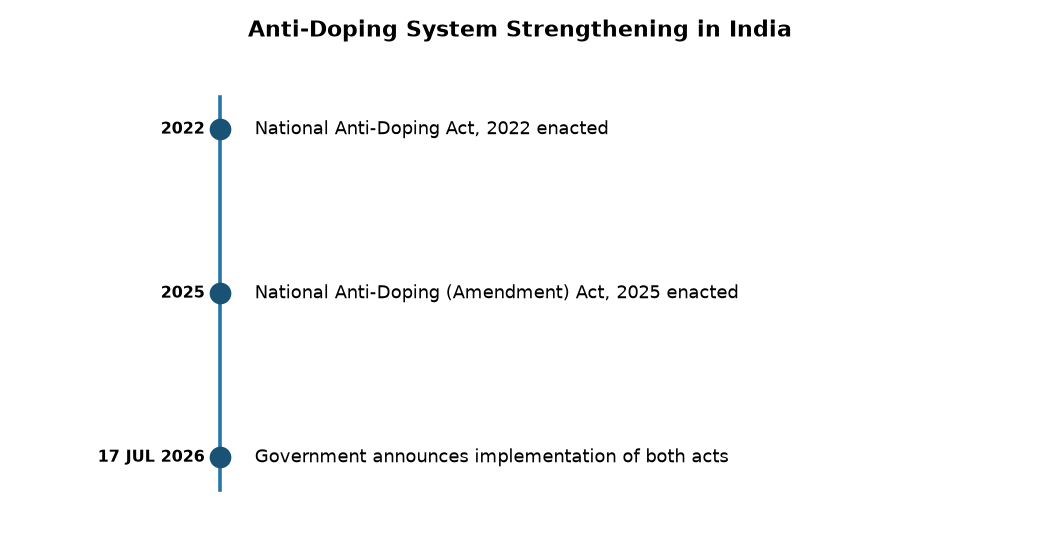
The Government of India has announced the implementation of the National Anti-Doping Act, 2022, and the National Anti-Doping (Amendment) Act, 2025. This significant legislative measure aims to fortify India’s legal and institutional framework for clean sports, ensuring athlete protection and aligning the national anti-doping ecosystem with international standards, thereby upholding the integrity and fairness of sporting competitions.
Background
- Doping, the use of performance-enhancing drugs, has been a persistent challenge in sports globally, undermining fair play and athlete health.
- India, as a significant sporting nation, has faced its share of doping incidents, necessitating a robust domestic anti-doping mechanism.
- The World Anti-Doping Agency (WADA) was established in 1999 to promote, coordinate, and monitor the fight against doping in sport internationally.
- The UNESCO International Convention against Doping in Sport, adopted in 2005, provides a global legal framework for governments to combat doping.
- Prior to the 2022 Act, India’s anti-doping efforts were primarily guided by administrative directives and the National Anti-Doping Agency (NADA) rules, which lacked statutory backing.
- The need for a comprehensive legal framework was underscored by the increasing complexity of doping practices and the imperative to protect athletes’ rights and ensure due process.
What is the National Anti-Doping Act, 2022, and the Amendment Act, 2025?
- The National Anti-Doping Act, 2022, is India’s first comprehensive statutory framework dedicated to prohibiting doping in sports.
- It provides a legal basis for anti-doping activities, including testing, results management, investigations, and sanctions.
- The Act establishes the National Anti-Doping Agency (NADA) as a statutory body, granting it enhanced powers and institutional independence.
- It also creates the National Board for Anti-Doping in Sports to oversee NADA’s functions and advise the government on anti-doping policy.
- The Act defines ‘anti-doping rule violations’ (ADRVs) and specifies penalties for such violations, including disqualification, forfeiture of medals, and financial sanctions.
- It ensures procedural safeguards for athletes, including the right to a fair hearing and appeal mechanisms.
- The National Anti-Doping (Amendment) Act, 2025, further strengthens the governance framework by enhancing institutional autonomy and aligning India’s anti-doping practices with evolving international best practices.
- These laws collectively aim to foster a transparent, fair, and athlete-centric anti-doping ecosystem in India, consistent with the World Anti-Doping Code and UNESCO Convention.
Key Features
| Feature | Significance |
|---|---|
| Statutory Backing for NADA | Transforms NADA into a legally empowered body, enhancing its authority and operational independence in conducting anti-doping activities. |
| Comprehensive Legal Framework | Provides a robust legal basis for all anti-doping measures, from testing and investigations to results management and sanctions, ensuring consistency and enforceability. |
| Alignment with International Standards | Ensures compliance with the World Anti-Doping Code and the UNESCO International Convention, facilitating international cooperation and recognition of India’s anti-doping program. |
| Protection of Athletes’ Rights | Incorporates provisions for fair hearings, appeal mechanisms, and due process, safeguarding the fundamental rights of athletes accused of doping violations. |
| Enhanced Institutional Autonomy (2025 Amendment) | Further strengthens the independence of anti-doping bodies, reducing potential governmental or sporting federation interference and bolstering credibility. |
| Streamlined Dispute Resolution | Establishes clear pathways for resolving anti-doping disputes, ensuring timely and equitable adjudication. |
Why it Matters
For Athletes and Sports Integrity
- Ensures a level playing field for all competitors, promoting fair play and the true spirit of sportsmanship.
- Protects the health and well-being of athletes by deterring the use of harmful performance-enhancing substances.
- Safeguards the careers and reputations of clean athletes by providing a robust system to identify and sanction those who cheat.
- Fosters trust in sporting results, enhancing the credibility of Indian athletes and sporting events on both national and international stages.
For India’s Global Standing
- Elevates India’s commitment to clean sports, aligning its domestic framework with global best practices and international obligations.
- Strengthens India’s position in international sports governance and diplomacy, potentially leading to greater influence in global anti-doping policy-making.
- Enhances the prospects of Indian athletes competing internationally without suspicion, bolstering national pride and sporting achievements.
- Fulfills India’s responsibilities under the UNESCO International Convention against Doping in Sport, demonstrating adherence to international norms.
For Governance and Rule of Law
- Provides a clear legal mandate for anti-doping activities, replacing administrative guidelines with statutory provisions, thereby enhancing accountability and transparency.
- Strengthens institutional independence of anti-doping bodies, crucial for impartial decision-making and effective enforcement.
- Establishes a robust legal framework that can adapt to evolving doping challenges and scientific advancements.
- Promotes a culture of ethics and integrity within the broader sports ecosystem, extending beyond just athletes to support personnel and federations.
Challenges
1. Resource Allocation and Infrastructure
- Ensuring adequate funding for NADA to conduct extensive testing, research, and educational programs across all sports and regions.
- Developing state-of-the-art testing laboratories and forensic capabilities to detect new and complex doping substances and methods.
UPSC Link: GS Paper III — Science and Technology, Infrastructure
2. Awareness and Education
- Educating athletes, coaches, support staff, and sports federations about anti-doping rules, prohibited substances, and the consequences of doping.
- Reaching athletes in remote areas and across diverse linguistic backgrounds with effective educational campaigns.
UPSC Link: GS Paper II — Social Justice, Governance
3. Evolving Doping Methods
- Staying ahead of constantly evolving doping techniques, including gene doping and designer drugs, which pose significant detection challenges.
- Investing in continuous research and development to improve detection methods and analytical capabilities.
UPSC Link: GS Paper III — Science and Technology
4. Institutional Independence and Governance
- Maintaining the true autonomy of NADA and the National Board for Anti-Doping in Sports, free from undue influence from sports federations or government bodies.
- Ensuring transparency and accountability in decision-making processes, particularly in results management and sanctioning.
UPSC Link: GS Paper II — Governance
5. Harmonisation with Global Standards
- Continuously adapting national legislation and practices to remain fully compliant with updates to the World Anti-Doping Code and international best practices.
- Navigating potential conflicts between national legal frameworks and international sporting regulations.
UPSC Link: GS Paper II — International Relations, Governance
Challenges — UPSC Perspective
| Issue | Concern |
|---|---|
| Funding for NADA | Sustained financial support required for extensive testing, research, and educational outreach. |
| Technological Advancements in Doping | Difficulty in detecting new and sophisticated performance-enhancing substances and methods. |
| Awareness Gap | Lack of comprehensive understanding of anti-doping rules among athletes and support personnel, especially at grassroots levels. |
| Maintaining Autonomy | Risk of external influence on NADA’s operations, compromising impartiality and effectiveness. |
| Legal Complexities | Challenges in navigating legal appeals and ensuring consistent application of sanctions across different sports. |
| International Compliance | Ensuring continuous alignment with evolving WADA Code and international anti-doping best practices. |
Government Initiatives — Must-Memorise for Prelims
- Khelo India Programme
- Target Olympic Podium Scheme (TOPS)
- National Sports Development Fund (NSDF)
- Assistance to National Sports Federations (NSFs)
- Scheme of Sports and Games for Persons with Disabilities
- Promotion of Sports amongst Women
- National Centre of Sports Sciences & Research (NCSSR)
- Fit India Movement
- National Youth Policy
- National Sports Policy
Way Forward
- Allocate dedicated and enhanced budgetary resources to NADA for infrastructure development, advanced testing technologies, and robust educational programmes.
- Launch widespread, multi-lingual awareness campaigns targeting athletes from grassroots to elite levels, coaches, and support staff on anti-doping regulations and ethical sportsmanship.
- Invest significantly in scientific research and development to anticipate and counter emerging doping methods, including gene doping and biological passport advancements.
- Strengthen international collaborations with WADA, UNESCO, and other national anti-doping organisations for knowledge sharing, capacity building, and harmonisation of practices.
- Ensure complete operational independence for NADA and the National Board for Anti-Doping in Sports, insulating them from any form of external pressure or interference.
- Establish a fast-track, specialised judicial mechanism for anti-doping cases to ensure timely and fair resolution of disputes.
- Integrate anti-doping education into sports curricula at all levels, from school sports to professional training academies.
- Implement robust whistleblower protection mechanisms to encourage reporting of doping violations without fear of reprisal.
UPSC Value Addition
Keywords for Mains Answer-Writing
Clean Sports · Anti-Doping Framework · Athlete Protection · Sports Integrity · WADA Code Compliance · UNESCO Convention · Institutional Autonomy · Procedural Safeguards · Fair Play · Ethical Governance · Level Playing Field · International Best Practices
Constitutional & Policy Linkages
- Article 21: Right to Life and Personal Liberty (implications for athlete’s health and career)
- Article 14: Equality before Law (ensuring fair treatment in anti-doping proceedings)
- Seventh Schedule: Union List (Entry 97 – Residuary powers, if specific sports legislation not covered elsewhere)
- UNESCO International Convention against Doping in Sport, 2005 (International Treaty)
- National Sports Policy (Government Policy Document)
Concept Flow
Prevalence of Doping in Sports → Need for Robust Anti-Doping Measures → Enactment of National Anti-Doping Act, 2022 → Strengthening via Amendment Act, 2025 → Alignment with WADA Code & UNESCO Convention → Enhanced Athlete Protection & Sports Integrity → Improved Global Standing for Indian Sports
Prelims Practice Questions
Q1. Consider the following statements regarding India’s anti-doping framework:
1. The National Anti-Doping Act, 2022, provides statutory backing to the National Anti-Doping Agency (NADA).
2. India is a signatory to the UNESCO International Convention against Doping in Sport.
3. The National Anti-Doping (Amendment) Act, 2025, aims to enhance institutional autonomy within the anti-doping structure.
Which of the statements given above are correct?
- A. 1 and 2 only
- B. 2 and 3 only
- C. 1 and 3 only
- D. 1, 2 and 3
Answer: D. 1, 2 and 3 — Statement 1 is correct as the Act provides statutory backing to NADA. Statement 2 is correct as India fulfills its responsibilities under the UNESCO Convention. Statement 3 is correct as the 2025 amendment specifically aims to strengthen institutional autonomy and align with international best practices. Therefore, all statements are correct.
Q2. Which of the following bodies is responsible for promoting, coordinating, and monitoring the fight against doping in sport internationally?
- A. International Olympic Committee (IOC)
- B. United Nations Sports Office (UNSO)
- C. World Anti-Doping Agency (WADA)
- D. Association of National Olympic Committees (ANOC)
Answer: C. World Anti-Doping Agency (WADA) — The World Anti-Doping Agency (WADA) was established in 1999 as an independent international agency to lead a collaborative worldwide movement for doping-free sport. The IOC is the supreme authority of the Olympic Movement, UNSO is not a primary anti-doping body, and ANOC represents National Olympic Committees.
Mains Practice Question
✍ The recent implementation of the National Anti-Doping Act, 2022, and its 2025 amendment marks a significant stride in strengthening India’s commitment to clean sports. Critically analyse the key features and implications of this legislative framework, highlighting both its potential benefits for athletes and the challenges that remain in achieving a truly doping-free sporting ecosystem in India. (250 words)
Approach: Begin by briefly introducing the Acts and their purpose. In the first part, discuss the key features like statutory backing for NADA, alignment with international standards, and enhanced athlete protection. In the second part, elaborate on the implications, focusing on benefits such as a level playing field, improved global standing, and strengthened governance. Conclude by identifying persistent challenges like resource allocation, evolving doping methods, awareness gaps, and ensuring institutional autonomy, offering a balanced perspective on the path ahead for India’s anti-doping efforts.
Source: PIB (Press Information Bureau)
Generated by AanyaAi for educational purpose.


No Comments