


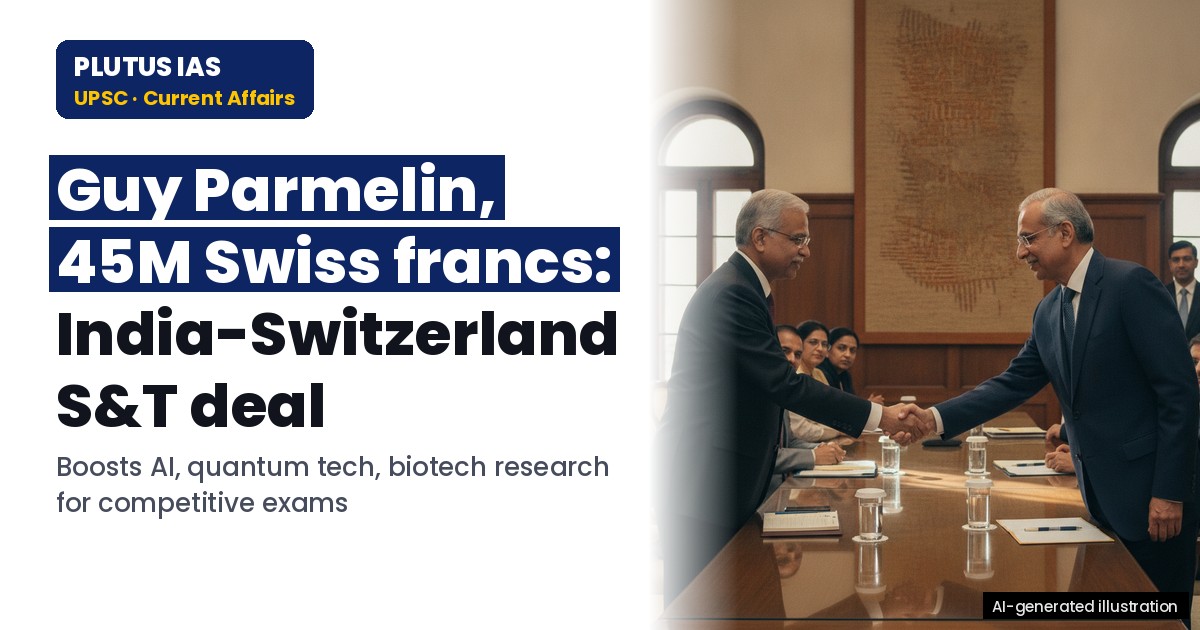
06 Oct India-Switzerland Strengthen Strategic S&T Partnership: Key for UPSC & PCS
✎ The India-Switzerland Strategic Science and Technology Partnership institutionalises long-term collaboration in emerging technologies through structured frameworks like ISRF and JSB, aligning with India’s mission-based S&T…
Subject Relevance — Where This Topic Fits
- GS Paper II — International Relations — Bilateral and Multilateral Groupings and Agreements involving India and/or affecting India’s interests | GS Paper III — Science and Technology — Developments and their Applications and Effects in Everyday Life | GS Paper III — Science and Technology — Awareness in the fields of IT, Space, Computers, Robotics, Nano-technology, Bio-technology
- Prelims: India-Switzerland Bilateral Science & Technology Agreement 2003, India-Switzerland Research Framework (ISRF), India-Switzerland Joint Scientific Board, Mission-based S&T approach in India, Quantum Technology Mission, Deep Ocean Mission, Blue Economy, Bioeconomy
- Essay: The Role of International Scientific Collaboration in National Development, Science Diplomacy as a Tool for Global Partnerships
Quick Revision: The India-Switzerland Strategic Science and Technology Partnership institutionalises long-term collaboration in emerging technologies through structured frameworks like ISRF and JSB, aligning with India’s mission-based S&T approach and Switzerland’s research strengths.
Why is this in the news?
The bilateral meeting between the Union Minister of State (Independent Charge) for Science & Technology and the President of Switzerland on 6 October 2026 underscores the formalisation of a long-term strategic partnership in science, technology, research, and innovation. This development is significant as it institutionalises collaboration in emerging domains such as artificial intelligence, quantum technology, biotechnology, space, and deep-ocean research, aligning with India’s mission-driven approach to national S&T programmes and Switzerland’s commitment to structured, sustained engagement.
Background
- The India-Switzerland Bilateral Science & Technology Agreement was signed in 2003, providing the foundational legal framework for cooperation in scientific research and technological innovation.
- Switzerland is a global leader in research and innovation, with a strong ecosystem in biotechnology, pharmaceuticals, and precision engineering, making it a strategic partner for India in advanced scientific domains.
- India’s mission-based approach to S&T, exemplified by initiatives such as the Quantum Technology Mission, Deep Ocean Mission, and Biotechnology Innovation Research Programme, seeks to integrate interdisciplinary expertise across ministries to address national priorities.
- The India-Switzerland Research Framework (ISRF) and the Joint Scientific Board (JSB) were established to provide a structured mechanism for collaborative research projects, joint funding, and institutional partnerships.
- Switzerland’s commitment of 45 million Swiss Francs (CHF) for joint research initiatives reflects its intent to deepen engagement with India, particularly in high-impact technological domains.
- The bilateral relationship between India and Switzerland is characterised by strong economic, scientific, and diplomatic ties, with Switzerland being one of India’s top trading partners in Europe.
What is the India-Switzerland Strategic Science and Technology Partnership?
- It is a long-term institutionalised framework for collaboration between India and Switzerland in the fields of science, technology, research, and innovation, formalised through bilateral agreements and joint mechanisms.
- The partnership is anchored in the India-Switzerland Bilateral Science & Technology Agreement of 2003, which provides the legal and policy basis for cooperation.
- Key institutional pillars include the India-Switzerland Research Framework (ISRF) and the Joint Scientific Board (JSB), which facilitate joint funding, research projects, and institutional exchanges between the two countries.
- The partnership prioritises emerging and disruptive technologies such as artificial intelligence (AI), quantum technology, biotechnology, space science, and deep-ocean research, aligning with India’s mission-driven S&T initiatives.
- India’s approach emphasises interdisciplinary integration, where AI is viewed as an enabler across sectors rather than a standalone domain, enhancing its utility in healthcare, agriculture, and smart infrastructure.
- Switzerland, with its strengths in pharmaceuticals, precision engineering, and fundamental research, complements India’s capabilities in applied research and innovation ecosystems.
- The partnership includes new institutional agreements such as a Letter of Intent between the Swiss National Science Foundation and India’s Department of Science & Technology (DST), and a Memorandum of Understanding between Zurich University of Applied Sciences and DST for collaborative research projects.
- The partnership is designed to be mutually reinforcing, with Switzerland committing 45 million CHF for joint research initiatives and India expected to reciprocate through structured funding mechanisms and institutional support.
Key Features
| Feature | Significance |
|---|---|
| India-Switzerland Research Framework (ISRF) | Establishes a structured, long-term bilateral mechanism for joint research funding and collaboration across scientific disciplines. |
| India-Switzerland Joint Scientific Board | Provides strategic oversight to prioritize research areas, allocate resources, and monitor progress in bilateral scientific cooperation. |
| Mission-based approach in S&T | Facilitates interdisciplinary integration of expertise from multiple ministries and departments to address national priorities. |
| Focus on emerging technologies (AI, Quantum, Biotechnology) | Aligns with global technological trends and enhances India’s competitive edge in high-impact research domains. |
| Deep-sea and space research collaboration | Expands scientific frontiers, supports India’s blue economy initiatives, and strengthens space exploration capabilities. |
Why it Matters
Strategic Science Diplomacy
- Demonstrates India’s proactive engagement in international scientific partnerships to address global challenges and leverage technological advancements.
- Reinforces Switzerland’s recognition of India as a key emerging research and development partner in the global scientific ecosystem.
- Strengthens institutional frameworks for sustained bilateral cooperation, reducing dependency on ad-hoc agreements.
Economic and Technological Competitiveness
- Enhances India’s capacity in high-technology sectors, fostering innovation-led economic growth and job creation.
- Promotes technology transfer and commercialization of research outcomes, particularly in AI, biotechnology, and quantum technologies.
- Supports India’s ‘Vocal for Local’ and ‘Aatmanirbhar Bharat’ initiatives by integrating global best practices in R&D.
Institutional Capacity Building
- Bolsters India’s research infrastructure through joint projects, shared facilities, and capacity-building programs with Swiss institutions.
- Encourages interdisciplinary research by integrating expertise from multiple ministries (e.g., S&T, Earth Sciences, Space) under a unified framework.
- Facilitates knowledge exchange and human resource development through student and researcher mobility programs.
Global Research Collaboration
- Aligns with India’s participation in international research initiatives (e.g., ITER, CERN) by strengthening bilateral ties with advanced research hubs.
- Provides a model for structured international cooperation in science and technology, which can be replicated with other nations.
- Enhances India’s visibility in global science diplomacy, positioning it as a preferred partner for cutting-edge research.
Challenges
1. Sustainable Funding Mechanisms
- Ensuring consistent and adequate funding for joint research projects over multi-year cycles to avoid project delays or premature terminations.
- Balancing financial commitments between India and Switzerland to maintain equitable partnership dynamics.
- Leveraging private sector investments to supplement public funding and accelerate commercialization of research outcomes.
UPSC Link: GS-III: Science & Tech
2. Intellectual Property Rights (IPR) Management
- Addressing conflicts over IPR ownership and commercialization rights in joint research projects to prevent disputes.
- Developing clear, pre-agreed frameworks for IPR sharing that align with both countries’ legal and ethical standards.
- Ensuring that IPR policies do not stifle innovation or discourage collaborative research.
UPSC Link: GS-II: International Relations
3. Regulatory and Bureaucratic Hurdles
- Streamlining approval processes for joint research projects, visas, and cross-border collaborations to reduce administrative delays.
- Harmonizing regulatory frameworks between India and Switzerland to facilitate seamless technology transfer and data sharing.
- Ensuring compliance with international treaties (e.g., Nagoya Protocol) while promoting research collaboration.
UPSC Link: GS-II: Governance
4. Equitable Knowledge Sharing
- Preventing brain drain by ensuring that joint research benefits both nations equally, particularly in human resource development.
- Promoting two-way knowledge transfer, including access to advanced research facilities and expertise in Switzerland.
- Addressing concerns about asymmetries in research capabilities and ensuring mutual benefit in collaborative projects.
UPSC Link: GS-III: Science & Tech
5. Alignment with National Priorities
- Ensuring that bilateral research projects align with India’s national S&T priorities (e.g., Make in India, Startup India) and Switzerland’s research strengths.
- Avoiding misalignment between mission-based approaches in India and Switzerland’s focus on fundamental research.
- Balancing short-term deliverables with long-term strategic goals in joint research initiatives.
UPSC Link: GS-III: Science & Tech
Challenges — UPSC Perspective
| Issue | Concern |
|---|---|
| Funding volatility | Inconsistent budget allocations may disrupt ongoing research projects and deter long-term commitments. |
| IPR disputes | Lack of clear agreements on patent ownership and commercialization rights may lead to legal conflicts. |
| Regulatory delays | Complex approval processes for visas, research permits, and technology transfers can hinder collaboration. |
| Knowledge asymmetry | Potential imbalance in research capabilities may result in unequal benefits for both nations. |
| Policy misalignment | Divergent national priorities could lead to misalignment in research focus areas and outcomes. |
| Data sharing restrictions | Stringent data protection laws may limit the scope of collaborative research, particularly in sensitive domains. |
Way Forward
- Establish a dedicated joint task force to monitor and accelerate the implementation of the India-Switzerland Research Framework (ISRF) and Joint Scientific Board recommendations.
- Develop a clear, time-bound roadmap for funding allocation, including mechanisms for private sector participation to supplement public investments.
- Formulate standardized IPR agreements for joint research projects, ensuring equitable ownership and commercialization rights for both nations.
- Streamline regulatory processes for visas, research permits, and technology transfers by leveraging digital platforms and pre-approved frameworks.
- Promote two-way researcher mobility programs, including fellowships and exchange initiatives, to foster knowledge exchange and capacity building.
- Align bilateral research projects with India’s national S&T missions (e.g., National AI Mission, Deep Ocean Mission) and Switzerland’s research strengths.
- Enhance public-private partnerships to accelerate the commercialization of research outcomes, particularly in AI, biotechnology, and quantum technologies.
- Conduct periodic reviews of the bilateral partnership to assess progress, address challenges, and identify new areas for collaboration.
UPSC Value Addition
Keywords for Mains Answer-Writing
India-Switzerland Science & Technology Cooperation · Artificial Intelligence · Quantum Technologies · Biotechnology & Vaccine Development · Deep Ocean Research · Blue Economy & Bio-Economy · India-Switzerland Research Framework (ISRF) · Joint Scientific Board · Mission-based Approach in Science & Technology · Interdisciplinary Research · Institutional Collaboration in R&D · Emerging Technologies · DeepTech Partnerships · National Missions in S&T · Swiss National Science Foundation (SNSF) · Department of Science & Technology (DST)
Concept Flow
Bilateral diplomatic engagement → Establishment of India-Switzerland Research Framework (ISRF) and Joint Scientific Board → Identification of emerging S&T priorities (AI, Quantum, Biotechnology) → Mission-based approach in India’s S&T policy → Allocation of funding (45 million CHF by Switzerland) → Joint research projects and institutional collaborations → Commercialization of research outcomes → Economic and strategic benefits for both nations → Reinforcement of long-term scientific partnership.
Prelims Practice Questions
Q1. Consider the following statements regarding the India-Switzerland Science & Technology Cooperation Framework:
1. The India-Switzerland Research Framework (ISRF) aims to establish a strategic and long-term research collaboration between the two countries.
2. The Joint Scientific Board under ISRF facilitates periodic review and coordination of bilateral research projects.
3. The cooperation exclusively focuses on traditional scientific disciplines such as physics and chemistry, excluding emerging technologies like AI and quantum computing.
How many of the above statements are correct?
- Only one
- Only two
- All three
- None
Answer: Only two — Statements 1 and 2 are correct as ISRF and the Joint Scientific Board are explicitly mentioned in the PIB release as mechanisms to strengthen bilateral research collaboration. Statement 3 is incorrect because the cooperation includes emerging technologies like AI, quantum technologies, and biotechnology.
Q2. Assertion (A): The India-Switzerland Science & Technology Cooperation emphasizes a mission-based approach in research and development.
Reason (R): This approach integrates expertise from multiple ministries and disciplines to address national priorities in science and technology.
In the context of the above two statements, which of the following is correct?
- Both A and R are true, and R is the correct explanation of A
- Both A and R are true, but R is NOT the correct explanation of A
- A is true but R is false
- A is false but R is true
Answer: Both A and R are true, and R is the correct explanation of A — Assertion (A) is true as the PIB release highlights India’s mission-based approach in S&T. Reason (R) is also true and correctly explains (A) by describing the integration of multi-ministerial expertise.
Q3. Match the following emerging technology domains with their respective areas of cooperation between India and Switzerland as highlighted in the bilateral meeting:
Column I (Technology Domain)
A. Artificial Intelligence
B. Quantum Technologies
C. Biotechnology
D. Deep Ocean Research
Column II (Focus Area)
1. Vaccine development and genome sequencing
2. Strategic partnerships in space and marine ecosystems
3. Cross-disciplinary applications in healthcare and automation
4. Fundamental research in quantum computing and cryptography
Select the correct match:
- A-3, B-4, C-1, D-2
- A-1, B-2, C-3, D-4
- A-4, B-3, C-2, D-1
- A-2, B-1, C-4, D-3
Answer: A-3, B-4, C-1, D-2 — A (AI) aligns with cross-disciplinary applications (3), B (Quantum) with fundamental research (4), C (Biotechnology) with vaccine development and genome sequencing (1), and D (Deep Ocean Research) with space and marine ecosystems (2).
Mains Practice Question
✍ Critically examine the significance of India’s mission-based approach in science and technology for fostering international collaborations such as the India-Switzerland partnership. Also, analyse how this approach aligns with the broader objectives of the National Missions in Science, Technology, and Innovation (NMSTI). (15 Marks)
Approach: MODEL-ANSWER SKELETON:
1. **Definition and Rationale of Mission-Based Approach**
– Define mission-based approach in S&T: targeted, time-bound, multi-stakeholder initiatives addressing national priorities (e.g., National Mission on Quantum Technologies & Applications, Deep Ocean Mission).
– Cite institutional mechanisms: PM-STIAC, Office of Principal Scientific Adviser, and inter-ministerial coordination.
2. **India-Switzerland Partnership: Key Features**
– Highlight the bilateral framework: ISRF, Joint Scientific Board, and institutional MoUs (e.g., DST-SNSF, DST-ZHAW).
– Emphasize focus areas: AI, quantum technologies, biotechnology, space, and deep ocean research as per PIB release.
– Note financial commitment: Swiss allocation of 45 million CHF for joint research.
3. **Alignment with NMSTI Objectives**
– Link to NMSTI’s goals: promoting translational research, fostering global partnerships, and leveraging interdisciplinary expertise.
– Discuss how mission-based projects (e.g., quantum computing, vaccine development) serve as platforms for international collaboration.
4. **Challenges and Limitations**
– Institutional hurdles: bureaucratic delays, funding fragmentation, and coordination between central ministries and state agencies.
– Capacity gaps: need for skilled human resources in emerging technologies and infrastructure development.
– Sustainability: ensuring long-term funding and continuity beyond initial mission phases.
5. **Comparative Perspective**
– Contrast with traditional project-based collaborations: mission-based approach ensures thematic focus and measurable outcomes.
– Reference global models: EU’s Horizon Europe, US’s ARPA-like initiatives, and their emphasis on mission-driven innovation.
6. **Conclusion**
– Summarise the strategic value of mission-based approach in enhancing India’s global S&T footprint.
– Recommend measures: strengthening PM-STIAC’s role, increasing private sector participation, and institutionalising international partnerships.
Source: PIB (Press Information Bureau)
Generated by AanyaAi for educational purpose.
Related guides on our sites
- Current affairs for upsc 2026
- Best PSIR optional coaching for upsc
- Best PSIR optional teacher for upsc
- Best teacher of PSIR optional for upsc

- क्या शांतिपूर्ण असहमति भारत में कमजोर हो रही है? जानिए संवैधानिक अधिकार - October 7, 2026
- Lok Sabha Speaker on Strengthening Democracy Through Dialogue and Inclusion - October 6, 2026
- बेंगलुरु में पांच पुलिस आयुक्तालयों के गठन को कैबिनेट की मंजूरी, पूर्व अधिकारियों ने व्यक्त की चिंता - October 6, 2026

No Comments