


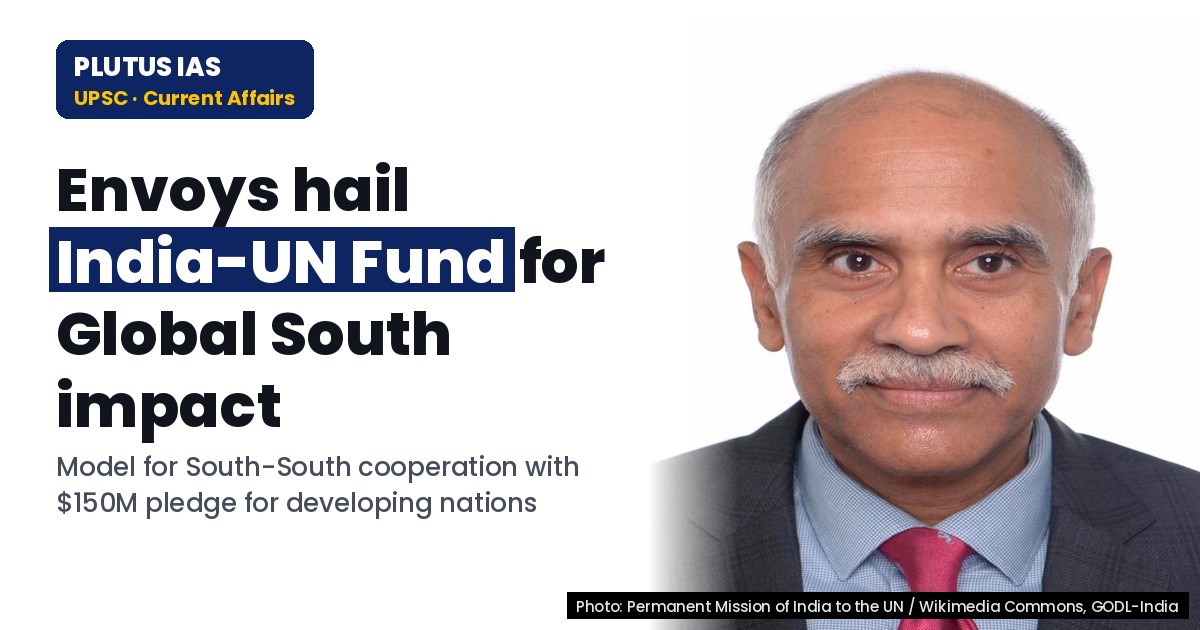
24 Oct India-UN Fund: A Model for South-South Cooperation in UPSC Exams
✎ The India-UN Development Partnership Fund is a demand-driven, nationally-owned initiative under South-South Cooperation, operationalised through a USD 150 million pledge, supporting 94 projects in 64 countries as of 2026, with a…
Subject Relevance — Where This Topic Fits
- GS Paper II — International Relations: Bilateral, Regional and Global Groupings and Agreements involving India and/or affecting India’s interests | GS Paper II — Important International Institutions, Agencies and Fora — their Structure, Mandate
- Prelims: South-South Cooperation, Vasudhaiva Kutumbakam, Least Developed Countries (LDCs), Landlocked Developing Countries (LLDCs), Small Island Developing States (SIDS), United Nations Development Programme (UNDP), United Nations Office for South-South Cooperation (UNOSSC), India-UN Development Partnership Fund, Global South
- Essay: South-South Cooperation as a Pathway to Inclusive Global Development, India’s Role in Shaping the Future of Multilateralism
Quick Revision: The India-UN Development Partnership Fund is a demand-driven, nationally-owned initiative under South-South Cooperation, operationalised through a USD 150 million pledge, supporting 94 projects in 64 countries as of 2026, with a focus on LDCs, LLDCs, and SIDS.
Why is this in the news?
The 9th edition of the India-UN Development Partnership Fund Annual Event, held at the UN headquarters in New York on 22 October 2026, witnessed high praise from envoys of Global South countries for the transformative impact of the Fund. The event, attended by Members of Parliament and senior UN officials, reaffirmed India’s commitment to sharing development experiences and supporting partner nations in attaining their sustainable development goals through nationally-driven, demand-responsive projects.
Background
- The India-UN Development Partnership Fund was launched in 2017 as a flagship initiative of India’s development cooperation policy, reflecting its commitment to South-South Cooperation (SSC) and the principle of ‘Vasudhaiva Kutumbakam’ (the world is one family).
- The Fund is jointly managed by the Government of India and the United Nations Development Programme (UNDP), with operational support from the United Nations Office for South-South Cooperation (UNOSSC).
- India pledged USD 150 million to the Fund in 2017, with a focus on assisting Least Developed Countries (LDCs), Landlocked Developing Countries (LLDCs), and Small Island Developing States (SIDS).
- The Fund prioritises national ownership, ensuring that projects are aligned with the development priorities identified by partner countries, thereby enhancing sustainability and local impact.
- South-South Cooperation (SSC) has gained prominence in global development discourse as a complementary approach to North-South development assistance, emphasising mutual learning, shared experiences, and technical cooperation among developing countries.
What is the India-UN Development Partnership Fund?
- A demand-driven, nationally-owned development cooperation initiative launched by India in partnership with the United Nations in 2017.
- Designed to support Least Developed Countries (LDCs), Landlocked Developing Countries (LLDCs), and Small Island Developing States (SIDS) in achieving their sustainable development goals.
- Operationalised through a USD 150 million pledge by the Government of India, with funds channelled through the United Nations Development Programme (UNDP) and the United Nations Office for South-South Cooperation (UNOSSC).
- Projects under the Fund are co-designed with partner countries, ensuring alignment with their national priorities, local needs, and developmental aspirations.
- The Fund embodies the principle of ‘Vasudhaiva Kutumbakam’, reflecting India’s civilisational ethos of viewing the world as one family and promoting collective well-being.
- Projects span diverse thematic areas including health, education, agriculture, renewable energy, infrastructure, and capacity building, tailored to the specific context of each partner country.
- As of October 2026, the Fund has supported 94 projects in 64 countries, demonstrating its growing footprint in global development cooperation.
- The Fund operates on the core tenets of South-South Cooperation: mutual respect, national ownership, horizontal learning, and non-conditionality, distinguishing it from traditional donor-recipient models.
Key Features
| Feature | Significance |
|---|---|
| Establishment and Purpose | A voluntary fund established by India in 2017 with an initial pledge of USD 150 million to support development projects in the Global South, particularly Least Developed Countries (LDCs), Landlocked Developing Countries (LLDCs), and Small Island Developing States (SIDS). |
| Project Ownership Principle | Projects are nationally-driven and tailored to the specific requirements of host countries, ensuring alignment with local development priorities and fostering self-reliance. |
| South-South Cooperation Framework | Operates under the principles of South-South cooperation, leveraging India’s development experiences and the UN’s global expertise to deliver targeted assistance. |
| Civilizational Ethos Integration | Embeds the concept of ‘Vasudhaiva Kutumbakam’ (the world is one family) into its operational philosophy, emphasizing solidarity and shared prosperity among developing nations. |
| Implementation Mechanism | Administered through the United Nations Development Programme (UNDP) and the United Nations Office for South-South Cooperation (UNOSSC), ensuring transparency and global oversight. |
Why it Matters
Diplomatic and Geopolitical
- Enhances India’s soft power by demonstrating commitment to global development and solidarity with the Global South, strengthening diplomatic ties and multilateral engagement.
- Reinforces India’s role as a responsible stakeholder in the United Nations system, particularly in addressing the developmental needs of vulnerable regions.
- Facilitates strategic partnerships with LDCs, LLDCs, and SIDS, creating avenues for long-term cooperation beyond traditional aid models.
Developmental and Humanitarian
- Provides targeted financial and technical assistance to countries facing acute development challenges, such as poverty, climate vulnerability, and limited infrastructure.
- Promotes sustainable development by supporting projects aligned with the Sustainable Development Goals (SDGs), particularly in education, health, and renewable energy.
- Empowers local communities through capacity-building initiatives, ensuring that development outcomes are inclusive and locally owned.
Economic and Institutional
- Leverages India’s developmental expertise to create scalable and replicable models of cooperation, reducing dependency on traditional donors.
- Encourages peer learning among developing nations, fostering innovation and best practices in governance and service delivery.
- Strengthens the role of the UN in coordinating South-South cooperation, enhancing the effectiveness of multilateral development efforts.
Challenges
1. Scalability and Sustainability
- Ensuring long-term sustainability of projects post-funding, particularly in contexts where institutional capacity is limited.
- Balancing the scale of funding (USD 82 million allocated so far) with the vast developmental needs of recipient countries.
- Addressing potential mismatches between donor priorities and host country priorities despite the ownership principle.
UPSC Link: GS Paper 2: Bilateral, Regional and Global Groupings
2. Coordination and Implementation Bottlenecks
- Managing multi-stakeholder coordination between India, the UN, and host governments to avoid delays in project execution.
- Overcoming bureaucratic hurdles in recipient countries that may impede timely disbursement and utilization of funds.
- Ensuring transparency and accountability in fund utilization to mitigate risks of misallocation or corruption.
UPSC Link: GS Paper 2: International Institutions
3. Resource Mobilization and Future Commitments
- Maintaining consistent funding flows to meet the USD 150 million pledge and potential future expansions.
- Diversifying funding sources beyond government contributions to include private sector and philanthropic partnerships.
- Addressing donor fatigue and ensuring sustained political and financial support from the international community.
UPSC Link: GS Paper 3: Indian Economy and Issues Relating to Planning
4. Alignment with Global Development Frameworks
- Ensuring that projects align with broader global agendas such as the SDGs, Paris Agreement, and Addis Ababa Action Agenda to maximize impact.
- Integrating climate resilience and environmental sustainability into project design to address emerging global challenges.
- Avoiding duplication of efforts with other international development initiatives to optimize resource use.
UPSC Link: GS Paper 2: Important International Institutions
Challenges — UPSC Perspective
| Issue | Concern |
|---|---|
| Fund Utilization Delays | Bureaucratic inertia and administrative inefficiencies in recipient countries may slow down project implementation. |
| Monitoring and Evaluation Gaps | Limited institutional capacity in host countries to track progress and measure outcomes effectively. |
| Political Instability in Recipient Nations | Frequent changes in governance or conflicts may disrupt project continuity and stakeholder engagement. |
| Climate and Geographical Vulnerabilities | Projects in SIDS or LLDCs may face heightened risks due to climate change, requiring adaptive strategies. |
| Cultural and Social Barriers | Differences in local customs, languages, or social structures may pose challenges to project acceptance and uptake. |
Way Forward
- Strengthen institutional capacity in recipient countries through targeted training programs for government officials and local stakeholders.
- Enhance transparency and accountability by adopting digital monitoring tools and third-party audits for fund utilization.
- Expand partnerships with private sector entities and philanthropic organizations to diversify funding sources and leverage additional expertise.
- Integrate climate resilience and environmental sustainability criteria into project design to future-proof development outcomes.
- Develop a robust grievance redressal mechanism to address implementation challenges and ensure community participation.
- Promote peer learning networks among recipient countries to share best practices and foster collaborative problem-solving.
- Increase public diplomacy efforts to highlight success stories and attract greater international support for the initiative.
- Conduct periodic reviews of project outcomes to assess alignment with SDGs and adjust strategies accordingly.
UPSC Value Addition
Keywords for Mains Answer-Writing
India-UN Development Partnership Fund · South-South Cooperation · Vasudhaiva Kutumbakam · Least Developed Countries (LDCs) · Landlocked Developing Countries (LLDCs) · Small Island Developing States (SIDS) · UN Development Programme (UNDP) · UN Office for South-South Cooperation (UNOSSC) · National ownership in development · Global South · Development cooperation · UN Charter principles · Sustainable Development Goals (SDGs) · India’s foreign policy commitments
Concept Flow
Global recognition of development challenges in LDCs, LLDCs, and SIDS → India’s pledge of USD 150 million to the India-UN Development Partnership Fund (2017) → Operationalization under UNDP and UNOSSC framework → Implementation of nationally-owned, tailor-made projects → Demonstration of impact through ground-level initiatives → Reinforcement of South-South cooperation principles → Strengthening of India’s diplomatic and developmental partnerships → Contribution to global SDG achievement.
Prelims Practice Questions
Q1. Consider the following statements regarding the India-UN Development Partnership Fund:
1. It was established in 2017 with an initial pledge of USD 150 million by the Government of India.
2. The Fund prioritises assistance to Least Developed Countries, Landlocked Developing Countries, and Small Island Developing States.
3. Projects under the Fund are designed and implemented solely by the United Nations Development Programme (UNDP) without host-country involvement.
How many of the above statements are correct?
- Only one
- Only two
- All three
- None
Answer: Only two — Statement 1 is correct (USD 150 million pledge in 2017). Statement 2 is correct (Fund targets LDCs, LLDCs, and SIDS). Statement 3 is incorrect (projects are nationally-driven with host-country ownership).
Q2. Assertion (A): The India-UN Development Partnership Fund operates on the principle of ‘Vasudhaiva Kutumbakam’ (the world is one family).
Reason (R): The Fund’s projects are tailor-made to align with the national priorities of partner countries in the Global South.
Options:
A. Both A and R are true, and R is the correct explanation of A.
B. Both A and R are true, but R is NOT the correct explanation of A.
C. A is true, but R is false.
D. A is false, but R is true.
Answer: ? — Assertion (A) is true (Fund’s ethos is rooted in Vasudhaiva Kutumbakam). Reason (R) is also true and correctly explains A (projects are nationally-owned and demand-driven).
Q3. Match the following initiatives with their respective objectives:
Column I (Initiative) Column II (Objective)
A. India-UN Development Partnership Fund 1. Promote triangular cooperation between developed and developing countries
B. UN Office for South-South Cooperation 2. Facilitate development projects in LDCs, LLDCs, and SIDS
C. Sustainable Development Goals (SDGs) 3. Achieve global development targets by 2030
D. India’s SAGAR initiative 4. Enhance maritime security and economic cooperation in the Indian Ocean Region
Options:
A-2, B-1, C-3, D-4
A-1, B-2, C-3, D-4
A-3, B-1, C-2, D-4
A-2, B-3, C-1, D-4
Answer: ? — A-2 (Fund targets LDCs, LLDCs, SIDS), B-1 (UNOSSC promotes South-South cooperation), C-3 (SDGs are global development targets), D-4 (SAGAR focuses on Indian Ocean Region).
Mains Practice Question
✍ Critically analyse the significance of the India-UN Development Partnership Fund in the context of India’s foreign policy and global development cooperation. How does the Fund embody the principles of South-South Cooperation and national ownership in development? Substantiate your arguments with reference to its thematic focus and operational modalities. (15 Marks)
Approach: MODEL-ANSWER SKELETON:
1. **Introduction (2 marks)**: Define the India-UN Development Partnership Fund (established 2017, USD 150 million pledge) and its alignment with India’s foreign policy ethos of ‘Vasudhaiva Kutumbakam’ and South-South Cooperation.
2. **Principles and Operational Modalities (4 marks)**:
– National ownership: Projects are demand-driven and aligned with host-country priorities (cite Ambassador Jayasuriya’s remarks).
– South-South Cooperation: Emphasis on mutual learning and solidarity among developing nations.
– Thematic focus: Targeting LDCs, LLDCs, and SIDS; integration with SDGs.
3. **Significance in India’s Foreign Policy (4 marks)**:
– Soft power and global leadership: Enhances India’s credibility as a development partner (cite Ambassador Harish’s remarks).
– Alignment with UN Charter principles: Promotes inclusive and equitable development.
– Contrast with North-South models: Highlights India’s alternative approach to development cooperation.
4. **Challenges and Critiques (3 marks)**:
– Sustainability: Long-term viability of projects post-funding.
– Scalability: Limited allocation (USD 82 million utilised for 94 projects in 64 countries).
– Coordination: Ensuring seamless collaboration between India, UNDP, and UNOSSC.
5. **Conclusion (2 marks)**: Summarise the Fund’s role in redefining development cooperation paradigms and its potential to address global inequalities. Conclude with a balanced view on its impact and future prospects.
Source: orissapost.com
Generated by AanyaAi for educational purpose.
Related guides on our sites
- Best PSIR optional coaching for upsc
- Best PSIR optional teacher for upsc
- Best teacher of PSIR optional for upsc
- Best PSIR optional coaching in delhi for UPSC

- India-UN Fund: A Model for South-South Cooperation in UPSC Exams - October 24, 2026
- उड़ीसा में चक्रवात खतरा: रेड अलर्ट, सरकार ने उठाए कदम - October 24, 2026
- How Warming Arabian Sea Fuels Mumbai’s Smog Crisis: UPSC Perspective - October 24, 2026

No Comments