


27 Jul IndiaAI Mission’s Trustworthy AI Pillar: Key Facts for UPSC & State PCS
Subject Relevance — Where This Topic Fits
- GS Paper II — Governance, Transparency and Accountability | GS Paper III — Science and Technology — Developments and their Applications and Effects in Everyday Life
- Prelims: Artificial Intelligence (AI), AI governance, IndiaAI Mission, Trusted AI, Responsible AI, Deepfake detection, Federated Learning, AI bias mitigation, AI compute infrastructure, AI standards
- Essay: Ethical governance of emerging technologies: Balancing innovation with societal trust in the age of artificial intelligence
Quick Revision: The Safe & Trusted AI pillar under IndiaAI Mission institutionalises ethical AI governance through indigenous frameworks, standards, and tools to ensure fairness, privacy, and accountability in AI systems, thereby strengthening public trust and enabling responsible innovation.
Why is this in the news?
The IndiaAI Mission’s ‘Safe and Trusted AI’ pillar has been highlighted for its role in institutionalising ethical frameworks, standards, and tools to promote responsible AI development and deployment, thereby strengthening public trust in AI systems. This initiative aligns with global efforts to shape AI governance while addressing risks such as bias, privacy violations, and deepfake proliferation. The announcement underscores India’s proactive stance in fostering a robust, inclusive, and accountable AI ecosystem through structured policy interventions and technological innovation.
Background
- The IndiaAI Mission was approved by the Union Cabinet in March 2024 with a budgetary outlay of ₹10,371 crore over five years, aiming to democratise AI technologies and create economic opportunities for youth.
- India’s AI policy is rooted in the vision of ‘Technology Democratisation’ articulated by Prime Minister Narendra Modi, emphasising equitable access, innovation, and risk mitigation.
- Global discourse on AI governance has intensified, with nations and blocs like the EU, US, and China advancing regulatory frameworks such as the EU AI Act and NIST AI Risk Management Framework.
- Deepfakes, algorithmic bias, and privacy concerns have emerged as critical challenges, necessitating proactive governance mechanisms to ensure ethical AI deployment.
- The Safe & Trusted AI pillar reflects India’s commitment to aligning technological advancement with constitutional values of fairness, transparency, and accountability.
What is the Safe & Trusted AI Pillar under IndiaAI Mission?
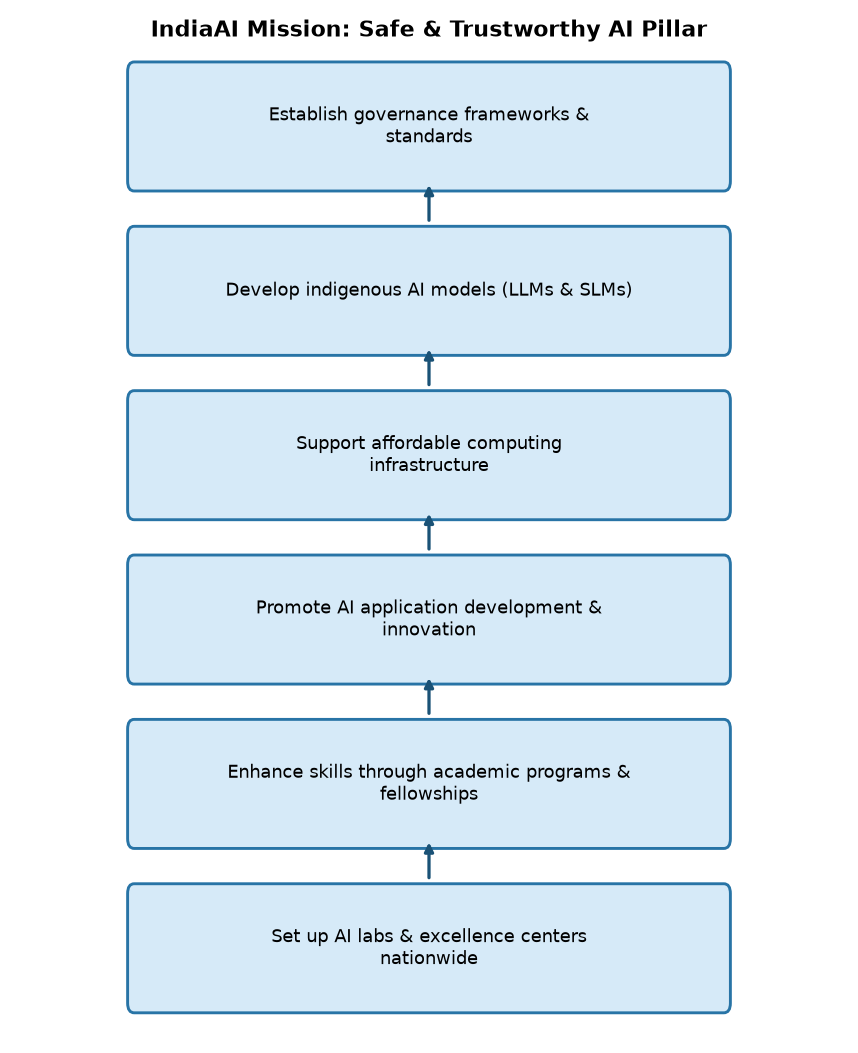
- The pillar aims to institutionalise ethical AI governance by developing indigenous frameworks, standards, tools, and evaluation mechanisms to ensure AI systems are safe, fair, and accountable.
- It supports 13 responsible AI projects across academic institutions, focusing on bias mitigation, explainable AI, privacy-preserving techniques, deepfake detection, and AI risk assessment.
- Key initiatives include multi-agent frameworks for deepfake detection (IIT Jodhpur & IIT Madras), real-time voice deepfake detection systems (IIT Kharagpur), and federated learning models for privacy-preserving AI (IIT Delhi & IIT Dharwad).
- The pillar also promotes the development of indigenous large language models (LLMs) and small language models (SLMs) with sovereign capabilities, reducing dependency on foreign technologies.
- It integrates with other Mission components such as AI Compute, Foundation Models, and FutureSkills to create a holistic ecosystem for responsible AI innovation.
- The pillar emphasises public trust by ensuring AI systems are transparent, auditable, and aligned with societal values, thereby fostering wider adoption of AI technologies.
- Collaboration with state governments, industry partners, and academic institutions ensures scalability and contextual relevance of AI governance frameworks.
- The pillar aligns with global best practices, including the OECD AI Principles and UNESCO Recommendation on the Ethics of AI, while adapting them to India’s socio-cultural and legal context.
Key Features
| Feature | Significance |
|---|---|
| 13 Responsible AI Projects | Address systemic biases, privacy risks, and explainability deficits in AI systems through domain-specific interventions in healthcare, defence, and governance. |
| 58 AI Excellence Centres | Foster state-level innovation hubs in collaboration with industry and academia, ensuring decentralised capacity building for AI governance and deployment. |
| 27 Data & AI Labs | Provide hands-on training to over 2,500 students, embedding ethical AI practices in curriculum and research across higher education institutions. |
| Indigenous Sovereign Models | Develop 20 sovereign LLMs/SLMs (e.g., GyanAI’s speech-to-speech model) to reduce dependency on foreign AI systems and enhance data sovereignty. |
| Safe & Trustworthy AI Pillar | Establishes governance frameworks, standards, and evaluation mechanisms to mitigate risks of deepfakes, algorithmic bias, and privacy violations. |
Why it Matters
Economic & Employment Generation
- Creates high-skilled jobs in AI development, deployment, and governance, aligning with the mission’s objective of leveraging AI for youth employment (₹10,371 crore budget allocation over 5 years).
- Supports 20 indigenous sovereign AI models, reducing import dependence and fostering a competitive domestic AI ecosystem.
- Facilitates 62 AI prototypes and 20 deployable solutions, accelerating commercialisation and start-up growth.
Strategic Autonomy & Data Sovereignty
- Promotes development of sovereign AI models (e.g., Sarvam 30B/105B parameters) to ensure control over critical AI infrastructure and reduce geopolitical vulnerabilities.
- Encourages federated learning and privacy-preserving AI to safeguard sensitive data in sectors like healthcare and defence.
- Strengthens India’s position in global AI governance by establishing indigenous standards for safe, fair, and responsible AI deployment.
Social Equity & Inclusion
- Targets bias mitigation in medical imaging and clinical decision-making, ensuring equitable healthcare outcomes across demographics.
- Expands AI literacy through programmes like ‘AI for All,’ reaching 26 lakh individuals to democratise access to AI knowledge.
- Supports multilingual foundation models (e.g., BharatGen) to bridge linguistic divides in digital public infrastructure.
Institutional Capacity Building
- Establishes 58 AI Excellence Centres in states/UTs, fostering regional innovation ecosystems and reducing urban-rural disparities in AI adoption.
- Trains 686 fellows across 178 institutions, creating a pipeline of AI-ready professionals for industry and research.
- Develops real-time deepfake detection systems (e.g., IIT Kharagpur’s voice deepfake detection) to safeguard electoral integrity and public trust.
Challenges
1. Algorithmic Bias & Fairness
- Risk of reinforcing societal biases in AI models trained on non-representative datasets, particularly in healthcare and law enforcement applications.
- Need for robust bias auditing frameworks and diversity in training data to ensure equitable outcomes.
UPSC Link: GS3: Ethical issues in AI
2. Privacy & Data Security
- Federated learning and privacy-preserving AI are still nascent; scalability and performance trade-offs remain unresolved.
- Risk of data leakage in cross-border AI deployments, necessitating stringent data localisation and encryption standards.
UPSC Link: GS3: Data protection & privacy
3. Deepfake & Misinformation
- Rapid advancements in generative AI exacerbate risks of synthetic media for electoral interference and fraud.
- Real-time detection systems (e.g., IIT Kharagpur’s) require continuous updates to counter evolving adversarial techniques.
UPSC Link: GS3: Cybersecurity & digital threats
4. Talent & Infrastructure Gap
- Shortage of AI-skilled professionals despite fellowship programmes; industry-academia collaboration remains uneven.
- High computational costs for training large models (e.g., Sarvam 105B parameters) strain public resources.
UPSC Link: GS3: Skill gaps & digital divide
5. Regulatory & Ethical Ambiguity
- Lack of a unified AI governance framework in India, leading to fragmented compliance and enforcement.
- Ethical dilemmas in AI deployment (e.g., predictive policing, autonomous weapons) require clear policy directives.
UPSC Link: GS2: Governance of emerging technologies
Challenges — UPSC Perspective
| Issue | Concern |
|---|---|
| Bias in AI Models | Reinforcement of societal prejudices in healthcare diagnostics, hiring algorithms, and judicial decision-support systems. |
| Deepfake Proliferation | Erosion of public trust due to AI-generated misinformation, impacting elections and social cohesion. |
| Data Privacy Risks | Exposure of sensitive personal data in federated learning and cross-border AI collaborations. |
| Computational Inequality | Unequal access to high-performance computing resources, limiting innovation in Tier-2/3 cities. |
| Ethical Dilemmas | Accountability gaps in autonomous AI systems (e.g., self-driving cars, military applications). |
| Regulatory Fragmentation | Overlap between sectoral laws (e.g., DPDP Act, IT Rules) and lack of a dedicated AI legislation. |
Government Initiatives — Must-Memorise for Prelims
- IndiaAI Mission (2024–2029)
- IndiaAI Compute
- IndiaAI Foundation Models
- IndiaAI Datasets
- IndiaAI Application Development Initiative
- IndiaAI FutureSkills
- IndiaAI Startup Financing
Way Forward
- Finalise and operationalise the National AI Governance Framework to standardise ethical, legal, and technical guidelines across sectors.
- Expand public-private partnerships to scale AI Excellence Centres and Data & AI Labs, prioritising Tier-2/3 cities.
- Accelerate the development of indigenous sovereign AI models by incentivising R&D in multilingual, domain-specific LLMs/SLMs.
- Strengthen real-time deepfake detection systems through adversarial training and cross-institutional collaboration (e.g., IITs, C-DAC).
- Enhance AI literacy programmes with modular curricula for school/college students, focusing on ethical AI and critical thinking.
- Establish a centralised AI risk assessment authority to audit high-risk AI systems (e.g., healthcare, defence) for bias and privacy compliance.
- Leverage IndiaAI Compute to democratise access to GPU resources for start-ups and academia, reducing computational barriers.
- Integrate AI governance principles into existing laws (e.g., DPDP Act, IT Rules) to ensure seamless compliance and enforcement.
UPSC Value Addition
Keywords for Mains Answer-Writing
Artificial Intelligence (AI) governance · Responsible AI · IndiaAI Mission · AI ethics and safety · Deepfake detection · Bias mitigation in AI · Privacy-preserving AI · AI standards and frameworks · AI for public trust · AI innovation ecosystem · AI policy and regulation · AI in healthcare · AI in defence · AI skill development · AI compute infrastructure
Constitutional & Policy Linkages
- Article 19(1)(a) Freedom of speech (balancing AI-enabled misinformation with regulatory oversight)
- Article 21 Right to life & personal liberty (privacy in AI-driven surveillance)
- Article 14 Equality before law (mitigating algorithmic bias in public services)
Concept Flow
AI adoption in governance → Risks of bias, privacy violations, and deepfakes → IndiaAI Mission’s Safe & Trustworthy AI Pillar → Development of 13 Responsible AI Projects → Establishment of 58 AI Excellence Centres & 27 Labs → Institutional capacity building → Enhanced public trust in AI systems → Sustainable AI-driven economic growth
Prelims Practice Questions
Q1. Which of the following is NOT a pillar of the IndiaAI Mission?
- A. IndiaAI Compute
- B. Foundation Models
- C. AI for Climate Change
- D. AI Applications Development Initiative
Answer: C. AI for Climate Change — The IndiaAI Mission comprises seven pillars: IndiaAI Compute, Foundation Models, AI Datasets, IndiaAI, Applications Development Initiative, FutureSkills, Startup Financing, and Trusted and Responsible AI. Climate change mitigation is not explicitly listed as a pillar.
Q2. Which institution is developing a real-time voice deepfake detection system under the IndiaAI Mission?
- A. IIT Bombay
- B. IIT Kharagpur
- C. IIT Madras
- D. IIT Delhi
Answer: B. IIT Kharagpur — IIT Kharagpur is leading the development of a real-time voice deepfake detection system as part of the 13 responsible AI projects approved under the IndiaAI Mission.
Q3. The IndiaAI Mission aims to create AI Excellence Centres in collaboration with:
- A. Only state governments
- B. State governments and industry partners
- C. Only central government agencies
- D. International AI research labs
Answer: B. State governments and industry partners — The 58 AI Excellence Centres are being established through collaboration between state/union territory governments and industry partners to foster local AI innovation ecosystems.
Mains Practice Question
✍ Critically examine the role of the ‘Trusted and Responsible AI’ pillar of the IndiaAI Mission in addressing ethical, safety, and governance challenges associated with artificial intelligence. How does this pillar contribute to building public trust in AI systems? Substantiate your answer with specific initiatives and outcomes.
Approach: Begin by defining the ‘Trusted and Responsible AI’ pillar within the IndiaAI Mission and its core objectives. Analyse its key components, such as indigenous governance frameworks, standards, and evaluation mechanisms, and explain how these address ethical risks like bias, privacy violations, and deepfake proliferation. Discuss specific initiatives under this pillar—e.g., deepfake detection systems (IIT Kharagpur), bias mitigation in healthcare AI (NIT Raipur), and privacy-preserving federated learning (IIT Delhi)—and their impact on public trust. Conclude by evaluating the pillar’s effectiveness in creating a robust, ethical AI ecosystem in India, while acknowledging limitations such as scalability and enforcement challenges.
Source: PIB (Press Information Bureau)
Generated by AanyaAi for educational purpose.

- नागरिक उड्डयन मंत्रालय ने विशेष अभियान 5.0 में हासिल की बड़ी उपलब्धि - September 17, 2026
- Civil Aviation Ministry’s Progress Under SCDPM 5.0: Key Achievements for UPSC - September 17, 2026
- स्वामित्व योजना: मध्यप्रदेश में 50 लाख संपत्तियों की मुफ्त रजिस्ट्री शुरू, जानिए पूरा विवरण - September 17, 2026

No Comments