


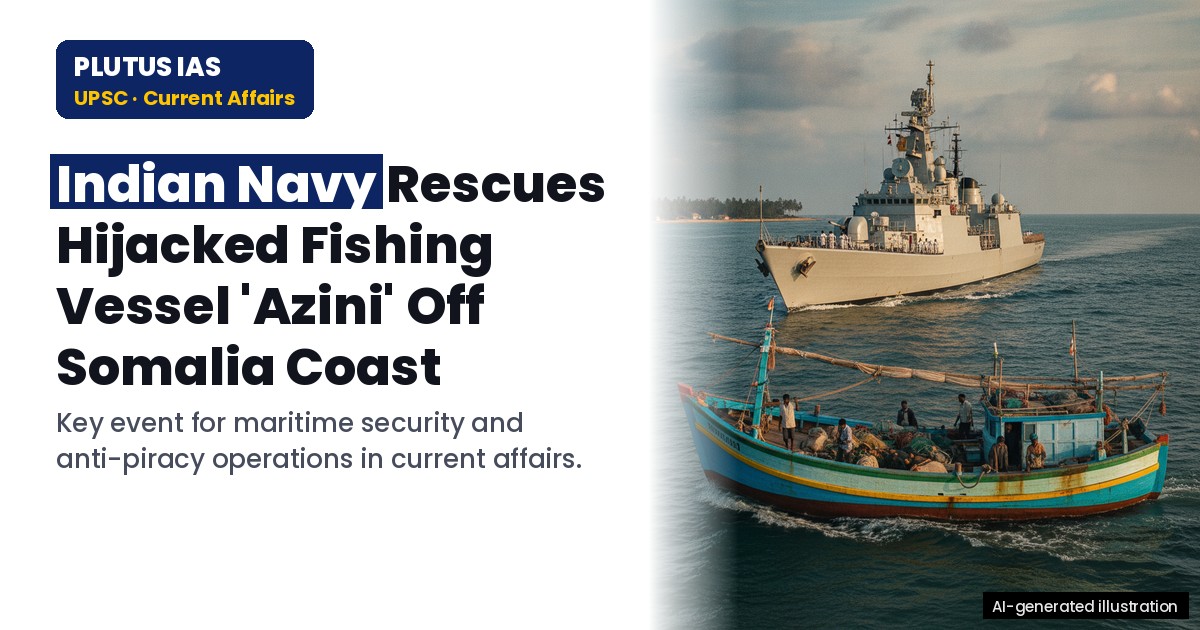
03 Nov Indian Navy Rescues Hijacked Vessel ‘Azini’ Off Somalia
✎ The Indian Navy's successful anti-piracy operation off Somalia underscores India's pivotal role in enhancing maritime security and upholding freedom of navigation in the strategically vital Indian Ocean Region, in line with…
Subject Relevance — Where This Topic Fits
- GS Paper II — International Relations: India’s foreign policy, security challenges, and engagement with international organisations. | GS Paper III — Internal Security: Challenges to internal security through external state and non-state actors, maritime security, and various security forces and agencies and their mandate.
- Prelims: Indian Ocean Region, Anti-piracy operations, Gulf of Aden, Somali piracy, UNCLOS, Indian Navy, Maritime security, Exclusive Economic Zone (EEZ)
- Essay: The evolving landscape of maritime security and its implications for global trade and regional stability., India’s role as a net security provider in the Indian Ocean Region.
Quick Revision: The Indian Navy’s successful anti-piracy operation off Somalia underscores India’s pivotal role in enhancing maritime security and upholding freedom of navigation in the strategically vital Indian Ocean Region, in line with international legal frameworks like UNCLOS.
Why is this in the news?
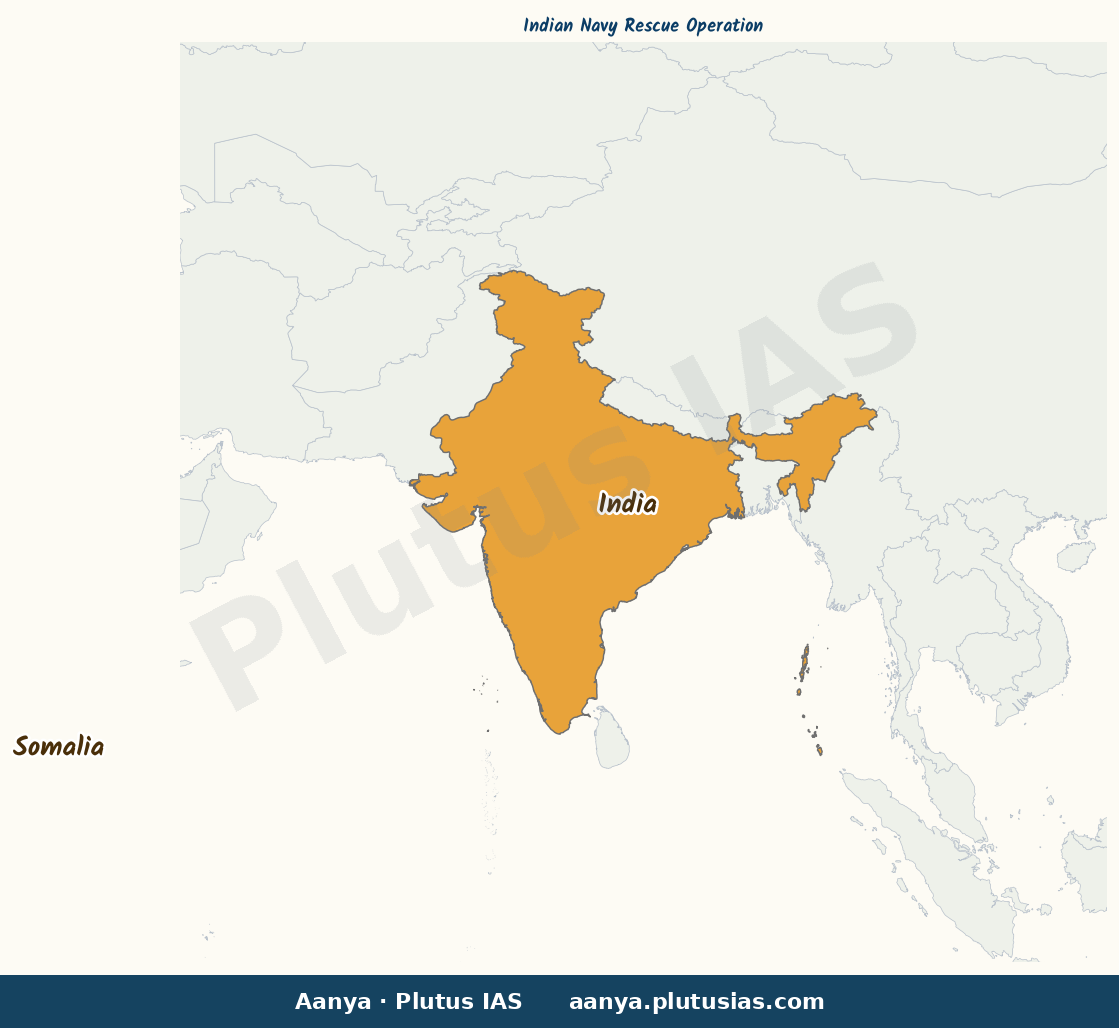
The Indian Navy successfully conducted a swift anti-piracy operation, rescuing a hijacked Iranian-flagged fishing vessel, ‘Azini’, and its 11 crew members off the coast of Somalia. This operation underscores India’s commitment to ensuring maritime security and freedom of navigation in the Indian Ocean Region, a critical sea lane for international trade.
Background
- The Indian Ocean Region (IOR) is strategically vital, encompassing major shipping lanes connecting Asia, Africa, and Europe, making it susceptible to various maritime threats, including piracy.
- Somali piracy emerged as a significant threat in the early 2000s, primarily targeting commercial vessels transiting the Gulf of Aden and the wider Indian Ocean, disrupting global trade and increasing shipping costs.
- In response to the escalating piracy, several international naval forces, including the Indian Navy, deployed assets to the region to conduct anti-piracy patrols and escort vulnerable shipping.
- India has consistently maintained a robust naval presence in the Gulf of Aden since 2008, undertaking anti-piracy operations under various international frameworks and in consonance with UN Security Council resolutions.
- The Indian Navy’s proactive approach aligns with India’s broader maritime security strategy, which includes safeguarding its economic interests, protecting its sea lines of communication, and contributing to regional stability.
- The recent resurgence of piracy incidents in the Arabian Sea and off the coast of Somalia highlights the persistent nature of this threat and the continued necessity for vigilant maritime security operations.
Maritime Piracy and International Law
- Maritime piracy is defined under Article 101 of the United Nations Convention on the Law of the Sea (UNCLOS) as any illegal act of violence or detention, or any act of depredation, committed for private ends by the crew or passengers of a private ship or a private aircraft, and directed on the high seas against another ship or aircraft, or against persons or property on board such ship or aircraft.
- UNCLOS provides a comprehensive legal framework for all ocean activities, including the jurisdiction over piracy. It stipulates that every State may seize a pirate ship or aircraft, or a ship or aircraft taken by piracy and under the control of pirates, and arrest the persons and seize the property on board.
- The high seas, where most piracy occurs, are beyond the jurisdiction of any single state, necessitating international cooperation for effective enforcement and suppression of piracy.
- International efforts to combat piracy include naval deployments by individual nations and multinational task forces, such as Combined Task Force 151 (CTF-151), which coordinates anti-piracy operations.
- The ‘Contact Group on Piracy off the Coast of Somalia’ (CGPCS) was established in January 2009 under UN auspices to facilitate coordination of political, military, and humanitarian efforts to combat piracy.
- India’s anti-piracy operations are conducted in accordance with international law, including UNCLOS, and relevant UN Security Council resolutions, demonstrating its commitment to a rules-based international order.
- The Indian Navy’s role extends beyond direct interdiction to include maritime domain awareness, surveillance, and providing assistance to merchant vessels and fishing boats in distress.
- The concept of ‘Exclusive Economic Zone’ (EEZ) grants coastal states sovereign rights for exploring and exploiting, conserving, and managing natural resources, but anti-piracy operations often occur on the high seas or within the territorial waters of the affected nation with their consent.
Key Features
| Feature | Significance |
|---|---|
| Operation Pralay | The Indian Navy’s comprehensive anti-piracy operation in the Arabian Sea, demonstrating India’s commitment to maritime security and freedom of navigation. |
| INS Sumitra | An offshore patrol vessel (OPV) of the Indian Navy, instrumental in the successful rescue operation, highlighting India’s naval capabilities and reach. |
| Maritime Domain Awareness (MDA) | The ability to comprehend the activities and events occurring in the maritime environment, crucial for early detection and response to threats like piracy. |
| International Cooperation | The rescue operation contributes to global efforts against piracy, showcasing India’s role as a responsible maritime power and a net security provider in the Indian Ocean Region. |
| Humanitarian Assistance and Disaster Relief (HADR) | Beyond security, naval operations often encompass HADR, reinforcing India’s broader commitment to regional stability and welfare. |
Why it Matters
Strategic Importance
- Reinforces India’s position as a credible maritime security provider in the Indian Ocean Region (IOR), crucial for safeguarding international shipping lanes.
- Demonstrates the Indian Navy’s operational readiness and capability to project power and respond to contingencies far from its shores.
- Contributes to regional stability and adherence to the United Nations Convention on the Law of the Sea (UNCLOS) principles regarding freedom of navigation.
Economic Implications
- Ensures the safety of maritime trade routes, which are vital for global commerce and India’s own economic interests, as a significant portion of its trade passes through these waters.
- Mitigates the financial costs associated with piracy, including increased insurance premiums, re-routing of vessels, and potential ransom payments.
Diplomatic & Geopolitical Impact
- Enhances India’s diplomatic standing and soft power by undertaking humanitarian and security operations that benefit the international community.
- Strengthens bilateral and multilateral maritime security partnerships with littoral states and other global powers involved in anti-piracy efforts.
Internal Security & Sovereignty
- Protects Indian citizens and assets, including fishing vessels and merchant ships, from external threats, thereby upholding national sovereignty and citizen welfare.
- Deters future acts of piracy and maritime crime, contributing to a more secure environment for Indian seafarers and the fishing community.
Challenges
1. Evolving Nature of Piracy
- Piracy tactics are constantly evolving, with pirates adapting to counter-piracy measures, necessitating continuous intelligence gathering and operational adjustments.
- The nexus between piracy and other transnational organized crimes, such as arms trafficking and drug smuggling, complicates enforcement efforts.
UPSC Link: Internal Security – Border Management
2. Jurisdictional Complexities
- Operations in international waters involve complex legal frameworks concerning arrest, prosecution, and detention of pirates, requiring international legal cooperation.
- The lack of a universally accepted legal definition of piracy and varying national laws can create challenges in prosecuting captured pirates.
UPSC Link: International Relations – International Law
3. Resource Intensive Operations
- Maintaining a continuous naval presence in vast maritime areas, such as the Arabian Sea and Gulf of Aden, demands significant financial and logistical resources.
- The deployment of naval assets for extended periods can strain operational budgets and personnel, impacting other naval priorities.
UPSC Link: Internal Security – Security Forces
4. Information Sharing and Coordination
- Effective anti-piracy operations depend on seamless information sharing among various national and international agencies, which can be hampered by bureaucratic hurdles or trust deficits.
- Coordination among diverse naval forces from different countries, each with its own protocols and command structures, presents operational challenges.
UPSC Link: Internal Security – Cyber Security
5. Root Causes of Piracy
- Addressing the underlying socio-economic issues in coastal states, such as poverty, lack of governance, and unemployment, which often drive individuals towards piracy, is a long-term challenge.
- Political instability and conflict in regions like Somalia provide fertile ground for the resurgence of piracy, making sustainable solutions difficult.
UPSC Link: International Relations – Indian Ocean Region
Challenges — UPSC Perspective
| Issue | Concern |
|---|---|
| Maritime Security Threats | Piracy, armed robbery at sea, maritime terrorism, and illegal fishing pose persistent threats to international shipping and regional stability. |
| Vulnerability of Fishing Vessels | Smaller, less-protected fishing vessels are often targets for hijackings, highlighting the need for enhanced security measures and awareness among fishing communities. |
| Economic Impact on Seafarers | Piracy incidents lead to psychological trauma for seafarers, loss of livelihood, and increased risks, affecting the global maritime workforce. |
| Environmental Damage | Pirate activities can lead to environmental degradation through illegal dumping or damage to marine ecosystems during confrontations. |
| Proliferation of Weapons | Successful hijackings can lead to the acquisition of weapons by pirate groups, escalating the threat level and making future interventions more dangerous. |
Way Forward
- Enhance Maritime Domain Awareness (MDA) through advanced surveillance technologies and intelligence sharing networks to predict and prevent maritime threats.
- Strengthen international cooperation and joint naval exercises with littoral states and global partners to foster interoperability and collective response capabilities.
- Invest in capacity building for coastal states, including training of maritime security forces and provision of surveillance equipment, to enhance their ability to combat piracy.
- Develop and implement comprehensive legal frameworks for the prosecution of pirates, ensuring accountability and deterring future acts of maritime crime.
- Address the socio-economic root causes of piracy in vulnerable coastal regions through sustainable development initiatives, poverty alleviation programs, and governance reforms.
- Promote the adoption of Best Management Practices (BMP) by commercial shipping and fishing vessels to enhance their self-protection measures against pirate attacks.
- Leverage diplomatic channels to foster regional stability and resolve conflicts in areas prone to piracy, thereby reducing the breeding grounds for such activities.
- Explore technological innovations, such as unmanned maritime systems and artificial intelligence, to augment surveillance and response capabilities in vast maritime zones.
UPSC Value Addition
Keywords for Mains Answer-Writing
Maritime Security · Indian Ocean Region · Anti-Piracy Operations · Indian Navy · Somali Piracy · Freedom of Navigation · International Maritime Law · Geopolitical Significance · SAGAR Vision · Coastal Security · Blue Economy · UNCLOS
Constitutional & Policy Linkages
- {‘article’: ‘Article 51’, ‘note’: ‘Promotion of international peace and security’}
- {‘article’: ‘Seventh Schedule, Union List, Entry 2’, ‘note’: ‘Naval, military and air forces’}
- {‘article’: ‘Seventh Schedule, Union List, Entry 27’, ‘note’: ‘Ports declared by or under law’}
Concept Flow
Pirate activity detected in international waters. → Indian Navy receives distress signal/intelligence. → Naval assets (e.g., INS Sumitra) deployed for interdiction. → Rescue operation conducted, vessel and crew secured. → Pirates apprehended and dealt with as per law. → Maritime security reinforced in the region.
Prelims Practice Questions
Q1. Consider the following statements regarding maritime security in the Indian Ocean Region (IOR):
1. The Indian Ocean is a critical maritime trade route, accounting for a significant portion of global oil and container traffic.
2. Piracy off the coast of Somalia has been largely eradicated due to sustained international efforts.
3. India’s ‘SAGAR’ (Security and Growth for All in the Region) vision primarily focuses on land-based security initiatives.
How many of the above statements are correct?
- Only one
- Only two
- Only three
- None
Answer: Only one — Statement 1 is correct: The Indian Ocean is indeed a vital global trade artery. Statement 2 is incorrect: While significantly reduced, piracy off Somalia has seen sporadic resurgence, necessitating continued vigilance. Statement 3 is incorrect: The ‘SAGAR’ vision is explicitly maritime-centric, aiming for comprehensive security and growth in the IOR through collaborative approaches.
Q2. Which of the following international conventions primarily deals with the legal framework for combating piracy on the high seas?
- United Nations Convention on the Law of the Sea (UNCLOS)
- International Convention for the Safety of Life at Sea (SOLAS)
- Convention on International Civil Aviation (Chicago Convention)
- Kyoto Protocol
Answer: United Nations Convention on the Law of the Sea (UNCLOS) — The United Nations Convention on the Law of the Sea (UNCLOS) provides the foundational legal framework for defining piracy and authorizing states to take action against it on the high seas. SOLAS deals with ship safety, Chicago Convention with civil aviation, and Kyoto Protocol with climate change.
Mains Practice Question
✍ Examine the evolving challenges to maritime security in the Indian Ocean Region (IOR) and discuss the multi-faceted approach adopted by India to address these threats. (15 Marks)
Approach: INTRODUCTION: Briefly define maritime security and its significance for India and the IOR.
PART 1: Evolving Challenges to Maritime Security in IOR:
– Traditional threats: Piracy (e.g., Somali piracy, resurgence), armed robbery at sea, maritime terrorism.
– Non-traditional threats: Illegal, Unreported, and Unregulated (IUU) fishing, drug trafficking, arms smuggling, human trafficking, climate change impacts on maritime zones, environmental degradation.
– Geopolitical complexities: Great power competition, presence of extra-regional navies, territorial disputes, freedom of navigation issues.
– Specific vulnerabilities: Chokepoints (Strait of Hormuz, Bab-el-Mandeb, Malacca Strait), vast coastline, island territories.
PART 2: India’s Multi-faceted Approach:
– Naval Diplomacy and Capacity Building: Bilateral and multilateral exercises (e.g., MALABAR, Milan), training foreign navies, HADR operations.
– Coastal Security Framework: Coastal security scheme, Sagar Prahari Bal, integration of various agencies (Indian Navy, Coast Guard, Marine Police).
– Information Sharing and Surveillance: Information Fusion Centre – Indian Ocean Region (IFC-IOR), coastal radar chain, satellite surveillance.
– International Cooperation: Participation in anti-piracy missions (e.g., CTF-151), collaboration with regional groupings (IOR-ARC, BIMSTEC), adherence to UNCLOS.
– ‘SAGAR’ Vision: Emphasis on Security and Growth for All in the Region, promoting regional stability, economic cooperation, and maritime domain awareness.
– Indigenous Defence Production: Strengthening naval capabilities through ‘Make in India’ initiatives.
CONCLUSION: Summarize the importance of a robust maritime security strategy for India’s strategic interests and regional stability, reiterating the need for continued vigilance and collaborative efforts.
Source: PIB (Press Information Bureau)
Generated by AanyaAi for educational purpose.
Related guides on our sites
- Best PSIR optional coaching for upsc
- Best PSIR optional teacher for upsc
- Best teacher of PSIR optional for upsc
- Best PSIR optional coaching in delhi for UPSC

- संयुक्त राष्ट्र रिपोर्ट: 2030 तक ‘जीरो हंगर’ लक्ष्य पर संकट - November 3, 2026
- Cyclone Murasu: AP’s Disaster Preparedness & Power Resilience - November 3, 2026
- ई-फाइलिंग 3.0 कार्यशाला: ई-न्यायालय मिशन मोड परियोजना का एक महत्वपूर्ण कदम - November 3, 2026

No Comments