


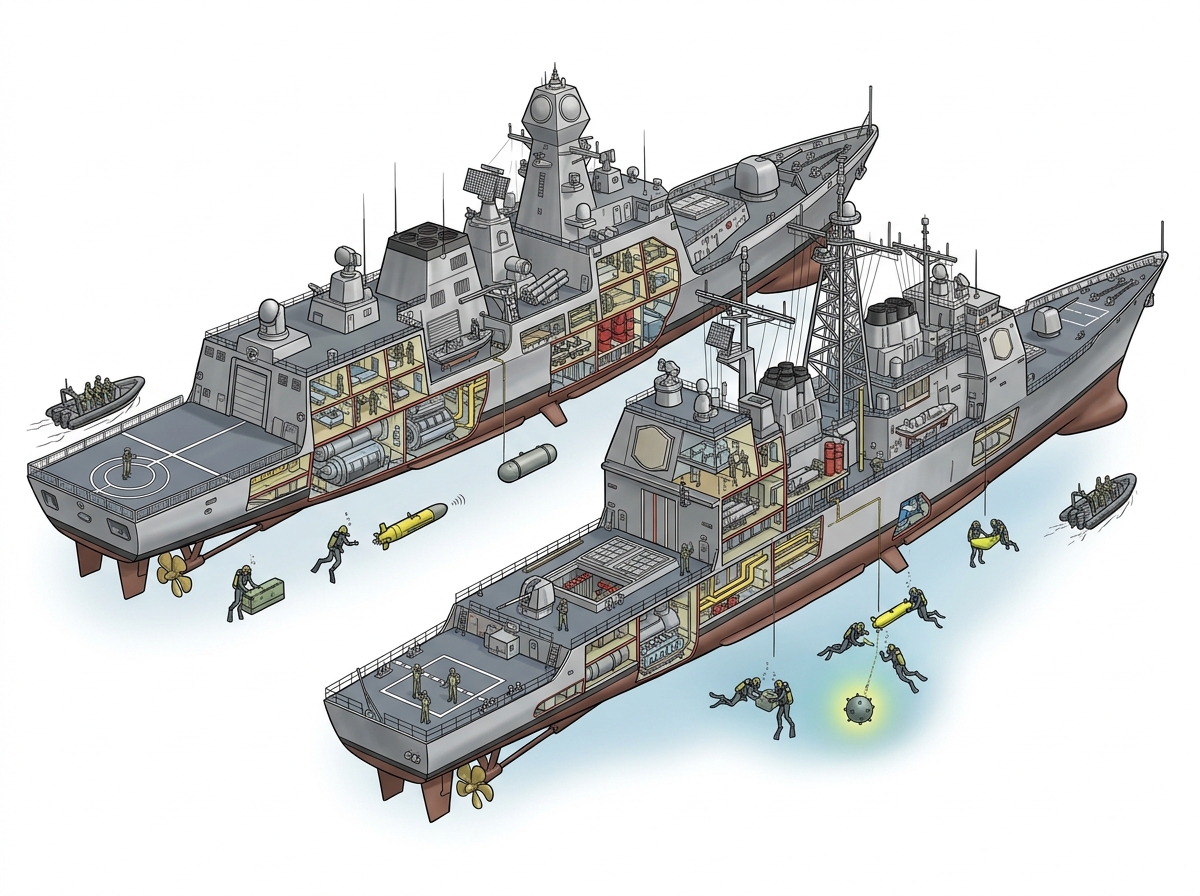
09 Aug Indian & US Navies to Conduct Joint EOD Exercise in Kochi from Aug 10
Naval shipsExplosive ordnanceMaritime securityInteroperability drills✎ The Indo-US bilateral naval exercise in Kochi (August 10–14, 2026) is a five-day engagement focused on explosive ordnance disposal (EOD), aimed at enhancing interoperability and operational readiness in the maritime domain…
Subject Relevance — Where This Topic Fits
- GS Paper II — International Relations: Bilateral and Multilateral Groupings and Agreements Involving India and/or Affecting India’s Interests | GS Paper III — Security: Challenges to Internal Security Through Communication Networks, Role of External State and Non-State Actors in Creating Challenges
- Prelims: Indo-US Naval exercises, Explosive Ordnance Disposal (EOD), Southern Naval Command (Kochi), Sea Dragon exercise, Maritime Domain Awareness, Interoperability, Joint Salvage Operations, Quadrilateral Security Dialogue (QUAD)
- Essay: The evolving paradigm of India’s strategic partnerships in the Indo-Pacific region, Maritime security as a cornerstone of national and regional stability
Quick Revision: The Indo-US bilateral naval exercise in Kochi (August 10–14, 2026) is a five-day engagement focused on explosive ordnance disposal (EOD), aimed at enhancing interoperability and operational readiness in the maritime domain, reflecting the strategic alignment of India and the U.S. in the Indo-Pacific.
Why is this in the news?
The bilateral naval exercise between the Indian Navy and the U.S. Navy, scheduled to be held in Kochi from August 10 to 14, 2026, is significant as it underscores the deepening defence cooperation between the two nations in the critical domain of explosive ordnance disposal (EOD). This exercise, aimed at enhancing interoperability and professional cooperation, reflects the strategic alignment of India and the U.S. in addressing maritime security challenges, particularly in the Indo-Pacific region. The timing of the exercise, following India’s participation in the U.S.-led ‘Sea Dragon’ drill in Guam, further highlights the continuity and expansion of joint naval engagements between the two countries.
Background
- The Indian Navy and the U.S. Navy have maintained a long-standing partnership in maritime security operations, with joint exercises dating back to 2005, focusing on salvage and explosive ordnance disposal.
- The U.S.-India defence cooperation has witnessed a marked intensification in recent years, driven by shared strategic interests in the Indo-Pacific region, including countering China’s assertive maritime posture.
- The Quadrilateral Security Dialogue (QUAD), comprising India, the U.S., Japan, and Australia, has emerged as a key platform for promoting maritime security, with a focus on capacity-building, information-sharing, and joint exercises.
- India’s ‘Act East Policy’ and the U.S. ‘Free and Open Indo-Pacific Strategy’ converge on the need for a rules-based maritime order, free from coercion and unilateral actions.
- The Southern Naval Command in Kochi serves as a critical hub for India’s naval operations in the Indian Ocean Region (IOR), given its strategic location and advanced infrastructure.
- Explosive ordnance disposal (EOD) remains a high-priority area for naval forces globally, given the proliferation of underwater munitions, improvised explosive devices, and other maritime threats.
What is the Indo-US Naval Exercise on Explosive Ordnance Disposal?
- The exercise is a bilateral naval engagement between the Indian Navy and the U.S. Navy, focused on enhancing interoperability in explosive ordnance disposal (EOD) operations.
- Scheduled to be held at the Southern Naval Command in Kochi from August 10 to 14, 2026, the exercise will span five days and involve specialist diving and EOD teams from both navies.
- The primary objective is to strengthen the ability of participating teams to respond to complex maritime EOD challenges, including underwater munitions, improvised explosive devices, and other threats.
- The exercise will feature expert exchanges, cross-training sessions, equipment demonstrations, and scenario-based practical exercises to foster mutual learning and skill enhancement.
- Contemporary EOD methodologies, emerging technologies, and operational best practices will be shared, with a focus on integrating advanced tools such as robotic systems, underwater drones, and AI-driven threat detection.
- The engagement is part of a broader Indo-US defence cooperation framework, which includes joint exercises like ‘Sea Dragon’, aimed at promoting interoperability and strategic alignment.
- The exercise aligns with the U.S. ‘Free and Open Indo-Pacific Strategy’, emphasizing collective maritime security and regional stability.
- Historically, such exercises have contributed to the development of standard operating procedures (SOPs) for joint EOD operations, enhancing the operational readiness of both navies.
Key Features
| Feature | Significance |
|---|---|
| Bilateral Exercise in Kochi | Demonstrates India-U.S. maritime interoperability and reinforces strategic partnership in the Indian Ocean Region (IOR), a critical geopolitical zone. |
| Explosive Ordnance Disposal (EOD) Focus | Enhances joint response capabilities to underwater threats, including mines and improvised explosive devices, a key aspect of maritime security. |
| Expert Exchanges and Cross-Training | Facilitates knowledge transfer of contemporary EOD methodologies, emerging technologies, and operational best practices between specialist teams. |
| Scenario-Based Practical Exercises | Improves real-time coordination and decision-making under simulated complex maritime threats, including salvage and disposal operations. |
| Longstanding Cooperation Since 2005 | Highlights the institutionalised nature of India-U.S. naval engagements, fostering trust and operational synergy over two decades. |
Why it Matters
Strategic
- Reinforces India’s role as a net security provider in the Indian Ocean Region (IOR) through joint exercises with a global naval power like the U.S.
- Demonstrates India’s commitment to maritime domain awareness and counter-threat operations, aligning with its ‘Security and Growth for All in the Region’ (SAGAR) policy.
- Strengthens the India-U.S. Comprehensive Global Strategic Partnership, particularly in maritime security, a key pillar of the bilateral relationship.
- Serves as a deterrent to non-state actors and state-sponsored threats in the IOR, where underwater threats (e.g., mines, sabotage) are a growing concern.
Operational
- Enhances interoperability between Indian and U.S. naval EOD teams, enabling seamless joint operations in crisis scenarios.
- Provides exposure to advanced technologies and methodologies in EOD, improving India’s indigenous capabilities in underwater threat mitigation.
- Validates and refines joint operational doctrines, ensuring rapid and effective responses to maritime security challenges.
- Facilitates the exchange of lessons learned from past operations, including salvage and disposal missions, to improve future readiness.
Geopolitical
- Signals India’s strategic alignment with the U.S. in maintaining a rules-based maritime order, countering China’s expanding influence in the IOR.
- Reinforces the Quadrilateral Security Dialogue (Quad) framework, where maritime security cooperation is a core focus area.
- Demonstrates India’s proactive engagement with like-minded nations to address shared maritime security challenges, including piracy and terrorism.
- Underscores the importance of the IOR as a critical maritime highway, where stability is vital for global trade and energy security.
Challenges
1. Technological Asymmetry in EOD Capabilities
- India’s EOD teams may face challenges in integrating advanced technologies demonstrated by U.S. counterparts, necessitating focused training and capacity-building.
- Limited indigenous development of underwater drones and robotic systems for EOD operations could hinder operational flexibility in joint exercises.
UPSC Link: GS3: Science and Technology
2. Interoperability Gaps in Joint Operations
- Differences in communication protocols, equipment standards, and operational doctrines may impede seamless coordination during joint EOD missions.
- Language barriers and cultural differences in team dynamics could affect real-time decision-making in high-pressure scenarios.
UPSC Link: GS2: International Relations
3. Resource Constraints in Maritime Security
- India’s naval fleet, though expanding, faces resource constraints in deploying dedicated EOD teams across multiple operational theatres.
- Budgetary limitations may delay the procurement of state-of-the-art EOD equipment, impacting long-term operational readiness.
UPSC Link: GS3: Security
4. Emerging Threats in the Maritime Domain
- The proliferation of improvised explosive devices (IEDs) and underwater drones poses new challenges for EOD teams, requiring adaptive training methodologies.
- Climate change-induced sea-level rise and coastal erosion may alter underwater threat landscapes, necessitating dynamic risk assessment frameworks.
UPSC Link: GS3: Disaster Management
5. Geopolitical Balancing in the IOR
- India’s strategic engagements with the U.S. must be carefully calibrated to avoid perceptions of alignment that could strain relations with other regional powers like Russia or Iran.
- Over-reliance on U.S. naval cooperation may limit India’s strategic autonomy in addressing maritime security challenges independently.
UPSC Link: GS2: Foreign Policy
Challenges — UPSC Perspective
| Issue | Concern |
|---|---|
| Technological Asymmetry | Risk of operational inefficiency due to gaps in advanced EOD technologies between Indian and U.S. teams. |
| Interoperability Gaps | Potential delays in joint response due to differences in communication and operational protocols. |
| Resource Constraints | Limited naval assets may hinder the deployment of EOD teams across multiple operational zones. |
| Emerging Threats | Rapid evolution of underwater threats (e.g., IEDs, drones) requires continuous adaptation of training and equipment. |
| Geopolitical Balancing | Need to maintain strategic autonomy while deepening ties with the U.S. to avoid regional friction. |
Way Forward
- Enhance indigenous R&D in underwater threat detection and disposal technologies to reduce dependency on foreign systems.
- Establish a dedicated maritime security research hub to foster innovation in EOD methodologies and equipment.
- Expand joint training programs with allied navies (e.g., Japan, Australia) to improve interoperability and operational synergy.
- Develop a national maritime security doctrine that integrates EOD operations with broader domain awareness and response frameworks.
- Increase budgetary allocation for procurement and maintenance of advanced EOD equipment and robotic systems.
- Promote public-private partnerships to accelerate the development of indigenous underwater surveillance and disposal technologies.
- Conduct regular joint exercises with regional partners to validate and refine operational doctrines for maritime security.
- Strengthen intelligence-sharing mechanisms with allied navies to preempt and counter emerging underwater threats.
UPSC Value Addition
Keywords for Mains Answer-Writing
Indo-US defence cooperation · Explosive Ordnance Disposal (EOD) · Maritime interoperability · Southern Naval Command Kochi · Joint naval exercises · Indo-Pacific maritime security · US-India defence logistics · Maritime domain awareness · Naval diplomacy · Defence technology exchange · Maritime domain awareness · Indo-Pacific strategy
Concept Flow
India-U.S. bilateral naval exercise in Kochi → Focus on Explosive Ordnance Disposal (EOD) → Enhances interoperability and operational readiness → Reinforces strategic partnership in the Indian Ocean Region (IOR) → Supports India’s SAGAR policy and Quad framework → Contributes to maritime domain security and deterrence against non-state actors.
Prelims Practice Questions
Q1. Consider the following statements regarding the bilateral naval exercise between India and the United States scheduled in Kochi from August 10 to 14, 2026:
1. The exercise is focused on explosive ordnance disposal (EOD) and diving operations.
2. The exercise is part of the longstanding cooperation between the two Navies since 2005.
3. The exercise includes scenario-based practical exercises and equipment demonstrations.
4. The exercise is a multilateral naval drill involving more than five countries.
How many of the above statements are correct?
- Only one
- Only two
- Only three
- All
Answer: Only three — Statements 1, 2, and 3 are correct as per the report. Statement 4 is incorrect because the exercise is bilateral, not multilateral.
Q2. Assertion (A): The bilateral naval exercise between India and the United States in Kochi is aimed at enhancing maritime domain awareness.
Reason (R): The exercise focuses on explosive ordnance disposal and diving operations, which are critical for maritime security.
Options:
A. Both A and R are true, and R is the correct explanation of A.
B. Both A and R are true, but R is not the correct explanation of A.
C. A is true, but R is false.
D. A is false, but R is true.
- A
- B
- C
- D
Answer: C — Assertion (A) is true as the exercise aims to enhance interoperability and professional cooperation, which includes maritime domain awareness. Reason (R) is also true but does not directly explain the assertion, as the focus is on EOD and diving operations rather than broader maritime domain awareness.
Q3. Match the following naval exercises involving India with their respective partner countries:
Column I (Exercise) Column II (Partner Country)
1. Malabar A. France
2. Varuna B. United States
3. INDRA C. Russia
4. SIMBEX D. Singapore
Options:
A. 1-B, 2-A, 3-C, 4-D
B. 1-B, 2-A, 3-D, 4-C
C. 1-A, 2-B, 3-C, 4-D
D. 1-B, 2-D, 3-C, 4-A
- A
- B
- C
- D
Answer: A — 1. Malabar is a naval exercise involving India and the United States. 2. Varuna is a naval exercise involving India and France. 3. INDRA is a naval exercise involving India and Russia. 4. SIMBEX is a naval exercise involving India and Singapore.
Mains Practice Question
✍ The bilateral naval exercise between the Indian Navy and the U.S. Navy in Kochi from August 10 to 14, 2026, underscores the evolving nature of Indo-U.S. defence cooperation in the maritime domain. Critically examine the significance of such exercises for India’s strategic autonomy and maritime security architecture. (15 Marks)
Approach: MODEL-ANSWER SKELETON:
1. **Strategic Significance**: Define Indo-U.S. defence cooperation and its evolution post-Cold War, highlighting the Indo-Pacific focus.
2. **Maritime Security Architecture**: Explain India’s maritime security priorities (e.g., SAGAR doctrine, Act East Policy) and how bilateral exercises contribute to domain awareness and capability building.
3. **Strategic Autonomy**: Discuss the balance between strategic autonomy and defence partnerships, citing India’s non-aligned stance and the role of exercises like this in enhancing interoperability without compromising sovereignty.
4. **Operational Benefits**: Highlight the specific focus on explosive ordnance disposal (EOD) and diving operations, linking it to India’s maritime challenges (e.g., piracy, underwater threats).
5. **Comparative Perspective**: Compare with other Indo-U.S. exercises (e.g., Malabar) and multilateral engagements (e.g., Quad) to illustrate the broader strategic context.
6. **Challenges**: Address potential limitations, such as dependency on foreign technology or geopolitical constraints (e.g., U.S.-China relations).
7. **Conclusion**: Summarise the exercise’s role in reinforcing India’s maritime security while maintaining strategic flexibility.
Source: The Hindu
Generated by AanyaAi for educational purpose.

- कुनो राष्ट्रीय उद्यान में चीता ने जन्मे 5 स्वस्थ शावक, भारत में चीता संख्या पहुंची 60 - October 5, 2026
- Swiss President’s India Visit: Key Outcomes for UPSC & PCS - October 5, 2026
- संचार साथी पोर्टल: 30 करोड़ विजिट्स, साइबर धोखाधड़ी से लड़ाई में जनभागीदारी बढ़ी - October 5, 2026

No Comments