


07 Mar India’s AI Revolution : A Roadmap to Viksit Bharat
This article covers “Daily Current Affairs” and topic details of India’s AI Revolution : A Roadmap to Viksit Bharat
SYLLABUS MAPPING:
GS- 03- Technology – India’s AI Revolution : A Roadmap to Viksit Bharat
FOR PRELIMS
What is AI India mission. Role of AI in Viksit Bharat.
FOR MAINS
Role of AI in India’s vision for Viksit Bharat 2047. How is the government fostering AI innovation.
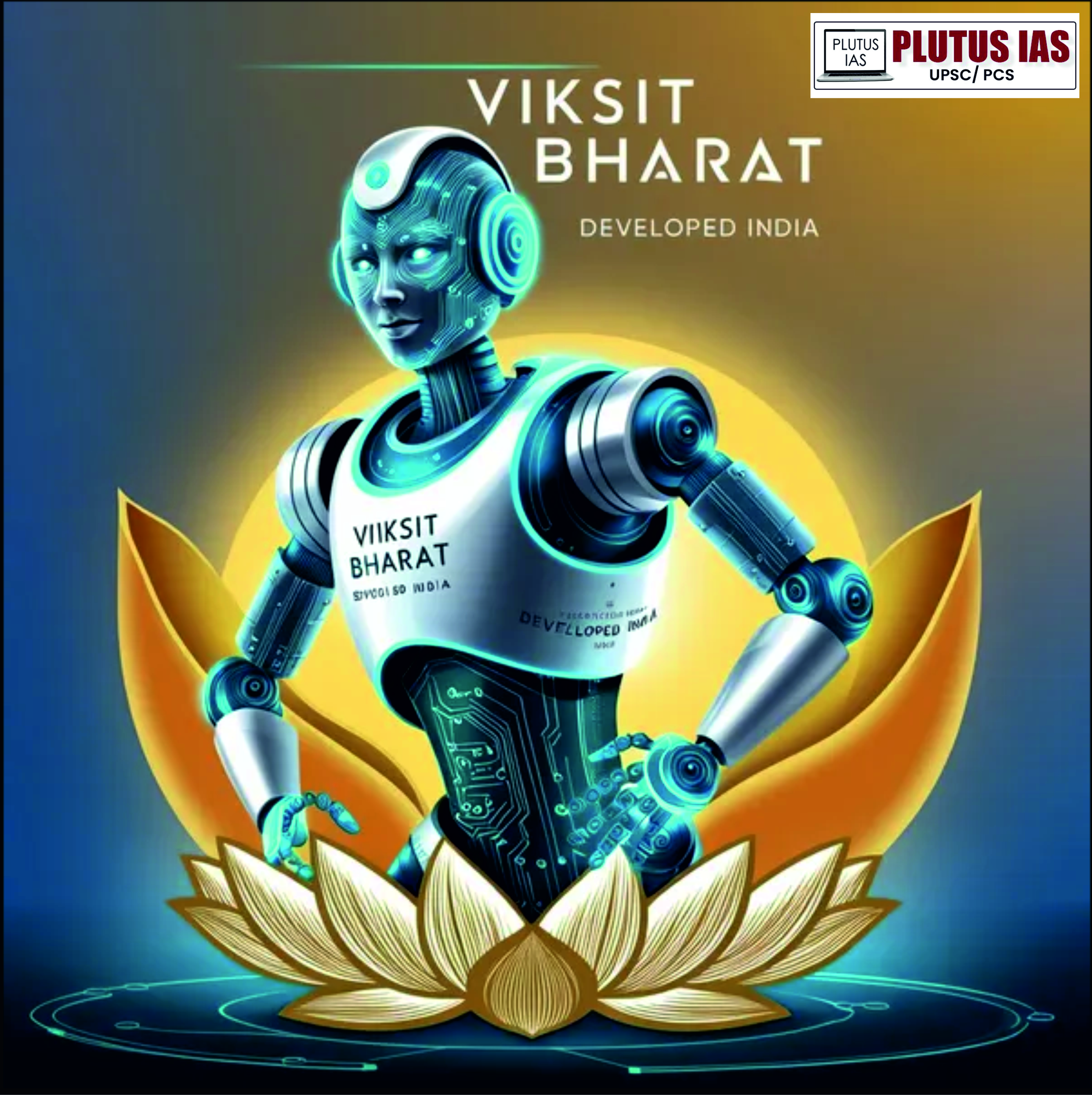
India is rapidly emerging as a global AI leader, with the government actively shaping an inclusive AI ecosystem. For the first time, AI resources like computing power, GPUs, and research opportunities are becoming widely accessible and affordable. Through initiatives like the IndiaAI Mission and Centres of Excellence for AI, the government is empowering students, startups, and innovators, ensuring a level playing field. These efforts align with the vision of Viksit Bharat 2047, leveraging AI for economic growth, governance, and societal progress.

AI Compute and Semiconductor Infrastructure
One of the fundamental pillars of AI growth is robust computational power, underpinned by advanced semiconductor infrastructure. India has recognized this need and is investing heavily in building AI-specific high-performance computing (HPC) capabilities.
Semiconductor Manufacturing: The Indian government launched the Semicon India Programme in 2021, with an outlay of ₹76,000 crores to develop domestic semiconductor manufacturing. Partnerships with Micron Technology, Foxconn, and Vedanta aim to reduce dependency on imports and establish India as a semiconductor hub.
AI Supercomputing Infrastructure: The National Supercomputing Mission (NSM) has been enhancing AI computational capabilities through the PARAM series of supercomputers. Additionally, companies like Tata, Nvidia, and Reliance Jio are collaborating to build AI-focused cloud infrastructure in India.
Example: In 2023, India’s AI research community saw an increase in access to high-performance GPUs through initiatives like the Bhashini Mission and private-sector partnerships.
Advancing AI with Open Data and Centres of Excellence (CoE)
Data is the fuel for AI, and ensuring open and accessible data is key to fostering innovation.
India’s Open Data Initiative: The National Data Governance Framework Policy (NDGFP) promotes open government data, enabling startups and researchers to leverage public datasets for AI model training.
AI Centres of Excellence (CoE): The government is setting up AI CoEs under MeitY (Ministry of Electronics and IT) in collaboration with academic institutions like IITs and IISc to drive AI research and innovation.
Example: NASSCOM’s AI CoEs are working on projects related to healthcare, agriculture, and smart governance, enabling AI adoption across multiple sectors.
India’s AI Models & Language Technologies
India’s linguistic diversity necessitates AI models that cater to multiple languages, making Natural Language Processing (NLP) a key focus area.
Bhashini Initiative: The Bhashini project, launched under Digital India, focuses on creating AI-powered language models that support Indic languages, ensuring digital inclusivity.
Indian Large Language Models (LLMs): Startups like Sarvam AI, Krutrim AI, and AI4Bharat are building LLMs trained on Indic datasets to facilitate AI-driven applications in local languages.
Example: AI models like GPT-4 and Llama 2 are being adapted for Indian languages through initiatives by IIT Madras and AI4Bharat, improving accessibility in education, governance, and customer services.
AI Integration with Digital Public Infrastructure
India’s Digital Public Infrastructure (DPI), including Aadhaar, UPI, and CoWIN, is a model for global digital transformation. AI integration is set to enhance these platforms significantly.
AI-driven Aadhaar & e-Governance: AI is being used for fraud detection in Aadhaar authentication, improving service delivery.
AI in Healthcare & CoWIN Expansion: AI models helped optimize vaccine distribution via CoWIN, and similar technologies are now aiding Ayushman Bharat Digital Mission.
AI in Financial Inclusion: AI-powered chatbots and voice assistants are making financial services accessible to rural populations through platforms like Jan Dhan Yojana and DigiLocker.
AI-powered UPI & Fintech Growth: AI is improving fraud detection, transaction security, and personalized financial services in platforms like PhonePe, Paytm, and Google Pay.
AI for Governance & Public Services: AI-enabled chatbots are enhancing citizen engagement on platforms like MyGov and AI-driven analytics are optimizing government decision-making.
Example: ONDC (Open Network for Digital Commerce) is using AI to democratize e-commerce by enabling small retailers to compete with large players like Amazon and Flipkart.
AI in Smart Cities & Urban Planning: AI-driven traffic management systems, waste management solutions, and predictive policing models are improving urban governance in cities like Bangalore and Pune.
AI in Agriculture & Rural Development: AI-powered weather prediction models and crop advisory systems like Krishi 24×7 and Kisan AI Chatbots are supporting farmers with real-time insights.
India’s Digital Public Infrastructure (DPI), including Aadhaar, UPI, and CoWIN, is a model for global digital transformation. AI integration is set to enhance these platforms significantly.
AI Talent & Workforce Development
Building a skilled AI workforce is essential for sustaining long-term AI innovation.
AI in Education: Institutions like IITs, IIITs, and NITs are integrating AI courses into their curriculum. NASSCOM’s FutureSkills Prime is training professionals in AI and ML.
AI for Rural & MSME Workforce: Initiatives like the Skill India Mission are offering AI upskilling programs for small businesses and rural workers.
Government-Led AI Skilling Programs: The Pradhan Mantri Kaushal Vikas Yojana (PMKVY) now includes AI and data science courses to boost employability.
Corporate AI Training Initiatives: Tech giants like Google, Microsoft, and IBM are partnering with Indian universities to offer AI certifications.
AI Research & Fellowships: SERB (Science and Engineering Research Board) and MeitY are funding AI Ph.D. fellowships and research grants to encourage deep AI expertise.
Example: Google and Microsoft have launched AI skilling programs targeting 2 million Indians, ensuring AI literacy at multiple levels.AI in Schools: The CBSE AI Curriculum is introducing AI literacy atthe school level, ensuring early exposure to AI concepts among students.
Women in AI: Initiatives like WiDS (Women in Data Science) India and NASSCOM’s Women in AI Program aim to bridge the gender gap in AI careers. Building a skilled AI workforce is essential for sustaining long-term AI innovation.
AI Adoption & Industry Growth
The AI-driven industrial revolution is reshaping multiple sectors in India.
AI in Manufacturing: AI-powered predictive maintenance and automation solutions, such as those by TCS and Bosch, are enhancing operational efficiency in factories.
AI in Smart Cities: AI-driven traffic management systems in cities like Bangalore and Delhi are improving urban mobility and reducing congestion.
AI in Retail: Companies like Reliance Jio and Flipkart leverage AI for personalized recommendations, supply chain optimization, and fraud detection.
AI in Governance: The government is using AI in tax compliance (GSTN AI analytics) and AI-driven legal case management to enhance efficiency.
AI in Defence: The Indian armed forces are integrating AI-powered surveillance, autonomous drones, and cybersecurity solutions for national security.AI in Logistics: AI-driven route optimization and automated warehousing solutions by firms like Delhivery and Blue Dart are revolutionizing supply chain management
AI in Healthcare: AI-driven diagnostics (e.g., Wadhwani AI’s tuberculosis detection models) are improving public health outcomes.
AI in Agriculture: AI-based precision farming solutions like AgNext and Gramophone are optimizing crop yields and reducing resource wastage.
AI in Finance: Fintech firms like Razorpay and Paytm leverage AI for fraud detection and personalized financial services.
Example: The AI-powered SATYABHAMA platform in the mining sector is automating compliance and exploration processes.
A Pragmatic AI Regulation Approach
Balancing AI innovation with ethical and security concerns is crucial for responsible AI deployment.
Draft National AI Policy: The Indian government is developing a comprehensive AI framework focusing on safety, ethics, and accountability.
Sector-Specific AI Guidelines: RBI’s AI guidelines for fintech and MeitY’s AI framework for public services ensure responsible AI use.
AI & Cybersecurity Measures: Strengthening AI-driven cybersecurity frameworks to counter threats from deepfakes, data breaches, and algorithmic biases.
AI & Privacy Laws: Integrating AI regulations with the Digital Personal Data Protection Act (DPDP Act, 2023) to protect user rights.
AI Ethics Committees: Establishing AI ethics boards in major institutions to assess and mitigate risks associated with AI applications.
Example: India has rejected overly restrictive AI regulations like EU’s AI Act, opting for a balanced, innovation-friendly approach that protects users while fostering growth.
Conclusion
India’s AI revolution is paving the way for ‘Viksit Bharat’, with advancements in semiconductor infrastructure, AI compute power, and digital public infrastructure. The government’s push for open data, AI skilling programs, and responsible AI regulation ensures sustainable AI-driven economic growth. By fostering a thriving AI ecosystem, India is poised to become a global AI powerhouse, driving innovation and inclusive development towards a prosperous digital future.
Download Plutus IAS Current Affairs (Eng) 7th March 2025
PRELIMS Questions:
Q.With reference to India’s semiconductor manufacturing initiatives, consider the following statements:
1. The Semicon India Programme was launched to promote domestic semiconductor manufacturing.
2. Micron Technology and Vedanta are among the key players collaborating with India in this sector.
3. The initiative is part of the broader National Supercomputing Mission (NSM).
Which of the statements given above is/are correct?
(a) 1 and 2 only
(b) 2 and 3 only
(c) 1 and 3 only
(d) 1, 2, and 3
ANSWER: A
Mains Questions:
Q. Discuss the role of Artificial Intelligence (AI) in India’s vision for Viksit Bharat 2047. Highlight key initiatives taken by the government to promote AI-driven economic and social development. (250 words, 15 marks)


No Comments