


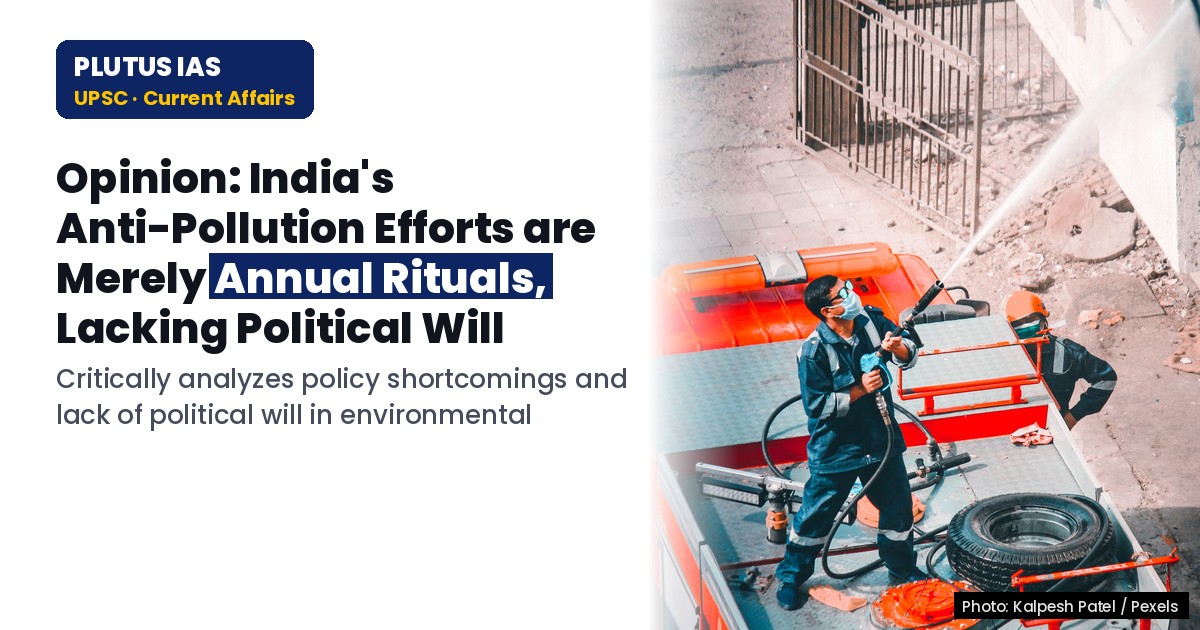
13 Nov India’s Air Pollution: Rituals vs. Effective Policy
✎ India's approach to air pollution often involves seasonal, ritualistic measures, necessitating a shift towards comprehensive, sustained, and equitable policy interventions addressing root causes and ensuring long-term public…
Subject Relevance — Where This Topic Fits
- GS Paper I — Geography of India and the World | GS Paper III — Environment and Ecology | GS Paper III — Disaster Management
- Prelims: Air Quality Index (AQI), Commission for Air Quality Management (CAQM), Stubble burning, Particulate Matter (PM2.5, PM10), National Clean Air Programme (NCAP), Graded Response Action Plan (GRAP)
- Essay: Environmental Governance and Sustainable Development, Balancing Economic Growth with Environmental Protection, Public Health and Policy Implementation
Quick Revision: India’s approach to air pollution often involves seasonal, ritualistic measures, necessitating a shift towards comprehensive, sustained, and equitable policy interventions addressing root causes and ensuring long-term public health and environmental sustainability.
Why is this in the news?
Recent observations highlight a recurring pattern of seasonal anti-pollution measures in India, particularly during winter, raising concerns about their efficacy and the broader policy approach to persistent air quality challenges. The discourse questions whether these interventions address the root causes of pollution or merely serve as temporary, ritualistic responses, with implications for public health and socio-economic equity.
Background
- Air pollution is a significant public health crisis in India, contributing to a substantial burden of disease and premature mortality across various regions.
- The problem intensifies during the winter months, especially in the Indo-Gangetic Plain, due to meteorological conditions that trap pollutants, combined with increased emissions from various sources.
- Key sources of air pollution include vehicular emissions, industrial activities, construction dust, biomass burning (including stubble burning), domestic cooking, and solid waste incineration.
- The Air Quality Index (AQI) was introduced to provide a simple, single-number metric for public communication on air quality, though its role in fostering accountability is debated.
- Government agencies, such as the Commission for Air Quality Management (CAQM) in the National Capital Region and Adjoining Areas, are tasked with formulating and implementing strategies to combat air pollution.
- Policy responses often involve bans on specific activities (e.g., construction, firecrackers, certain fuels) and the deployment of technologies like anti-smog guns and road vacuum cleaners.
Understanding Air Pollution and India’s Policy Landscape
- Air pollution refers to the presence of substances in the atmosphere that are harmful to human health and the environment, primarily comprising particulate matter (PM2.5, PM10), nitrogen oxides (NOx), sulfur dioxide (SO2), carbon monoxide (CO), and ozone (O3).
- The National Clean Air Programme (NCAP), launched in 2019, aims to achieve a 20-30% reduction in PM2.5 and PM10 concentrations by 2024, with 131 non-attainment cities identified for targeted interventions.
- The Graded Response Action Plan (GRAP) is an emergency measure implemented in the National Capital Region (NCR) to combat air pollution, prescribing progressively stricter actions based on the severity of air quality levels.
- Stubble burning, the practice of intentionally setting fire to crop residue after harvest, is a major contributor to winter air pollution in northern India, prompting efforts for in-situ and ex-situ management solutions.
- The socio-economic implications of anti-pollution measures are significant, with concerns raised about the disproportionate impact on daily-wage laborers, small businesses, and economically vulnerable populations.
- Effective waste management, including segregation, processing, and disposal, is crucial for mitigating air pollution from landfill fires and open burning of waste.
- Long-term solutions necessitate a multi-sectoral approach encompassing technological advancements, behavioral changes, robust enforcement mechanisms, and sustained public engagement beyond seasonal interventions.
- The ‘polluter pays’ principle, enshrined in environmental law, holds that those who produce pollution should bear the costs of managing it to prevent damage to human health or the environment.
Key Features
| Feature | Significance |
|---|---|
| Annual Anti-Pollution Rituals | Characterised by short-term, visible actions such as mist cannons, anti-smog guns, and tree-planting drives, often lacking sustained impact. |
| Focus on Seasonal Disruptors | Emphasis on factors like stubble burning and firecrackers, diverting attention from systemic environmental degradation. |
| Disproportionate Impact on Vulnerable Populations | Measures like construction bans and restrictions on ‘dirty energy’ disproportionately affect daily-wage labourers and small businesses. |
| Obsession with Air Quality Index (AQI) | The daily monitoring of AQI in certain regions, particularly Delhi, has become a measure of acceptance rather than accountability. |
| Lack of Political Demand for Environmental Measures | Absence of sustained public pressure in most states beyond Delhi for comprehensive environmental policies. |
Why it Matters
Environmental Significance
- Highlights the persistent failure to address the root causes of air pollution, leading to chronic environmental degradation.
- Underscores the inadequacy of current policy approaches in achieving sustainable air quality improvements across India.
Social Significance
- Reveals the exacerbation of socio-economic inequalities, as anti-pollution measures often burden the poor and daily-wage earners.
- Indicates a potential erosion of public health and quality of life due to prolonged exposure to high levels of air pollution.
Governance Significance
- Points to a gap in policy implementation and enforcement, where short-term, visible actions are prioritised over long-term strategic planning.
- Suggests a need for more robust mechanisms of accountability and public participation in environmental governance.
Challenges
1. Ineffectiveness of Current Measures
- Existing anti-pollution initiatives are often superficial and fail to address the systemic issues contributing to air pollution.
- The focus on ‘ritualistic’ actions rather than comprehensive, sustained interventions limits their efficacy.
UPSC Link: Environmental Pollution and Degradation
2. Socio-Economic Disparities in Policy Impact
- Anti-pollution regulations disproportionately affect vulnerable populations, such as daily-wage labourers and small businesses, without adequate compensatory mechanisms.
- This creates a perception of policies being punitive to the poor while protecting more privileged segments of society.
UPSC Link: Social Justice; Vulnerable Sections
3. Lack of Sustained Political Will and Public Pressure
- Beyond specific regions like Delhi, there is a notable absence of consistent political demand and public pressure for robust environmental policies.
- This hinders the formulation and implementation of long-term, impactful solutions.
UPSC Link: Governance; Environmental Policy
4. Fragmented and Reactive Approach
- The policy framework tends to be reactive, focusing on seasonal events and visible disruptors rather than a holistic and proactive strategy.
- This leads to a cycle of annual interventions without fundamental improvements in environmental quality.
UPSC Link: Environmental Management; Policy Formulation
5. Data Interpretation and Accountability
- The obsession with AQI numbers, particularly in Delhi, has become a monitoring exercise rather than a trigger for accountability and effective action.
- This can lead to a normalisation of poor air quality and reduced public expectations for improvement.
UPSC Link: Environmental Monitoring; Public Accountability
Challenges — UPSC Perspective
| Issue | Concern |
|---|---|
| Annual Anti-Pollution ‘Rituals’ | These measures are often symbolic, short-term, and fail to address the underlying, persistent causes of air pollution. |
| Disproportionate Impact on the Poor | Regulations such as construction bans or restrictions on ‘dirty energy’ primarily affect daily-wage labourers and small enterprises, exacerbating economic hardship. |
| Focus on Seasonal Factors | Overemphasis on stubble burning and firecrackers diverts attention from industrial emissions, vehicular pollution, and waste management failures. |
| Lack of Comprehensive Waste Management | Ineffective waste management practices contribute significantly to air pollution through open burning and landfill emissions. |
| Limited Political and Public Demand | Outside of specific urban centres, there is a general lack of sustained political will and public pressure to implement stringent environmental measures. |
Way Forward
- Implement a comprehensive, multi-sectoral strategy addressing all major sources of air pollution, including industrial emissions, vehicular pollution, waste management, and construction dust.
- Develop and enforce equitable anti-pollution policies that include provisions for financial relief or alternative livelihoods for vulnerable populations affected by restrictions.
- Strengthen inter-state and inter-agency coordination for effective implementation of pollution control measures, particularly for transboundary issues like stubble burning.
- Invest in advanced, real-time monitoring systems beyond AQI, coupled with transparent data dissemination and public accountability mechanisms.
- Promote public awareness and civic engagement to foster sustained political demand for environmental protection and sustainable practices.
- Incentivise the adoption of cleaner technologies and sustainable practices across industries, agriculture, and urban development.
- Prioritise research and development into cost-effective and scalable solutions for air pollution control, including alternative energy sources and waste-to-energy technologies.
UPSC Value Addition
Keywords for Mains Answer-Writing
Air Pollution Management · National Clean Air Programme (NCAP) · Commission for Air Quality Management (CAQM) · Sustainable Development Goals (SDGs) · Environmental Governance · Public Health Policy · Socio-economic Disparities · Polluter Pays Principle · Green Economy · Circular Economy
Constitutional & Policy Linkages
- Article 21: Right to a healthy environment
- Article 48A: Protection and improvement of environment
- Article 51A(g): Duty to protect and improve environment
Concept Flow
Annual pollution rituals implemented → Root causes of pollution remain unaddressed → Air quality deteriorates, especially in winter → Vulnerable populations disproportionately affected → Public health and quality of life compromised → Cycle of ineffective policy responses continues
Prelims Practice Questions
Q1. Consider the following statements regarding air pollution in India:
1. The National Clean Air Programme (NCAP) aims to reduce particulate matter concentration by 20-30% by 2024, with 2017 as the base year.
2. The Commission for Air Quality Management (CAQM) is a statutory body established to coordinate efforts to improve air quality in the National Capital Region and adjoining areas.
3. Stubble burning is a significant contributor to air pollution, particularly in northern India during winter months.
How many of the above statements are correct?
- Only one
- Only two
- All three
- None
Answer: All three — Statement 1 is incorrect: The NCAP initially aimed for a 20-30% reduction by 2024, but this target has since been revised to a 40% reduction in particulate matter concentration by 2026. Statement 2 is correct: The CAQM was established by an Act of Parliament in 2021, making it a statutory body. Statement 3 is correct: Stubble burning in states like Punjab and Haryana is a well-documented major source of air pollution in the Indo-Gangetic Plain.
Q2. Which of the following is NOT a primary pollutant directly emitted into the atmosphere?
- Sulphur Dioxide (SO2)
- Nitrogen Oxides (NOx)
- Ozone (O3)
- Carbon Monoxide (CO)
Answer: Ozone (O3) — Ozone (O3) in the troposphere is a secondary pollutant, formed when primary pollutants such as nitrogen oxides and volatile organic compounds react in the presence of sunlight. Sulphur Dioxide, Nitrogen Oxides, and Carbon Monoxide are primary pollutants.
Mains Practice Question
✍ Critically examine the effectiveness of India’s current policy approach to combating air pollution, particularly in urban centres. Discuss the socio-economic implications of short-term, ritualistic measures on vulnerable populations. (15 Marks)
Approach: MODEL-ANSWER SKELETON:
1. **Introduction:** Briefly define air pollution as a major public health and environmental challenge in India, especially in urban areas.
2. **Effectiveness of Current Policy Approach (Critical Examination):**
* **Strengths:** Mention initiatives like NCAP, CAQM, Graded Response Action Plan (GRAP), promotion of cleaner fuels (BS-VI), and renewable energy.
* **Weaknesses/Criticisms:** Focus on the ‘ritualistic’ nature as highlighted in the article – seasonal bans, mist cannons, anti-smog guns, tree-planting drives often lacking sustained impact. Discuss the lack of comprehensive, year-round, source-specific interventions. Emphasise the disproportionate focus on visible, seasonal disruptors (stubble burning, firecrackers) without addressing systemic issues (industrial emissions, vehicular pollution, waste management, construction dust).
* **Implementation Gaps:** Highlight issues of inter-agency coordination, enforcement, and data-driven policy formulation.
3. **Socio-economic Implications of Short-term Measures:**
* **Impact on Daily Wage Labourers:** Discuss how construction bans or restrictions on ‘dirty energy’ disproportionately affect informal sector workers, leading to loss of livelihood without adequate compensation or alternative support mechanisms (e.g., CAQM ban on construction and its impact on Gurgaon/Manesar workers).
* **Impact on Small Businesses/Eateries:** Explain how regulations targeting ‘small fires’ or certain energy sources can hinder the survival strategies of the poor and small enterprises.
* **Exacerbation of Inequality:** Refer to the ‘laptop class’ analogy – measures that protect the privileged while imposing costs and risks on ordinary workers.
* **Health Disparities:** Mention how the poor often live in more polluted areas and have less access to protective measures or healthcare, compounding the health burden.
4. **Conclusion:** Summarise the need for a paradigm shift from reactive, ritualistic measures to a proactive, comprehensive, equitable, and sustained long-term strategy that addresses root causes and integrates socio-economic considerations.
Source: The Indian Express
Generated by AanyaAi for educational purpose.
Related guides on our sites
- Best PSIR optional coaching for upsc
- Best PSIR optional teacher for upsc
- Best teacher of PSIR optional for upsc
- Best PSIR optional coaching in delhi for UPSC

- NAMASTE Scheme: Enhancing Sanitation Workers’ Livelihoods & Safety - November 14, 2026
- एमएसएमई का विशेष अभियान 6.0: स्वच्छता और लंबित मामलों का निपटारा - November 14, 2026
- Sea Vigil-26: Coastal Defence Drills Off Visakhapatnam - November 14, 2026

No Comments