


21 Sep India’s G20 Energy Consensus: Key Outcomes for UPSC & State PCS Aspirants
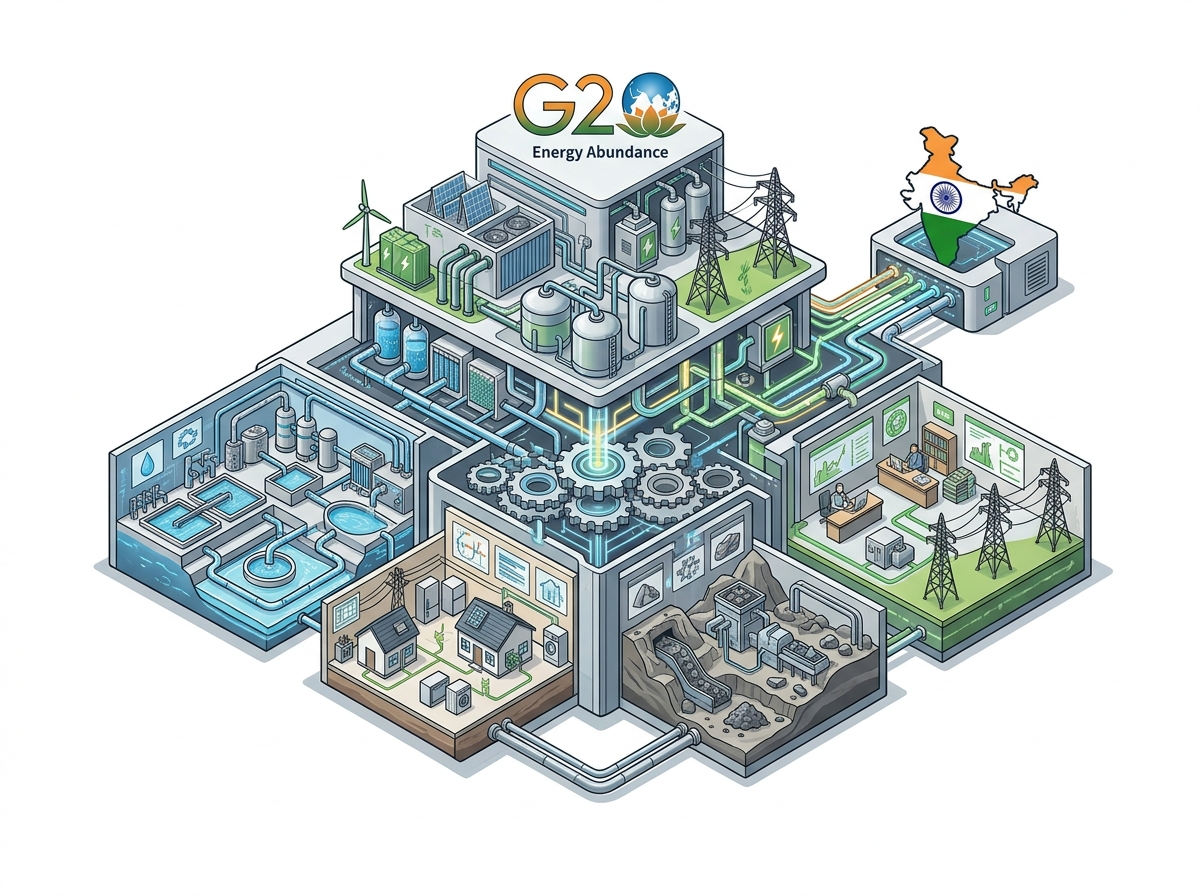
✎ The G20 Energy Abundance Ministerial outcomes focus on four pillars: household energy access (via LPG adoption), permitting efficiency, water reuse, and resilient critical-mineral supply chains—all aimed at balancing energy…
Subject Relevance — Where This Topic Fits
- GS Paper II — International Organisations | GS Paper III — Infrastructure, Energy, and Sustainable Development
- Prelims: G20, Energy Transition, Critical Minerals, LPG Access, Water Reuse, Permitting Efficiency, Energy Security
- Essay: The Role of Multilateral Consensus in Addressing Global Energy Challenges, Balancing Energy Security, Sustainability, and Economic Growth
Quick Revision: The G20 Energy Abundance Ministerial outcomes focus on four pillars: household energy access (via LPG adoption), permitting efficiency, water reuse, and resilient critical-mineral supply chains—all aimed at balancing energy security, affordability, and sustainability.
Why is this in the news?
India’s recent endorsement of the G20 Energy Abundance Ministerial consensus outcomes marks a significant step in aligning domestic energy policies with global frameworks. The agreements focus on four critical areas—household energy access, infrastructure approvals, water reuse, and secure critical-mineral supply chains—reflecting India’s commitment to sustainable energy transitions while addressing developmental priorities. This development is particularly pertinent given India’s role as a major energy consumer and its ongoing efforts to balance affordability, reliability, and environmental sustainability in its energy sector.
Background
- The G20 Energy Abundance Working Group was established to address global energy security challenges, particularly in the context of post-pandemic economic recovery and the transition to cleaner energy systems.
- India’s participation underscores its growing engagement in global energy governance, aligning with its commitments under international agreements such as the Paris Agreement and the UN Sustainable Development Goals.
- The consensus outcomes build on prior G20 initiatives, including the 2021 Rome Summit’s focus on energy transition and the 2022 Bali Leaders’ Declaration on sustainable energy.
- The adoption of voluntary frameworks reflects a shift toward flexible, non-binding cooperation in global energy governance, allowing nations to tailor commitments to domestic priorities.
- India’s domestic context includes its ambitious targets for renewable energy expansion (500 GW by 2030) and the Pradhan Mantri Ujjwala Yojana (PMUY), which aims to provide LPG connections to 80 million households.
What are the G20 Energy Consensus Outcomes?
- The G20 Energy Abundance Ministerial in Houston adopted four consensus outcomes to enhance global energy security, affordability, and sustainability.
- Household energy access: Ministers endorsed affordable and scalable solutions, recognising LPG as a transitional fuel for replacing traditional biomass in developing countries where reliable LPG infrastructure exists.
- Permitting and regulatory efficiency: The consensus calls for streamlined, predictable, and effective domestic processes for infrastructure approvals to accelerate energy and industrial projects.
- Water reuse initiative: A voluntary framework promotes the safe and purpose-specific reuse of water across sectors, including energy production, agriculture, and manufacturing, to enhance resource efficiency.
- Critical-mineral supply chains: The agreement emphasizes diversified, resilient, and secure supply chains for minerals essential to energy transitions, including information-sharing, investment, and local value addition.
- The outcomes align with the G20’s broader priorities of energy security, affordability, and environmental sustainability, while respecting national sovereignty over natural resources.
- The consensus is non-binding, allowing member states to implement commitments in a manner consistent with their domestic legal and policy frameworks.
- The agreements complement existing multilateral initiatives, such as the International Energy Agency’s (IEA) Critical Minerals Market Reviews and the World Bank’s Energy Sector Management Assistance Program (ESMAP).
Key Features
| Feature | Significance |
|---|---|
| Household energy access consensus | Promotes affordable and scalable energy solutions, with specific recognition of LPG as a transitional fuel to replace traditional biomass, particularly in developing nations. |
| Permitting and regulatory efficiency for infrastructure | Advocates for streamlined, predictable, and effective domestic approval processes to accelerate energy and infrastructure project implementation. |
| Voluntary water-reuse initiative | Encourages cross-sectoral adoption of water reuse practices, ensuring sustainable water management for energy production, agriculture, and manufacturing. |
| Critical-mineral supply chain resilience | Establishes voluntary cooperation for diversified, secure, and affordable mineral value chains through information-sharing, innovation, and local value addition. |
Why it Matters
Global Energy Governance
- Reinforces multilateral cooperation under the G20 framework to address energy security, affordability, and sustainability through consensus-based outcomes.
- Demonstrates India’s alignment with global priorities in energy transition, infrastructure development, and critical mineral security.
- Highlights the role of the G20 Energy Abundance Working Group in shaping policy agendas for energy resilience and economic growth.
Domestic Policy Implications
- Aligns with India’s energy transition goals, particularly in reducing household pollution through cleaner cooking fuels and improving infrastructure approval processes.
- Supports India’s strategic focus on critical minerals, essential for renewable energy technologies, electric vehicles, and advanced manufacturing.
- Encourages adoption of water reuse practices to address water scarcity challenges in energy-intensive sectors.
Economic and Industrial Impact
- Facilitates investment in energy infrastructure, as evidenced by commercial announcements such as Hitachi Energy’s $528 million facility in the U.S.
- Promotes job creation and industrial growth through expanded energy and manufacturing sectors, contributing to economic resilience.
- Encourages innovation and capacity-building in critical mineral supply chains, fostering self-reliance and reducing import dependence.
Environmental Sustainability
- Addresses household air pollution by promoting LPG adoption, aligning with SDG 7 (Affordable and Clean Energy) and SDG 13 (Climate Action).
- Supports water conservation and reuse, contributing to SDG 6 (Clean Water and Sanitation) and reducing environmental strain.
- Encourages diversification of energy sources to reduce carbon intensity and enhance energy security.
Challenges
1. Transition from Traditional Biomass to Cleaner Fuels
- High upfront costs for LPG adoption in rural and low-income households may limit scalability without targeted subsidies or financial incentives.
- Cultural and behavioral resistance to adopting LPG in regions accustomed to traditional biomass fuels.
- Logistical challenges in ensuring reliable LPG supply chains in remote and underserved areas.
UPSC Link: SDG 7: Energy Access and Affordability
2. Regulatory and Permitting Bottlenecks
- Complex and time-consuming approval processes for energy infrastructure projects, leading to delays and cost overruns.
- Fragmented regulatory frameworks across states and sectors, requiring harmonization for efficiency.
- Need for capacity-building among bureaucratic and technical stakeholders to implement streamlined processes.
UPSC Link: Ease of Doing Business: Infrastructure Approvals
3. Water Scarcity and Reuse Adoption
- Limited awareness and technological readiness for water reuse in energy-intensive sectors such as thermal power plants and manufacturing.
- Regulatory and policy gaps in incentivizing water reuse, particularly in agriculture and industrial applications.
- High initial investment costs for water treatment and reuse infrastructure, requiring public-private partnerships.
UPSC Link: SDG 6: Water and Sanitation Management
4. Critical Mineral Supply Chain Vulnerabilities
- Overreliance on a limited number of suppliers for critical minerals, exposing economies to geopolitical and supply chain disruptions.
- Environmental and social concerns associated with mining and processing of critical minerals, necessitating sustainable practices.
- Need for domestic processing and value addition to reduce import dependence and enhance economic resilience.
UPSC Link: National Mineral Policy: Supply Chain Resilience
Challenges — UPSC Perspective
| Issue | Concern |
|---|---|
| Affordability of LPG for low-income households | Financial barriers may hinder adoption despite policy support. |
| Regulatory fragmentation in infrastructure approvals | Delays and inefficiencies in project implementation. |
| Technological readiness for water reuse | Limited adoption due to lack of infrastructure and expertise. |
| Geopolitical risks in critical mineral supply chains | Vulnerability to supply disruptions and price volatility. |
| Environmental degradation from mineral extraction | Need for sustainable mining practices to mitigate ecological impact. |
Way Forward
- Enhance financial incentives and subsidies for LPG adoption in rural and underserved areas to ensure equitable access.
- Establish a national-level task force to harmonize regulatory frameworks for energy infrastructure approvals, reducing bureaucratic delays.
- Develop a national water-reuse policy with clear guidelines, incentives, and capacity-building programs for industries and agriculture.
- Invest in domestic critical mineral processing and refining infrastructure to reduce import dependence and strengthen supply chain resilience.
- Promote research and development in alternative materials and technologies to diversify supply chains and reduce reliance on scarce minerals.
- Strengthen international cooperation under the G20 framework to share best practices in energy transition, regulatory efficiency, and water management.
- Integrate climate resilience and environmental safeguards into all energy and infrastructure projects to align with global sustainability goals.
UPSC Value Addition
Keywords for Mains Answer-Writing
G20 Energy Abundance Ministerial 2026 · Household energy access · LPG adoption for clean cooking · Permitting and regulatory efficiency for energy infrastructure · Water reuse initiatives in energy and agriculture · Critical mineral supply chains resilience · G20 Energy Abundance Working Group · Affordable baseload power · Energy security and diversification · Domestic regulatory processes for infrastructure projects
Concept Flow
G20 Energy Abundance Ministerial identifies global energy challenges → → Ministers adopt consensus outcomes on energy access, permitting, water reuse, and critical minerals → → India aligns with these outcomes, reinforcing its commitment to energy transition and sustainability → → Domestic policy adjustments are required to implement these consensus points, particularly in LPG adoption, regulatory reforms, and water management → → Economic and industrial sectors benefit from improved energy security, infrastructure efficiency, and sustainable resource use → → Long-term outcomes include reduced pollution, enhanced resilience, and alignment with global sustainability targets.
Prelims Practice Questions
Q1. Consider the following statements regarding the outcomes of the G20 Energy Abundance Ministerial held in Houston, 2026:
1. Ministers adopted a voluntary water-reuse initiative covering communities, energy production, manufacturing, and agriculture.
2. The consensus included a mandatory global target for liquefied petroleum gas (LPG) adoption in all developing countries.
3. The agreements emphasized the need for resilient, affordable, secure, and diversified critical-mineral value chains.
How many of the above statements are correct?
- Only one
- Only two
- Only three
- None
Answer: Only two — Statement 1 is correct as the ministerial adopted a voluntary water-reuse initiative. Statement 2 is incorrect because the LPG adoption was framed as an affordable and scalable approach, not a mandatory global target. Statement 3 is correct as the consensus called for resilient critical-mineral supply chains.
Q2. Assertion (A): The G20 Energy Abundance Ministerial outcomes prioritize permitting and regulatory efficiency for energy infrastructure projects.
Reason (R): The outcomes aim to reduce bureaucratic delays and enhance the predictability of project approvals to accelerate energy infrastructure development.
In the context of the above statements, which of the following is correct?
- Both A and R are true, and R is the correct explanation of A.
- Both A and R are true, but R is not the correct explanation of A.
- A is true, but R is false.
- A is false, but R is true.
Answer: Both A and R are true, and R is the correct explanation of A. — Assertion (A) is true as the outcomes explicitly call for efficient permitting and regulatory processes. Reason (R) correctly explains why this is prioritized— to reduce delays and enhance predictability in project approvals.
Q3. Match the following outcomes of the G20 Energy Abundance Ministerial 2026 with their respective focus areas:
Column I (Outcome) | Column II (Focus Area)
1. Household energy access | A. Resilient critical-mineral supply chains
2. Permitting and regulatory efficiency | B. Affordable and scalable clean cooking fuels
3. Water reuse initiative | C. Efficient domestic permitting for infrastructure
4. Critical-mineral supply chains | D. Voluntary water-reuse across sectors
Select the correct match:
- 1-B, 2-C, 3-D, 4-A
- 1-A, 2-B, 3-C, 4-D
- 1-D, 2-A, 3-B, 4-C
- 1-C, 2-D, 3-A, 4-B
Answer: 1-B, 2-C, 3-D, 4-A — 1-B: Household energy access focuses on affordable and scalable clean cooking fuels like LPG. 2-C: Permitting and regulatory efficiency aims to streamline domestic infrastructure approvals. 3-D: The water reuse initiative promotes voluntary water-reuse across sectors. 4-A: Critical-mineral supply chains focus on resilience and diversification.
Mains Practice Question
✍ The G20 Energy Abundance Ministerial outcomes adopted in Houston, 2026, emphasize energy security, regulatory efficiency, and resilient supply chains. Critically examine the significance of these outcomes for India’s energy transition and sustainable development goals. (15 Marks)
Approach: MODEL-ANSWER SKELETON:
1. **Introduction**: Contextualise India’s energy challenges—household biomass dependence, infrastructure bottlenecks, water scarcity, and critical mineral import reliance. Cite India’s commitments under SDG 7 (Affordable and Clean Energy) and NITI Aayog’s energy transitions reports.
2. **Household Energy Access (LPG Adoption)**:
– Explain India’s Pradhan Mantri Ujjwala Yojana (PMUY) and its impact on reducing indoor air pollution.
– Discuss the G20 consensus on LPG as a scalable clean cooking fuel and its alignment with India’s energy transition goals.
– Critique: Challenges in LPG penetration in remote areas and the need for complementary policies (e.g., biogas, electric cooktops).
3. **Permitting and Regulatory Efficiency**:
– Highlight India’s current regulatory delays in energy infrastructure (e.g., coal, renewables, transmission projects).
– Reference the G20 call for predictable permitting and compare with India’s Ease of Doing Business reforms (e.g., single-window clearances under the National Infrastructure Pipeline).
– Critique: Implementation gaps in state-level compliance and judicial delays in environmental clearances.
4. **Water Reuse Initiative**:
– Link to India’s water-stressed regions (e.g., Punjab, Maharashtra) and the National Water Mission.
– Discuss the G20’s voluntary framework for water reuse in energy, agriculture, and manufacturing.
– Critique: Policy fragmentation and lack of incentivisation for water recycling in industrial sectors.
5. **Critical Mineral Supply Chains**:
– Outline India’s import dependence for lithium, cobalt, and rare earths (e.g., 100% import reliance for lithium-ion batteries).
– Discuss the G20 consensus on diversifying supply chains and India’s strategic mineral policy (e.g., MMDR Act amendments, Khanij Bidesh India Ltd.).
– Critique: Challenges in domestic mining, R&D gaps, and geopolitical risks in supply chain diversification.
6. **Conclusion**:
– Summarise the strategic value of G20 consensus for India’s energy security and climate goals.
– Emphasise the need for domestic policy coherence, inter-ministerial coordination (e.g., Ministry of Power, MNRE, MoEFCC), and public-private partnerships to translate G20 commitments into action.
Source: orissapost.com
Generated by AanyaAi for educational purpose.
Related guides on our sites
- Best PSIR optional coaching for upsc
- Best PSIR optional teacher for upsc
- Best teacher of PSIR optional for upsc
- Best PSIR optional coaching in delhi for UPSC

- India’s G20 Energy Consensus: Key Outcomes for UPSC & State PCS Aspirants - September 21, 2026
- मध्य प्रदेश स्वामित्व योजना: मुफ्त भूमि रजिस्ट्री में पटवारी की भूमिका, विवादों में सरकार करेगी पैरवी - September 21, 2026
- MP Swamitva Scheme: New Free Land Registry Plan with Patwari Role Clarified - September 21, 2026

No Comments