


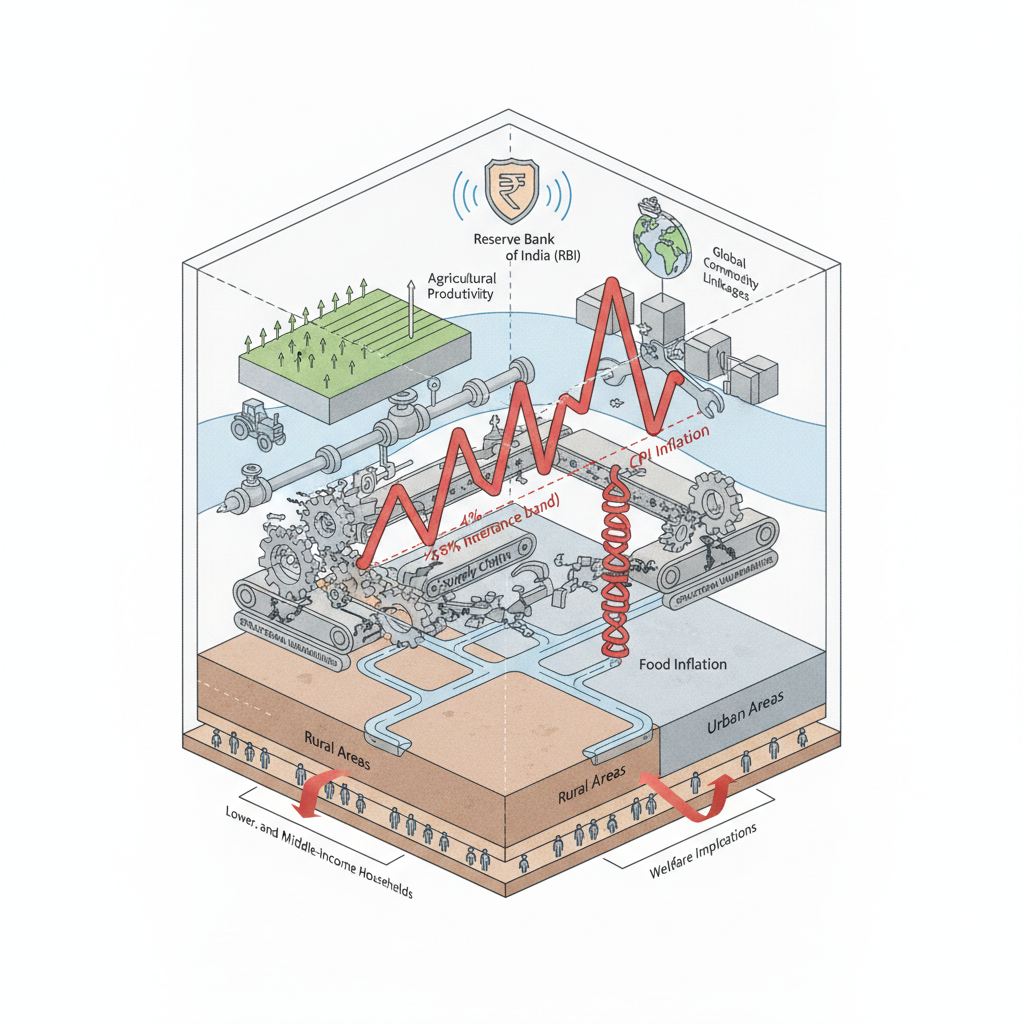
20 Sep India’s Inflation Crisis: RBI’s 4% Target Challenge & Policy Solutions for 2026
✎ Inflation in India is primarily driven by supply-side constraints in agriculture and global commodity prices, necessitating structural reforms in supply chain resilience, climate-resilient agriculture, and calibrated monetary…
Subject Relevance — Where This Topic Fits
- GS Paper III — Indian Economy: Issues relating to Planning, Mobilization of Resources, Growth, Development and Employment | GS Paper III — Effects of Liberalization on the Economy, Changes in Industrial Policy and their Effects on Industrial Growth | GS Paper III — Government Budgeting and Fiscal Policy | GS Paper III — Inclusive Growth and Issues Arising from it | GS Paper III — Food Security and Public Distribution System
- Prelims: Consumer Price Index (CPI), Wholesale Price Index (WPI), Core Inflation, Headline Inflation, Monetary Policy Committee (MPC), Repo Rate, Reverse Repo Rate, Cash Reserve Ratio (CRR), Food Inflation, Supply Chain Management, Cold Storage Infrastructure, Fiscal Policy, Subsidies, Direct Benefit Transfer (DBT), Agricultural Productivity, Minimum Support Price (MSP), Agri-Infrastructure Fund
- Essay: The interplay between economic growth and inflation: Balancing development with price stability, Sustainable development and climate resilience: Integrating environmental policy with economic governance
Quick Revision: Inflation in India is primarily driven by supply-side constraints in agriculture and global commodity prices, necessitating structural reforms in supply chain resilience, climate-resilient agriculture, and calibrated monetary policy to achieve sustainable price stability.
Why is this in the news?
Recent data from the Ministry of Statistics and Programme Implementation indicates a sustained rise in India’s headline Consumer Price Index (CPI) inflation to 4.82% in August 2026, up from 4.45% in July, with food inflation reaching 5.95%. While headline inflation remains within the Reserve Bank of India’s (RBI) 2–6% tolerance band, it has breached the central bank’s 4% medium-term target for three consecutive months. The persistence of food-price pressures, particularly in rural areas (5.23% vs. urban 4.31%), underscores the need for a multi-pronged policy response that addresses structural vulnerabilities in supply chains, agricultural productivity, and global commodity linkages.
Background
- Inflation is a persistent challenge for India’s macroeconomic stability, with significant welfare implications for households, particularly those in lower- and middle-income brackets whose expenditure is disproportionately allocated to essential goods such as food, housing, and transport.
- India’s inflation dynamics are influenced by both domestic and global factors, including agricultural productivity, weather variability, storage and logistics inefficiencies, and fluctuations in global crude oil prices, which impact transportation and manufacturing costs.
- The Reserve Bank of India (RBI) operates under a flexible inflation-targeting framework, with a mandate to maintain headline inflation within a 2–6% band and a medium-term target of 4% ± 2%. Monetary policy tools, such as the repo rate and reverse repo rate, are calibrated to influence demand and inflation expectations.
- Agricultural supply chains in India suffer from significant post-harvest losses (estimated at 10–15% for perishable commodities), inadequate cold storage infrastructure, and fragmented market integration, which exacerbate price volatility.
- Climate change has intensified the frequency and severity of weather-related shocks (e.g., droughts, floods, and heatwaves), disrupting agricultural output and contributing to food-price inflation.
- India’s reliance on imported edible oils (approximately 60% of domestic consumption) and crude oil (over 80% of domestic demand) exposes the economy to global commodity price volatility, particularly geopolitical disruptions in supply chains.
What is Inflation and Why Does It Matter for India?
- Inflation refers to the sustained rise in the general price level of goods and services in an economy over a period of time, eroding the purchasing power of money and reducing real incomes, particularly for vulnerable households.
- Headline inflation, measured by the Consumer Price Index (CPI), captures price changes across a basket of goods and services, including food, fuel, housing, and transport, and is the primary metric for monetary policy decisions in India.
- Food inflation, a subset of headline inflation, disproportionately affects low- and middle-income households, as food constitutes a larger share of their expenditure (over 50% in rural areas and approximately 40% in urban areas).
- Core inflation excludes volatile components such as food and fuel, providing a clearer picture of underlying price pressures and the effectiveness of monetary policy in managing demand-side inflation.
- Inflation is influenced by both demand-side factors (e.g., rising incomes, credit expansion, and fiscal stimulus) and supply-side factors (e.g., agricultural productivity, supply chain disruptions, and global commodity prices).
- For a developing economy like India, managing inflation is a delicate balance between containing price pressures and sustaining economic growth, employment, and investment.
- The Reserve Bank of India (RBI) uses monetary policy tools—such as the repo rate, reverse repo rate, and cash reserve ratio (CRR)—to influence inflation expectations and demand conditions, while fiscal policy tools (e.g., subsidies, direct benefit transfers) are employed to mitigate the welfare impact on vulnerable populations.
- Structural reforms in agriculture, supply chain management, and climate resilience are essential to address the root causes of inflation and reduce its persistence beyond short-term cyclical factors.
Key Features
| Feature | Significance |
|---|---|
| Headline CPI Inflation (4.82% in August 2026) | Exceeds RBI’s 4% medium-term target, indicating persistent price pressures despite remaining within the 2–6% tolerance band. |
| Food Inflation (5.95%) | Disproportionately impacts lower- and middle-income households due to high expenditure share on essential food items. |
| Rural vs Urban Inflation (5.23% vs 4.31%) | Higher rural inflation reflects greater sensitivity to food price shocks and supply chain vulnerabilities in agricultural regions. |
| Second-Round Effects | Rising food and fuel prices transmit to broader inflation via increased production and logistics costs, necessitating broader policy responses. |
| Import Dependency (Edible Oils & Crude Oil) | Exposes domestic inflation to global price volatility and geopolitical risks, complicating monetary and fiscal management. |
Why it Matters
Economic Stability
- Sustained inflation erodes household purchasing power, particularly for vulnerable sections, and may dampen consumer demand and savings.
- Persistent inflation above target can lead to unanchored inflation expectations, complicating long-term investment and growth planning.
Policy Coordination
- Requires synchronised action between monetary policy (RBI), fiscal measures (government), and supply-side interventions (agriculture, logistics).
- Highlights the limitations of monetary policy alone in addressing structural supply-side constraints in food and energy markets.
Structural Vulnerabilities
- Agricultural productivity, post-harvest losses, and climate resilience directly influence food inflation, necessitating long-term agricultural reforms.
- Dependence on imported crude oil and edible oils creates exposure to global commodity price fluctuations and geopolitical risks.
Social Equity
- Lower- and middle-income households face disproportionate welfare losses due to higher expenditure shares on essential goods and services.
- Inflation exacerbates inequality by reducing real incomes and increasing the cost of living for the most vulnerable.
Challenges
1. Supply Chain Bottlenecks
- Inefficient cold storage, inadequate warehousing, and poor transportation networks lead to significant post-harvest losses (estimated at 20–30% for perishables).
- Fragmented agricultural markets limit price discovery and reduce market efficiency, exacerbating price volatility.
UPSC Link: Agricultural Marketing (APMC Act) reforms
2. Climate-Induced Agricultural Shocks
- Increasing frequency of extreme weather events (droughts, floods) disrupts crop cycles and reduces agricultural output, triggering food price spikes.
- Limited adoption of climate-resilient crop varieties and precision agriculture techniques increases vulnerability to weather shocks.
UPSC Link: National Mission for Sustainable Agriculture
3. Global Commodity Price Volatility
- India’s reliance on imported edible oils (70% of domestic demand) and crude oil exposes domestic inflation to global price swings.
- Geopolitical tensions (e.g., supply disruptions in West Asia) can rapidly transmit to domestic inflation via higher input costs.
UPSC Link: Global Supply Chain Resilience
4. Monetary Policy Constraints
- Monetary tightening to curb inflation may dampen investment and employment, particularly in labour-intensive sectors.
- Second-round effects from supply-side shocks limit the effectiveness of interest rate adjustments alone.
UPSC Link: RBI’s Monetary Policy Framework
5. Fiscal Space Limitations
- Subsidies on food and fuel to mitigate inflationary pressures strain fiscal resources, limiting scope for public investment.
- Balancing inflation control with growth and employment objectives requires careful fiscal-monetary coordination.
UPSC Link: Fiscal Responsibility and Budget Management Act
Challenges — UPSC Perspective
| Issue | Concern |
|---|---|
| Post-Harvest Losses | 20–30% loss in perishables due to inadequate storage and transport infrastructure. |
| Fragmented Agricultural Markets | Limited price discovery and inefficiencies in APMC-regulated markets. |
| Climate Vulnerability | Increased frequency of extreme weather events disrupting agricultural output. |
| Import Dependency | 70% reliance on imported edible oils and exposure to global crude oil prices. |
| Monetary Policy Trade-offs | Tightening to curb inflation risks stifling investment and employment. |
| Fiscal Constraints | Subsidies strain public finances, limiting growth-enhancing expenditures. |
Way Forward
- Enhance cold storage and warehouse infrastructure to reduce post-harvest losses and improve supply chain efficiency.
- Expand climate-resilient agricultural practices, including irrigation, drought-resistant crop varieties, and precision farming.
- Strengthen agricultural market integration through e-NAM (Electronic National Agriculture Market) and better price dissemination mechanisms.
- Diversify import sources for edible oils and strategic oil reserves to mitigate global price volatility risks.
- Improve logistics and transportation networks to reduce transit costs and improve market access for farmers.
- Calibrate monetary policy to balance inflation control with growth and employment objectives, considering second-round effects.
- Use strategic food stock management to stabilise prices during supply disruptions and prevent excessive volatility.
UPSC Value Addition
Keywords for Mains Answer-Writing
Inflation management in India · Consumer Price Index (CPI) inflation · Food inflation and supply chain resilience · Monetary policy and inflation targeting · Agricultural productivity and climate resilience · Post-harvest losses and food processing · Second-round effects of inflation · Reserve Bank of India (RBI) inflation mandate · Edible oil imports and price volatility · Climate-resilient agriculture strategies · Strategic food stock management · Rural-urban inflation disparity
Constitutional & Policy Linkages
- [‘Article 39(b) – Directive Principles’, ‘Promotion of welfare via equitable resource distribution’]
- [‘Article 47 – Directive Principles’, ‘Public health and nutrition enhancement’]
Concept Flow
Global commodity price volatility (e.g., crude oil, edible oils) → Increased input costs for agriculture and transport → Higher food and fuel prices → Elevated headline inflation → Extreme weather events (droughts, floods) → Reduced agricultural output → Supply shortages → Food price spikes → Rural inflation above urban levels → Inefficient agricultural supply chains (post-harvest losses, fragmented markets) → Higher wastage and inefficiencies → Reduced market availability → Persistent food inflation → Monetary policy tightening (interest rate hikes) → Reduced demand and investment → Potential growth slowdown → Trade-off between inflation control and employment → Fiscal subsidies (food, fuel) → Increased government expenditure → Fiscal strain → Reduced scope for public investment and growth-enhancing expenditures → Second-round effects (wage-price spiral) → Persistent inflation beyond supply shocks → Unanchored inflation expectations → Long-term economic instability
Prelims Practice Questions
Q1. Consider the following statements regarding India’s inflation dynamics as of August 2026:
1. Headline CPI inflation stood at 4.82%, exceeding the RBI’s medium-term target of 4%.
2. Food inflation, measured by the Consumer Food Price Index, was 5.95%.
3. Rural inflation was lower than urban inflation during this period.
How many of the above statements are correct?
- Only one
- Only two
- All three
- None
Answer: Only two — Statement 1 is correct as headline CPI inflation (4.82%) exceeded the RBI’s 4% medium-term target. Statement 2 is correct as food inflation was 5.95%. Statement 3 is incorrect because rural inflation (5.23%) was higher than urban inflation (4.31%).
Q2. Assertion (A): The Reserve Bank of India (RBI) targets headline CPI inflation within a tolerance band of 2–6%.
Reason (R): The RBI’s flexible inflation-targeting framework, adopted under the RBI Act, 1934, mandates this band to balance growth and price stability.
Options:
A. Both A and R are true, and R is the correct explanation of A.
B. Both A and R are true, but R is not the correct explanation of A.
C. A is true, but R is false.
D. A is false, but R is true.
Answer: ? — Both the Assertion (A) and Reason (R) are factually correct. The RBI’s flexible inflation-targeting framework, operationalised under the RBI Act, 1934, indeed targets CPI inflation within a 2–6% tolerance band to achieve price stability while supporting growth.
Q3. Match the following inflation metrics with their respective definitions:
Column I
1. Headline CPI Inflation
2. Food Inflation
3. Rural Inflation
4. Core Inflation
Column II
A. Inflation measured excluding food and fuel items
B. Inflation based on the Consumer Price Index for Agricultural Labourers (CPI-AL)
C. Overall inflation measured by the Consumer Price Index (CPI)
D. Inflation measured by the Consumer Food Price Index (CFPI)
- 1-C, 2-D, 3-B, 4-A
- 1-D, 2-C, 3-A, 4-B
- 1-B, 2-A, 3-D, 4-C
- 1-A, 2-B, 3-C, 4-D
Answer: 1-C, 2-D, 3-B, 4-A — 1-C: Headline CPI Inflation measures the overall change in the CPI. 2-D: Food Inflation is measured by the Consumer Food Price Index (CFPI). 3-B: Rural Inflation is based on the Consumer Price Index for Agricultural Labourers (CPI-AL). 4-A: Core Inflation excludes volatile food and fuel items.
Mains Practice Question
✍ Inflation in India has increasingly exhibited second-round effects, with price pressures extending beyond food and fuel. Critically analyse the causes of persistent food inflation in India and evaluate the policy measures required to ensure price stability without compromising economic growth. (15 Marks)
Approach: MODEL-ANSWER SKELETON:
1. **Introduction (2 marks)**
– Define inflation and its types (headline, food, core, rural/urban).
– State the RBI’s inflation mandate (CPI inflation target: 4% ± 2%).
– Highlight the August 2026 data: CPI at 4.82%, food inflation at 5.95%, rural inflation at 5.23%.
2. **Causes of Persistent Food Inflation (5 marks)**
– **Supply-side factors:**
– Agricultural productivity constraints (land ceiling, fragmentation, low mechanisation).
– Post-harvest losses (estimated at 10–15% due to inadequate storage/transport).
– Climate vulnerability (erratic monsoons, heatwaves, floods disrupting kharif/rabi crops).
– Edible oil imports dependency (India imports ~60% of its edible oil needs, exposing prices to global volatility).
– **Demand-side factors:**
– Rising incomes and dietary shifts (increased demand for protein-rich foods).
– Urbanisation and changing consumption patterns.
– **Structural factors:**
– Market intermediaries and supply chain inefficiencies (APMC mandi system, middlemen).
– Limited integration of agricultural markets (fragmented markets across states).
– **External shocks:**
– Geopolitical disruptions (e.g., Ukraine-Russia war affecting wheat/edible oil supplies).
– Global commodity price fluctuations (crude oil prices impacting transport/logistics costs).
3. **Policy Measures for Price Stability (6 marks)**
– **Supply-side interventions:**
– Expand cold storage and warehousing infrastructure (e.g., PM Kisan SAMPADA Yojana, Mega Food Parks).
– Promote food processing and value addition (e.g., 100% FDI in food processing, PLI schemes).
– Strengthen agricultural market integration (e.g., e-NAM, One District One Product).
– Strategic food stock management (buffer stocks for cereals, pulses, edible oils).
– **Demand-side management:**
– Rationalise subsidies (e.g., PDS reforms, direct benefit transfers for LPG, fertilizers).
– Encourage crop diversification (e.g., millets promotion under ‘Shree Anna’ initiative).
– **Climate-resilient agriculture:**
– Invest in irrigation (e.g., PM Krishi Sinchayee Yojana, micro-irrigation under ‘Per Drop More Crop’).
– Promote climate-smart agriculture (e.g., drought-resistant varieties, precision farming).
– Enhance weather forecasting and early warning systems.
– **Monetary and fiscal coordination:**
– Maintain RBI’s flexible inflation targeting while avoiding excessive tightening that stifles growth.
– Use fiscal measures (e.g., GST rationalisation on essential commodities) to mitigate price shocks.
4. **Balancing Growth and Stability (2 marks)**
– **Trade-offs:**
– Monetary tightening may control inflation but risks reducing investment and employment.
– Supply-side reforms (e.g., storage, logistics) require long-term investment but yield sustained benefits.
– **Way forward:**
– Adopt a multi-pronged approach combining short-term price stabilisation with long-term structural reforms.
– Enhance inter-ministerial coordination (e.g., between Ministry of Agriculture, Food and Public Distribution, and RBI).
– Leverage technology (AI/ML for demand forecasting, blockchain for supply chain transparency).
Source: orissapost.com
Generated by AanyaAi for educational purpose.
Related guides on our sites
- Best economics optional coaching for upsc
- Best economics optional teacher for upsc
- How to prepare for GS paper 1 for UPSC CSE mains exam
- Best UPSC coaching for IFOS exam

- जम्मू-कश्मीर: अनुच्छेद 370 से राज्यत्व तक का संवैधानिक सफर - September 30, 2026
- Supreme Court to Hear Plea Against CEC’s Suspension & SIR Validity - September 30, 2026
- पश्चिम बंगाल में परिवहन सुधार: AI सिग्नलिंग, ट्राम पुनरुद्धार और जल टैक्सी की योजना - September 30, 2026

No Comments