


02 Aug India’s New Plan to Stop Human-Elephant Conflicts: UPSC & PCS Analysis
✎ The State-wise Master Plan for Human-Elephant Conflict Mitigation prioritises pre-emptive strategies over post-incident compensation, focusing on habitat restoration, early warning systems, and community engagement to achieve…
 Human-elephant conflictMaster PlanWildlife InstituteRural communitiesElephant populations
Subject Relevance — Where This Topic Fits
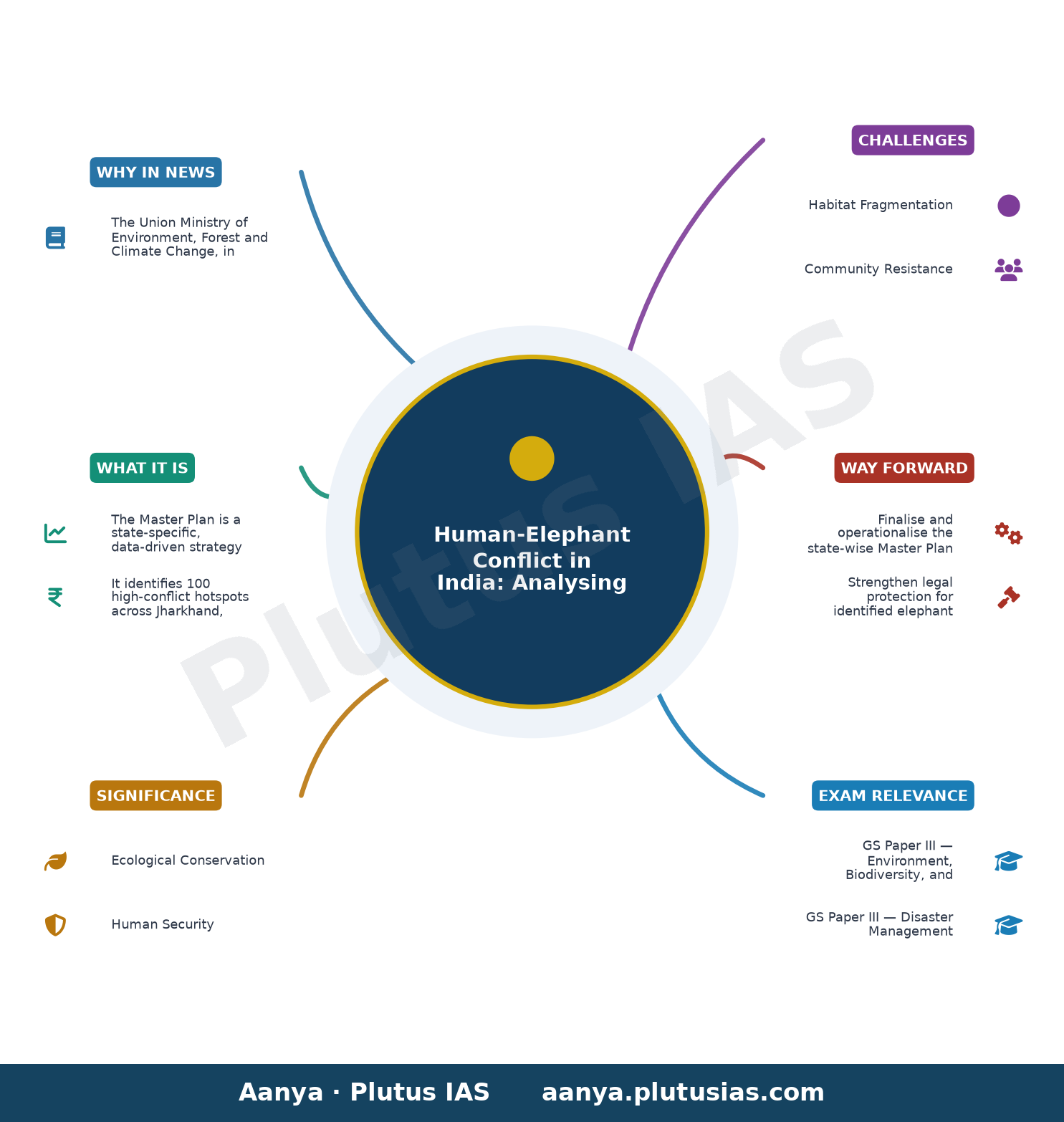
- GS Paper III — Environment, Biodiversity, and Climate Change | GS Paper III — Disaster Management
- Prelims: Human-Wildlife Conflict (HWC), Project Elephant, Wildlife Protection Act, 1972, Compensatory Afforestation Fund Management and Planning Authority (CAMPA), Habitat fragmentation, Corridor conservation, Mitigation strategies: trenches, fences, early warning systems
- Essay: Human-Wildlife Coexistence: Balancing Conservation and Livelihood Security, Ethical Imperatives in Environmental Governance: Reconciling Development and Biodiversity
Quick Revision: The State-wise Master Plan for Human-Elephant Conflict Mitigation prioritises pre-emptive strategies over post-incident compensation, focusing on habitat restoration, early warning systems, and community engagement to achieve zero deaths in high-conflict zones.
Why is this in the news?
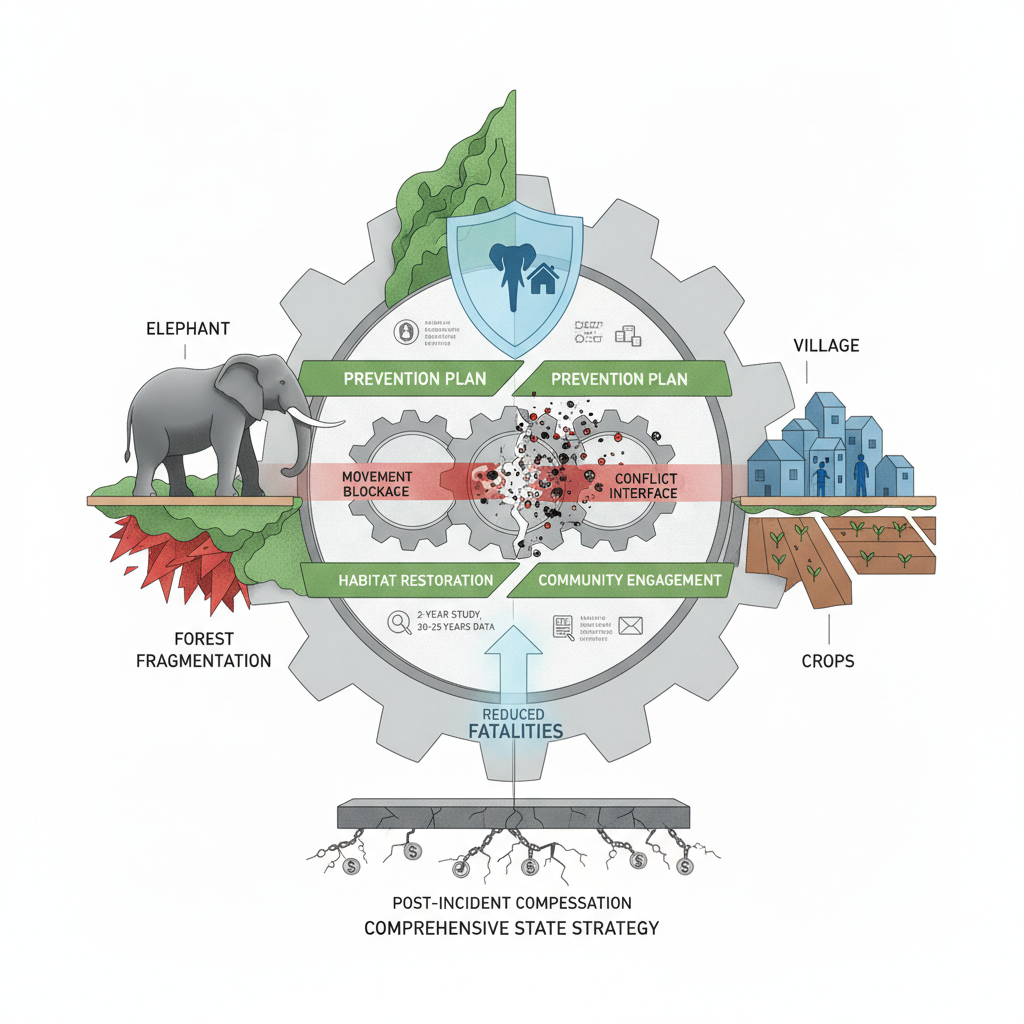
The Union Ministry of Environment, Forest and Climate Change, in collaboration with the Wildlife Institute of India (WII), Dehradun, has developed a state-wise Master Plan to address human-elephant conflict (HEC) in India. This initiative, based on a two-year study and 20-25 years of data, aims to reduce the annual average of approximately 600 human and 120 elephant deaths by preventing conflicts rather than merely providing post-incident compensation. The plan, expected to be released in August 2026, marks the first comprehensive, state-specific strategy to ensure the safety of both rural communities and elephant populations, particularly in high-conflict states like Jharkhand, Odisha, and West Bengal.
Background
- Human-Elephant Conflict (HEC) is a critical conservation challenge in India, driven by habitat loss, fragmentation, and encroachment into elephant ranges.
- With the highest density in southern India, over 60% of HEC incidents occur in eastern India (Jharkhand, Odisha, West Bengal, and Assam).
- The Wildlife Protection Act, 1972, provides the legal framework for elephant conservation, while Project Elephant (launched in 1992) focuses on habitat management, research, and mitigation of HEC.
- Traditional mitigation measures such as trenches, solar-powered fences, and early warning systems have had limited success due to high maintenance costs and ecological disruptions.
- The National Wildlife Action Plan (2017-2031) and the Compensatory Afforestation Fund Management and Planning Authority (CAMPA) allocate funds for habitat restoration and conflict mitigation, but implementation gaps persist.
- Climate change exacerbates HEC by altering food and water availability, forcing elephants to venture into human-dominated landscapes.
What is the State-wise Master Plan for Human-Elephant Conflict Mitigation?
- The Master Plan is a state-specific, data-driven strategy developed by the Wildlife Institute of India (WII) under the aegis of the Union Ministry of Environment, Forest and Climate Change, based on two years of field studies and 20-25 years of historical conflict data.
- It identifies 100 high-conflict hotspots across Jharkhand, Odisha, and West Bengal, where proactive measures will be prioritised to prevent human-elephant encounters.
- The plan shifts the focus from post-conflict compensation to pre-emptive conflict avoidance through habitat management, early warning systems, and community engagement.
- Key strategies include: (a) restoration and protection of elephant corridors, (b) creation of alternative food and water sources in elephant habitats, (c) deployment of AI-based early warning systems, (d) community-based conflict mitigation training, and (e) enforcement of strict land-use regulations in critical habitats.
- The plan emphasises the role of local communities in conflict mitigation, including the establishment of ‘Elephant Response Teams’ (ERTs) comprising trained villagers to deter elephants using non-lethal methods.
- It integrates climate adaptation measures, such as afforestation in degraded habitats and water conservation, to reduce pressure on elephants to enter human settlements.
- The Master Plan is expected to be released in August 2026 and will be implemented in phases, with annual reviews and adjustments based on real-time conflict data.
- The plan aligns with India’s commitments under the Convention on Biological Diversity (CBD) and the Global Biodiversity Framework (GBF), which mandate the reduction of human-wildlife conflict as a conservation priority.
Key Features
| Feature | Significance |
|---|---|
| State-specific Master Plan | Tailors interventions to regional ecological and socio-economic conditions, ensuring higher efficacy than a uniform national policy. |
| Preventive Focus | Shifts from post-conflict compensation to pre-emptive measures, reducing fatalities among both humans and elephants. |
| Hotspot Identification | Systematic mapping of 100 conflict zones in Jharkhand, Odisha, and West Bengal to prioritise resource allocation and mitigation efforts. |
| Multi-stakeholder Coordination | Integrates inputs from forest departments, local communities, and scientific institutions like the Wildlife Institute of India. |
| Data-Driven Approach | Uses 20–25 years of historical conflict data to design evidence-based strategies for long-term sustainability. |
Why it Matters
Ecological Conservation
- Protects the endangered Asian elephant (Elephas maximus), a keystone species critical to forest ecosystem stability.
- Preserves biodiversity by reducing habitat fragmentation caused by human-elephant interface zones.
Human Security
- Mitigates loss of life and livelihoods in rural communities adjacent to elephant habitats.
- Reduces economic burden of crop depredation and property damage, particularly in agrarian economies.
Policy Innovation
- First-of-its-kind state-wise master plan for human-wildlife conflict resolution in India.
- Demonstrates a shift from reactive to proactive governance in wildlife management.
Climate Resilience
- Supports adaptation to climate-induced changes in elephant migration patterns due to altered food and water availability.
- Enhances forest resilience by reducing anthropogenic pressure on critical habitats.
Challenges
1. Habitat Fragmentation
- Expansion of agriculture, infrastructure, and human settlements encroaches upon elephant corridors, intensifying conflicts.
- Lack of legal protection for identified corridors exacerbates displacement of elephant populations.
UPSC Link: Environmental degradation
2. Community Resistance
- Local populations may oppose measures like crop guarding or alternative livelihoods due to cultural or economic constraints.
- Distrust in government initiatives stemming from historical neglect or ineffective implementation.
UPSC Link: People’s participation
3. Resource Constraints
- Inadequate funding for state-level implementation, particularly in low-income regions with high conflict intensity.
- Shortage of trained personnel in forest departments and wildlife institutions for ground-level execution.
UPSC Link: Administrative challenges
4. Scientific Uncertainty
- Incomplete understanding of elephant migration dynamics and behavioural adaptations in fragmented landscapes.
- Limited data on long-term efficacy of proposed interventions like early warning systems or deterrent techniques.
UPSC Link: Research gaps
5. Legal and Ethical Dilemmas
- Balancing conservation goals with the rights of indigenous communities dependent on forest resources.
- Ethical concerns surrounding translocation of conflict-prone elephants, which often leads to high mortality rates.
UPSC Link: Ethics in governance
Challenges — UPSC Perspective
| Issue | Concern |
|---|---|
| Corridor Encroachment | Unregulated development disrupts traditional elephant pathways, forcing animals into human settlements. |
| Compensation Delays | Post-conflict relief mechanisms are slow, undermining trust and exacerbating community hostility. |
| Human-Elephant Coexistence | Cultural practices (e.g., crop raiding) are deeply embedded, making behavioural change challenging. |
| Climate Variability | Erratic monsoons and droughts alter food availability, pushing elephants toward human-dominated areas. |
| Institutional Capacity | Forest departments lack technical and financial resources to implement advanced conflict mitigation tools. |
| Policy Fragmentation | Overlapping jurisdictions between central and state agencies create implementation gaps. |
Way Forward
- Finalise and operationalise the state-wise Master Plan by integrating inputs from local stakeholders, including tribal communities and forest-dwelling populations.
- Strengthen legal protection for identified elephant corridors under the Wildlife (Protection) Act, 1972, and the Forest Rights Act, 2006.
- Develop community-based early warning systems using indigenous knowledge and modern technology (e.g., GPS collaring, mobile alerts).
- Invest in alternative livelihoods for rural populations to reduce dependence on forest resources, such as eco-tourism or sustainable agriculture.
- Enhance inter-state coordination mechanisms to address transboundary elephant movements and shared conflict hotspots.
- Expand research on elephant behaviour and habitat use to refine mitigation strategies, in collaboration with institutions like the Wildlife Institute of India.
- Establish dedicated funds for conflict mitigation, sourced from both central and state budgets, with transparent disbursal mechanisms.
- Conduct periodic audits of implementation progress to ensure accountability and course-correction where necessary.
UPSC Value Addition
Keywords for Mains Answer-Writing
Human-Wildlife Conflict · Project Elephant · Ministry of Environment, Forest and Climate Change · Elephant Corridors · Habitat Fragmentation · Mitigation Strategies · Wildlife Conservation · Human-Elephant Coexistence · Elephant Mortality · Community-Based Conservation · Wildlife (Protection) Act, 1972 · Elephant Reserves
Concept Flow
Expansion of human settlements and agriculture → Fragmentation of elephant habitats → Disruption of traditional migration routes → Increased human-elephant interface → Escalation in conflict incidents → Development of state-wise Master Plan → Implementation of preventive measures → Reduction in fatalities and crop depredation → Enhanced ecological and human security → Sustainable coexistence framework
Prelims Practice Questions
Q1. Consider the following statements regarding human-elephant conflict in India:
1. The highest incidence of human-elephant conflict occurs in South India.
2. Jharkhand, Odisha, and West Bengal are among the most conflict-prone states.
3. The Wildlife (Protection) Act, 1972, mandates the establishment of elephant corridors.
4. Project Elephant was launched in 1992.
How many of the above statements are correct?
- Only one
- Only two
- Only three
- All
Answer: Only three — Statement 1 is incorrect: 60% of human-elephant conflict occurs in eastern India, not South India. Statements 2, 3, and 4 are correct. Jharkhand, Odisha, and West Bengal are identified as conflict hotspots. The Wildlife (Protection) Act, 1972, provides the legal framework for wildlife protection, including corridors. Project Elephant was launched in 1992 by the Ministry of Environment, Forest and Climate Change.
Q2. Assertion (A): The newly proposed state-wise Master Plan for human-elephant conflict mitigation aims to reduce both human and elephant fatalities to near zero.
Reason (R): The plan emphasizes preemptive measures over post-incident compensation.
- Both A and R are true, and R is the correct explanation of A
- Both A and R are true, but R is not the correct explanation of A
- A is true, but R is false
- A is false, but R is true
Answer: Both A and R are true, but R is not the correct explanation of A — Assertion (A) is true: the Master Plan targets reducing fatalities to near zero. Reason (R) is also true and directly explains the assertion, as the plan shifts focus from post-incident compensation to preemptive measures such as habitat management and corridor restoration.
Q3. Match the following states with their respective roles in the human-elephant conflict mitigation strategy:
Column I (State) | Column II (Role)
A. Assam | 1. Highest elephant population but lower conflict incidence
B. Tamil Nadu | 2. Focus on restoration of traditional elephant corridors
C. West Bengal | 3. Implementation of community-based early warning systems
D. Kerala | 4. High conflict hotspots with over 100 identified areas
- A-2, B-1, C-4, D-3
- A-3, B-1, C-4, D-2
- A-1, B-2, C-3, D-4
- A-4, B-3, C-2, D-1
Answer: A-3, B-1, C-4, D-2 — Assam focuses on restoring traditional elephant corridors (A-2). Tamil Nadu has the highest elephant population but lower conflict incidence due to better habitat management (B-1). West Bengal has over 100 conflict hotspots (C-4). Kerala implements community-based early warning systems (D-3).
Mains Practice Question
✍ Critically examine the efficacy of the newly proposed state-wise Master Plan for mitigating human-elephant conflict in India. In your answer, address the structural challenges posed by habitat fragmentation, socio-economic factors, and institutional capacities. Also, evaluate whether the plan’s emphasis on preemptive measures over post-incident compensation can achieve its stated goal of reducing fatalities to near zero. (15 Marks)
Approach: MODEL-ANSWER SKELETON:
1. **Context and Objectives**: Briefly introduce the Master Plan—its genesis under the Ministry of Environment, Forest and Climate Change, and the Indian Wildlife Institute’s role. State the goal: reducing human and elephant fatalities to near zero by addressing preemptive measures.
2. **Structural Challenges**:
– **Habitat Fragmentation**: Discuss the role of linear infrastructure (railways, highways), agricultural expansion, and deforestation in disrupting elephant corridors. Cite examples such as the fragmentation of the Rajaji-Corbett landscape.
– **Socio-Economic Factors**: Highlight the dependence of local communities on forest resources, land-use conflicts, and the lack of alternative livelihoods. Reference studies on crop raiding and retaliatory killings.
– **Institutional Capacities**: Critique the implementation gaps in Project Elephant, including underfunding, lack of inter-state coordination, and delayed corridor notifications.
3. **Preemptive Measures vs. Compensation**:
– **Preemptive Measures**: Evaluate the plan’s focus on corridor restoration, early warning systems, and habitat enrichment. Discuss the role of community-based conservation (e.g., ‘Haathi Mere Saathi’ in Assam).
– **Post-Incident Compensation**: Acknowledge its limitations (delayed disbursement, inadequate amounts) but argue its continued necessity as a safety net.
4. **Comparative Analysis**: Contrast India’s approach with global models (e.g., Sri Lanka’s electric fencing, Thailand’s eco-tourism integration). Highlight India’s unique challenges (higher human density, diverse ecosystems).
5. **Way Forward**: Propose solutions—strengthening the National Board for Wildlife, integrating tribal knowledge, and leveraging technology (drones, AI-based tracking). Conclude with a balanced view: while the plan is a step forward, its success hinges on multi-stakeholder collaboration and sustained funding.
Source: amarujala.com
Generated by AanyaAi for educational purpose.


No Comments