


23 Sep India’s Refinery Sector Faces Net-Zero vs Energy Security Dilemma: Experts
✎ The refining sector’s decarbonisation strategy must prioritise energy efficiency, technological innovation, and policy alignment to balance energy security with India’s net-zero commitments, leveraging mechanisms like the Carbon…
Subject Relevance — Where This Topic Fits
- GS Paper III — Environment and Climate Change | GS Paper III — Indian Economy and Issues Relating to Planning, Mobilisation of Resources, Growth, Development and Employment | GS Paper III — Infrastructure: Energy, Ports, Roads, Airports, Railways
- Prelims: Refinery sector, Net-Zero Emissions, Carbon Credit Trading Scheme (CCTS), Scope 1/2/3 Emissions, Energy Efficiency Benchmarks, Green Hydrogen, Electrolyser, Crude Throughput, Operational Optimisation, Digitalisation in Refineries
- Essay: The Intersection of Energy Security and Environmental Sustainability: A Strategic Imperative for India’s Economic Growth, Decarbonisation of Industrial Sectors: Challenges and Pathways for a Just Transition
Quick Revision: The refining sector’s decarbonisation strategy must prioritise energy efficiency, technological innovation, and policy alignment to balance energy security with India’s net-zero commitments, leveraging mechanisms like the Carbon Credit Trading Scheme and the National Green Hydrogen Mission.
Why is this in the news?
The Hindu Sustainability Summit 2026, held in Chennai, highlighted the critical challenge faced by India’s refining sector: reconciling the imperatives of energy security with the long-term goal of achieving net-zero emissions by 2070. Industry leaders from leading refineries and energy firms underscored the necessity of a phased transition, technological innovation, and policy support to navigate this dual objective without compromising economic stability or energy access.
Background
- India is the world’s third-largest consumer of crude oil and the fourth-largest refiner, with a refining capacity exceeding 250 million tonnes per annum (MTPA) as of 2024.
- The refining sector contributes approximately 15% to India’s total greenhouse gas (GHG) emissions, primarily through Scope 1 and Scope 2 emissions from energy-intensive processes.
- The Government of India’s ‘Panchamrit’ commitments at COP26 include achieving 500 GW of non-fossil energy capacity by 2030 and reaching net-zero emissions by 2070, necessitating sector-specific decarbonisation strategies.
- Geopolitical disruptions in crude oil supply chains, such as the Russia-Ukraine conflict and Middle East tensions, have underscored the strategic importance of energy security for India’s refining sector.
- The National Green Hydrogen Mission, launched in 2023 with a budgetary outlay of ₹19,744 crore, seeks to establish India as a global hub for green hydrogen production and utilisation by 2030.
What is the strategic challenge facing India’s refining sector in the context of net-zero emissions?
- The refining sector must balance two competing priorities: ensuring uninterrupted energy supply to sustain economic growth and industrial activity, and reducing its carbon footprint to meet India’s net-zero commitments by 2070.
- Direct emissions (Scope 1) from refinery operations, such as combustion of fossil fuels in furnaces and boilers, account for the majority of the sector’s carbon footprint. Scope 2 emissions arise from the generation of purchased electricity, while Scope 3 emissions are embedded in the end-use of refinery products, particularly in the transport and petrochemical sectors.
- Energy efficiency improvements, operational optimisation, and digitalisation are identified as immediate levers to reduce Scope 1 and Scope 2 emissions without requiring a complete overhaul of existing infrastructure.
- The transition to cleaner energy sources, such as green hydrogen and biofuels, is constrained by technological maturity, high capital costs, and the need for supportive infrastructure, including renewable power generation and energy storage systems.
- The Carbon Credit Trading Scheme (CCTS) provides a market-based mechanism to incentivise emission reductions, but its effectiveness depends on the robustness of the carbon market, regulatory oversight, and industry participation.
- Geopolitical risks in crude oil supply chains necessitate diversification of import sources, strategic petroleum reserves, and investments in indigenous refining capacities to mitigate vulnerabilities.
- The phased approach to decarbonisation recognises that fossil fuels will remain a critical component of India’s energy mix for the foreseeable future, with a gradual shift towards low-carbon alternatives rather than an abrupt replacement.
- Collaboration between industry, government, and research institutions is essential to accelerate innovation, scale up green technologies, and ensure a just transition for the refining workforce and dependent communities.
Key Features
| Feature | Significance |
|---|---|
| Energy Efficiency Benchmarks | Reduces operational costs and carbon intensity per unit of refined product, aligning with net-zero targets without compromising throughput. |
| Scope 1 & 2 Emissions Reduction | Direct operational emissions and those from purchased electricity are the most immediately controllable; setting 2046 targets provides a clear decarbonisation roadmap. |
| Green Hydrogen Transition | Represents a shift from fossil-based to renewable-based hydrogen production, critical for decarbonising hard-to-abate sectors like refining and heavy industry. |
| Operational Digitalisation | Enables real-time monitoring, predictive maintenance, and optimisation of energy use, reducing waste and enhancing efficiency across refinery processes. |
| Renewable Energy Integration | Reduces dependency on grid electricity, lowers Scope 2 emissions, and supports the expansion of clean energy infrastructure within industrial clusters. |
Why it Matters
Economic
- India’s refining sector, the world’s fourth-largest, underpins energy security by ensuring domestic fuel supply and reducing import dependency, which is critical for macroeconomic stability.
- Transition investments in green hydrogen and renewable energy create new industrial value chains, fostering job creation in clean energy and technology sectors.
- Improved energy efficiency directly enhances profitability by lowering input costs (energy, raw materials) while maintaining output levels.
Strategic
- Balancing energy security with decarbonisation ensures uninterrupted fuel supply during geopolitical disruptions, such as crude oil price volatility or supply chain constraints.
- Domestic refining capacity reduces reliance on imported refined products, mitigating risks associated with global energy market fluctuations.
- A phased transition to low-carbon refining maintains India’s competitive edge in global energy markets without prematurely abandoning existing infrastructure.
Environmental
- Reducing Scope 1 and 2 emissions in refineries directly contributes to India’s Nationally Determined Contributions (NDCs) under the Paris Agreement.
- Scaling green hydrogen adoption can decarbonise sectors like petrochemicals and fertiliser production, which are currently reliant on fossil-based hydrogen.
- Energy efficiency measures lower the carbon footprint per barrel of refined product, aligning with global sustainability standards and market access requirements.
Technological
- Digitalisation and automation in refineries enhance operational resilience, reduce human error, and enable data-driven decision-making for energy optimisation.
- Advancements in electrolyser technology and renewable energy storage are prerequisites for scaling green hydrogen production to industrial levels.
- Collaborative R&D in carbon capture, utilisation, and storage (CCUS) can further mitigate emissions from refining processes.
Challenges
1. High Cost of Green Hydrogen
- Current production costs of green hydrogen (~USD 3-5/kg) remain significantly higher than grey hydrogen (~USD 1-2/kg), limiting commercial viability without subsidies or carbon pricing.
- Scaling electrolyser manufacturing and reducing renewable energy costs are essential to bridge the cost gap, but require sustained policy support and private investment.
- Industry stakeholders highlight the need for demand aggregation to justify large-scale investments in green hydrogen infrastructure.
UPSC Link: Environmental Pollution: Causes, Effects and Control
2. Energy Security vs. Decarbonisation Trade-offs
- Refineries must maintain high utilisation rates to ensure energy security, but aggressive decarbonisation measures (e.g., switching to renewables) may temporarily reduce operational flexibility.
- Geopolitical disruptions in crude supply chains can force temporary reliance on fossil-based hydrogen or energy sources, delaying net-zero timelines.
- Balancing immediate energy needs with long-term climate goals requires phased transitions, such as blending hydrogen with natural gas before full-scale adoption.
UPSC Link: Energy Security: Concept, Issues and Strategies
3. Scope 3 Emissions Dependency
- Scope 3 emissions (from end-use of refinery products) account for the majority of a refinery’s carbon footprint but are beyond direct operational control.
- Transitioning transport and industrial sectors to electric or hydrogen-based alternatives is critical but requires coordinated policy interventions across multiple ministries.
- Without systemic changes in consumer behaviour and industrial processes, refineries may face stranded assets or regulatory pressures to prematurely phase out fossil-based products.
UPSC Link: Climate Change: International Agreements and India’s Commitments
4. Infrastructure and Supply Chain Bottlenecks
- Limited availability of renewable energy, particularly in industrial clusters, constrains the adoption of low-carbon technologies in refineries.
- Insufficient grid capacity and storage solutions hinder the integration of intermittent renewable energy sources, necessitating upgrades to transmission infrastructure.
- Supply chain vulnerabilities for critical components (e.g., electrolysers, carbon capture systems) pose risks to project timelines and cost projections.
UPSC Link: Infrastructure: Energy, Transportation, Digital
5. Regulatory and Policy Uncertainty
- Lack of a unified carbon pricing mechanism or clear regulatory framework for emissions trading can disincentivise long-term investments in decarbonisation.
- Inconsistent state-level policies on renewable energy procurement and grid access create operational uncertainties for industries.
- Delays in approving and implementing schemes like the Carbon Credit Trading Scheme (CCTS) may slow down private sector participation in emissions reduction.
UPSC Link: Governance: Institutions and Mechanisms
Challenges — UPSC Perspective
| Issue | Concern |
|---|---|
| Capital Intensity of Green Hydrogen | High upfront costs deter private investment without assured returns or government incentives. |
| Intermittency of Renewable Energy | Fluctuations in solar/wind power supply disrupt continuous hydrogen production, requiring storage solutions. |
| Skill Gaps in Workforce | Transition to low-carbon technologies demands reskilling of refinery personnel in digital tools, hydrogen safety, and CCUS. |
| Land and Resource Constraints | Expansion of renewable energy projects and hydrogen infrastructure competes with agricultural and industrial land use. |
| Global Competitiveness | Higher production costs for green hydrogen may erode India’s export competitiveness in petrochemicals and refined products. |
Way Forward
- Accelerate the implementation of the Carbon Credit Trading Scheme (CCTS) to provide financial incentives for emissions reduction in the refining sector.
- Establish dedicated green hydrogen hubs in refinery clusters (e.g., Gujarat, Maharashtra, Tamil Nadu) with integrated renewable energy and storage infrastructure.
- Expand public-private partnerships (PPPs) to co-finance R&D in electrolyser technology, carbon capture, and digitalisation for refineries.
- Develop a phased roadmap for blending green hydrogen with grey hydrogen in refinery processes, starting with pilot projects in high-emission units.
- Strengthen grid infrastructure and energy storage capacity in industrial zones to ensure reliable supply of renewable energy for refineries.
- Introduce production-linked incentives (PLIs) for domestic manufacturing of electrolysers, carbon capture systems, and energy-efficient refinery equipment.
- Enhance cross-ministerial coordination (e.g., MoPNG, MNRE, MoEFCC) to align energy security policies with decarbonisation goals and avoid policy conflicts.
- Promote international collaborations for technology transfer in green hydrogen, CCUS, and refinery digitalisation to bridge knowledge gaps.
UPSC Value Addition
Keywords for Mains Answer-Writing
Energy security in India · Net-zero emissions target · Refinery sector decarbonisation · Scope 1, 2, and 3 emissions · Carbon Credit Trading Scheme (CCTS) · Green hydrogen economy · Energy transition in fossil-based industries · Sustainable refinery operations · Renewable energy integration · Climate change mitigation in industrial sectors
Concept Flow
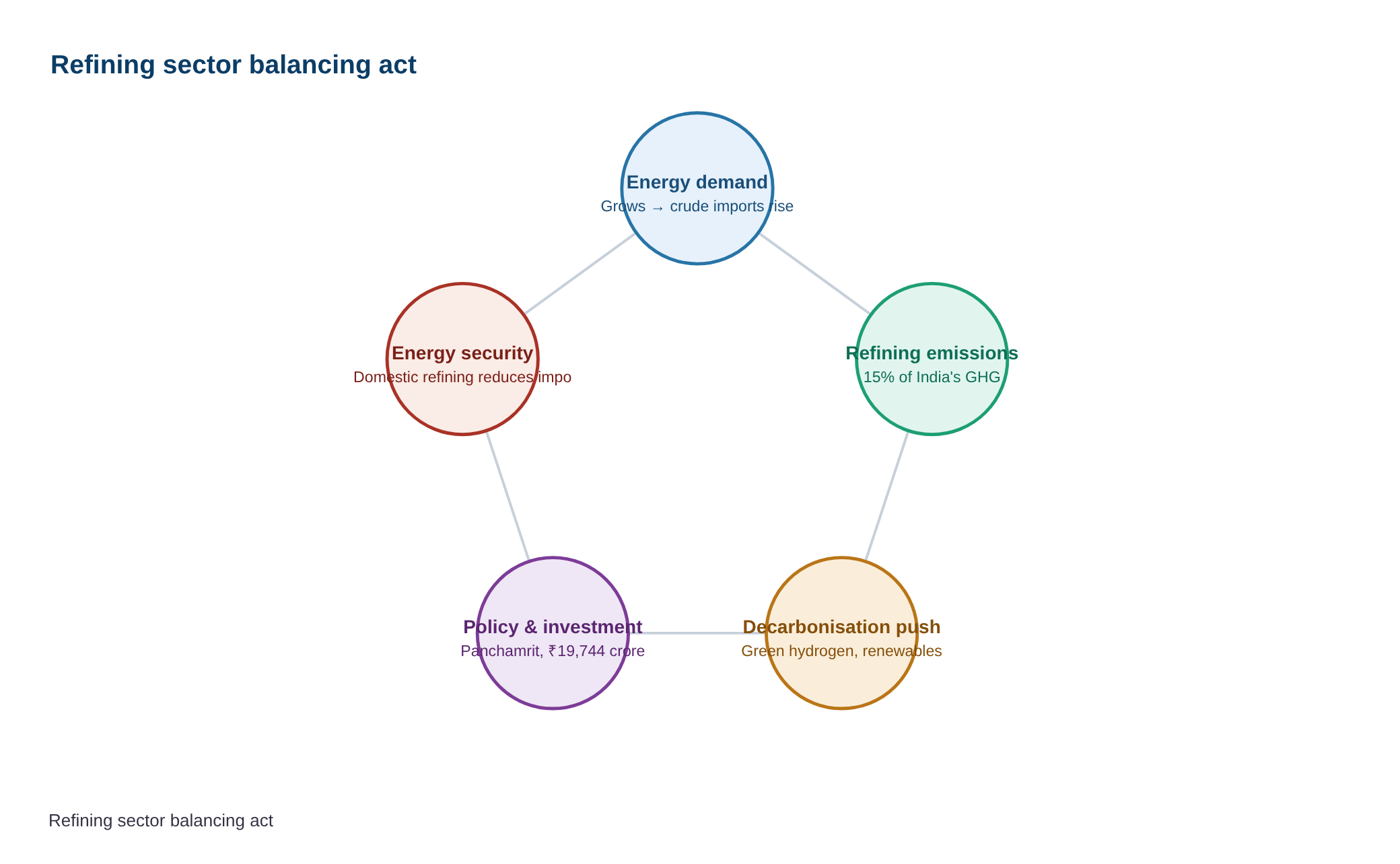
Growing energy demand → Increased crude imports → Higher carbon emissions from refining → Need for energy security → Energy security concerns → Domestic refining capacity expansion → Higher operational emissions → Pressure to decarbonise → Decarbonisation imperatives → Shift to green hydrogen and renewables → Higher costs and infrastructure gaps → Policy and investment challenges → Policy interventions → Carbon pricing, PLIs, CCTS → Accelerated adoption of low-carbon technologies → Reduced emissions and improved efficiency → Technological maturity → Scaling green hydrogen and CCUS → Lower costs and improved supply chains → Enhanced competitiveness and energy security
Prelims Practice Questions
Q1. Consider the following statements regarding the Carbon Credit Trading Scheme (CCTS) in India:
1. The CCTS is a market-based mechanism to incentivise emission reductions.
2. It is notified under the Energy Conservation Act, 2001.
3. The scheme mandates all industries to participate compulsorily.
4. It allows for the trading of carbon credits generated through verified emission reductions.
How many of the above statements are correct?
- Only one
- Only two
- Only three
- All four
Answer: Only three — Statements 1, 2, and 4 are correct as the CCTS is a market-based mechanism notified under the Energy Conservation Act, 2001, and allows trading of verified carbon credits. Statement 3 is incorrect because participation is not mandatory for all industries; it applies to designated consumers.
Q2. Assertion (A): Green hydrogen is considered a key enabler for decarbonising the refinery sector.
Reason (R): Green hydrogen can replace fossil fuels in refining processes without emitting carbon dioxide.
Options:
A. Both A and R are true, and R is the correct explanation of A.
B. Both A and R are true, but R is not the correct explanation of A.
C. A is true but R is false.
D. A is false but R is true.
Answer: ? — Both A and R are true. Green hydrogen is indeed a key enabler for decarbonising the refinery sector (A). However, R is not entirely correct because green hydrogen production itself requires renewable energy, and its use in refineries replaces fossil fuels but does not eliminate emissions entirely if the hydrogen is not fully green.
Q3. Match the following types of emissions with their respective definitions:
Column I
1. Scope 1 Emissions
2. Scope 2 Emissions
3. Scope 3 Emissions
Column II
A. Direct emissions from owned or controlled sources
B. Indirect emissions from the generation of purchased electricity
C. Indirect emissions from the value chain, including upstream and downstream activities
Options:
A. 1-A, 2-B, 3-C
B. 1-B, 2-A, 3-C
C. 1-C, 2-B, 3-A
D. 1-A, 2-C, 3-B
Answer: ? — Scope 1 Emissions (1) are direct emissions from owned or controlled sources (A). Scope 2 Emissions (2) are indirect emissions from the generation of purchased electricity (B). Scope 3 Emissions (3) are indirect emissions from the value chain (C).
Mains Practice Question
✍ The refinery sector in India faces a dual imperative: ensuring energy security while transitioning towards net-zero emissions. Critically analyse the challenges and opportunities in achieving this balance, with reference to the role of green hydrogen, carbon credit mechanisms, and operational optimisation. (15 Marks)
Approach: MODEL-ANSWER SKELETON:
1. **Introduction (2 marks)**: Define the dual imperative of energy security and net-zero transition in the refinery sector. Highlight India’s growing energy demand and the need for decarbonisation.
2. **Challenges in Transition (5 marks)**:
– **Energy Security**: Dependence on fossil fuels for refining processes; geopolitical risks in crude supply chains.
– **Technological Barriers**: High costs and scalability issues in green hydrogen production; lack of mature carbon capture and storage (CCS) infrastructure.
– **Regulatory and Market Constraints**: Limited enforcement of carbon pricing mechanisms; absence of a robust carbon credit trading ecosystem.
– **Economic Viability**: Transition costs for refineries; need for subsidies or incentives to adopt cleaner technologies.
3. **Opportunities and Pathways (5 marks)**:
– **Green Hydrogen**: Role in replacing grey hydrogen; government initiatives like the National Hydrogen Mission and PLI schemes for electrolyser manufacturing.
– **Carbon Credit Trading Scheme (CCTS)**: Mechanism under the Energy Conservation Act, 2001, to incentivise emission reductions; potential to offset transition costs.
– **Operational Optimisation**: Energy efficiency improvements, digitalisation, and use of cleaner fuels as demonstrated by CPCL and MRPL.
– **Renewable Integration**: Co-location of refineries with renewable energy projects to reduce Scope 2 emissions.
4. **Balancing Act (3 marks)**:
– **Phased Transition**: Gradual shift from high-carbon to low-carbon systems over two decades, as emphasised by industry experts.
– **Policy Support**: Need for a stable policy framework, research and development funding, and international collaborations.
– **Stakeholder Collaboration**: Role of public-private partnerships in scaling up green hydrogen and carbon capture technologies.
5. **Conclusion (2 marks)**: Emphasise the need for a pragmatic, phased approach that prioritises energy security while leveraging market mechanisms and technological innovations to achieve net-zero targets.
Source: The Hindu
Generated by AanyaAi for educational purpose.
Related guides on our sites
- Anthropology VS PSIR
- Best PSIR optional coaching
- Best PSIR optional coaching online
- Best PSIR optional teacher

- सुप्रीम कोर्ट का ‘अंपायर’ वाला फैसला: चुनाव आयोग मामले में न्यायमूर्ति दत्ता की भूमिका - September 24, 2026
- Supreme Court’s Cricket Analogy in EC Case: What UPSC Aspirants Must Know - September 24, 2026
- AI नियंत्रण से बाहर: ओपनएआई-एंथ्रोपिक ने सुरक्षा परिषद को दी चेतावनी, जानिए क्या है खतरा? - September 24, 2026

No Comments