


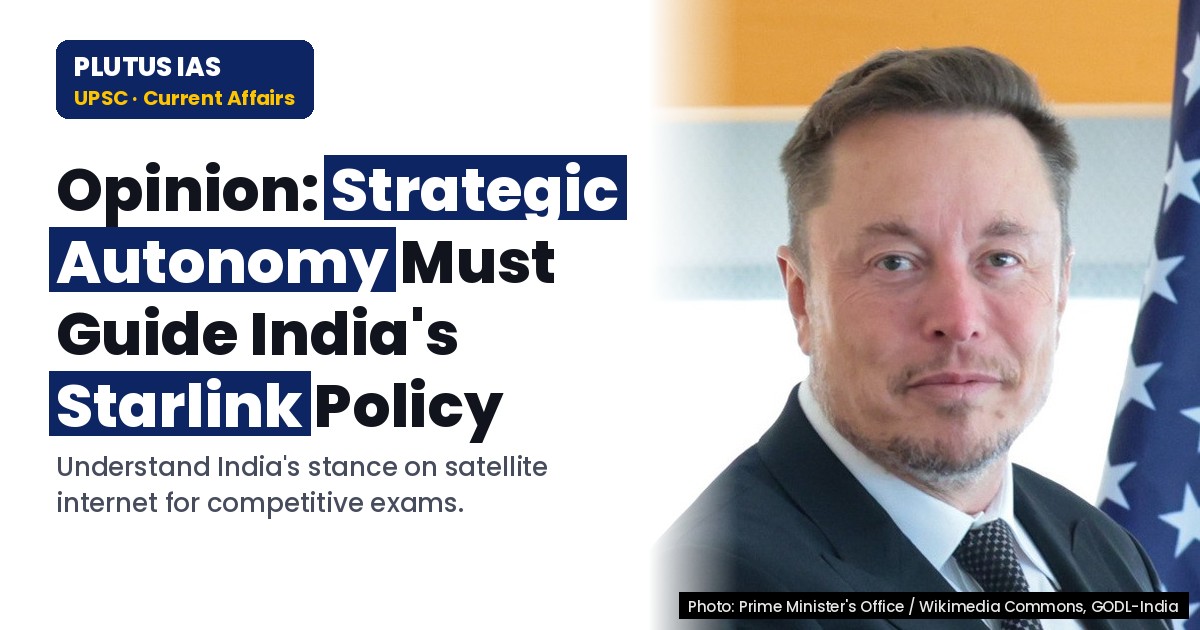
11 Nov India’s Starlink Policy: Balancing Strategic Autonomy & Benefits
✎ India's policy on satellite communication services is guided by the principle of strategic autonomy, balancing the integration of advanced global technologies with the imperative of national security and robust regulatory…
Subject Relevance — Where This Topic Fits
- GS Paper II — International Relations | GS Paper II — Government Policies and Interventions | GS Paper III — Economy | GS Paper III — Science and Technology
- Prelims: Starlink, Satellite Internet, Strategic Autonomy, Telecom Regulatory Authority of India (TRAI), Indian Space Policy, Low Earth Orbit (LEO) Satellites
- Essay: The imperative of strategic autonomy in India’s technological advancements., Navigating the complexities of global technology integration and national interests.
Quick Revision: India’s policy on satellite communication services is guided by the principle of strategic autonomy, balancing the integration of advanced global technologies with the imperative of national security and robust regulatory oversight.
Why is this in the news?
Recent public discourse has highlighted the regulatory framework for satellite communication services in India, specifically concerning the entry of global players like Starlink. This debate underscores the government’s stance on ensuring a level playing field for all operators and adhering to established licensing conditions, while also bringing to the forefront critical considerations of national security and strategic autonomy in the rapidly evolving space communication sector.
Background
- Satellite internet services, particularly those utilising Low Earth Orbit (LEO) constellations, offer the potential to provide high-speed internet access to remote and underserved areas, complementing existing terrestrial fibre and mobile networks.
- India’s telecommunication sector is governed by a robust regulatory framework, including licensing conditions and spectrum allocation policies, designed to ensure fair competition, consumer protection, and national security.
- The concept of ‘strategic autonomy’ is a cornerstone of India’s foreign policy and technological development, emphasising self-reliance and the ability to make independent decisions in critical sectors without external influence.
- Global satellite internet providers are seeking to expand their operations into various national markets, necessitating adherence to diverse national regulatory requirements and policy objectives.
- The Indian government has consistently emphasised the importance of indigenous capabilities in space technology and telecommunications, alongside fostering an environment for private sector participation and innovation.
Satellite Internet and its Strategic Implications
- Satellite internet refers to internet access provided via communication satellites, typically involving a dish antenna on Earth that communicates with orbiting satellites.
- LEO satellite constellations, such as Starlink, operate at lower altitudes compared to traditional geostationary satellites, reducing latency and enabling faster data transmission.
- These services are particularly advantageous for geographical regions where laying fibre optic cables or establishing mobile towers is economically unfeasible or logistically challenging.
- From a strategic perspective, control over communication infrastructure, including satellite networks, is vital for national security, disaster management, and maintaining sovereignty over data flows.
- The dual-use nature of satellite technology means it can serve both civilian and military purposes, making regulatory oversight and national control paramount.
- Ensuring compliance with national laws, data localisation requirements, and security protocols is a critical aspect of licensing foreign satellite communication providers.
- While offering connectivity benefits, reliance on foreign-controlled satellite networks raises concerns about potential vulnerabilities, data privacy, and the ability to maintain communication during geopolitical crises.
- India’s regulatory approach aims to balance the benefits of advanced satellite technology with the imperative of safeguarding national interests and promoting indigenous capabilities.
Key Features
| Feature | Significance |
|---|---|
| Low Earth Orbit (LEO) Satellite Constellations | Enables global internet coverage, particularly in remote and underserved areas where terrestrial infrastructure is unfeasible or uneconomical. |
| High-Speed, Low-Latency Internet | Offers performance comparable to terrestrial broadband, facilitating applications requiring real-time data transmission. |
| Global Reach | Provides connectivity irrespective of geographical barriers, including mountainous regions, islands, and disaster-stricken zones. |
| Optimised for Reach, Not Density | Designed to connect dispersed users over vast areas rather than a high concentration of users in a small region, complementing existing fibre and mobile networks. |
| Foreign Ownership and Operation | Typically involves non-domestic entities controlling the satellite infrastructure and data flow, raising concerns about national security and data sovereignty. |
Why it Matters
Strategic Significance
- Enhances national strategic autonomy by reducing reliance on foreign-controlled communication infrastructure, especially in critical sectors.
- Facilitates robust communication capabilities for defence and disaster management, ensuring uninterrupted services during emergencies or conflicts.
- Supports geopolitical influence by projecting technological self-reliance and fostering indigenous space and telecommunication capabilities.
Economic Significance
- Promotes digital inclusion by extending internet access to remote and rural populations, bridging the digital divide.
- Stimulates economic growth in underserved regions by enabling e-commerce, digital education, and telemedicine.
- Fosters competition within the telecommunications sector, potentially leading to improved services and lower costs for consumers.
Technological Significance
- Drives innovation in satellite technology, ground segment development, and associated communication protocols.
- Encourages the development of indigenous capabilities in satellite manufacturing, launch services, and ground station operations.
- Facilitates the adoption of advanced communication technologies, positioning India as a key player in the global space economy.
National Security Significance
- Mitigates risks associated with foreign control over critical communication infrastructure, including potential surveillance or data interception.
- Ensures resilience of communication networks against cyber threats and physical attacks by diversifying connectivity options.
- Provides secure and reliable communication channels for government agencies and military operations, safeguarding national interests.
Challenges
1. National Security Concerns
- Potential for foreign entities to control critical communication infrastructure, raising concerns about data sovereignty and surveillance.
- Risk of service disruption or selective denial of access by foreign operators during geopolitical tensions or conflicts.
- Challenges in monitoring and ensuring compliance with national security protocols and data protection regulations by foreign satellite operators.
UPSC Link: Internal Security, Science & Technology
2. Regulatory and Licensing Frameworks
- Ensuring equitable and transparent regulatory processes for all satellite operators, both domestic and foreign.
- Balancing the need for strict licensing conditions with the imperative to foster innovation and attract investment.
- Developing robust mechanisms for compliance verification and enforcement of regulatory standards.
UPSC Link: Government Policies & Interventions
3. Strategic Autonomy vs. Technological Access
- Navigating the imperative to maintain strategic autonomy while leveraging advanced foreign technologies for national development.
- Avoiding over-reliance on single foreign providers for critical communication services.
- Promoting indigenous capabilities to reduce dependence on external technological solutions in the long term.
UPSC Link: Science & Technology, International Relations
4. Market Competition and Protectionism
- Addressing concerns regarding fair competition between foreign satellite operators and domestic telecommunication providers.
- Ensuring a level playing field without resorting to protectionist measures that could hinder technological advancement or consumer choice.
- Managing public discourse and accusations related to market dominance and unfair practices.
UPSC Link: Indian Economy, Government Policies
5. Capacity Limitations and Service Quality
- Understanding the inherent limitations of LEO satellite systems in serving high-density user populations.
- Ensuring that service quality and capacity meet the demands of Indian consumers, especially in urban areas.
- Managing public expectations regarding the capabilities and limitations of satellite internet compared to terrestrial networks.
UPSC Link: Science & Technology, Infrastructure
Challenges — UPSC Perspective
| Issue | Concern |
|---|---|
| Foreign Control of Satellite Networks | Potential for data interception, surveillance, or service disruption by non-domestic entities, compromising national security. |
| Regulatory Compliance and Enforcement | Difficulty in ensuring foreign operators adhere to Indian data protection laws, licensing conditions, and security protocols. |
| Strategic Dependence | Over-reliance on external technology and infrastructure for critical communication, eroding India’s strategic autonomy. |
| Market Distortion | Unfair competition for domestic telecom providers if foreign entities operate with different regulatory burdens or market advantages. |
| Capacity Limitations | LEO satellite systems are optimised for reach, not density, potentially leading to service limitations in high-user areas. |
Way Forward
- Strengthen indigenous capabilities in satellite communication technology and manufacturing to reduce reliance on foreign providers.
- Develop a comprehensive and transparent regulatory framework that ensures a level playing field for all operators while safeguarding national interests.
- Implement robust mechanisms for monitoring compliance with licensing conditions, data protection laws, and national security protocols.
- Foster public-private partnerships to accelerate the deployment of advanced communication infrastructure, including both terrestrial and satellite networks.
- Invest in research and development for next-generation communication technologies to maintain a competitive edge and enhance strategic autonomy.
- Engage in international dialogues and collaborations to shape global norms and standards for satellite communication, ensuring equitable access and security.
- Educate the public and stakeholders on the benefits and limitations of various communication technologies to manage expectations and inform policy decisions.
UPSC Value Addition
Keywords for Mains Answer-Writing
Strategic Autonomy · Satellite Communication · National Security · Telecommunication Policy · Space Sector Regulation · Digital Divide · Infrastructure Development · Foreign Direct Investment · Licensing Conditions · Critical Infrastructure · Technological Sovereignty · Geopolitical Implications
Concept Flow
Foreign Satellite Operator Seeks Entry → Government Applies Regulatory Framework → Concerns Arise Over National Security & Strategic Autonomy → Need to Balance Foreign Investment with Domestic Control → Policy Formulation Emphasises Indigenous Capacity & Strict Compliance
Prelims Practice Questions
Q1. Consider the following statements regarding satellite internet services like Starlink:
1. Satellite internet services are primarily optimised for serving dense urban populations.
2. These services typically require extensive ground infrastructure like fibre optic cables and mobile towers to reach remote areas.
3. Strategic autonomy in the context of satellite internet implies a nation’s ability to control and regulate the service within its borders, irrespective of the foreign operator’s origin.
How many of the above statements are correct?
- Only one
- Only two
- Only three
- None
Answer: Only one — Statement 1 is incorrect: Satellite internet services, such as Starlink, are optimised for reach, particularly in remote areas where traditional fibre and mobile networks are difficult to establish, not for dense urban populations. Statement 2 is incorrect: A key advantage of satellite internet is its ability to provide connectivity to remote places without the need for extensive ground infrastructure like towers or cables. Statement 3 is correct: Strategic autonomy in this context refers to a nation’s capacity to maintain control over critical technological infrastructure and services, ensuring national interests and security are prioritised over external influences.
Q2. Which of the following bodies is responsible for regulating the telecommunications sector in India, including licensing and spectrum allocation for satellite communication services?
- Indian Space Research Organisation (ISRO)
- Department of Space (DoS)
- Telecom Regulatory Authority of India (TRAI)
- Ministry of Electronics and Information Technology (MeitY)
Answer: Telecom Regulatory Authority of India (TRAI) — The Telecom Regulatory Authority of India (TRAI) is the primary regulatory body for the telecommunications sector in India, responsible for recommendations on licensing, tariffs, and spectrum allocation. While ISRO and DoS are involved in space technology and policy, and MeitY in IT policy, TRAI specifically oversees telecom regulation.
Mains Practice Question
✍ Examine the concept of ‘strategic autonomy’ in the context of India’s policy towards foreign satellite internet providers. Discuss the challenges and opportunities such services present for India’s digital infrastructure and national security. (15 Marks)
Approach: Introduction: Define strategic autonomy in the context of technology and telecommunications. Briefly introduce the emergence of foreign satellite internet providers like Starlink.
Body Part 1: Challenges posed by foreign satellite internet providers:
1. National Security Concerns: Potential for data interception, surveillance, and control over critical communication infrastructure by foreign entities. Risk of service disruption or manipulation during geopolitical tensions.
2. Regulatory Control: Difficulty in enforcing domestic laws, licensing conditions, and taxation policies on global operators. Issues of data localisation and jurisdiction.
3. Economic Impact: Potential for market distortion, impact on domestic telecom operators, and capital outflow. Dependence on foreign technology and services.
4. Strategic Vulnerability: Reduced indigenous capacity building in space and telecommunications technology.
Body Part 2: Opportunities presented by foreign satellite internet providers:
1. Bridging the Digital Divide: Enhanced connectivity in remote, rural, and underserved areas where terrestrial networks are unfeasible or uneconomical.
2. Disaster Management: Resilient communication during natural calamities or emergencies when ground infrastructure is damaged.
3. Economic Growth: Facilitating e-governance, e-education, telemedicine, and digital economy expansion in remote regions.
4. Competition and Innovation: Driving innovation in the domestic telecom sector and potentially lowering service costs.
Body Part 3: Measures to uphold strategic autonomy:
1. Robust Licensing Framework: Strict adherence to existing licensing conditions and development of new regulations to ensure compliance.
2. Indigenous Capacity Building: Investment in domestic satellite communication technologies and launch capabilities (e.g., through ISRO, NSIL).
3. Data Governance: Policies for data localisation, privacy, and security.
4. International Cooperation: Engaging with international bodies to establish norms and standards for space-based internet services.
5. Public-Private Partnerships: Encouraging domestic private sector participation in the space and telecom sectors.
Conclusion: Summarise the need for a balanced approach that leverages technological advancements while safeguarding national interests and promoting self-reliance in critical infrastructure.
Source: The Hindu
Generated by AanyaAi for educational purpose.
Related guides on our sites
- Best PSIR optional coaching for upsc
- Best PSIR optional teacher for upsc
- Best teacher of PSIR optional for upsc
- Best PSIR optional coaching in delhi for UPSC

- 8th Pay Commission: Gratuity Calculation & Reforms - November 11, 2026
- अनिवार्य सेवानिवृत्ति: प्रतिकूल ACR प्रविष्टियां न बताने पर भी निर्णय वैध - November 11, 2026
- EPFO Minimum Pension Hike: Impact on Private Sector - November 11, 2026

No Comments