


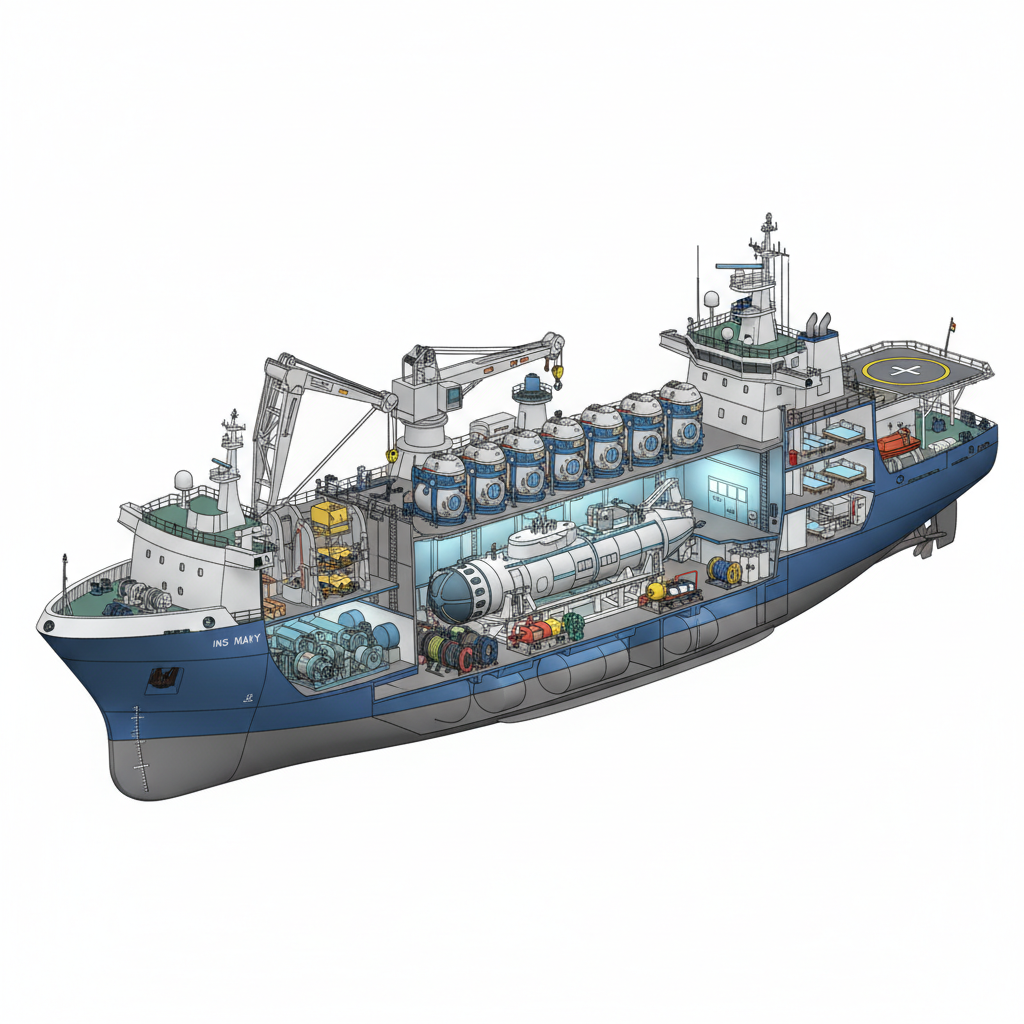
31 Aug INS Nipun Commissioned: Boosting India’s Deep-Sea Diving & Submarine Rescue Capabilities
✎ INS Nipun enhances India’s deep-sea diving and submarine rescue capabilities with a 300-metre diving range, aligning with the ‘Atmanirbhar Bharat’ defence manufacturing initiative and strengthening maritime security in the Indian…
Subject Relevance — Where This Topic Fits
- GS Paper III — Security: Challenges and their Management involving Use of Technology | GS Paper III — Disaster Management
- Prelims: Deep-Sea Diving Support Vessel (DSV), Submarine Rescue Operations, Nistar-class vessels, Hindustan Shipyard Limited, Strategic Maritime Capabilities, Disaster Relief Operations at Sea, 300-metre diving capability
- Essay: India’s Maritime Security Imperatives in the Indo-Pacific: Balancing Strategic Autonomy and Global Responsibilities, Technological Self-Reliance in Defence Production: A Case Study of Indigenous Warship Construction
Quick Revision: INS Nipun enhances India’s deep-sea diving and submarine rescue capabilities with a 300-metre diving range, aligning with the ‘Atmanirbhar Bharat’ defence manufacturing initiative and strengthening maritime security in the Indian Ocean Region.
Why is this in the news?
The commissioning of INS Nipun, the second Diving Support Vessel (DSV) of the Nistar-class, marks a significant augmentation of India’s deep-sea diving and submarine rescue capabilities. This development is critical amid evolving maritime security dynamics, particularly in the context of contested maritime environments and the need for rapid disaster response in the Indian Ocean Region (IOR). The vessel’s deployment underscores India’s commitment to enhancing operational readiness in submarine rescue, disaster relief, and humanitarian assistance, thereby strengthening its maritime security posture.
Background
- The Indian Navy’s Diving Support Vessel (DSV) programme was initiated to address critical gaps in deep-sea diving, submarine rescue, and disaster relief operations, particularly in the aftermath of the 2008 Mumbai terror attacks and subsequent reviews of India’s maritime security framework.
- The Nistar-class DSVs are part of a broader indigenous shipbuilding initiative under the ‘Make in India’ and ‘Atmanirbhar Bharat’ policies, aimed at reducing reliance on foreign defence platforms and enhancing self-sufficiency in naval capabilities.
- Hindustan Shipyard Limited (HSL), Visakhapatnam, a Defence Public Sector Undertaking (DPSU), was contracted for the construction of these vessels, aligning with the government’s push for indigenous defence manufacturing.
- India’s maritime security strategy has evolved to prioritise rapid response capabilities, including submarine rescue, given the increasing deployment of submarines in the IOR by both regional and extra-regional actors.
- The commissioning of INS Nipun coincides with heightened geopolitical tensions in the West Asian maritime domain, necessitating robust and versatile naval assets to safeguard India’s maritime interests.
What is INS Nipun?
- INS Nipun is a Deep-Sea Diving Support Vessel (DSV) of the Nistar-class, designed to provide advanced diving support, submarine rescue, and disaster relief capabilities to the Indian Navy.
- The vessel was commissioned at the Naval Dockyard, Mumbai, on August 31, 2026, in the presence of the Chief of the Naval Staff, Admiral Krishna Swaminathan, signifying its operational induction into the fleet.
- Constructed by Hindustan Shipyard Limited (HSL), Visakhapatnam, INS Nipun embodies India’s indigenous shipbuilding prowess and aligns with the ‘Atmanirbhar Bharat’ initiative in defence manufacturing.
- The vessel has a length of 119.4 metres and a displacement of 10,500 tonnes, making it one of the largest DSVs in the Indian Navy’s inventory.
- INS Nipun is equipped to support diving operations up to a depth of 300 metres, utilising advanced saturation diving systems and remotely operated vehicles (ROVs) for deep-sea interventions.
- The ship is designed for rapid submarine rescue operations, including the deployment of Deep Submergence Rescue Vessels (DSRVs) and associated diving teams to assist distressed submarines.
- Beyond military applications, INS Nipun is capable of conducting disaster relief and humanitarian operations, including search and rescue missions, medical evacuations, and provision of logistical support during natural calamities at sea.
- The vessel is powered by advanced propulsion systems and incorporates state-of-the-art navigation, communication, and life-support systems to ensure operational reliability in diverse maritime conditions.
Key Features
| Feature | Significance |
|---|---|
| Deep-sea diving capability | Enables underwater operations up to 300 metres, enhancing submarine rescue and salvage missions. |
| Submarine rescue capability | Provides rapid response for submarine emergencies, aligning with international maritime safety standards. |
| Disaster relief and humanitarian operations | Equipped to support operations during natural disasters, such as floods or cyclones, with onboard medical and logistical facilities. |
| Diving Support Vessel (DSV) classification | Part of the Nistar-class, designed for high endurance and operational flexibility in diverse maritime environments. |
| Indigenous construction | Built by Hindustan Shipyard Limited, contributing to India’s ‘Atmanirbhar Bharat’ initiative in defence manufacturing. |
Why it Matters
Strategic Security
- Enhances India’s submarine rescue and salvage capabilities, reducing response time in case of underwater emergencies.
- Strengthens India’s maritime domain awareness by enabling deeper underwater operations and rapid deployment.
- Supports India’s ‘SAGAR’ (Security and Growth for All in the Region) policy by projecting naval presence and capability in the Indian Ocean Region (IOR).
- Contributes to India’s blue-water naval ambitions by expanding operational reach and endurance in contested maritime environments.
Operational Efficiency
- Provides a dedicated platform for deep-sea diving operations, reducing reliance on multi-role vessels for specialised tasks.
- Improves interoperability with international naval forces during joint exercises and humanitarian missions.
- Enhances India’s disaster response framework by integrating naval assets into national emergency management protocols.
Industrial and Technological
- Demonstrates India’s indigenous defence manufacturing capabilities, particularly in shipbuilding and underwater systems.
- Fosters collaboration between the Indian Navy, Hindustan Shipyard Limited, and research institutions for technological advancements.
- Supports the ‘Make in India’ initiative by reducing import dependency in critical naval assets.
Challenges
1. Operational Readiness
- Ensuring continuous training and certification of personnel for deep-sea diving and submarine rescue operations.
- Maintaining the vessel’s operational readiness through regular maintenance and upgrades in a high-stress maritime environment.
- Coordinating with international partners for submarine rescue standards and interoperability.
UPSC Link: GS Paper 3: Defence and Security
2. Logistical and Infrastructure Constraints
- Addressing the need for advanced port infrastructure to support deep-sea diving vessels and their operations.
- Managing the logistical challenges of deploying such vessels for extended periods in remote maritime regions.
UPSC Link: GS Paper 3: Infrastructure and Logistics
3. Technological Advancements
- Keeping pace with rapid advancements in underwater technology, including autonomous systems and AI for submarine rescue.
- Ensuring compatibility with emerging naval technologies to maintain operational superiority.
UPSC Link: GS Paper 3: Science and Technology
Challenges — UPSC Perspective
| Issue | Concern |
|---|---|
| Personnel Training | Need for specialised training in deep-sea diving and submarine rescue operations. |
| Maintenance and Upgrades | Ensuring the vessel remains technologically relevant over its operational lifespan. |
| Infrastructure Support | Availability of advanced ports and logistical hubs for deployment and maintenance. |
| Interoperability | Standardisation of protocols for joint operations with international naval forces. |
| Technological Obsolescence | Risk of rapid technological advancements outpacing vessel capabilities. |
Way Forward
- Conduct regular joint exercises with international naval forces to enhance interoperability and standardise submarine rescue protocols.
- Invest in advanced training facilities and certification programmes for deep-sea diving and submarine rescue personnel.
- Develop a phased upgrade plan for the vessel to incorporate emerging technologies such as AI and autonomous systems.
- Strengthen port infrastructure in key naval bases to support the operational deployment of deep-sea diving vessels.
- Enhance collaboration between the Indian Navy, Hindustan Shipyard Limited, and research institutions for indigenous technological advancements.
- Integrate the vessel’s capabilities into national disaster management frameworks for rapid response during emergencies.
- Establish a dedicated submarine rescue centre to streamline operations and improve response times.
UPSC Value Addition
Keywords for Mains Answer-Writing
INS Nipun · Deep-sea diving vessel · Nistar-class Diving Support Vessel · Submarine rescue capability · Indian Navy modernisation · Disaster relief operations · Maritime security · Strategic churn in maritime domain · Hindustan Shipyard Limited · Deep diving operations up to 300 metres · Defence indigenisation · Maritime domain awareness
Concept Flow
India’s maritime security challenges in the Indian Ocean Region (IOR) necessitate advanced naval capabilities. → Deep-sea diving vessels like INS Nipun are developed to address submarine rescue and underwater operations. → Indigenous construction (Hindustan Shipyard Limited) aligns with ‘Atmanirbhar Bharat’ and reduces import dependency. → Operational deployment enhances India’s ‘SAGAR’ policy and maritime domain awareness. → Technological advancements and personnel training ensure sustained operational readiness and interoperability. → Integration into national disaster management frameworks expands the vessel’s utility beyond defence.
Prelims Practice Questions
Q1. Consider the following statements regarding INS Nipun:
1. INS Nipun is the first Diving Support Vessel (DSV) commissioned by the Indian Navy.
2. It has the capability to support diving operations up to 300 metres depth.
3. The vessel was built by Hindustan Shipyard Limited.
4. INS Nipun is primarily designed for amphibious warfare operations.
How many of the above statements are correct?
- Only one
- Only two
- Only three
- All four
Answer: Only three — Statements 2 and 3 are correct. INS Nipun is the second DSV of the Nistar-class, not the first, and it is designed for deep-sea diving and submarine rescue, not amphibious warfare.
Q2. Assertion (A): The Indian Navy’s acquisition of deep-sea diving vessels like INS Nipun enhances its submarine rescue capabilities.
Reason (R): These vessels are equipped to operate at depths up to 300 metres and can provide rapid response in disaster relief operations.
In the context of the above two statements, which one of the following is correct?
- Both A and R are true, and R is the correct explanation of A.
- Both A and R are true, but R is not the correct explanation of A.
- A is true, but R is false.
- A is false, but R is true.
Answer: Both A and R are true, and R is the correct explanation of A. — Both the Assertion (A) and Reason (R) are true, and R correctly explains A, as the vessel’s deep-diving capability directly enhances submarine rescue operations.
Q3. Match the following vessels with their respective classes:
Column I (Vessel) | Column II (Class)
— | —
A. INS Nipun | 1. Arihant-class
B. INS Vikramaditya | 2. Nistar-class
C. INS Kalvari | 3. Modified Kiev-class
D. INS Arihant | 4. Kalvari-class
Choose the correct match from the options below:
- A-2, B-3, C-4, D-1
- A-1, B-2, C-3, D-4
- A-4, B-3, C-2, D-1
- A-2, B-4, C-1, D-3
Answer: A-2, B-3, C-4, D-1 — INS Nipun belongs to the Nistar-class (A-2), INS Vikramaditya is a Modified Kiev-class aircraft carrier (B-3), INS Kalvari is part of the Kalvari-class submarines (C-4), and INS Arihant is an Arihant-class submarine (D-1).
Mains Practice Question
✍ The commissioning of deep-sea diving vessels such as INS Nipun signifies a strategic shift in India’s maritime security architecture. Critically examine the significance of such vessels for India’s maritime domain awareness, submarine rescue capabilities, and disaster response operations. Also analyse the role of indigenisation in enhancing India’s defence preparedness in this context. (15 Marks)
Approach: MODEL-ANSWER SKELETON:
1. **Introduction (2 marks)**
– Define deep-sea diving vessels and their role in maritime security.
– Mention INS Nipun as part of the Nistar-class and its commissioned capabilities.
2. **Significance for Maritime Domain Awareness (3 marks)**
– Enhanced surveillance and monitoring of underwater threats.
– Integration with India’s broader maritime security framework (e.g., Information Fusion Centre-Indian Ocean Region).
– Contribution to real-time data collection in contested maritime zones.
3. **Submarine Rescue Capabilities (4 marks)**
– Role in rapid submarine rescue operations (e.g., alignment with International Submarine Escape and Rescue Liaison Office standards).
– Comparison with legacy systems (e.g., INS Nireekshak) and global best practices.
– Strategic implications for safeguarding nuclear submarines (e.g., Arihant-class).
4. **Disaster Response and Humanitarian Operations (3 marks)**
– Deployment in search-and-rescue missions (e.g., post-cyclone or underwater accident scenarios).
– Support for coastal and island disaster relief (e.g., Tsunami Warning System integration).
– Case studies of similar vessels in other navies (e.g., USNS Safeguard, UK’s LR5).
5. **Indigenisation and Defence Preparedness (3 marks)**
– Role of Hindustan Shipyard Limited in building INS Nipun (Make in India initiative).
– Reduction in import dependency and enhancement of self-reliance (Atmanirbhar Bharat).
– Challenges: Technology transfer, cost-efficiency, and maintenance infrastructure.
6. **Conclusion (2 marks)**
– Synthesis of the vessel’s strategic importance.
– Future outlook: Expansion of DSV fleet and integration with multi-domain operations.
Source: The Hindu
Generated by AanyaAi for educational purpose.

- माई भारत अभियान: ग्राम सेवा एवं खेल दिवस के तहत गांवों में Nasha Mukt Yuva Abhiyan - October 24, 2026
- Odisha’s Zero Casualty Plan as Cyclone Threatens: UPSC Geography Insights - October 24, 2026
- आरबीआई का ओडिशा डेटा सेंटर: अर्थव्यवस्था के लिए क्यों है महत्वपूर्ण? - October 24, 2026

No Comments