


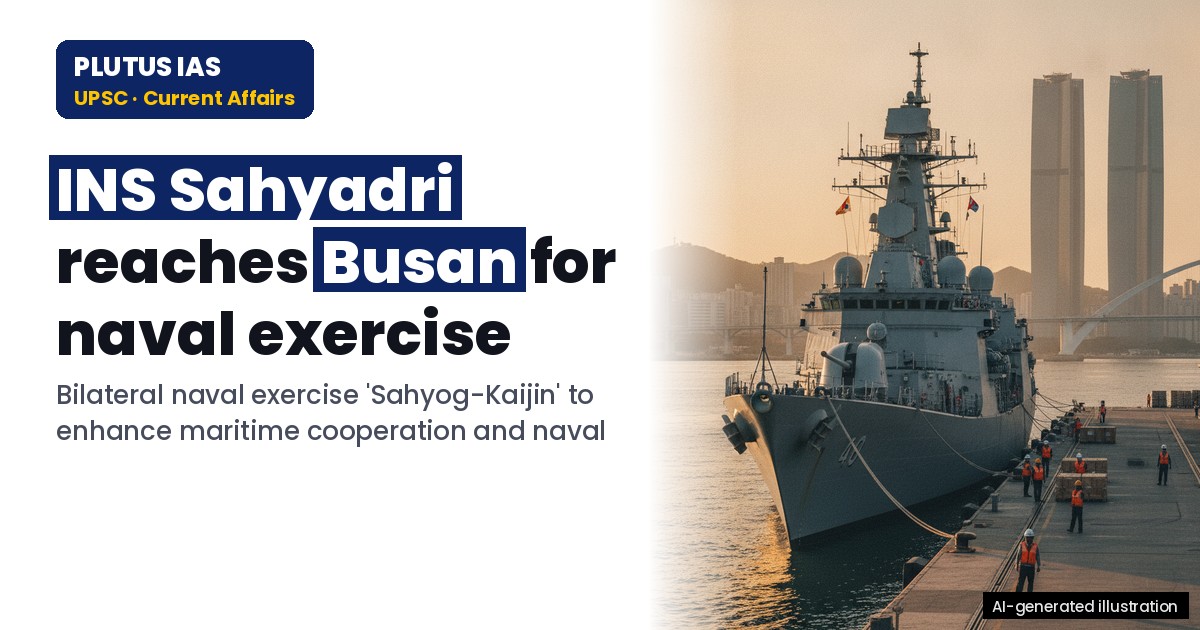
28 Oct INS Sahyadri reaches Busan for India-Republic of Korea naval exercise
✎ The India-Republic of Korea bilateral naval exercise, featuring INS Sahyadri, is a strategic naval diplomacy initiative aimed at enhancing maritime security cooperation, interoperability, and regional stability in the…
Subject Relevance — Where This Topic Fits
- GS Paper II — International Relations: Bilateral, Regional and Global Groupings and Agreements involving India and/or affecting India’s interests | GS Paper III — Security: Challenges to Internal Security through External State and Non-State Actors
- Prelims: INS Sahyadri, Bilateral Naval Exercises, Indo-Pacific Strategy, Republic of Korea (RoK), Maritime Security, Exclusive Economic Zone (EEZ), Malabar Exercise, ASEAN Outlook on the Indo-Pacific
- Essay: The evolving architecture of maritime security in the Indo-Pacific: Challenges and opportunities for India, Diplomacy as a tool of national power: Case studies from India’s maritime engagements
Quick Revision: The India-Republic of Korea bilateral naval exercise, featuring INS Sahyadri, is a strategic naval diplomacy initiative aimed at enhancing maritime security cooperation, interoperability, and regional stability in the Indo-Pacific.
Why is this in the news?
The arrival of INS Sahyadri, an indigenously built stealth frigate of the Indian Navy, at Busan, Republic of Korea, for a bilateral naval exercise with the Republic of Korea Navy (RoKN) underscores the growing strategic convergence between India and the RoK in the maritime domain. This engagement is significant as it aligns with India’s broader Indo-Pacific strategy and reinforces naval diplomacy as a key instrument of foreign policy to ensure regional stability, freedom of navigation, and adherence to international maritime law.
Background
- The Indian Navy’s deployment of INS Sahyadri to the Republic of Korea follows a series of high-level diplomatic engagements between India and the RoK, including the elevation of bilateral ties to a ‘Special Strategic Partnership’ in 2015.
- The Republic of Korea has emerged as a key partner for India in the Indo-Pacific, with shared interests in ensuring maritime security, countering piracy, and promoting rules-based order in the region.
- India’s Act East Policy and the Indo-Pacific Oceans Initiative (IPOI) emphasize strengthening maritime cooperation with like-minded countries, including the RoK, to address common challenges such as illegal fishing, smuggling, and territorial disputes.
- The bilateral naval exercise between India and the RoK is part of a broader trend of India’s proactive engagement with regional navies, including Japan, Australia, and the United States, to enhance interoperability and address shared maritime security concerns.
- The Republic of Korea’s strategic location along the vital sea lanes of communication (SLOCs) in the East China Sea and its active participation in multilateral naval exercises, such as RIMPAC, further highlight the importance of this engagement.
- India’s indigenous warship INS Sahyadri, commissioned in 2012, is a multi-role stealth frigate equipped with advanced sensors, weapons systems, and communication suites, designed for long-range operations and maritime domain awareness.
What is the India-Republic of Korea Bilateral Naval Exercise?
- The bilateral naval exercise between India and the Republic of Korea is a structured maritime engagement aimed at enhancing interoperability, operational coordination, and mutual trust between the Indian Navy and the Republic of Korea Navy (RoKN).
- The exercise typically includes a range of activities such as joint manoeuvres, anti-submarine warfare drills, air defence exercises, maritime surveillance, and search-and-rescue operations.
- These exercises are designed to improve the operational readiness of both navies, facilitate the exchange of best practices, and strengthen maritime domain awareness in the Indo-Pacific region.
- The participation of INS Sahyadri, an indigenously built stealth frigate, highlights India’s growing indigenous naval capabilities and its commitment to self-reliance in defence production (Atmanirbhar Bharat).
- The exercise also serves as a platform for high-level interactions between naval officers, fostering professional relationships and enabling the sharing of technological advancements in naval warfare.
- Such engagements are aligned with India’s broader maritime strategy, which emphasizes the protection of maritime interests, the promotion of freedom of navigation, and adherence to international maritime law, including the United Nations Convention on the Law of the Sea (UNCLOS).
- The exercise in Busan is part of a series of regular bilateral and multilateral naval engagements that India conducts with regional partners to ensure a stable and secure maritime environment.
- These exercises also contribute to the broader objectives of the Indo-Pacific Strategy, which seeks to foster a rules-based order, promote sustainable development, and address common security challenges in the region.
Key Features
| Feature | Significance |
|---|---|
| Bilateral naval exercise | Enhances interoperability between Indian and Republic of Korea (RoK) naval forces, fostering maritime security cooperation in the Indo-Pacific region. |
| INS Sahyadri deployment | Demonstrates India’s operational reach and commitment to regional maritime stability through forward presence in East Asian waters. |
| Port visit to Busan | Facilitates logistical coordination, crew rest, and diplomatic engagement, strengthening bilateral ties beyond military exercises. |
| Multilateral framework context | Contributes to India’s Act East Policy and RoK’s New Southern Policy, aligning with broader regional security architectures. |
| Operational readiness | Validates combat readiness, tactical proficiency, and adherence to international maritime norms and protocols. |
Why it Matters
Strategic Security
- Reinforces India’s maritime posture in the Indo-Pacific, complementing partnerships with like-minded nations to counterbalance regional power dynamics.
- Demonstrates India’s proactive engagement in multilateral naval exercises, enhancing deterrence and crisis response capabilities.
- Supports freedom of navigation and overflight principles, aligning with the United Nations Convention on the Law of the Sea (UNCLOS).
- Strengthens mutual trust and confidence-building measures (CBMs) between Indian and RoK naval forces.
Diplomatic Relations
- Bilateral naval engagements serve as a diplomatic tool to deepen strategic partnerships without formal alliances.
- Facilitates high-level exchanges and mutual understanding of maritime security challenges.
- Enhances economic and technological cooperation through defense diplomacy.
Operational Synergy
- Improves joint operational capabilities, including anti-submarine warfare, air defense, and maritime domain awareness.
- Enables exchange of best practices in naval training, maintenance, and logistics.
- Promotes standardization of communication and interoperability protocols.
Regional Stability
- Contributes to a rules-based maritime order in the Indo-Pacific, countering unilateral assertions of maritime claims.
- Supports capacity-building initiatives for smaller littoral states in the region.
- Deters non-state actors and illicit maritime activities through coordinated patrols.
Challenges
1. Geopolitical Tensions in Indo-Pacific
- Naval exercises may inadvertently escalate tensions with rival powers, necessitating careful diplomatic calibration.
- Balancing engagements with multiple stakeholders without compromising strategic autonomy.
UPSC Link: GS2: Regional groupings
2. Logistical and Operational Constraints
- Extended deployments strain naval resources, requiring efficient rotation and maintenance schedules.
- Ensuring seamless interoperability despite differences in naval doctrines and equipment.
UPSC Link: GS3: Security challenges
3. Maritime Domain Awareness Gaps
- Limited real-time data sharing across regional navies due to technological and policy constraints.
- Addressing gaps in surveillance and reconnaissance in vast maritime zones.
UPSC Link: GS3: Security challenges
4. Resource Allocation Priorities
- Balancing naval modernization with other defense and developmental priorities.
- Ensuring sustained funding for operational deployments and exercises.
UPSC Link: GS3: Security challenges
5. Climate Change and Maritime Security
- Increasing frequency of extreme weather events disrupts naval operations and supply chains.
- Rising sea levels and coastal erosion threaten naval infrastructure and basing.
UPSC Link: GS3: Disaster management
Challenges — UPSC Perspective
| Issue | Concern |
|---|---|
| Differing naval doctrines | Potential friction in joint operations due to varying tactical approaches and training standards. |
| Technology transfer restrictions | Limits on sharing sensitive defense technologies between partner nations. |
| Supply chain vulnerabilities | Dependence on foreign ports for refueling and resupply during long deployments. |
| Legal ambiguities in maritime zones | Disputes over jurisdiction and enforcement in overlapping exclusive economic zones (EEZs). |
| Cybersecurity threats | Increased risk of cyber intrusions targeting naval communication and logistics systems. |
| Environmental regulations | Compliance with international maritime environmental standards during exercises. |
Way Forward
- Institutionalize regular bilateral naval exercises with the Republic of Korea to ensure sustained operational synergy.
- Enhance maritime domain awareness through joint patrols, information sharing, and technological collaboration.
- Strengthen logistical support infrastructure in the Indo-Pacific to reduce dependence on foreign ports.
- Develop standardized protocols for interoperability, including communication, navigation, and combat systems.
- Promote joint research and development in naval technologies to address emerging security challenges.
- Expand participation in multilateral maritime security initiatives to build a robust regional security architecture.
- Conduct periodic reviews of operational readiness and lessons learned to refine future engagements.
- Foster civilian-military cooperation in maritime security to address non-traditional threats.
UPSC Value Addition
Keywords for Mains Answer-Writing
Indo-Korean bilateral defence cooperation · INS Sahyadri · Busan port call · maritime security · defence diplomacy · Indian Navy’s operational deployment · bilateral naval exercises · strategic partnerships in the Indo-Pacific · maritime domain awareness · defence cooperation agreements · India’s Act East Policy · Regional maritime security architecture · Blue Economy · maritime trade routes · defence logistics support · quadrilateral security dialogue (Quad) · ASEAN-centric security framework · UNCLOS and maritime disputes · India’s naval modernisation · strategic autonomy in foreign policy
Concept Flow
India’s Act East Policy → Enhanced engagement with East Asian nations → Bilateral naval exercises with RoK → Operational readiness and interoperability → Strengthened maritime security in Indo-Pacific → Regional stability and deterrence → Maritime security challenges in Indo-Pacific → Need for collective action → India-RoK naval cooperation → Joint exercises and port visits → Capacity-building and CBMs → Rules-based maritime order → Global maritime governance frameworks (UNCLOS) → India’s adherence to international norms → Participation in bilateral exercises → Reinforcement of freedom of navigation → Countering unilateral maritime claims → Naval modernization priorities → Resource allocation for operational deployments → Forward presence in East Asian waters → Bilateral engagements with RoK → Enhanced deterrence and crisis response capabilities
Prelims Practice Questions
Q1. Consider the following statements regarding India’s naval exercises with foreign countries:
1. INS Sahyadri participated in a bilateral naval exercise with the Republic of Korea Navy (RoKN) in Busan.
2. The exercise was conducted under the framework of India’s ‘Act East Policy’.
3. The exercise included joint patrolling in the South China Sea.
4. The exercise was a part of India’s commitment to the Quadrilateral Security Dialogue (Quad).
How many of the above statements are correct?
- Only one
- Only two
- Only three
- All four
Answer: Only two — Statement 1 is correct as INS Sahyadri arrived at Busan for a bilateral exercise with RoKN. Statement 2 is correct as the exercise aligns with India’s Act East Policy. Statement 3 is incorrect as no joint patrolling in the South China Sea was mentioned. Statement 4 is incorrect as the exercise was bilateral, not Quad-related.
Q2. Assertion (A): The Indian Navy’s operational deployments, such as INS Sahyadri’s visit to Busan, are primarily aimed at enhancing maritime security in the Indo-Pacific region.
Reason (R): India’s Act East Policy prioritises strengthening defence and economic ties with countries in East and Southeast Asia.
In the context of the above two statements, which one of the following is correct?
- Both A and R are true, and R is the correct explanation of A.
- Both A and R are true, but R is NOT the correct explanation of A.
- A is true, but R is false.
- A is false, but R is true.
Answer: Both A and R are true, but R is NOT the correct explanation of A. — Assertion (A) is true as the deployment aims to enhance maritime security. Reason (R) is also true and correctly explains the assertion, as the Act East Policy is a key framework for such engagements.
Q3. Match the following naval exercises with their respective partner countries:
Column I (Naval Exercise) Column II (Partner Country)
A. Varuna 1. United States
B. Malabar 2. France
C. Sahyadri 3. Republic of Korea
D. SIMBEX 4. Singapore
Select the correct match:
- A-2, B-1, C-3, D-4
- A-1, B-2, C-3, D-4
- A-2, B-1, C-4, D-3
- A-4, B-2, C-3, D-1
Answer: A-2, B-1, C-3, D-4 — Varuna is a bilateral naval exercise with France, Malabar is with the United States and Japan, Sahyadri is with the Republic of Korea, and SIMBEX is with Singapore.
Mains Practice Question
✍ India’s maritime strategy in the Indo-Pacific is increasingly shaped by bilateral and multilateral defence engagements. In this context, critically examine the significance of INS Sahyadri’s recent port call to Busan, Republic of Korea, for India’s defence diplomacy and maritime security architecture. (15 Marks)
Approach: MODEL-ANSWER SKELETON:
1. **Context and Background (2 Marks)**
– Briefly outline India’s Act East Policy and its objectives in the Indo-Pacific.
– Mention the role of the Indian Navy in India’s maritime strategy, including the deployment of INS Sahyadri.
2. **Significance of INS Sahyadri’s Port Call (5 Marks)**
– **Defence Diplomacy**: Explain how such engagements strengthen bilateral defence ties with the Republic of Korea (RoK), including potential agreements on logistics support, maritime domain awareness, and joint exercises.
– **Operational Significance**: Discuss the operational benefits, such as interoperability, joint training, and experience sharing in maritime security operations.
– **Strategic Messaging**: Analyse how such deployments signal India’s commitment to a rules-based maritime order and its role in the Indo-Pacific security architecture.
– **Economic and Trade Dimensions**: Highlight the importance of Busan as a major port and its role in India’s trade with East Asia.
3. **Maritime Security Architecture (4 Marks)**
– Discuss India’s broader engagement in the Indo-Pacific, including its participation in the Quad, ASEAN-centric frameworks, and bilateral exercises with other countries (e.g., Malabar, Varuna).
– Explain how such engagements contribute to regional maritime security, including counter-piracy, anti-submarine warfare, and disaster response.
– Reference India’s commitment to the United Nations Convention on the Law of the Sea (UNCLOS) and its role in resolving maritime disputes.
4. **Challenges and Limitations (3 Marks)**
– Discuss potential challenges, such as resource constraints, balancing engagements with multiple partners, and navigating geopolitical sensitivities (e.g., in the South China Sea).
– Highlight the need for sustained diplomatic efforts to translate such engagements into tangible outcomes.
5. **Conclusion (1 Mark)**
– Summarise the strategic importance of INS Sahyadri’s deployment and its role in shaping India’s maritime strategy in the Indo-Pacific.
Source: PIB (Press Information Bureau)
Generated by AanyaAi for educational purpose.
Related guides on our sites
- Best PSIR optional coaching for upsc
- Best PSIR optional teacher for upsc
- Best teacher of PSIR optional for upsc
- Best PSIR optional coaching in delhi for UPSC

- Vice-President Meets EU Parliament AFET: Key Polity Insights for UPSC & PCS - October 28, 2026
- आंध्र प्रदेश में चक्रवात अरनब: केंद्र से सहायता की अपील, जानिए मुख्य बिंदु - October 28, 2026
- ISRO to launch NVS-03 satellite on October 30: Key details for UPSC & State PCS - October 28, 2026

No Comments