


15 Jul IPC और UPPPC का समझौता: स्वास्थ्य सेवा में गुणवत्ता व नवाचार को बढ़ावा
Subject Relevance — Where This Topic Fits
- GS Paper II — Governance, Social Justice, and Health | GS Paper III — Indian Economy and Issues Relating to Planning, Mobilization of Resources, Growth, Development and Employment; Science and Technology- Developments and their Applications and Effects in Everyday Life
- Prelims: Indian Pharmacopoeia Commission (IPC), Uttar Pradesh Pharmacopoeia Council (UPPPC), Memorandum of Understanding (MoU), Pharmaceutical and Medical Device Ecosystem, Drug Vigilance, Materiovigilance, Quality Assurance, Patient Safety, MSMEs in Healthcare, Regulatory Excellence
- Essay: Quality Healthcare as a Cornerstone of National Development: Challenges and Opportunities, India’s Pharmaceutical Sector: A Global Pharmacy with Local Imperatives for Quality and Innovation
Quick Revision: The IPC-UPPPC MoU aims to elevate healthcare quality, innovation, and patient safety by strengthening the pharmaceutical and medical device ecosystem in Uttar Pradesh through enhanced standards, vigilance, and MSME support.
Why is this in the news?
The Indian Pharmacopoeia Commission (IPC) and the Uttar Pradesh Pharmacopoeia Council (UPPPC) have signed a Memorandum of Understanding (MoU) on July 14, 2026, during the YEIDA MedTech Investors Meet and Site Visit 2026 in Greater Noida. This strategic partnership aims to bolster quality standards, regulatory compliance, innovation, and capacity building within the pharmaceutical and medical device ecosystem, with a specific focus on enhancing patient safety and supporting Micro, Small, and Medium Enterprises (MSMEs) through digital reporting tools.
Background
- India’s pharmaceutical industry is the third largest in the world by volume and 14th by value, playing a crucial role in global healthcare.
- Uttar Pradesh, with its large population and growing industrial base, is strategically positioned to become a significant hub for pharmaceuticals and medical devices.
- The regulatory landscape for drugs and medical devices in India is complex, involving various central and state bodies, necessitating coordinated efforts for effective oversight.
- Quality assurance and patient safety are paramount concerns, especially given the prevalence of counterfeit drugs and substandard medical devices in some markets.
- Innovation in the pharmaceutical and medical device sectors is vital for addressing evolving health challenges and ensuring India’s competitiveness on a global scale.
- MSMEs constitute a significant portion of the Indian pharmaceutical and medical device manufacturing base, requiring targeted support for compliance and quality improvement.
Understanding the Indian Pharmacopoeia Commission (IPC) and Uttar Pradesh Pharmacopoeia Council (UPPPC)
- The Indian Pharmacopoeia Commission (IPC) is an autonomous institution of the Ministry of Health & Family Welfare, Government of India, established to set standards for drugs manufactured, sold, and consumed in India.
- IPC’s primary function is to update the Indian Pharmacopoeia (IP), which serves as a book of standards for drugs, ensuring their quality, safety, and efficacy.
- It also publishes the National Formulary of India (NFI) and provides reference substances for quality control testing.
- IPC plays a crucial role in promoting rational use of medicines and ensuring the availability of quality medicines to the public.
- The Uttar Pradesh Pharmacopoeia Council (UPPPC) is a state-level body focused on promoting and enforcing quality standards for pharmaceuticals within Uttar Pradesh.
- UPPPC aims to strengthen the regulatory framework at the state level, facilitate compliance, and foster innovation in the local pharmaceutical and medical device industries.
- The Council is instrumental in capacity building, awareness generation, and supporting local manufacturers, particularly MSMEs, in adhering to national and international quality benchmarks.
- This collaboration signifies a synergistic approach to leverage IPC’s national expertise with UPPPC’s regional focus to achieve comprehensive healthcare quality improvements.
Key Features
| Feature of Collaboration | Significance |
|---|---|
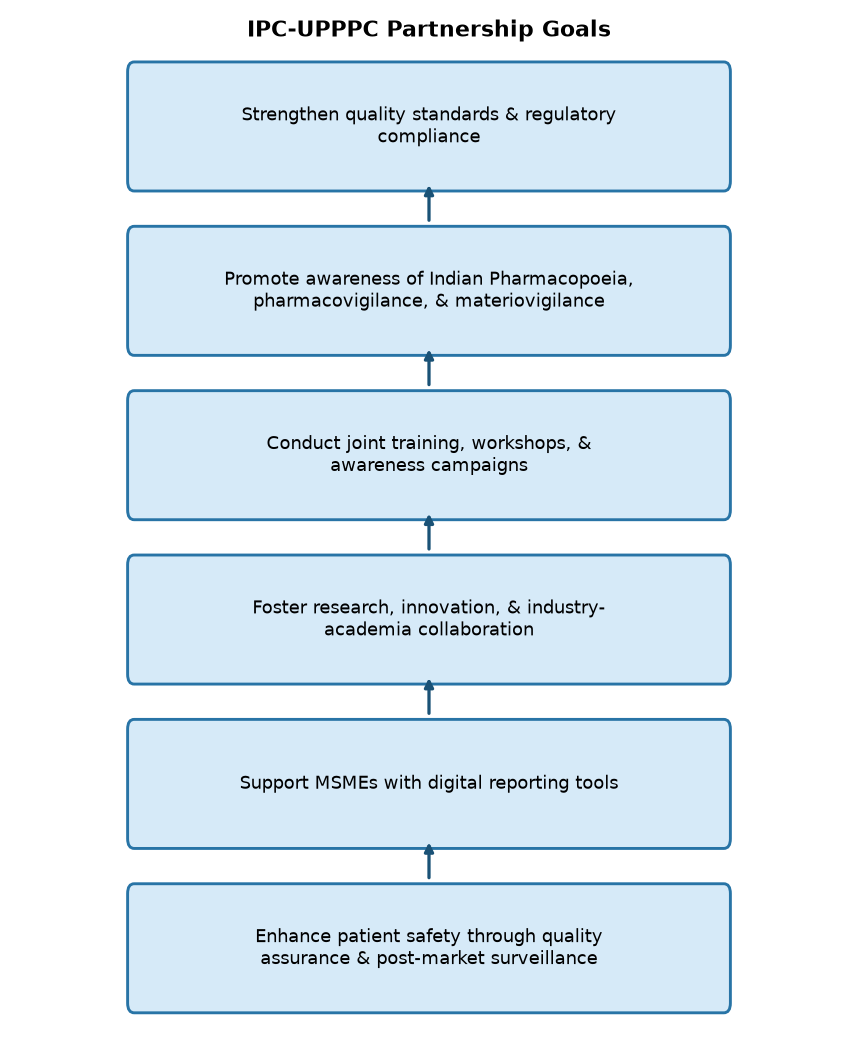
| Strengthening Quality Standards and Regulatory Compliance | Ensures adherence to national and international benchmarks for drug and medical device manufacturing, reducing substandard products. |
| Promoting Awareness of Indian Pharmacopoeia, Drug Vigilance, and Materiovigilance | Educates stakeholders on critical quality control documents and post-market surveillance mechanisms, enhancing patient safety. |
| Joint Training Programs, Workshops, and Awareness Campaigns | Builds capacity among industry professionals, regulators, and academics, fostering a culture of quality and innovation. |
| Fostering Research, Innovation, and Industry-Academia Collaboration | Drives the development of new drugs and medical devices, addressing unmet medical needs and promoting self-reliance. |
| Supporting MSMEs with Digital Tools for Adverse Event Reporting | Simplifies compliance for smaller enterprises, enabling timely reporting of adverse events and improving product safety profiles. |
| Enhancing Patient Safety through Quality Assurance and Post-Market Surveillance | Establishes robust systems for monitoring product performance and safety after market release, protecting public health. |
Why it Matters
Enhancing Public Health and Patient Safety
- The collaboration directly contributes to ensuring the availability of high-quality, safe, and efficacious drugs and medical devices, thereby safeguarding public health.
- Robust post-market surveillance mechanisms, including drug vigilance and materiovigilance, will enable prompt detection and redressal of adverse events, significantly improving patient safety outcomes.
Boosting Economic Growth and Industrial Competitiveness
- By strengthening the pharmaceutical and medical device ecosystem, the partnership will attract further investment, foster innovation, and create employment opportunities, particularly in Uttar Pradesh.
- Improved quality standards and regulatory compliance will enhance the competitiveness of Indian manufacturers in both domestic and international markets, aligning with the ‘Make in India’ initiative.
Promoting Innovation and Research & Development
- The emphasis on research, innovation, and industry-academia collaboration will stimulate the development of advanced pharmaceutical formulations and cutting-edge medical devices.
- This will position India as a leader in healthcare innovation, capable of addressing complex health challenges and contributing to global health solutions.
Strengthening Regulatory Framework and Governance
- The MoU signifies a concerted effort to harmonize and strengthen regulatory practices at both national and state levels, leading to more efficient and transparent governance in the healthcare sector.
- Capacity building and awareness campaigns will empower all stakeholders, including regulators, manufacturers, and healthcare professionals, to adhere to best practices and ethical standards.
Empowering MSMEs
- Providing digital tools for adverse event reporting and facilitating compliance will significantly ease the burden on MSMEs, enabling them to meet stringent quality requirements without disproportionate costs.
- This support is crucial for integrating MSMEs into the mainstream quality-driven pharmaceutical and medical device supply chain, fostering inclusive growth.
Challenges
1. Regulatory Harmonization and Enforcement
- Ensuring consistent application of quality standards and regulatory compliance across diverse manufacturing units, especially in a large state like Uttar Pradesh.
- Addressing the challenges of fragmented regulatory oversight between central and state bodies, requiring continuous coordination and capacity building.
UPSC Link: GS Paper II: Governance; GS Paper III: Economy
2. Quality Control and Counterfeit Products
- Combating the persistent issue of substandard and counterfeit drugs and medical devices, which pose significant public health risks.
- Implementing robust testing infrastructure and surveillance mechanisms to detect and eliminate such products from the market effectively.
UPSC Link: GS Paper II: Health; GS Paper III: Science and Technology
3. Technological Adoption and Digital Divide
- Ensuring widespread adoption of digital reporting tools and advanced manufacturing technologies, particularly among smaller MSMEs with limited technological capabilities.
- Bridging the digital divide and providing necessary training and infrastructure support to facilitate seamless integration of digital solutions.
UPSC Link: GS Paper III: Science and Technology; GS Paper II: Social Justice
4. Skilled Manpower and Capacity Building
- Developing a skilled workforce capable of operating advanced manufacturing technologies, conducting sophisticated quality control, and performing effective regulatory oversight.
- Sustaining continuous training and development programs to keep pace with evolving scientific advancements and regulatory requirements.
UPSC Link: GS Paper II: Human Resources; GS Paper III: Economy
5. Funding and Investment for R&D
- Securing adequate funding and incentivizing private sector investment in research and development for new drugs and medical devices.
- Creating an attractive ecosystem for innovation that translates research into commercially viable and accessible products.
UPSC Link: GS Paper III: Economy; GS Paper III: Science and Technology
Challenges — UPSC Perspective
| Issue | Concern |
|---|---|
| Regulatory Overlap | Potential for confusion and inefficiency due to multiple agencies involved in drug and device regulation. |
| Substandard Manufacturing | Risk of low-quality products entering the market due to inadequate adherence to Good Manufacturing Practices (GMP). |
| Limited R&D Investment | Insufficient private and public funding for cutting-edge research and development in pharmaceuticals and medical devices. |
| Lack of Awareness | Stakeholders, particularly smaller manufacturers, may lack awareness of evolving pharmacopoeial standards and vigilance protocols. |
| Data Management | Challenges in collecting, analyzing, and utilizing adverse event data effectively for informed decision-making and policy formulation. |
Government Initiatives — Must-Memorise for Prelims
- National Health Policy 2017
- Ayushman Bharat Pradhan Mantri Jan Arogya Yojana (PMJAY)
- Pradhan Mantri Bhartiya Janaushadhi Pariyojana (PMBJP)
- Production Linked Incentive (PLI) Scheme for Pharmaceuticals
- Production Linked Incentive (PLI) Scheme for Medical Devices
- Scheme for Promotion of Medical Device Parks
- National Medical Device Policy 2023
- Drug Price Control Order (DPCO)
- Indian Council of Medical Research (ICMR) initiatives for R&D
- Startup India initiative (for healthcare startups)
Way Forward
- Establish a joint task force for continuous monitoring and evaluation of the MoU’s implementation, ensuring timely achievement of objectives.
- Develop a robust digital platform for integrated adverse event reporting, accessible to all stakeholders, with strong data analytics capabilities.
- Intensify capacity building programs for regulatory personnel, industry professionals, and academic researchers, focusing on emerging technologies and global best practices.
- Incentivize private sector investment in R&D and manufacturing of high-quality pharmaceuticals and medical devices through tax benefits and streamlined regulatory approvals.
- Promote public-private partnerships (PPPs) for establishing advanced testing laboratories and research facilities across Uttar Pradesh.
- Launch widespread awareness campaigns to educate healthcare providers and the general public about the importance of quality medicines and medical devices, and mechanisms for reporting adverse events.
- Harmonize state-level regulations with national standards to create a seamless and efficient regulatory environment for the pharmaceutical and medical device sectors.
- Leverage artificial intelligence and machine learning for predictive analytics in drug vigilance and materiovigilance, enhancing proactive safety measures.
UPSC Value Addition
Keywords for Mains Answer-Writing
Pharmaceutical Ecosystem · Medical Device Industry · Quality Assurance · Regulatory Excellence · Patient Safety · Drug Vigilance · Materiovigilance · Innovation in Healthcare · Capacity Building · MSME Support · Public Health Governance · Industry-Academia Collaboration
Constitutional & Policy Linkages
- Article 21: Right to Life and Personal Liberty (implies right to health)
- Article 47: Duty of the State to raise the level of nutrition and the standard of living and to improve public health
- Seventh Schedule (List III – Concurrent List): Drugs and Poisons; Medical and other professions
- Drugs and Cosmetics Act, 1940: Primary legislation governing drug and cosmetic regulation
- Medical Devices Rules, 2017: Specific rules for medical device regulation
- National Health Policy 2017: Policy framework for healthcare improvement
Concept Flow
IPC-UPPPC MoU signed → Strengthened quality standards & regulatory compliance → Enhanced drug vigilance & materiovigilance → Increased patient safety & public trust → Boosted innovation & R&D in healthcare → Uttar Pradesh emerges as healthcare hub → Improved national health outcomes & economic growth
Prelims Practice Questions
Q1. With reference to the Indian Pharmacopoeia Commission (IPC), consider the following statements:
1. It is an autonomous institution under the Ministry of Health & Family Welfare.
2. Its primary function is to publish the National Formulary of India (NFI).
3. It is responsible for setting standards for drugs manufactured and sold in India.
- A. 1 only
- B. 1 and 2 only
- C. 1 and 3 only
- D. 1, 2 and 3
Answer: C. 1 and 3 only — Statement 1 is correct. IPC is indeed an autonomous institution under the Ministry of Health & Family Welfare. Statement 2 is incorrect. While IPC publishes NFI, its primary function is to update the Indian Pharmacopoeia (IP), which sets standards for drugs. Statement 3 is correct. IPC is responsible for setting standards for drugs to ensure their quality, safety, and efficacy.
Q2. The recent Memorandum of Understanding (MoU) between the Indian Pharmacopoeia Commission (IPC) and the Uttar Pradesh Pharmacopoeia Council (UPPPC) aims to achieve which of the following?
1. Strengthen quality standards in pharmaceutical and medical device industries.
2. Promote awareness about Materiovigilance.
3. Provide digital tools for adverse event reporting to MSMEs.
4. Establish a new central drug testing laboratory in Uttar Pradesh.
- A. 1 and 2 only
- B. 3 and 4 only
- C. 1, 2 and 3 only
- D. 1, 2, 3 and 4
Answer: C. 1, 2 and 3 only — Statements 1, 2, and 3 are explicitly mentioned as objectives of the MoU in the news. The MoU aims to strengthen quality standards, promote awareness about Materiovigilance (and Drug Vigilance), and support MSMEs with digital reporting tools. Statement 4, establishing a new central drug testing laboratory, is not explicitly stated as an objective of this particular MoU, although it might be a related future development or part of broader initiatives.
Mains Practice Question
✍ The recent collaboration between the Indian Pharmacopoeia Commission (IPC) and the Uttar Pradesh Pharmacopoeia Council (UPPPC) marks a significant step towards bolstering India’s pharmaceutical and medical device ecosystem. Analyze the multi-faceted significance of this partnership for public health, economic growth, and regulatory governance. What are the key challenges that need to be addressed for its successful implementation, and suggest a comprehensive way forward?
Approach: Begin by briefly introducing the IPC-UPPPC MoU and its core objective. In the first part, analyze the ‘multi-faceted significance’ by discussing its impact on public health (patient safety, quality medicines), economic growth (investment, innovation, MSME support), and regulatory governance (harmonization, compliance, capacity building). In the second part, identify and elaborate on key challenges such as regulatory enforcement, counterfeit products, technological adoption, skilled manpower, and R&D funding. Conclude by suggesting a comprehensive way forward, including specific actionable steps like digital platform development, intensified capacity building, incentivizing R&D, and public-private partnerships, to ensure the partnership’s long-term success.
Source: PIB (Press Information Bureau)

- महाराष्ट्र में त्योहार जुलूसों पर बॉम्बे हाईकोर्ट का बड़ा फैसला: पटाखे, लेजर और संगीत पर रोक - September 24, 2026
- Bombay HC Bans Firecrackers, Music in Maharashtra Processions: Key UPSC Analysis - September 24, 2026
- तमिलनाडु में महिला कर्मचारियों के लिए सवैतनिक माहवारी अवकाश नीति पर HC का आदेश - September 24, 2026

No Comments