


19 Aug Iran’s New Strait of Hormuz Security Bill: UPSC Polity Analysis 2026
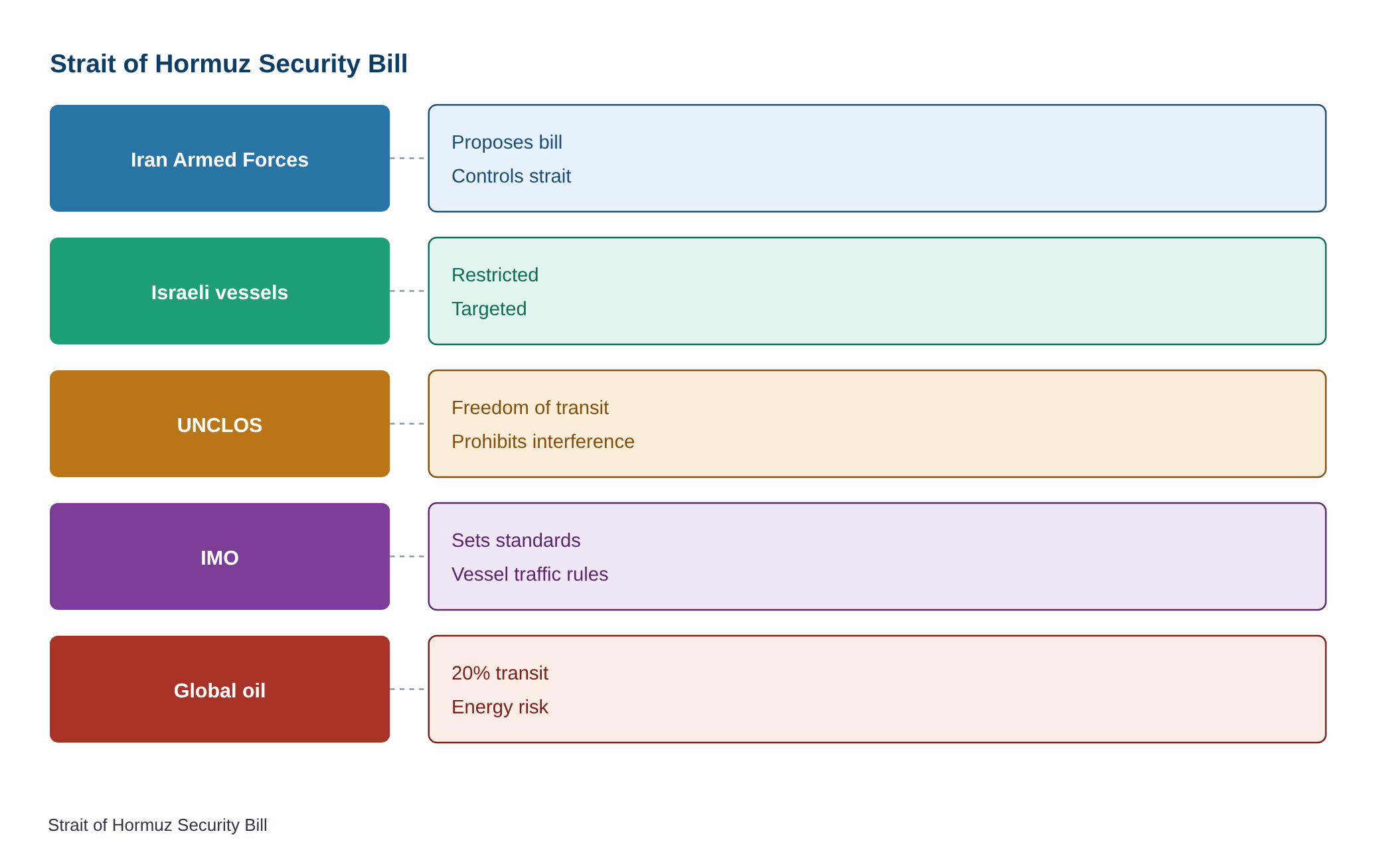
✎ The Strait of Hormuz Security Bill, if enacted, would challenge the UNCLOS principle of freedom of transit passage and could disrupt global oil supply chains, necessitating a review of maritime security frameworks.
Subject Relevance — Where This Topic Fits
- GS Paper II — International Relations — Maritime Security and Straits | GS Paper II — International Relations — Regional Groupings and Agreements | GS Paper III — Economy — Trade Routes and Supply Chain Disruptions | GS Paper III — Security — Non-Traditional Security Threats
- Prelims: Strait of Hormuz, Armed Forces General Staff (Iran), International Maritime Organization (IMO), UN Convention on the Law of the Sea (UNCLOS), Chokepoint, Maritime Security, Economic Sanctions, Ballistic Missile Threats
- Essay: Global Energy Security and Geopolitical Risks, The Role of Chokepoints in International Trade and Diplomacy
Quick Revision: The Strait of Hormuz Security Bill, if enacted, would challenge the UNCLOS principle of freedom of transit passage and could disrupt global oil supply chains, necessitating a review of maritime security frameworks.
Why is this in the news?
Iran’s Parliament is deliberating a draft ‘Strait of Hormuz Security Bill’ that seeks to place the strategic waterway under the exclusive management of Iran’s Armed Forces General Staff. The proposed legislation includes provisions to restrict Israeli vessels and ships suspected of espionage or other ‘hostile’ activity. This development is significant as the Strait of Hormuz is a critical chokepoint for global oil transit, and any unilateral assertion of control could disrupt international maritime law, escalate regional tensions, and impact global energy markets.
Background
- The Strait of Hormuz, connecting the Persian Gulf to the Gulf of Oman, is one of the world’s most strategically vital maritime chokepoints, through which approximately 20-30% of global oil supply passes annually.
- Historically, the strait has been a flashpoint in US-Iran relations, with incidents such as the 1988 Operation Praying Mantis and the 2019 tanker seizures highlighting its geopolitical sensitivity.
- UNCLOS (United Nations Convention on the Law of the Sea, 1982) establishes the legal framework for straits used for international navigation, mandating freedom of transit passage and prohibiting unilateral interference.
- The International Maritime Organization (IMO) sets global standards for maritime safety, security, and environmental protection, including guidelines for vessel traffic management in straits.
- Iran has previously threatened to close the Strait of Hormuz in response to sanctions or perceived threats, most notably during the 2011-2012 tensions with Western powers.
- The proposed bill follows a prolonged period of heightened tensions between Iran and the US, including allegations of cyberattacks, ballistic missile launches, and trade disruptions.
What is the Strait of Hormuz Security Bill?
- The draft bill seeks to vest the Armed Forces General Staff of Iran with exclusive authority over the management, monitoring, and inspection of vessels transiting the Strait of Hormuz, overriding existing international norms.
- Under the proposed legislation, Israeli-flagged vessels and ships suspected of espionage or hostile activity would be barred from entering the strait, aligning with Iran’s long-standing policy of opposing Israeli presence in the region.
- The legislation is framed as a response to perceived US provocations, including claims of US territorial assertions over the strait and ongoing sanctions that have frozen Iranian assets.
- If enacted, the bill could challenge the principle of freedom of navigation under UNCLOS, which guarantees the right of unimpeded transit passage through straits used for international navigation.
- The proposal reflects Iran’s broader strategy of leveraging its geographic position to counter external pressures, including through asymmetric deterrence and economic leverage.
- The bill is under consideration by Iran’s Parliament, with deliberations ongoing amid regional and international scrutiny.
Key Features
| Feature | Significance |
|---|---|
| Proposed ‘Strait of Hormuz Security’ bill | Seeks to place the Strait of Hormuz under the Armed Forces General Staff of Iran, enhancing state control over maritime traffic and inspections. |
| Targeting of Israeli vessels | Prohibits Israeli ships and those suspected of espionage or hostile activities from using the Strait, reflecting geopolitical tensions. |
| Authority to determine tolls and service charges | Grants Iran the power to levy charges in Iranian rials, potentially impacting global shipping costs and trade dynamics. |
| Seizure of assets of hostile governments | Empowers Iran to confiscate assets of states deemed hostile if Iranian interests are harmed globally, raising concerns over legal and economic sovereignty. |
| Mechanism for payments in Iranian rials | Proposes the use of local currency for tolls, aligning with Iran’s economic policies but complicating international transactions. |
Why it Matters
Economic Implications
- The Strait of Hormuz is a critical chokepoint for global oil transit, handling approximately 20% of the world’s oil supply, making any disruption a potential threat to global energy security.
- Iran’s control over tolls and inspections could influence international shipping costs, particularly for Middle Eastern oil exports.
- The proposed use of Iranian rials for tolls may challenge the dominance of the US dollar in global trade, reflecting broader shifts in monetary sovereignty.
- Oil prices have already risen due to geopolitical tensions, and further escalation could exacerbate inflationary pressures globally.
Strategic and Geopolitical Impact
- The Strait of Hormuz is a vital maritime route connecting the Persian Gulf to the Gulf of Oman, and any unilateral control by Iran could alter regional power dynamics.
- The bill’s focus on Israeli vessels underscores Iran’s alignment with regional security narratives, particularly in the context of the Israel-Palestine conflict.
- The proposed legislation could escalate tensions with the UAE, which has already suspended trade relations following allegations of missile launches from Iran.
- The US-Iran stalemate and Iran’s demands for lifting sanctions and releasing frozen assets highlight the fragility of regional ceasefire agreements.
Legal and Sovereignty Concerns
- The bill’s assertion of control over the Strait challenges the principle of freedom of navigation, a cornerstone of international maritime law under the United Nations Convention on the Law of the Sea (UNCLOS).
- Iran’s demand for lifting sanctions and releasing frozen assets aligns with its broader stance on economic sovereignty and non-interference in domestic affairs.
- The proposed seizure of assets of hostile governments raises questions about the legality of such measures under international law and the principles of state immunity.
Regional Stability and Security
- The bill’s emphasis on monitoring and inspection could lead to increased military presence in the Strait, heightening the risk of accidental confrontations.
- Iran’s denial of missile launches towards the UAE, despite UAE’s claims, reflects a breakdown in regional trust and communication mechanisms.
- The proposed legislation could further isolate Iran diplomatically, particularly if it is perceived as a unilateral assertion of control over a shared international waterway.
Challenges
1. Freedom of Navigation vs. State Sovereignty
- The proposed bill challenges the principle of freedom of navigation, a fundamental tenet of UNCLOS, which guarantees the right of innocent passage through international straits.
- Iran’s assertion of control over the Strait of Hormuz could set a precedent for other states to impose unilateral restrictions on global maritime routes.
- The international community may face a dilemma between respecting state sovereignty and upholding global maritime norms.
UPSC Link: UNCLOS Part III, Article 38
2. Economic Disruptions and Global Trade
- Any disruption in the Strait of Hormuz could lead to significant delays in oil shipments, impacting global energy markets and supply chains.
- The imposition of tolls in Iranian rials could complicate trade transactions, particularly for countries reliant on dollar-denominated contracts.
- Rising oil prices due to geopolitical tensions could exacerbate inflationary pressures and slow down economic growth in import-dependent nations.
UPSC Link: GS Paper 3: Indian Economy and Issues relating to Planning
3. Regional Security and Diplomatic Strains
- The bill’s focus on Israeli vessels could escalate tensions with Israel and its allies, particularly the US, further destabilizing the Middle East.
- The UAE’s suspension of trade relations with Iran highlights the potential for economic retaliation and its impact on regional stability.
- The breakdown in trust between Iran and the UAE, as evidenced by conflicting claims of missile launches, underscores the fragility of regional security frameworks.
UPSC Link: GS Paper 2: India and its Neighbourhood
4. Legal and Humanitarian Concerns
- The proposed seizure of assets of hostile governments raises ethical and legal questions about the principles of state immunity and the protection of private property.
- The targeting of Israeli vessels and ships suspected of espionage could lead to arbitrary detentions and violations of international humanitarian law.
- The bill’s emphasis on monitoring and inspection could infringe upon the rights of ships passing through the Strait, particularly if inspections are conducted without due process.
UPSC Link: GS Paper 2: International Law
5. Energy Security and Policy Responses
- India, as a major importer of oil from the Middle East, could face disruptions in its energy supply, necessitating contingency plans to diversify its sources.
- The rise in oil prices could strain India’s fiscal balance, particularly if subsidies are maintained to cushion the impact on consumers.
- The government may need to engage in diplomatic efforts to de-escalate tensions and ensure the safety of Indian-flagged vessels in the region.
UPSC Link: GS Paper 3: Energy Security
Challenges — UPSC Perspective
| Issue | Concern |
|---|---|
| Freedom of Navigation | Potential violation of UNCLOS principles and global maritime norms. |
| Economic Disruptions | Rising oil prices, trade complications, and inflationary pressures. |
| Regional Security | Escalation of tensions with Israel, UAE, and the US. |
| Legal and Humanitarian Concerns | Arbitrary detentions, asset seizures, and violations of international law. |
| Energy Security for India | Disruptions in oil supply and fiscal strain due to rising prices. |
| Diplomatic Strains | Breakdown in trust and communication between regional actors. |
Way Forward
- India must engage in diplomatic dialogues with Iran, the UAE, and the US to ensure the safety of Indian-flagged vessels and uninterrupted oil supply.
- The Ministry of External Affairs should monitor the situation closely and issue advisories to Indian shipping companies operating in the region.
- India should diversify its oil import sources to reduce dependence on the Middle East, particularly the Strait of Hormuz.
- The government should collaborate with international partners to uphold the principles of freedom of navigation and prevent unilateral assertions of control over maritime routes.
- India must prepare contingency plans for potential disruptions in oil supply, including strategic petroleum reserves and alternative routes.
- The Ministry of Defence should assess the security risks to Indian vessels and personnel in the region and enhance naval presence if necessary.
- India should advocate for a multilateral framework to address maritime security concerns in the Strait of Hormuz, ensuring inclusivity and adherence to international law.
- The government should communicate its stance on the proposed bill to the United Nations and other international forums to garner support for maritime norms.
UPSC Value Addition
Keywords for Mains Answer-Writing
Strait of Hormuz · maritime security · International Maritime Organization · United Nations Convention on the Law of the Sea (UNCLOS) · freedom of navigation · geopolitical tensions · maritime choke points · Iranian Armed Forces General Staff · maritime sovereignty · economic sanctions · maritime trade routes · Strait of Malacca · maritime dispute resolution
Concept Flow
Geopolitical tensions between Iran and Israel/US escalate → Iran proposes ‘Strait of Hormuz Security’ bill to assert control → Bill targets Israeli vessels and grants authority to Armed Forces General Staff → Potential violation of UNCLOS principles of freedom of navigation → Rise in oil prices and global economic disruptions → Regional security concerns and diplomatic strains → Impact on India’s energy security and trade routes → Need for diplomatic engagement and contingency planning by India.
Prelims Practice Questions
Q1. Consider the following statements regarding the Strait of Hormuz:
1. It is a narrow waterway connecting the Persian Gulf to the Gulf of Oman.
2. The strait is bordered by Iran to the north and the United Arab Emirates and Oman to the south.
3. It is one of the world’s most significant maritime choke points for oil transit.
4. The United Nations Convention on the Law of the Sea (UNCLOS) grants exclusive economic zones (EEZ) to coastal states, allowing them to regulate maritime traffic.
How many of the above statements are correct?
- Only one
- Only two
- Only three
- All
Answer: All — Statements 1, 2, and 3 are correct. Statement 4 is incorrect because UNCLOS does not grant exclusive rights to regulate maritime traffic beyond innocent passage in territorial waters; coastal states cannot unilaterally restrict transit passage through straits used for international navigation.
Q2. Assertion (A): The Strait of Hormuz is classified as a strait used for international navigation under the United Nations Convention on the Law of the Sea (UNCLOS).
Reason (R): Coastal states have the right to suspend the right of innocent passage through such straits under UNCLOS.
Options:
A. Both A and R are true, and R is the correct explanation of A.
B. Both A and R are true, but R is not the correct explanation of A.
C. A is true, but R is false.
D. A is false, but R is true.
Answer: ? — Assertion (A) is true: the Strait of Hormuz is a strait used for international navigation under UNCLOS. Reason (R) is false: UNCLOS does not permit coastal states to suspend the right of transit passage through such straits; only the right of innocent passage may be suspended under specific conditions.
Q3. Match the following maritime choke points with their respective countries or regions:
Column I (Choke Point) | Column II (Country/Region)
1. Strait of Hormuz | A. Between Malaysia and Singapore
2. Strait of Malacca | B. Between Egypt and Saudi Arabia
3. Bab-el-Mandeb | C. Between Iran and Oman
4. Suez Canal | D. Between Yemen and Djibouti
Options:
A. 1-C, 2-A, 3-D, 4-B
B. 1-A, 2-B, 3-C, 4-D
C. 1-B, 2-C, 3-A, 4-D
D. 1-D, 2-A, 3-B, 4-C
Answer: ? — Correct matches are: 1-C (Strait of Hormuz between Iran and Oman), 2-A (Strait of Malacca between Malaysia and Singapore), 3-D (Bab-el-Mandeb between Yemen and Djibouti), 4-B (Suez Canal between Egypt and Saudi Arabia).
Mains Practice Question
✍ Analyse the geopolitical and legal implications of Iran’s proposed ‘Strait of Hormuz Security’ bill that seeks to place the strait under the management of its Armed Forces General Staff. In your answer, address the following dimensions: (i) the legal framework governing straits used for international navigation under the United Nations Convention on the Law of the Sea (UNCLOS); (ii) the potential impact on global maritime trade and energy security; and (iii) the balance between coastal state sovereignty and the principle of freedom of navigation. (15 Marks)
Approach: MODEL-ANSWER SKELETON:
1. **Legal Framework under UNCLOS (3 marks)**
– Define straits used for international navigation (Art. 37, UNCLOS): must be essential for international maritime traffic.
– Transit passage regime (Art. 38): guarantees freedom of navigation and overflight; cannot be suspended by coastal states.
– Innocent passage (Art. 19): applies in territorial seas; may be suspended for security, but not in straits used for international navigation.
– Iran’s proposed bill conflicts with Art. 38 as it seeks to regulate, inspect, and impose tolls on vessels, which exceeds coastal state rights.
2. **Impact on Global Maritime Trade and Energy Security (4 marks)**
– Strait of Hormuz handles ~20-30% of global oil supply; disruption risks price volatility and supply chain disruptions.
– Potential for retaliatory measures by user states (e.g., military patrols, sanctions) escalating tensions.
– Economic implications: higher shipping costs, insurance premiums, and rerouting of vessels via alternate routes (e.g., Cape of Good Hope).
3. **Sovereignty vs. Freedom of Navigation (5 marks)**
– Coastal state rights: UNCLOS grants sovereignty over territorial seas (12 nautical miles) but limits regulatory authority in straits used for international navigation.
– Iran’s argument: national security, historical claims, and countering perceived threats (e.g., Israeli vessels).
– Counter-argument: unilateral regulation violates customary international law and UNCLOS; risks setting a precedent for other choke points (e.g., Strait of Malacca).
4. **Conclusion (3 marks)**
– Iran’s proposal challenges the existing maritime order but lacks legal validity under UNCLOS.
– Emphasise the need for diplomatic resolution through multilateral forums (e.g., IMO, UNSC) to uphold freedom of navigation.
– Highlight the role of the International Tribunal for the Law of the Sea (ITLOS) or ICJ in resolving disputes.
Source: Mint
Generated by AanyaAi for educational purpose.

- मद्रास उच्च न्यायालय में ‘वेट्ट्री पयणम’ योजना को असंवैधानिक घोषित करने की मांग - October 4, 2026
- Gurugram’s groundwater extraction exceeds limit by 212%; HC seeks ban - October 4, 2026
- स्वतंत्रता सेनानी श्यामजी कृष्ण वर्मा की जन्म जयंती पर पीएम का श्रद्धांजलि - October 4, 2026

No Comments