


01 Aug ISRO Urges Academia-Industry Synergy for India’s Space Ambitions by 2040
✎ ISRO’s emphasis on academia-industry collaboration is a strategic move to leverage academic research for practical space missions, ensuring India’s self-reliance and global competitiveness in space technology.
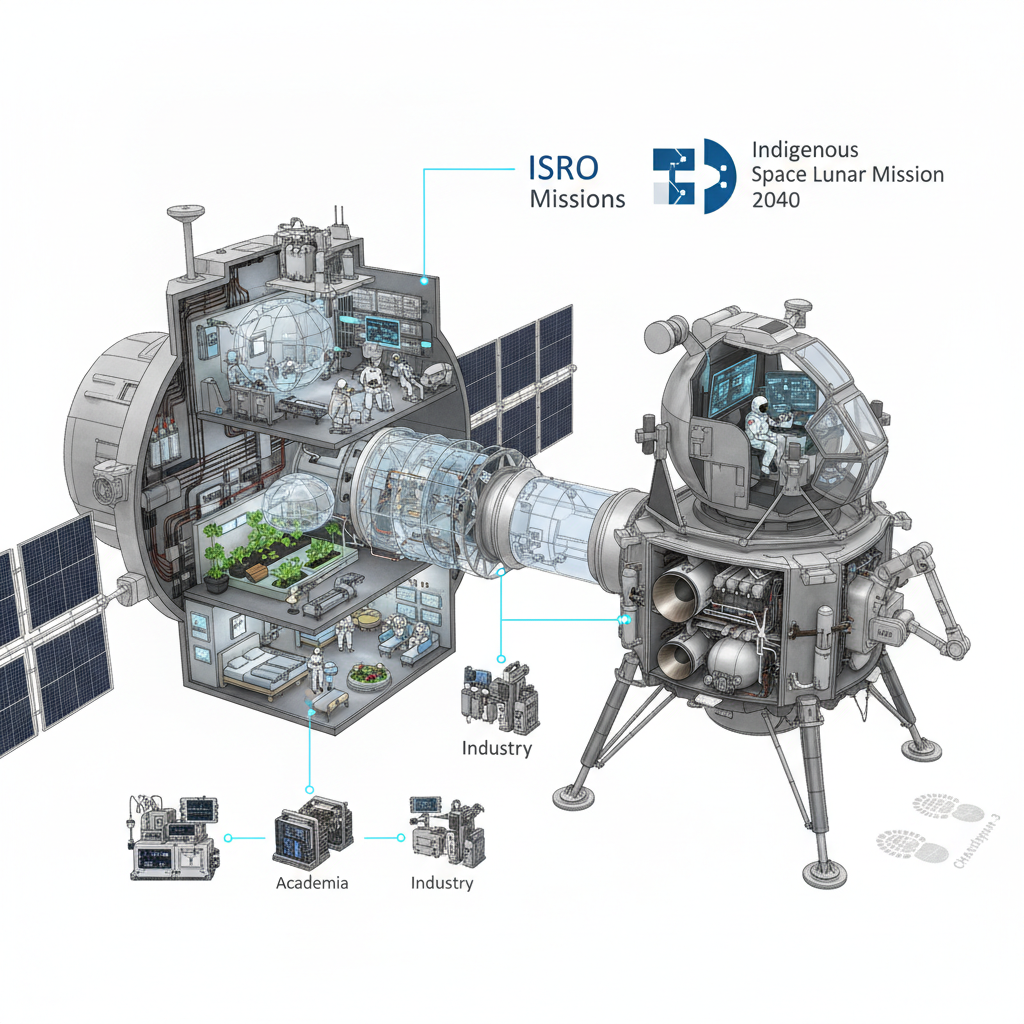 Academia-industry partnershipIndigenous space stationManned lunar mission
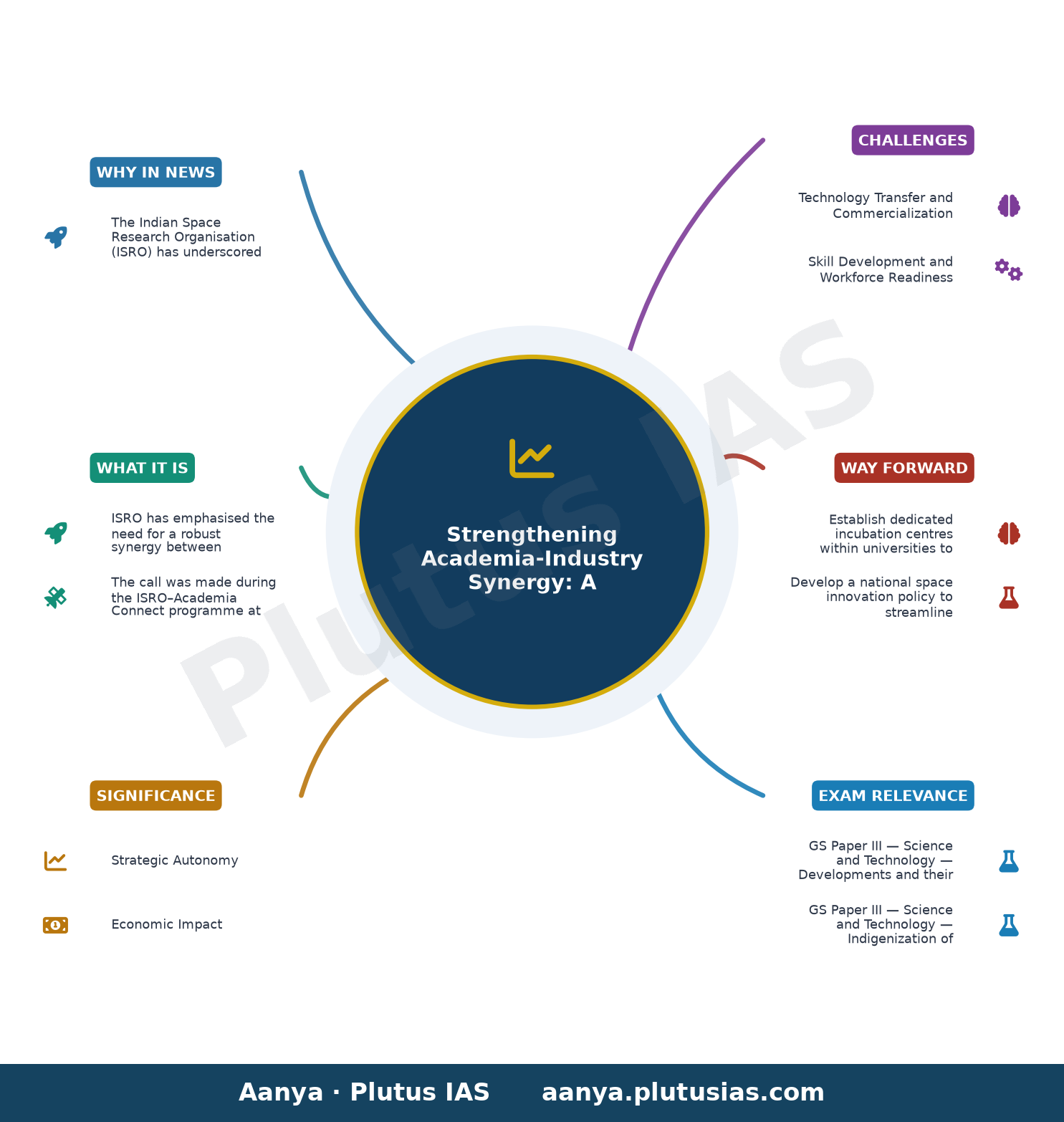
Subject Relevance — Where This Topic Fits
- GS Paper III — Science and Technology — Developments and their Applications and Effects in Everyday Life | GS Paper III — Science and Technology — Indigenization of Technology and Developing New Technology
- Prelims: ISRO, Vikram Sarabhai Space Centre, Chandrayaan-3, indigenous cryogenic technology, space station by 2035, Moon landing by 2040, Capacity Building Programme Office (CBPO), Academia-Industry Partnership, mission-oriented research, patents, technologies, prototypes
- Essay: The Role of Public-Private Partnerships in National Development: The Case of India’s Space Sector, Innovation and Indigenous Technology: The Backbone of a Self-Reliant India
Quick Revision: ISRO’s emphasis on academia-industry collaboration is a strategic move to leverage academic research for practical space missions, ensuring India’s self-reliance and global competitiveness in space technology.
Why is this in the news?
The Indian Space Research Organisation (ISRO) has underscored the critical need for enhanced collaboration between academia, industry, and research institutions to accelerate India’s space ambitions, including the establishment of an indigenous space station by 2035 and a manned lunar mission by 2040. This call was made during the ISRO–Academia Connect programme at Andhra University, highlighting the necessity of bridging the gap between theoretical research and practical, application-oriented innovation to sustain and expand India’s space capabilities.
Background
- India’s space programme, spearheaded by ISRO, has achieved global recognition through milestones such as the successful soft landing of Chandrayaan-3 near the Moon’s south pole, marking the first such achievement in history.
- The denial of access to critical cryogenic technology by other countries in the past necessitated India’s development of indigenous cryogenic engines, a testament to the nation’s self-reliance in space technology.
- ISRO’s satellites currently support over 50 sectors, including telecommunications, weather forecasting, disaster management, agriculture, fisheries, water resources, and border security, underscoring the societal impact of space technology.
- The Capacity Building Programme Office (CBPO) of ISRO has been instrumental in fostering academic partnerships through initiatives like the ISRO–Academia Connect programme, now in its fifth edition.
- Andhra University, with its century-long legacy in producing scientists and academicians, has been identified as a strategic partner for advancing research and innovation in space technology.
- India’s space programme operates under the Department of Space, with ISRO functioning as its primary executive arm, aligning with the broader goal of achieving self-sufficiency in space exploration.
What is ISRO’s Call for Academia-Industry Partnership?
- ISRO has emphasised the need for a robust synergy between academia, industry, and research institutions to drive India’s future space missions, including the establishment of a space station by 2035 and a manned lunar mission by 2040.
- The call was made during the ISRO–Academia Connect programme at Andhra University, highlighting the role of universities in translating academic research into tangible technologies and products.
- ISRO has urged universities to move beyond traditional academic publications and focus on application-oriented research, patent development, and the creation of prototypes that benefit society.
- The collaboration aims to bridge the gap between theoretical knowledge and practical innovation, ensuring that space technology directly impacts the common citizen through sectors like agriculture, disaster management, and telecommunications.
- ISRO’s Scientific Secretary highlighted that every successful space mission is built upon decades of research, innovation, and academic excellence, necessitating mission-oriented research in universities.
- The initiative seeks to create greater opportunities for research and internships, fostering a pipeline of skilled professionals to support India’s space programme.
- The call aligns with India’s broader strategy of indigenisation and self-reliance in critical technologies, as demonstrated by the development of indigenous cryogenic engines.
- The partnership model underscores the importance of interdisciplinary collaboration, integrating engineering, physics, materials science, and computational fields to advance space technology.
Key Features
| Feature | Significance |
|---|---|
| Indigenous cryogenic technology | Reduces dependency on foreign technology transfers and enhances strategic autonomy in space missions. |
| Chandrayaan-3 soft landing success | Demonstrates India’s capability in lunar exploration and positions ISRO as a global leader in space technology. |
| ISRO–Academia Connect initiative | Facilitates knowledge transfer, research collaboration, and skill development between ISRO and academic institutions. |
| Mission-oriented research focus | Ensures academic institutions contribute directly to societal and technological advancements rather than limiting research to theoretical outputs. |
| Multi-sectoral satellite applications | Integrates space technology into telecommunications, agriculture, disaster management, and border security, enhancing governance and public welfare. |
Why it Matters
Strategic Autonomy
- Development of indigenous cryogenic technology underscores India’s self-reliance in critical space technologies, mitigating risks associated with geopolitical restrictions.
- Establishment of an indigenous space station by 2035 and a lunar landing by 2040 positions India as a major player in global space exploration, independent of external collaborations.
- Strengthened academia-industry partnerships ensure a sustained pipeline of skilled professionals and innovative solutions tailored to national priorities.
Economic Impact
- Space technology applications in sectors like agriculture, fisheries, and telecommunications drive economic growth by improving productivity and efficiency.
- Commercialization of space technologies through patents and products fosters a space economy, creating jobs and attracting investments in research and development.
- Reduction in import dependence for space-related technologies lowers long-term costs and enhances the competitiveness of Indian space industries in the global market.
Scientific and Technological Advancement
- Collaborative research between ISRO and academia accelerates innovation, particularly in propulsion systems, satellite technology, and planetary exploration.
- Mission-oriented research ensures that academic institutions contribute directly to solving real-world challenges, bridging the gap between theory and application.
- The success of Chandrayaan-3 and ongoing missions like Chandrayaan-4 and Chandrayaan-5 demonstrate India’s growing expertise in lunar and deep-space exploration.
Governance and Public Welfare
- Satellite-based services in weather forecasting, disaster management, and border security enhance the government’s capacity to respond to national challenges.
- Integration of space technology into rural and agricultural development programs ensures inclusive growth and equitable access to technological benefits.
- Strengthened partnerships with institutions like Andhra University create opportunities for research internships, fostering a skilled workforce aligned with national priorities.
Challenges
1. Technology Transfer and Commercialization
- Academic institutions often prioritize publications over patents and product development, limiting the translation of research into market-ready technologies.
- Bridging the gap between research and commercialization requires robust funding mechanisms, industry-academia collaboration frameworks, and incentives for innovation.
- Intellectual property rights management poses challenges in balancing open research with commercial exploitation, particularly in collaborative projects.
UPSC Link: GS3 Science and Technology
2. Skill Development and Workforce Readiness
- There is a need for curricula in universities to align with industry requirements, particularly in emerging fields like space propulsion, satellite systems, and planetary science.
- Ensuring a steady pipeline of skilled professionals demands sustained investment in STEM education, internships, and research opportunities.
- Retention of talent within the country is critical to prevent brain drain, especially as global space agencies and private firms compete for expertise.
UPSC Link: GS2 Education
3. Resource Allocation and Funding
- High-cost space missions and research projects require significant public funding, necessitating efficient allocation and prioritization of resources.
- Encouraging private sector participation through public-private partnerships (PPPs) can supplement government funding but requires clear regulatory and financial frameworks.
- Balancing investment in space exploration with other national priorities, such as healthcare and education, demands strategic planning and long-term vision.
UPSC Link: GS3 Science and Technology
4. Regulatory and Policy Frameworks
- The absence of a comprehensive space policy can lead to ambiguity in roles, responsibilities, and collaborations between academia, industry, and government agencies.
- Streamlining regulatory processes for technology transfer, foreign collaborations, and commercial space activities is essential to foster innovation.
- Ensuring ethical and sustainable use of space resources, particularly in lunar and planetary missions, requires robust international and domestic policy frameworks.
UPSC Link: GS2 Governance
5. Global Competitiveness and Collaboration
- Competing with established space agencies like NASA and ESA requires continuous innovation, investment, and strategic collaborations with global partners.
- Balancing self-reliance with international cooperation is critical to access advanced technologies, share scientific data, and participate in joint missions.
- Addressing geopolitical sensitivities in space collaborations, particularly with countries facing restrictions on technology transfers, remains a persistent challenge.
UPSC Link: GS2 International Relations
Challenges — UPSC Perspective
| Issue | Concern |
|---|---|
| Technology transfer delays | Protracted negotiations and bureaucratic hurdles slow down the adoption of research outcomes into operational technologies. |
| Limited industry participation | Private sector engagement in space research remains suboptimal due to perceived high risks and low immediate returns. |
| Curriculum misalignment | University syllabi often lag behind industry needs, resulting in graduates lacking practical skills for space-related roles. |
| Funding volatility | Fluctuations in government budgets and reliance on external funding sources disrupt long-term research projects. |
| Regulatory ambiguity | Unclear guidelines on intellectual property, data sharing, and commercialization hinder collaboration and innovation. |
Way Forward
- Establish dedicated incubation centres within universities to nurture space technology startups, providing mentorship, funding, and infrastructure support.
- Develop a national space innovation policy to streamline collaborations, incentivize patents, and accelerate the commercialization of research outcomes.
- Expand the ISRO–Academia Connect initiative to include more institutions, particularly those in Tier-2 and Tier-3 cities, to democratize access to space research opportunities.
- Introduce specialized courses and internships in space propulsion, satellite systems, and planetary science to align academic curricula with industry requirements.
- Strengthen public-private partnerships (PPPs) by offering tax incentives, grants, and regulatory support to private firms investing in space technology development.
- Enhance funding mechanisms for high-risk, high-reward space research through dedicated grants, venture capital funds, and international collaborations.
- Promote international collaborations in lunar and planetary missions to share technological advancements, reduce costs, and enhance India’s global standing in space exploration.
UPSC Value Addition
Keywords for Mains Answer-Writing
ISRO Academia Connect programme · academia-industry partnership in space sector · Chandrayaan-3 achievements · indigenous space station by 2035 · Moon mission by 2040 · cryogenic technology indigenisation · ISRO Capacity Building Programme Office (CBPO) · application-oriented research in space science · space sector reforms in India · technology transfer from academia to industry
Concept Flow
ISRO’s call for academia-industry partnership → Need for indigenous technology and self-reliance in space missions → Collaboration between ISRO and universities → Mission-oriented research and skill development → Development of indigenous cryogenic technology → Reduced dependency on foreign technology → Success of Chandrayaan-3 → Enhanced global standing and confidence in India’s space capabilities → Integration of space technology into governance → Improved public welfare and economic growth → Establishment of indigenous space station by 2035 → Strategic autonomy and long-term space exploration goals → Commercialization of space technologies → Growth of space economy and job creation
Prelims Practice Questions
Q1. Consider the following statements regarding ISRO’s recent initiatives and achievements:
1. ISRO has successfully achieved a soft landing near the Moon’s south pole through Chandrayaan-3.
2. India has developed indigenous cryogenic technology after being denied access to it by other countries.
3. ISRO’s satellites support more than 50 sectors, including telecommunications, weather forecasting, and border security.
How many of the above statements are correct?
- Only one
- Only two
- All three
- None
Answer: All three — Statements 1 and 3 are correct as per the news report. Statement 2 is also correct, as ISRO developed indigenous cryogenic technology after being denied access to it by other countries. Thus, two statements are correct.
Q2. Assertion (A): The ISRO–Academia Connect programme aims to foster collaboration between academia, industry, and research institutions to advance India’s space programme.
Reason (R): The programme seeks to bridge the gap between theoretical research and practical, application-oriented innovations in space technology.
Code:
- Both A and R are true, and R is the correct explanation of A
- Both A and R are true, but R is NOT the correct explanation of A
- A is true, but R is false
- A is false, but R is true
Answer: Both A and R are true, and R is the correct explanation of A — Assertion (A) is true as the programme explicitly aims to strengthen academia-industry collaboration for space missions. Reason (R) is also true and correctly explains A, as the programme focuses on moving beyond academic publications to develop patents and technologies.
Q3. Match the following ISRO missions with their respective achievements:
Column I (Mission) | Column II (Achievement)
—————————————|—————————————
A. Chandrayaan-3 | 1. Indigenous cryogenic technology
B. Chandrayaan-4 | 2. Soft landing near Moon’s south pole
C. Chandrayaan-5 | 3. Ongoing development for future missions
D. ISRO’s satellite applications | 4. Supporting over 50 sectors
Select the correct match:
- A-2, B-3, C-3, D-4
- A-2, B-3, C-1, D-4
- A-1, B-2, C-3, D-4
- A-4, B-3, C-2, D-1
Answer: A-2, B-3, C-3, D-4 — Chandrayaan-3 achieved a soft landing near the Moon’s south pole (A-2). Chandrayaan-4 and Chandrayaan-5 are under development for future missions (B-3, C-3). ISRO’s satellites support over 50 sectors (D-4). Indigenous cryogenic technology is not directly linked to any specific mission listed.
Mains Practice Question
✍ Critically analyse the role of academia-industry partnerships in advancing India’s space programme, with reference to ISRO’s recent initiatives. Also, examine the challenges in translating academic research into practical space technologies. (15 Marks)
Approach: MODEL-ANSWER SKELETON:
1. **Introduction (2 marks)**: Define academia-industry partnerships and their significance in the space sector, citing ISRO’s recent call for stronger collaboration.
2. **ISRO’s Initiatives and Achievements (3 marks)**:
– Highlight ISRO’s indigenous achievements: Chandrayaan-3’s soft landing, indigenous cryogenic technology, and support to over 50 sectors.
– Mention ISRO–Academia Connect programme and its objectives (e.g., bridging gaps between academia and industry, fostering application-oriented research).
3. **Role of Partnerships in Space Programme (4 marks)**:
– Discuss how academia-industry partnerships accelerate innovation (e.g., development of patents, prototypes, and technologies).
– Cite examples of successful collaborations (e.g., Andhra University’s contributions, ISRO’s Capacity Building Programme Office).
– Link partnerships to India’s ambitious goals: indigenous space station by 2035 and Moon mission by 2040.
4. **Challenges in Translation (3 marks)**:
– Identify barriers: lack of funding, bureaucratic hurdles, misalignment between academic research and industry needs.
– Discuss the need for mission-oriented research and moving beyond academic publications.
– Highlight the importance of intellectual property rights and technology transfer mechanisms.
5. **Conclusion (3 marks)**:
– Summarise the critical role of partnerships in India’s space ambitions.
– Provide a balanced view: while partnerships are essential, systemic reforms are needed to overcome challenges.
– Conclude with a forward-looking statement on India’s potential to become a global leader in space technology through such collaborations.
Source: The Hindu
Generated by AanyaAi for educational purpose.

- हिमाचल में डिजिटल भुगतान क्रांति: बिलासपुर अव्वल, महिलाओं की भागीदारी 93% तक पहुंची - September 23, 2026
- Himachal Pradesh Leads in Digital Payments: Bilaspur Tops, Women’s Role Rises - September 23, 2026
- केरल लोक सेवा आयोग ने उच्च न्यायालय में दायर किया मामला, सदस्यों के खिलाफ मामला रद्द करने की मांग - September 23, 2026

No Comments