


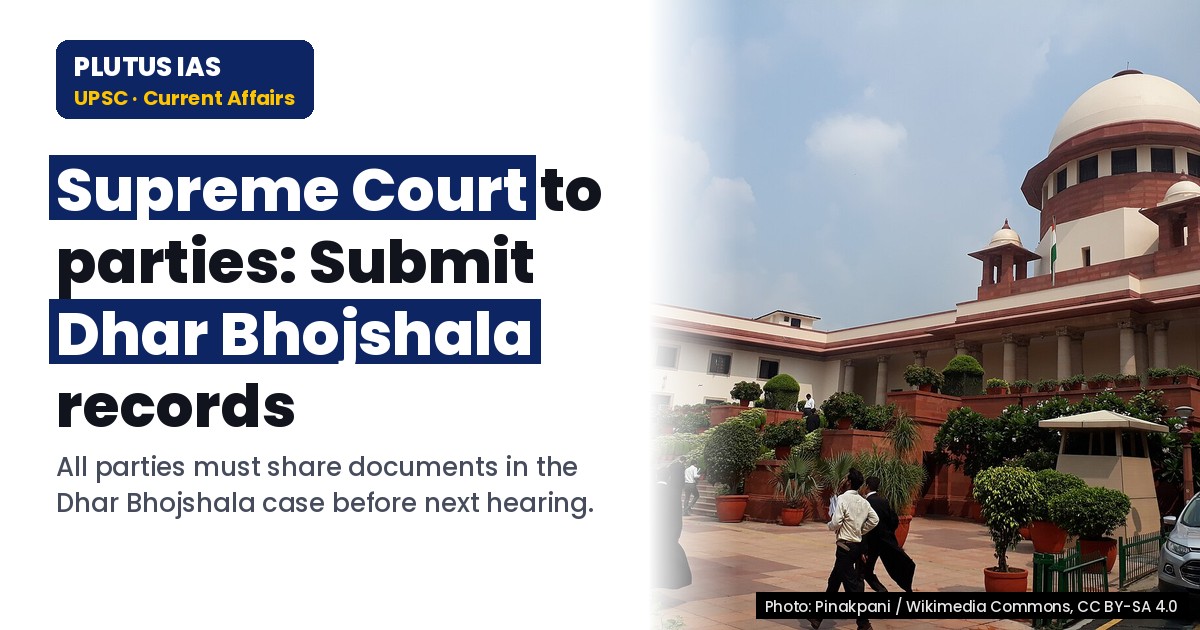
30 Oct Supreme Court Directs Parties to Submit Documents in Dhar Bhojshala Case
✎ The Supreme Court’s directive in the Dhar Bhojshala dispute underscores the constitutional and archaeological dimensions of heritage management, requiring all parties to submit documents for judicial review under Article 136 of…
Subject Relevance — Where This Topic Fits
- GS Paper II — Polity and Governance (Constitutional Provisions, Judicial Review, Fundamental Rights) | GS Paper II — Governance (Public Policy, Archaeological and Heritage Management) | GS Paper IV — Ethics (Conflict Resolution, Pluralism)
- Prelims: Article 29 and 30 (Cultural and Educational Rights), Article 49 (Protection of Monuments and Places and Objects of National Importance), Ancient Monuments and Archaeological Sites and Remains Act, 1958, Supreme Court’s powers under Article 136 (Special Leave Petition), Waqf Act, 1995, ASI (Ancient Monuments and Archaeological Sites and Remains) Act, 1958
- Essay: Cultural heritage and national identity: Balancing preservation and pluralism
Quick Revision: The Supreme Court’s directive in the Dhar Bhojshala dispute underscores the constitutional and archaeological dimensions of heritage management, requiring all parties to submit documents for judicial review under Article 136 of the Constitution.
Why is this in the news?
The Supreme Court of India, in a hearing related to the Dhar Bhojshala dispute, has directed all parties to submit documents and records pertaining to the site. This directive follows the Madhya Pradesh High Court’s 2026 judgment, which, based on the Archaeological Survey of India (ASI) report, declared Bhojshala a Hindu temple and granted Hindus the right to worship there throughout the year. The Supreme Court’s intervention underscores the intersection of constitutional governance, archaeological evidence, and the management of disputed heritage sites in India.
Background
- The Dhar Bhojshala is a historical site located in Dhar, Madhya Pradesh, with architectural and cultural significance dating back to the 11th century.
- The site has been subject to competing claims by Hindu and Muslim communities regarding its religious and historical identity.
- The Madhya Pradesh High Court, in its May 2026 judgment, relied on the ASI’s comprehensive archaeological survey report to classify Bhojshala as a Hindu temple and permitted year-round Hindu worship.
- The High Court’s decision prompted the state government to propose the development of a ‘Saraswati Lok’ at the site, which was approved in a cabinet meeting.
- Subsequent to the High Court’s verdict, three parties—Shahar Qazi, Kamal Maula Welfare Society, and the Waqf Board (through Jibran Ansari)—filed Special Leave Petitions (SLPs) in the Supreme Court challenging the judgment.
- The Hindu side has filed a caveat to ensure that no stay order is passed without hearing their objections, indicating the procedural complexity of the dispute.
What is the Dhar Bhojshala Dispute?
- The Dhar Bhojshala is a medieval-era structure whose religious and historical identity has been contested, with claims by both Hindu and Muslim communities.
- The ASI’s archaeological survey report, spanning approximately 2,000 pages, is a critical document in the dispute, providing evidence-based conclusions about the site’s historical usage.
- The Madhya Pradesh High Court’s judgment relied on the ASI report to classify Bhojshala as a Hindu temple, citing architectural and epigraphic evidence.
- The High Court’s decision granted Hindus the right to conduct worship at the site throughout the year, while also acknowledging the site’s historical significance for other communities.
- The state government’s proposal to develop ‘Saraswati Lok’ at the site reflects an attempt to reconcile heritage conservation with community aspirations, though it has been challenged in the Supreme Court.
- The Supreme Court’s directive for document submission aims to ensure a comprehensive review of all relevant records, including those held by the ASI, state government, and contesting parties.
- The dispute exemplifies the challenges in managing contested heritage sites under India’s legal and constitutional framework, particularly where religious and archaeological claims intersect.
- The case highlights the role of the judiciary in adjudicating heritage disputes, balancing the protection of monuments under the Ancient Monuments and Archaeological Sites and Remains Act, 1958, with the rights of communities.
Key Features
| Feature | Significance |
|---|---|
| Supreme Court directive to submit documents | Ensures all stakeholders provide verifiable evidence, maintaining procedural fairness and transparency in adjudicating religious property disputes. |
| ASI survey report (2000+ pages) | Provides archaeological evidence on the historical status of the structure, serving as a critical reference for judicial determination of its religious character. |
| High Court’s 15 May 2026 verdict | Legally establishes the structure as a Hindu temple while granting Hindu worship rights, setting a precedent for similar disputes under the Places of Worship (Special Provisions) Act, 1991. |
| State government’s Saraswati Lok proposal | Demonstrates executive action following judicial interpretation, potentially integrating heritage conservation with public cultural infrastructure development. |
| Caveat filed by Hindu parties | Prevents ex-parte orders by ensuring their representation in any interim relief proceedings, upholding the principle of natural justice. |
Why it Matters
Legal Precedent
- Reinforces the judicial role in resolving religious property disputes under secular constitutional framework, balancing historical evidence and statutory provisions.
- Clarifies the application of the Places of Worship (Special Provisions) Act, 1991, particularly in cases involving pre-1947 religious conversions.
- Sets a procedural template for future disputes involving contested religious sites, emphasizing documentary evidence and multi-party hearings.
Cultural Heritage
- Highlights the intersection of archaeology, religion, and governance in preserving India’s pluralistic heritage, especially for structures with layered historical claims.
- Underscores the need for state-led heritage documentation and conservation, as evidenced by the ASI’s role and the proposed Saraswati Lok project.
- Raises questions about the repatriation of religious artifacts (e.g., Maa Vagdevi idol) and their role in cultural identity and public memory.
Administrative Governance
- Illustrates the coordination between the judiciary, executive, and statutory bodies (ASI, Waqf Board) in managing contested public spaces.
- Exemplifies the implementation challenges of post-judicial executive decisions, particularly in land-use planning and public infrastructure projects.
- Demonstrates the use of caveats and SLP filings as tools for ensuring fair representation in litigation involving multiple stakeholders.
Challenges
1. Balancing Religious Rights and Secular Governance
- The dispute tests the constitutional balance between freedom of religion (Article 25) and the state’s duty to maintain public order (Article 25(2)).
- Judicial intervention must reconcile historical claims with contemporary legal frameworks, avoiding communal polarisation.
- Executive decisions (e.g., Saraswati Lok) risk being perceived as privileging one community, necessitating transparent stakeholder consultations.
UPSC Link: GS-II: Fundamental Rights
2. Documentary Evidence and Historical Interpretation
- The reliability of ASI reports and ancient manuscripts as historical evidence remains contested, requiring expert validation.
- Divergent interpretations of the same archaeological data by opposing parties can lead to prolonged litigation.
- The burden of proof shifts between parties, complicating the adjudication of claims dating back centuries.
UPSC Link: GS-I: Indian Culture
3. Implementation of Judicial Directives
- Ensuring compliance with court orders (e.g., document submission deadlines) while addressing logistical and administrative constraints.
- Managing public expectations and potential protests following judicial pronouncements on sensitive religious matters.
- Coordinating between central authorities (ASI, Supreme Court) and state governments (e.g., Madhya Pradesh) in executing directives.
UPSC Link: GS-II: Judiciary
4. Heritage Conservation vs. Religious Use
- Balancing the preservation of a historical structure as a cultural monument with its active religious use by a community.
- Addressing concerns about structural damage or commercialisation due to increased footfall or proposed infrastructure projects.
- Integrating modern conservation standards with traditional religious practices in managing the site.
UPSC Link: GS-I: Art & Culture
Challenges — UPSC Perspective
| Issue | Concern |
|---|---|
| Historical evidence reliability | Conflicting interpretations of ASI reports and ancient texts may undermine judicial objectivity. |
| Statutory compliance under PW Act, 1991 | Ensuring the dispute resolution aligns with the Act’s prohibition on altering the religious character of places post-1947. |
| Executive-judicial coordination | Potential delays or conflicts between court directives and state government actions (e.g., Saraswati Lok proposal). |
| Public order and communal harmony | Risk of unrest or polarisation due to perceived bias in judicial or executive decisions. |
| Artifact repatriation | Legal and diplomatic complexities in retrieving religious artifacts from foreign institutions for display at the site. |
Way Forward
- Constitute a multi-disciplinary committee comprising historians, archaeologists, legal experts, and representatives from all stakeholder communities to compile and verify documentary evidence.
- Accelerate the submission of all relevant records by parties to the Supreme Court within the stipulated timelines to avoid procedural delays.
- Explore mediation mechanisms under judicial supervision to facilitate an out-of-court settlement, if feasible, to reduce adversarial litigation.
- Develop a heritage management plan for the site that delineates zones for religious worship, conservation, and public access, in consultation with the ASI and local authorities.
- Enhance transparency by publishing periodic updates on the judicial process, including summaries of submitted documents and expert testimonies, on official portals.
- Conduct community outreach programmes to educate stakeholders about the legal process and the importance of preserving cultural heritage.
- Establish a grievance redressal mechanism for addressing concerns of affected communities regarding the site’s management or proposed developments.
- Review the Saraswati Lok project’s alignment with heritage conservation guidelines to ensure it does not compromise the site’s archaeological integrity.
UPSC Value Addition
Keywords for Mains Answer-Writing
Dhar Bhojshala · ASI survey report · Supreme Court directives · Waqf Board · Kazi Kamal Maulana Welfare Society · Article 25-26 · Freedom of Religion · Ancient Monuments and Archaeological Sites and Remains Act, 1958 · Madhya Pradesh High Court judgment · Constitutional morality · Secularism · Religious places of worship · Historical monuments · Archaeological evidence · State intervention in religious matters · Balancing religious rights and heritage conservation
Constitutional & Policy Linkages
- Article 25: Freedom of conscience and free profession, practice, and propagation of religion (subject to public order, morality, and health).
- Article 26: Freedom to manage religious affairs (subject to public order, morality, and health).
- Article 29: Protection of interests of minorities (cultural and educational rights).
- Article 30: Right of minorities to establish and administer educational institutions.
Concept Flow
Disputed religious site (Dhar Bhojshala) → High Court verdict (15 May 2026) declaring it a Hindu temple → Appeals filed in Supreme Court → Supreme Court directs all parties to submit documents → ASI survey report and ancient manuscripts as key evidence → Executive action (Saraswati Lok proposal) → Judicial scrutiny of evidence and legal provisions → Final adjudication on religious character and rights → Implementation of conservation and public access plan.
Prelims Practice Questions
Q1. Consider the following statements regarding the Archaeological Survey of India (ASI):
1. The ASI is responsible for the preservation and conservation of ancient monuments and archaeological sites.
2. The ASI functions under the Ministry of Culture, Government of India.
3. The ASI has the authority to declare any monument as a protected monument under the Ancient Monuments and Archaeological Sites and Remains Act, 1958.
How many of the above statements are correct?
- Only one
- Only two
- All three
- None
Answer: All three — Statements 1 and 2 are correct. The ASI is indeed responsible for the preservation and conservation of ancient monuments and archaeological sites and functions under the Ministry of Culture. Statement 3 is incorrect because the power to declare a monument as protected lies with the Central Government under the Ancient Monuments and Archaeological Sites and Remains Act, 1958, not the ASI itself.
Q2. Assertion (A): The Supreme Court of India has the power to issue directions to all parties in a matter involving religious places to submit documents and records.
Reason (R): The Supreme Court derives its authority from Article 142 of the Constitution of India, which empowers it to pass any order necessary for doing complete justice in any cause or matter.
- Both A and R are true, and R is the correct explanation of A
- Both A and R are true, but R is not the correct explanation of A
- A is true, but R is false
- A is false, but R is true
Answer: Both A and R are true, but R is not the correct explanation of A — Both the assertion and reason are true. The Supreme Court, under Article 142, can issue directions to ensure complete justice, including directing parties to submit documents. The reason correctly explains the assertion.
Q3. Match the following pairs related to the protection of religious and historical sites in India:
Column I (Legislation/Institution)
A. Ancient Monuments and Archaeological Sites and Remains Act, 1958
B. Waqf Act, 1995
C. Places of Worship (Special Provisions) Act, 1991
D. Article 25 of the Constitution of India
Column II (Key Provision)
1. Prohibits conversion of any place of worship of any religious denomination into a place of worship of a different religious denomination
2. Ensures freedom of conscience and free profession, practice, and propagation of religion
3. Regulates the administration and management of Waqf properties
4. Provides for the preservation of ancient monuments and archaeological sites
Select the correct match:
- A-4, B-3, C-1, D-2; A-2, B-1, C-4, D-3; A-3, B-2, C-1, D-4; A-1, B-4, C-3, D-2
- answer_array_indexes_to_correct_pairing_string_answer_here
- answer_array_indexes_to_correct_pairing_string_answer_here
- A-4, B-3, C-1, D-2
Answer: A-4, B-3, C-1, D-2; A-2, B-1, C-4, D-3; A-3, B-2, C-1, D-4; A-1, B-4, C-3, D-2 — The correct matching is: A-4 (Ancient Monuments and Archaeological Sites and Remains Act, 1958 provides for preservation of ancient monuments), B-3 (Waqf Act, 1995 regulates administration of Waqf properties), C-1 (Places of Worship Act, 1991 prohibits conversion of places of worship), D-2 (Article 25 ensures freedom of religion).
Mains Practice Question
✍ The Supreme Court’s directive to all parties in the Dhar Bhojshala matter to submit documents and records underscores the delicate balance between religious rights, historical heritage, and constitutional morality. Critically examine the legal and constitutional dimensions of this issue, with reference to the Ancient Monuments and Archaeological Sites and Remains Act, 1958, the Places of Worship (Special Provisions) Act, 1991, and recent judicial precedents. Also, analyse the implications of such judicial interventions on the preservation of historical monuments and the protection of religious freedoms under Articles 25 and 26 of the Constitution of India. (15 Marks)
Approach: A well-structured answer must cover the following dimensions:
1. **Introduction (2 marks)**: Briefly introduce the Dhar Bhojshala case, its historical and religious significance, and the Supreme Court’s directive. State the core constitutional and legal questions involved.
2. **Legal Framework (5 marks)**:
– **Ancient Monuments and Archaeological Sites and Remains Act, 1958**: Explain its objectives, provisions for preservation, and the role of the ASI. Discuss how the Act balances conservation with religious practices.
– **Places of Worship (Special Provisions) Act, 1991**: Highlight its key provision (Section 4) prohibiting conversion of places of worship and its implications for the Dhar Bhojshala case.
– **Articles 25 and 26 of the Constitution**: Elaborate on the freedom of religion, including the right to manage religious affairs, and the state’s power to regulate secular activities.
3. **Judicial Precedents (4 marks)**:
– Cite relevant Supreme Court judgments such as *M. Ismail Faruqui v. Union of India* (1994) on the Ayodhya dispute, *Commissioner, Hindu Religious Endowments, Madras v. Sri Lakshmindra Thirtha Swamiar* (1954), and *S.R. Bommai v. Union of India* (1994) on secularism.
– Discuss how these judgments interpret the balance between religious rights and state intervention in religious matters.
4. **Constitutional Morality and Secularism (2 marks)**:
– Define constitutional morality as enunciated in *S.R. Bommai* and its relevance in adjudicating disputes involving religious places.
– Discuss the principle of secularism in India, emphasizing its accommodative and non-discriminatory character.
5. **Implications and Way Forward (2 marks)**:
– Analyse the implications of the Supreme Court’s directive on the preservation of historical monuments and the protection of religious freedoms.
– Suggest measures to ensure that judicial interventions do not undermine the core principles of secularism and constitutional morality, such as promoting dialogue between communities and ensuring transparency in archaeological surveys.
**Balance of Views**: Present both the arguments of the Hindu and Muslim parties, as well as the state’s role in preserving heritage. Acknowledge the complexity of balancing historical evidence, religious sentiments, and legal provisions without taking sides.
Source: amarujala.com
Generated by AanyaAi for educational purpose.
Related guides on our sites
- Anthropology VS PSIR
- Best PSIR optional coaching
- Best PSIR optional coaching online
- Best coaching for law optional

- Supreme Court Directs Parties to Submit Documents in Dhar Bhojshala Case - October 30, 2026
- पीएम मोदी कल गुजरात में पीएम-किसान की 24वीं किस्त जारी करेंगे, जानें पूरा विवरण - October 30, 2026
- SGB 2019-20 Series VI: Redemption Price for Premature Redemption on Oct 30, 2026 - October 30, 2026

No Comments