


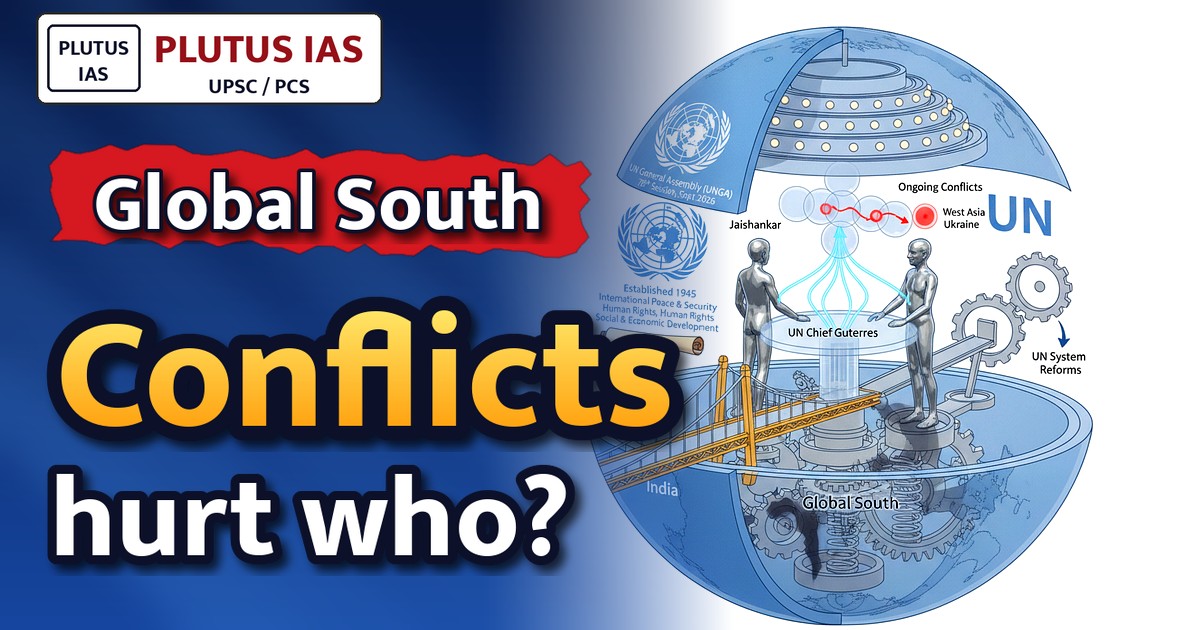
30 Sep Jaishankar-Guterres meet: India raises Global South concerns at UN
✎ India’s foreign policy prioritises multilateralism, UN reforms, and solidarity with the Global South, leveraging platforms like the UNGA to advocate for equitable global governance and sustainable development.
Subject Relevance — Where This Topic Fits
- GS Paper II — International Relations: India and its neighbourhood, Bilateral, Regional and Global Groupings involving India and/or affecting India’s interests, Important International Institutions, agencies and fora — their structure, mandate | GS Paper II — International Relations: Effect of policies and politics of developed and developing countries on India’s interests, Indian diaspora
- Prelims: United Nations General Assembly (UNGA), Mission LiFE, Global South, BRICS, Multilateralism, West Asia, Ukraine conflict, India’s foreign policy objectives
- Essay: Multilateralism in the 21st Century: Challenges and Opportunities, The Role of the Global South in Shaping a Just International Order
Quick Revision: India’s foreign policy prioritises multilateralism, UN reforms, and solidarity with the Global South, leveraging platforms like the UNGA to advocate for equitable global governance and sustainable development.
Why is this in the news?
The discussions centred on ongoing geopolitical conflicts, particularly in West Asia and Ukraine, and their disproportionate impact on the Global South, underscoring India’s role as a bridge between developed and developing nations in multilateral forums.
Background
- The United Nations, established in 1945, is a universal intergovernmental organisation dedicated to maintaining international peace and security, promoting human rights, and fostering social and economic development.
- The UN General Assembly (UNGA) is the main deliberative, policymaking, and representative organ of the UN, where all 193 member states have equal voting rights; its 78th session convened in September 2026.
- India, a founding member of the UN, has consistently advocated for reforms in the UN system to enhance the representation of the Global South, including permanent membership of the UN Security Council for India.
- Mission LiFE (Lifestyle for Environment), launched by Prime Minister Narendra Modi in 2022, is a global initiative to promote sustainable living and environmental conservation, aligning with the UN’s Sustainable Development Goals (SDGs).
- The Global South refers to developing countries, often characterised by economic disparities, colonial histories, and vulnerability to global shocks such as conflicts, climate change, and economic instability.
- India’s foreign policy under the rubric of ‘Vasudhaiva Kutumbakam’ (the world is one family) emphasises solidarity with the Global South, multilateralism, and strategic autonomy.
Key Dimensions of India-UN Engagement and the Global South
- **Multilateralism and UN Reforms**: India has long advocated for comprehensive reforms in the UN, including expansion of the Security Council to reflect contemporary geopolitical realities. This includes permanent membership for India, Brazil, Germany, and Japan (G4), and representation for African countries, to enhance the legitimacy and effectiveness of the UN.
- India’s engagement with the UN is guided by the principles of strategic autonomy, non-alignment, and support for the Global South, ensuring that the concerns of developing nations are addressed in global decision-making processes.
- The UN’s role in conflict resolution and peacekeeping remains critical, with over 70,000 Indian peacekeepers having served in 50 UN missions since 1948, making India one of the largest contributors to UN peacekeeping operations.
- India’s participation in the UNGA serves as a platform to articulate the priorities of the Global South, including climate justice, equitable trade, technology transfer, and debt relief for vulnerable economies.
- The UN’s 2030 Agenda for Sustainable Development and its 17 Sustainable Development Goals (SDGs) provide a framework for India’s domestic policies, such as the National Mission for Sustainable Agriculture and the Jal Jeevan Mission, aligning national development with global commitments.
- India’s presidency of the G20 in 2023 and its hosting of the Voice of the Global South Summit in January 2023 underscored its commitment to amplifying the voices of developing nations in global governance.
- The UN’s humanitarian and development agencies, such as UNDP, UNICEF, and WFP, collaborate with India on programmes addressing poverty, education, health, and disaster resilience, particularly in Least Developed Countries (LDCs) and Small Island Developing States (SIDS).
- India’s engagement with the UN also includes participation in peacebuilding initiatives, counter-terrorism efforts, and global health governance, reflecting its evolving role as a responsible stakeholder in the international system.
Key Features
| Feature | Significance |
|---|---|
| High-level bilateral meeting between India’s External Affairs Minister and UN Secretary-General | Demonstrates India’s proactive engagement in multilateral forums, particularly the United Nations, to address global challenges. |
| Discussion on ongoing conflicts (e.g., Ukraine, Middle East) | Highlights India’s role in advocating for diplomatic solutions to conflicts that disproportionately impact the Global South. |
| Focus on impact on Global South countries | Reflects India’s commitment to addressing the vulnerabilities of developing nations in geopolitical and economic crises. |
| Reference to India’s Mission LiFE during UNGA address | Showcases India’s leadership in global sustainability initiatives and alignment with UN priorities. |
| Final UNGA week for Secretary-General Guterres | Provides a historical context for evaluating the tenure of a key UN leader and India’s diplomatic relations with the organisation. |
Why it Matters
Diplomatic and Strategic
- Reinforces India’s position as a key interlocutor in global governance, particularly within the UN framework.
- Underscores the importance of multilateralism in addressing transnational challenges such as conflicts and climate change.
- Demonstrates India’s proactive diplomacy in engaging with the UN during critical geopolitical junctures.
- Highlights the role of the Global South in shaping international discourse on peace, security, and development.
Economic
- Conflicts and geopolitical instability often disrupt global supply chains, affecting developing economies disproportionately.
- India’s advocacy for the Global South aligns with its economic interests in fostering stable and predictable international trade environments.
- Discussions on conflicts may indirectly influence India’s economic partnerships and foreign direct investment flows.
Institutional
- Showcases the UN as a platform for India to articulate its vision for global governance and conflict resolution.
- Reflects the evolving role of the UN in addressing emerging challenges, including climate change and geopolitical tensions.
- Highlights the importance of continuity in diplomatic engagements, especially during transitions in leadership.
Challenges
1. Geopolitical Fragmentation
- Ongoing conflicts, such as in Ukraine and the Middle East, exacerbate global instability, complicating multilateral responses.
- Divergent national interests among major powers hinder collective action on issues critical to the Global South.
- The erosion of consensus within the UN Security Council reduces its effectiveness in addressing conflicts.
UPSC Link: GS II: Bilateral, regional and global groupings and agreements involving India
2. Economic Vulnerabilities of the Global South
- Developing nations face disproportionate economic burdens due to conflicts, including disrupted trade, inflation, and debt crises.
- Limited access to resources and technology exacerbates the impact of global crises on the Global South.
- The need for equitable access to global public goods, such as food security and energy, remains unmet.
UPSC Link: GS II: Important International institutions, agencies and fora
3. Climate Change and Conflict Nexus
- Climate-induced resource scarcity can exacerbate conflicts, creating a feedback loop that undermines stability.
- The Global South bears the brunt of climate change impacts while contributing minimally to historical emissions.
- Integrating climate resilience into conflict prevention strategies is a critical but underaddressed challenge.
UPSC Link: GS III: Conservation, environmental pollution and degradation
4. Multilateralism Under Strain
- Rising nationalism and protectionism challenge the efficacy of multilateral institutions like the UN.
- The legitimacy of global governance structures is questioned, particularly by nations seeking greater representation.
- Balancing national sovereignty with collective action remains a persistent dilemma for multilateral diplomacy.
UPSC Link: GS II: Effect of policies and politics of developed and developing countries
5. Transition in Global Leadership
- The impending departure of UN Secretary-General Guterres necessitates a smooth transition to maintain institutional continuity.
- Ensuring that India’s diplomatic engagements remain aligned with the evolving priorities of the UN is a strategic challenge.
- The transition period may create opportunities for India to shape the agenda of the next UN leadership.
UPSC Link: GS II: Important International institutions, agencies and fora
Challenges — UPSC Perspective
| Issue | Concern |
|---|---|
| Conflict-driven displacement | Humanitarian crises disproportionately affect the Global South, straining resources and stability. |
| Economic spillovers of conflicts | Global supply chain disruptions and inflation impact developing economies more severely. |
| Climate-conflict nexus | Resource scarcity due to climate change exacerbates existing tensions and conflicts. |
| Erosion of multilateral consensus | Divergent national interests undermine the UN’s ability to address global challenges effectively. |
| Leadership transition at the UN | The departure of Secretary-General Guterres requires careful management to ensure continuity. |
| Access to global public goods | Developing nations struggle to secure equitable access to essential resources like food and energy. |
Way Forward
- Enhance India’s role in facilitating dialogue between conflicting parties to promote peaceful resolutions.
- Strengthen collaboration with the UN to address the specific vulnerabilities of the Global South in conflict zones.
- Advocate for reforms in multilateral institutions to improve representation and effectiveness for developing nations.
- Promote initiatives that integrate climate resilience into conflict prevention and post-conflict reconstruction strategies.
- Leverage India’s presidency or leadership roles in international forums to shape agendas on global governance and sustainability.
- Encourage the UN to prioritise the economic recovery and resilience-building of conflict-affected Global South countries.
- Foster partnerships with regional organisations (e.g., African Union, ASEAN) to amplify the voice of the Global South in multilateral forums.
UPSC Value Addition
Keywords for Mains Answer-Writing
United Nations Charter · Global South · Multilateralism · UN Security Council reform · India-UN cooperation · Peacekeeping operations · Sustainable Development Goals · Geopolitical conflicts · Mission LiFE · UN General Assembly · Secretary-General of the UN · Geopolitical impact on developing nations · International law and conflict resolution · India’s foreign policy · UN reform agenda
Concept Flow
Ongoing conflicts (e.g., Ukraine, Middle East) → Disproportionate impact on Global South → Need for multilateral intervention → Role of UN in conflict resolution → India’s diplomatic engagement with UN → Advocacy for Global South priorities → Alignment with Mission LiFE and sustainability goals.
Prelims Practice Questions
Q1. Consider the following statements regarding the United Nations (UN):
1. The UN Charter was signed in 1945 and came into force on 24 October 1945.
2. The UN Security Council consists of 15 members, of which 5 are permanent members with veto power.
3. The UN General Assembly meets in regular sessions twice a year.
How many of the above statements are correct?
- Only one
- Only two
- All three
- None
Answer: Only two — Statement 1 is correct: The UN Charter was signed on 26 June 1945 and came into force on 24 October 1945. Statement 2 is correct: The UN Security Council has 15 members, including 5 permanent members (China, France, Russia, the United Kingdom, and the United States) with veto power. Statement 3 is incorrect: The UN General Assembly meets in one regular session per year, commencing on the third Tuesday of September.
Q2. Assertion (A): The United Nations Secretary-General is appointed by the UN Security Council on the recommendation of the UN General Assembly.
Reason (R): The UN Charter mandates that the Secretary-General shall be appointed for a term of five years, renewable once.
In the context of the above two statements, which of the following is correct?
- Both A and R are true, and R is the correct explanation of A
- Both A and R are true, but R is not the correct explanation of A
- A is true, but R is false
- A is false, but R is true
Answer: A is true, but R is false — Assertion (A) is true: The UN Secretary-General is appointed by the UN General Assembly on the recommendation of the UN Security Council. Reason (R) is true: The term of the Secretary-General is five years, renewable once, as per Article 97 of the UN Charter. However, R does not explain A, as the appointment process and term are distinct provisions.
Q3. Match the following columns related to the United Nations:
Column I (UN Organs) | Column II (Principal Functions)
1. Economic and Social Council (ECOSOC) | A. Maintenance of international peace and security
2. International Court of Justice (ICJ) | B. Coordination of economic, social, and related work
3. Security Council | C. Settlement of legal disputes between states
4. Secretariat | D. Administration and coordination of UN activities
Select the correct match:
- 1-B, 2-C, 3-A, 4-D
- 1-A, 2-B, 3-C, 4-D
- 1-D, 2-A, 3-B, 4-C
- 1-C, 2-D, 3-A, 4-B
Answer: 1-B, 2-C, 3-A, 4-D — 1-B: ECOSOC coordinates economic, social, and related work. 2-C: ICJ settles legal disputes between states. 3-A: Security Council maintains international peace and security. 4-D: Secretariat administers and coordinates UN activities.
Mains Practice Question
✍ The United Nations, as a multilateral institution, faces persistent challenges in maintaining international peace and security amid ongoing geopolitical conflicts. Critically examine the evolving role of the UN in addressing the impact of such conflicts on the Global South, with reference to recent developments. (15 Marks)
Approach: MODEL-ANSWER SKELETON:
1. **Context**: Define the Global South and its vulnerabilities to geopolitical conflicts (e.g., food insecurity, economic instability, displacement). Cite recent conflicts (e.g., Ukraine, Middle East) and their disproportionate impact on developing nations.
2. **UN’s Institutional Framework**:
– **UN Charter Provisions**: Articles 1(1), 2(4), 24, and Chapter VII (peacekeeping and enforcement).
– **UN Security Council**: Role in conflict resolution, limitations due to veto power, and proposals for reform (e.g., G4, Uniting for Consensus).
– **Peacekeeping Operations**: India’s contributions (e.g., MONUSCO, UNIFIL) and challenges (e.g., lack of enforcement powers, funding constraints).
3. **Recent Developments**:
– **Mission LiFE**: Link to UN Secretary-General’s support and India’s initiative on sustainable lifestyles.
– **UN General Assembly’s Role**: Resolutions on conflict impact (e.g., 2023 resolution on humanitarian consequences of conflicts).
– **Global South Representation**: Demand for UNSC reform to include more permanent seats for African, Asian, and Latin American nations.
4. **Critique and Challenges**:
– **Structural Limitations**: Veto power, lack of consensus, and resource constraints.
– **Alternative Mechanisms**: Role of regional organisations (e.g., African Union, ASEAN) in conflict resolution.
– **Geopolitical Realities**: Great-power rivalries undermining UN effectiveness.
5. **Way Forward**:
– Strengthening UNSC reform to enhance legitimacy.
– Expanding peacekeeping mandates to address climate-induced conflicts.
– Promoting South-South cooperation under UN auspices.
6. **Conclusion**: Balance between UN’s normative role and practical limitations, emphasizing the need for multilateralism to address Global South’s concerns.
Source: orissapost.com
Generated by AanyaAi for educational purpose.
Related guides on our sites
- Anthropology VS PSIR
- Best PSIR optional coaching
- Best PSIR optional coaching online
- Best PSIR optional teacher

- Jaishankar-Guterres meet: India raises Global South concerns at UN - September 30, 2026
- राजस्थान पंचायतीराज चुनाव: ईवीएम मतदान चार चरणों में, एक ही दिन होगी मतगणना - September 30, 2026
- Trump, Tech CEOs Sign AI Safety Pact: UPSC Science & Tech Insights - September 30, 2026

No Comments