


06 Aug Jal Jeevan Mission 2.0: ₹6,154.96 Cr Released for 10 States in FY 2026-27
✎ Jal Jeevan Mission 2.0 prioritises community-led O&M, digital governance via ‘SNA Sparsh’, and sustainable water supply, with ₹8.69 lakh crore outlay and ₹3.59 lakh crore central assistance.
Subject Relevance — Where This Topic Fits
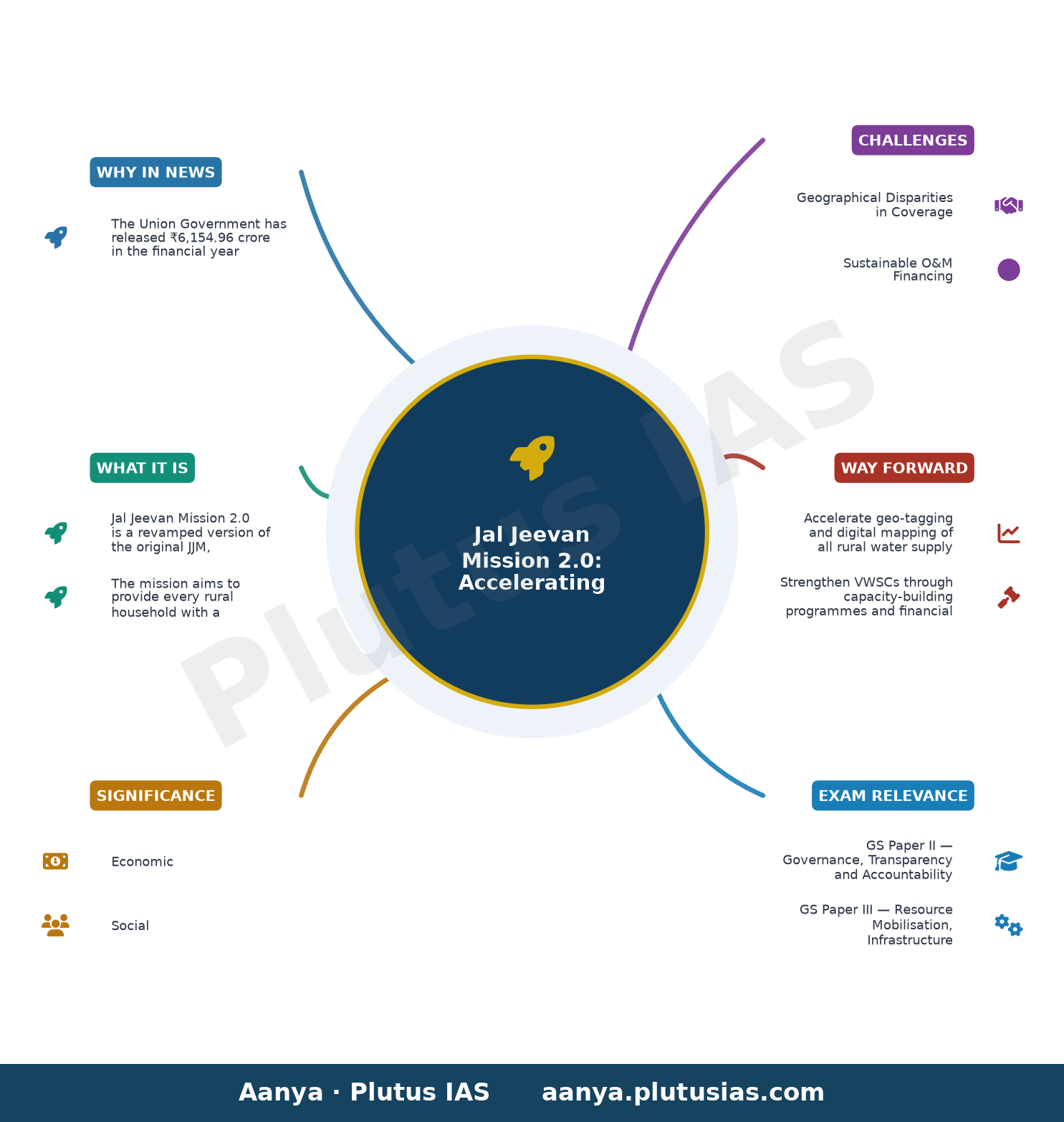
- GS Paper II — Governance, Transparency and Accountability | GS Paper III — Resource Mobilisation, Infrastructure Development, and Digital Governance
- Prelims: Jal Jeevan Mission, Har Ghar Jal, SNA Sparsh, Village Water and Sanitation Committees (VWSCs), PM Gati Shakti Platform, Sujalam Bharat ID
- Essay: The Role of Digital Governance in Public Service Delivery: A Case Study of Jal Jeevan Mission 2.0, Sustainable Development Goals and India’s Progress in Ensuring Water Security
Quick Revision: Jal Jeevan Mission 2.0 prioritises community-led O&M, digital governance via ‘SNA Sparsh’, and sustainable water supply, with ₹8.69 lakh crore outlay and ₹3.59 lakh crore central assistance.
Why is this in the news?
The Union Government has released ₹6,154.96 crore in the financial year 2026-27 to accelerate the implementation of Jal Jeevan Mission (JJM) 2.0, including ₹5,289.09 crore as central assistance to 10 states and ₹865.87 crore through the ‘SNA Sparsh’ platform to 13 states. This financial infusion, announced on 6 August 2026, underscores the mission’s focus on reliable, safe, and sustainable drinking water supply to rural households, with a total outlay of ₹8.69 lakh crore and central support of ₹3.59 lakh crore. The release highlights the shift from infrastructure creation to operation, maintenance, and community-led governance, reinforced by digital tools such as ‘SNA Sparsh’, ensuring transparency, accountability, and long-term water security.
Background
- The Jal Jeevan Mission (JJM) was launched in August 2019 with the objective of providing Functional Household Tap Connection (FHTC) to every rural household by 2024.
- The mission was revamped as JJM 2.0 in March 2026, extending its timeline to December 2028 and prioritising reliable, adequate, and safe drinking water supply through community ownership and digital governance.
- JJM 2.0 introduces a paradigm shift from mere infrastructure creation to sustainable service delivery, operation, and maintenance (O&M), with a focus on source sustainability and water quality monitoring.
- The mission’s financial architecture includes a total outlay of ₹8.69 lakh crore, with ₹3.59 lakh crore as central assistance, and the remaining to be mobilised by states and Union Territories.
- Previously, JJM 1.0 achieved significant milestones, including the provision of tap connections to over 14 crore households, though challenges in O&M and service reliability persisted.
- The introduction of ‘SNA Sparsh’ in JJM 2.0 marks a technological leap, enabling real-time fund tracking, audit facilitation, and transparent disbursement of financial assistance to states.
What is Jal Jeevan Mission 2.0?
- Jal Jeevan Mission 2.0 is a revamped version of the original JJM, launched by the Union Cabinet on 10 March 2026, with an extended implementation timeline until December 2028.
- The mission aims to provide every rural household with a functional household tap connection (FHTC), ensuring reliable, adequate, and safe drinking water supply on a sustainable basis.
- A key shift in JJM 2.0 is the focus on Operation & Maintenance (O&M) of water supply systems, with responsibility entrusted to Gram Panchayats and Village Water and Sanitation Committees (VWSCs) under community ownership.
- The mission integrates digital governance tools such as ‘SNA Sparsh’ for real-time fund tracking, expenditure monitoring, and audit facilitation, enhancing transparency and accountability in fund utilisation.
- The mission emphasises source sustainability, water quality monitoring, and community-led assessments through ‘Jal Seva Assessment’ to ensure long-term water security.
- Financial disbursement under JJM 2.0 is now streamlined through ‘SNA Sparsh’, which facilitates plan-based payments directly to states, reducing delays and improving efficiency in fund utilisation.
- JJM 2.0 also promotes the formal handover of completed water supply schemes to Gram Panchayats, ensuring local accountability and sustainable service delivery.
Key Features
| Feature | Significance |
|---|---|
| Extension of JJM 2.0 to December 2028 | Ensures continuity of efforts to achieve universal rural household coverage under Har Ghar Jal, aligning with Sustainable Development Goal 6.1. |
| Central Assistance of ₹3.59 lakh crore | Provides fiscal support to states for infrastructure creation, O&M, and capacity-building, reducing financial burden on sub-national governments. |
| SNA Sparsh Platform | Enables real-time fund release, expenditure tracking, and auditability through geo-tagged digital mapping of rural water supply assets. |
| Village-level O&M strengthening | Shifts focus from construction to sustainable service delivery via Gram Panchayats and Village Water and Sanitation Committees (VWSCs), ensuring long-term functionality. |
| Jal Seva Assessment | Community-led evaluation mechanism to monitor service reliability, water quality, and user satisfaction, fostering accountability. |
| Sujalam Bharat ID | Unique digital identifier for water supply assets to track asset lifecycle, maintenance history, and performance metrics. |
Why it Matters
Economic
- Reduces out-of-pocket expenditure on water by rural households, particularly in water-scarce regions, thereby improving disposable income and local economic activity.
- Leverages public funds to catalyse private investment in water infrastructure through public-private partnerships (PPPs) in O&M and technology adoption.
- Creates employment opportunities in rural areas through skill development in water management, plumbing, and digital governance.
Social
- Ensures equitable access to safe drinking water, reducing drudgery for women and girls who traditionally bear the burden of water collection.
- Improves health outcomes by lowering waterborne diseases, thereby reducing healthcare costs and improving workforce productivity.
- Empowers marginalised communities through participatory governance in water resource management.
Environmental
- Promotes source sustainability through rainwater harvesting, groundwater recharge, and watershed management in JJM 2.0 planning.
- Encourages water-use efficiency via community awareness campaigns and adoption of low-water-use technologies.
- Supports climate resilience by integrating drought-proofing measures in rural water supply schemes.
Governance
- Enhances transparency and accountability in fund utilisation through digital platforms like SNA Sparsh and geo-tagging.
- Strengthens cooperative federalism by aligning central funding with state-level priorities and local needs.
- Fosters multi-stakeholder collaboration among government, civil society, and private sector for sustainable water management.
Challenges
1. Geographical Disparities in Coverage
- Persistent gaps in water supply coverage in hilly, tribal, and remote regions due to terrain challenges and low population density.
- States like Odisha, Chhattisgarh, and Andhra Pradesh exhibit lower per-household coverage rates, requiring targeted interventions.
UPSC Link: GS1: Regional disparities in development
2. Sustainable O&M Financing
- Reliance on central funds for O&M raises concerns about long-term financial sustainability post-JJM 2.0.
- Limited revenue generation models in rural areas hinder Gram Panchayats’ ability to maintain water supply systems independently.
UPSC Link: GS3: Resource mobilisation
3. Water Quality Monitoring
- Groundwater contamination (arsenic, fluoride, nitrates) in states like West Bengal, Rajasthan, and Telangana poses health risks despite infrastructure creation.
- Lack of standardised testing protocols and real-time monitoring systems delays corrective action.
UPSC Link: GS3: Environmental pollution
4. Community Participation and Ownership
- Low awareness and participation in water management committees (VWSCs) in some states undermines long-term sustainability.
- Cultural barriers and lack of incentives discourage local ownership of water assets.
UPSC Link: GS2: Local governance
5. Technological Adoption Barriers
- Digital literacy gaps among rural stakeholders hinder effective use of platforms like SNA Sparsh and Sujalam Bharat ID.
- Limited access to smartphones and internet connectivity in remote areas restricts real-time data collection.
UPSC Link: GS3: Science & Technology
6. Climate Change Vulnerability
- Increased frequency of droughts and erratic rainfall patterns threaten water source sustainability in arid and semi-arid regions.
- Flooding events in states like Assam and Bihar disrupt water supply infrastructure and O&M activities.
UPSC Link: GS3: Climate change
Challenges — UPSC Perspective
| Issue | Concern |
|---|---|
| Hilly and Tribal Regions | Low coverage rates due to difficult terrain and dispersed settlements. |
| Groundwater Contamination | Arsenic, fluoride, and nitrate levels exceed permissible limits in several states. |
| O&M Funding Gaps | Central funds may not suffice for long-term maintenance post-mission completion. |
| Digital Divide | Limited access to technology impedes monitoring and governance. |
| Climate Resilience | Increased vulnerability to droughts and floods threatens infrastructure durability. |
| Community Engagement | Low participation in VWSCs reduces ownership and sustainability. |
Government Initiatives — Must-Memorise for Prelims
- Jal Jeevan Mission (JJM) 2.0
Way Forward
- Accelerate geo-tagging and digital mapping of all rural water supply assets to enable real-time monitoring via SNA Sparsh.
- Strengthen VWSCs through capacity-building programmes and financial incentives for active participation.
- Integrate climate-resilient measures (rainwater harvesting, groundwater recharge) in all new and ongoing JJM 2.0 projects.
- Establish standardised water quality testing labs in each district with mobile units for remote areas.
- Promote PPP models for O&M in water-scarce regions to ensure financial sustainability beyond central funding.
- Launch awareness campaigns in local languages to enhance community ownership and usage of digital platforms.
- Converge JJM 2.0 with MGNREGS for skill development in rural water infrastructure maintenance.
- Develop a national-level water data repository integrating Sujalam Bharat ID and SNA Sparsh for policy formulation.
UPSC Value Addition
Keywords for Mains Answer-Writing
Jal Jeevan Mission 2.0 · Har Ghar Jal · Source Sustainability · Operation & Maintenance (O&M) · Village Water and Sanitation Committees (VWSC) · Sujalam Bharat ID · PM Gati Shakti Platform · Digital Governance in Water Sector · Community Ownership · SNA Sparsh Platform · Long-term Water Security · Rural Drinking Water Supply · Central Assistance to States · Water Quality Monitoring · Geotagging of Assets
Constitutional & Policy Linkages
- Article 243G (Panchayats) – Empowers local bodies to manage water supply and sanitation.
- Article 21 (Right to Life) – Implies access to safe drinking water as a fundamental right.
- Seventh Schedule (State List – Item 17: Water supply)
Concept Flow
Central Government approves JJM 2.0 with extended timeline and enhanced funding (March 2026) → → States utilise central funds (₹5,289.09 crore) and SNA Sparsh platform (₹865.87 crore) for infrastructure and O&M (August 2026) → → Digital governance (SNA Sparsh, Sujalam Bharat ID) enables real-time monitoring and transparency → → Community-led O&M through VWSCs ensures long-term service reliability → → Sustainable water security achieved via source sustainability and climate-resilient measures → → Universal rural coverage under Har Ghar Jal aligns with SDG 6.1 and reduces health disparities.
Prelims Practice Questions
Q1. Consider the following statements regarding Jal Jeevan Mission (JJM) 2.0:
1. JJM 2.0 aims to provide tap water connection to every rural household by December 2028.
2. The mission includes a provision for creating a unique ‘Sujalam Bharat ID’ for drinking water assets.
3. The ‘SNA Sparsh’ platform is used exclusively for fund disbursement without monitoring of expenditure.
4. The mission emphasizes the operationalization of Village Water and Sanitation Committees (VWSC) for maintenance of water supply systems.
How many of the above statements are correct?
- Only one
- Only two
- Only three
- All
Answer: All — Statements 1, 2, and 4 are correct. Statement 3 is incorrect as ‘SNA Sparsh’ is designed for both fund disbursement and expenditure monitoring.
Q2. Assertion (A): The Jal Jeevan Mission 2.0 shifts focus from infrastructure creation to sustainable operation and maintenance of rural water supply systems.
Reason (R): The mission introduces reforms such as community ownership, digital governance, and source sustainability to ensure reliable water supply.
In the context of the above two statements, which one of the following is correct?
- Both A and R are true, and R is the correct explanation of A.
- Both A and R are true, but R is not the correct explanation of A.
- A is true, but R is false.
- A is false, but R is true.
Answer: Both A and R are true, and R is the correct explanation of A. — Both the assertion and reason are true, and the reason correctly explains the assertion. JJM 2.0 indeed prioritizes O&M, community ownership, and digital governance over mere infrastructure creation.
Q3. Match the following initiatives under Jal Jeevan Mission 2.0 with their respective objectives:
Column I (Initiative) | Column II (Objective)
— | —
A. Sujalam Bharat ID | 1. Geotagging and digital mapping of rural water supply infrastructure
B. PM Gati Shakti Platform | 2. Unique identification of drinking water assets
C. SNA Sparsh Platform | 3. Fund disbursement and expenditure monitoring
D. Village Water and Sanitation Committees (VWSC) | 4. Community-led operation and maintenance of water supply systems
Choose the correct match:
- A-2, B-1, C-3, D-4
- A-1, B-2, C-3, D-4
- A-3, B-1, C-2, D-4
- A-2, B-3, C-1, D-4
Answer: A-2, B-1, C-3, D-4 — A matches with 2 (Sujalam Bharat ID for unique identification), B matches with 1 (PM Gati Shakti for geotagging), C matches with 3 (SNA Sparsh for fund monitoring), and D matches with 4 (VWSC for community-led O&M).
Mains Practice Question
✍ Critically analyse the transformative reforms introduced under Jal Jeevan Mission (JJM) 2.0, with particular emphasis on its shift from infrastructure-centric approaches to sustainable service delivery. How does the mission integrate digital governance, community ownership, and source sustainability to ensure long-term water security? (15 Marks)
Approach: MODEL-ANSWER SKELETON:
1. **Introduction (2 Marks)**:
– Briefly define JJM 2.0 and its objective: ensuring ‘Har Ghar Jal’ (tap water to every rural household) by December 2028.
– Highlight the paradigm shift from JJM 1.0 (infrastructure creation) to JJM 2.0 (sustainable service delivery).
2. **Transformative Reforms (6 Marks)**:
– **Digital Governance**:
– ‘Sujalam Bharat ID’ for unique identification of drinking water assets.
– PM Gati Shakti Platform for geotagging and digital mapping of rural water supply infrastructure.
– ‘SNA Sparsh’ platform for real-time fund disbursement, expenditure tracking, and financial transparency.
– **Community Ownership**:
– Empowerment of Village Water and Sanitation Committees (VWSC) for operation and maintenance (O&M).
– ‘Jal Seva Assessment’ for community-led evaluation of water supply services.
– **Source Sustainability**:
– Emphasis on water quality monitoring and long-term water security.
– Formal handover of completed assets to VWSCs for sustainable management.
3. **Sustainability and Long-term Impact (4 Marks)**:
– Discuss how community ownership and digital governance enhance accountability, transparency, and efficiency.
– Explain the role of source sustainability in mitigating water scarcity and ensuring reliable supply.
– Highlight the mission’s focus on O&M to prevent asset degradation and ensure service continuity.
4. **Challenges and Way Forward (3 Marks)**:
– Acknowledge potential challenges: funding gaps, institutional capacity, and behavioral resistance in rural communities.
– Suggest measures: capacity building for VWSCs, leveraging technology for real-time monitoring, and ensuring equitable resource allocation.
**Balanced View**:
– Acknowledge the mission’s strengths in integrating technology, community participation, and sustainability.
– Critically examine limitations: scalability in large states, data accuracy in geotagging, and long-term funding sustainability.
Source: PIB (Press Information Bureau)
Generated by AanyaAi for educational purpose.

- नीलकुरिंजी के विनाश से मुनार की जैव विविधता पर संकट: जानिए कारण और समाधान - September 22, 2026
- Neelakurinji Destruction Threatens Munnar Biodiversity: UPSC Exam Insight - September 22, 2026
- आंध्र प्रदेश सरकार ने बुजुर्ग पेंशनरों को वापस दी अतिरिक्त पेंशन राशि: मुख्यमंत्री चंद्रबाबू नायडू का फैसला - September 22, 2026

No Comments