


06 Aug Jal Jeevan Mission 2.0: ₹6,154.96 Cr Released for 10 States in FY 2026-27
✎ Jal Jeevan Mission 2.0 redefines rural water security by shifting from infrastructure creation to sustainable service delivery, digital governance, and community ownership, with ₹6,154.96 crore disbursed in FY 2026–27 to…
Subject Relevance — Where This Topic Fits
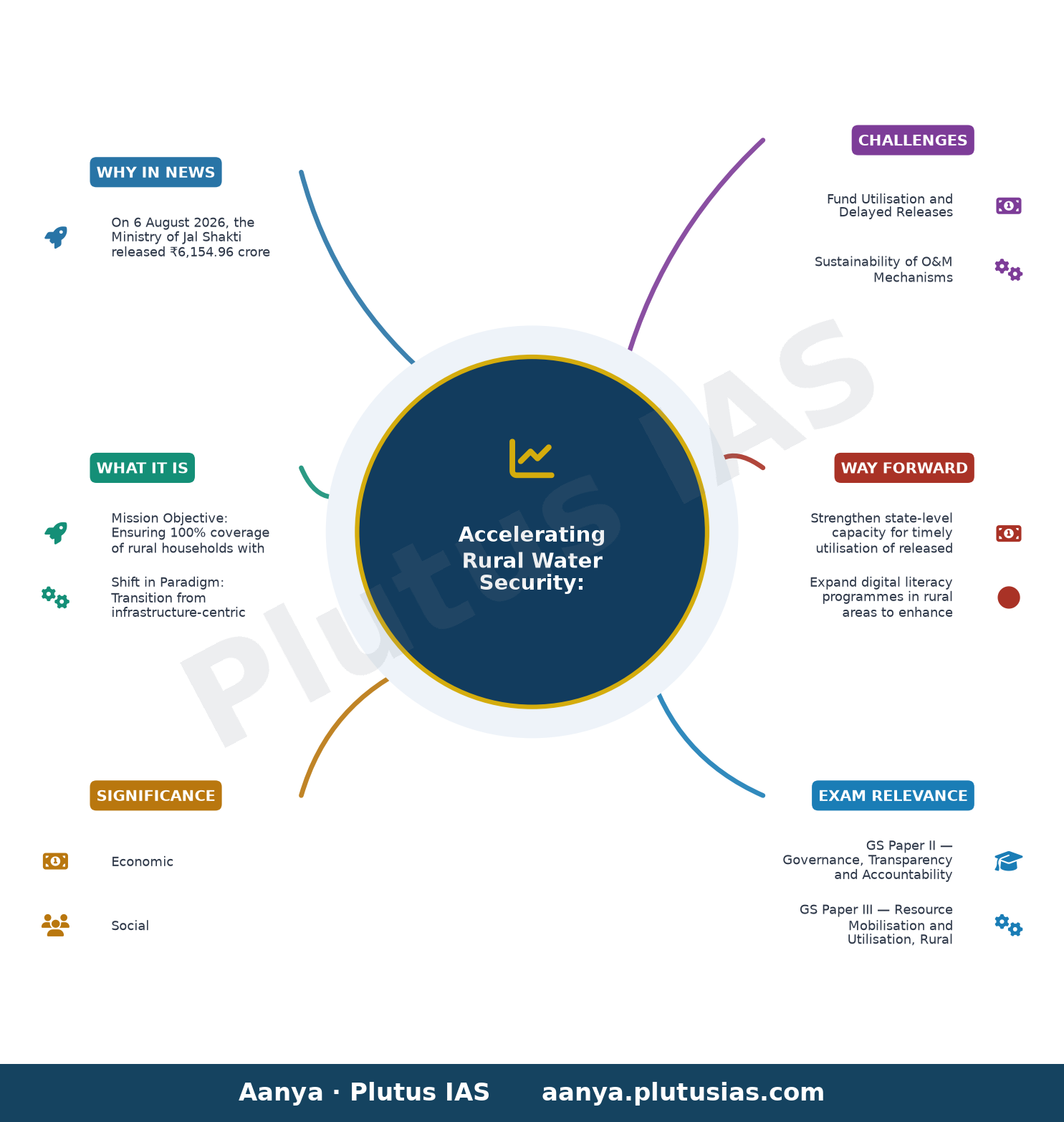
- GS Paper II — Governance, Transparency and Accountability | GS Paper III — Resource Mobilisation and Utilisation, Rural Development
- Prelims: Jal Jeevan Mission 2.0, SNA Sparsh, PM Gati Shakti, Village Water and Sanitation Committees (VWSCs), Sujalam Bharat ID
- Essay: Water Security and Sustainable Development: Balancing Infrastructure and Community Ownership, Digital Governance as a Catalyst for Rural Transformation
Quick Revision: Jal Jeevan Mission 2.0 redefines rural water security by shifting from infrastructure creation to sustainable service delivery, digital governance, and community ownership, with ₹6,154.96 crore disbursed in FY 2026–27 to accelerate progress toward 100% tap water coverage by December 2028.
Why is this in the news?
On 6 August 2026, the Ministry of Jal Shakti released ₹6,154.96 crore to states under Jal Jeevan Mission 2.0 for the financial year 2026–27, including ₹5,289.09 crore as central reimbursements to 10 states and ₹865.87 crore via the SNA Sparsh platform to 13 states. This disbursement underscores the Centre’s commitment to sustaining momentum in achieving universal, reliable, and safe piped water supply in rural India by December 2028, while introducing transformative reforms in operations, maintenance, and digital governance.
Background
- The original Jal Jeevan Mission (JJM 1.0) was launched in August 2019 with the objective of providing Functional Household Tap Connection (FHTC) to every rural household by 2024.
- As of March 2026, approximately 80% of rural households had access to tap water, but challenges persisted in ensuring reliable supply, quality monitoring, and sustainable O&M.
- Recognising these gaps, the Union Cabinet approved Jal Jeevan Mission 2.0 on 10 March 2026, extending the mission timeline to December 2028 with a revised outlay of ₹8.69 lakh crore, including ₹3.59 lakh crore central assistance.
- JJM 2.0 shifts focus from mere infrastructure creation to sustainable service delivery, community ownership, and digital governance, with special emphasis on source sustainability and water quality monitoring.
- The transition period between JJM 1.0 completion and JJM 2.0 approval saw proactive state-level initiatives to utilise available funds for ongoing rural water supply schemes, ensuring continuity in service delivery.
What is Jal Jeevan Mission 2.0?
- Mission Objective: Ensuring 100% coverage of rural households with reliable, adequate, and safe piped water supply by December 2028 through Functional Household Tap Connections (FHTCs).
- Shift in Paradigm: Transition from infrastructure-centric approach (JJM 1.0) to service delivery-centric model (JJM 2.0), prioritising operations, maintenance, and community-led governance.
- Financial Outlay: Total approved budget of ₹8.69 lakh crore, with ₹3.59 lakh crore as central assistance, aiming for financial sustainability through convergence with other schemes.
- Digital Governance: Introduction of the SNA Sparsh platform for scheme-wise fund release, real-time expenditure tracking, and enhanced transparency and auditability of public funds.
- Community Ownership: Formal transfer of completed water supply assets to Gram Panchayats and Village Water and Sanitation Committees (VWSCs), fostering local accountability and sustainability.
- Quality Assurance: Strengthened water quality monitoring mechanisms at the community level to ensure safe drinking water.
Key Features
| Feature | Significance |
|---|---|
| SNA Sparsh Platform | Enables plan-level fund release, real-time expenditure tracking, and financial auditability, enhancing transparency and accountability in fund utilisation. |
| Village-level O&M (Operation & Maintenance) | Shifts focus from infrastructure creation to sustainable service delivery, ensuring long-term reliability of water supply through community ownership. |
| Sustainable Source Management | Prioritises source sustainability and water quality monitoring to ensure reliable and safe drinking water over extended periods. |
| Digital Governance Integration | Leverages geotagging, digital mapping (PM Gati Shakti), and unique asset identifiers (Sujalam Bharat ID) for efficient monitoring and asset management. |
| Community-led Assessment (Jal Seva Assessment) | Empowers local communities to evaluate service delivery, fostering ownership and accountability in rural water supply systems. |
Why it Matters
Economic
- Enhances rural productivity by reducing time and health costs associated with water fetching, thereby improving labour participation and economic output.
Social
- Ensures equitable access to safe drinking water, reducing disparities in rural communities and improving public health outcomes.
Administrative
- Demonstrates Centre-State coordination through targeted fund releases and structured engagement with MPs, ensuring timely implementation.
Technological
- Adoption of digital tools (SNA Sparsh, geotagging, Sujalam Bharat ID) modernises rural water governance, aligning with India’s digital transformation goals.
Environmental
- Promotes sustainable water resource management, reducing over-extraction and ensuring long-term ecological balance in rural areas.
Challenges
1. Fund Utilisation and Delayed Releases
- Risk of underutilisation of funds due to administrative bottlenecks or lack of state-level preparedness.
- Delays in fund release may stall project timelines, particularly in fiscally constrained states.
UPSC Link: GS3: Infrastructure financing
2. Sustainability of O&M Mechanisms
- Ensuring long-term viability of village-led O&M systems requires capacity building and institutional support.
- Dependence on community resources may lead to variability in service quality across regions.
UPSC Link: GS2: Local governance
3. Water Quality Monitoring
- Rural water sources are vulnerable to contamination (arsenic, fluoride, microbial), necessitating robust monitoring systems.
- Limited technical capacity in rural areas may hinder effective quality assessment.
UPSC Link: GS3: Environmental pollution
4. Geographical and Demographic Disparities
- Hilly, tribal, and remote regions face higher implementation costs and logistical challenges.
- High-density rural areas may strain existing infrastructure, requiring phased scaling.
UPSC Link: GS1: Regional diversity
5. Digital Divide and Capacity Gaps
- Rural communities may lack digital literacy to utilise platforms like SNA Sparsh effectively.
- Training and awareness programmes are essential for seamless adoption.
UPSC Link: GS3: Science & technology
6. Inter-State Coordination
- Coordination between upstream and downstream states is critical for transboundary water resource management.
- Conflicts over water sharing may delay project implementation.
UPSC Link: GS2: Centre-State relations
Challenges — UPSC Perspective
| Issue | Concern |
|---|---|
| Underutilisation of Funds | Risk of funds remaining unspent due to administrative inefficiencies or lack of project readiness. |
| Quality of Service Delivery | Variability in water supply reliability and quality across states due to uneven O&M capacity. |
| Contamination of Water Sources | Persistent issues with arsenic, fluoride, and microbial contamination in rural water supplies. |
| Logistical Challenges in Remote Areas | High costs and delays in transporting materials and deploying manpower to hilly or tribal regions. |
| Digital Literacy Gaps | Limited awareness and training among rural communities to utilise digital governance tools effectively. |
| Coordination Gaps | Delays in inter-state projects due to lack of synchronised planning and resource sharing. |
Government Initiatives — Must-Memorise for Prelims
- Jal Jeevan Mission (JJM) 2.0
- SNA Sparsh Platform
Way Forward
- Strengthen state-level capacity for timely utilisation of released funds through pre-emptive planning and training.
- Expand digital literacy programmes in rural areas to enhance adoption of platforms like SNA Sparsh and Sujalam Bharat ID.
- Prioritise water quality testing and treatment infrastructure in arsenic/fluoride-affected regions.
- Enhance inter-state coordination mechanisms for transboundary water resource management.
- Institutionalise community-led O&M training programmes with periodic refresher courses.
- Leverage PM KUSUM and other renewable energy schemes to power rural water supply systems sustainably.
- Integrate JJM 2.0 with MGNREGS for convergence in rural infrastructure development.
- Establish a real-time monitoring dashboard for fund utilisation and service delivery metrics.
UPSC Value Addition
Keywords for Mains Answer-Writing
Jal Jeevan Mission 2.0 · Safe Drinking Water · Community Ownership · Digital Governance · Source Sustainability · Water Quality Monitoring · SNA Sparsh Platform · Village Water and Sanitation Committee · PM Gati Shakti Platform · Rural Water Supply Infrastructure · Geotagging of Assets · Long-term Water Security · Jal Adhikar · Sujalam Bharat ID · Water Service Assessment
Concept Flow
Cabinet approval of JJM 2.0 (March 2026) → Expansion of mission scope to December 2028 → Allocation of ₹8.69 lakh crore (₹3.59 lakh crore central share) → State-wise fund releases (₹5,289.09 crore + ₹865.87 crore via SNA Sparsh) → Implementation of digital governance tools (SNA Sparsh, geotagging) → Community-led O&M and sustainability focus → Long-term rural water security and equitable access
Prelims Practice Questions
Q1. Consider the following statements regarding Jal Jeevan Mission (JJM) 2.0:
1. JJM 2.0 aims to provide tap water connections to all rural households by December 2028.
2. The mission includes a provision for a unique ‘Sujalam Bharat ID’ for water supply assets.
3. The ‘SNA Sparsh’ platform is designed to facilitate geotagging and digital mapping of rural water supply infrastructure.
4. JJM 2.0 focuses solely on the construction of new water supply infrastructure without emphasis on operations and maintenance.
How many of the above statements are correct?
- Only one
- Only two
- Only three
- All
Answer: Only three — Statements 1, 2, and 3 are correct as per the mission’s objectives. Statement 4 is incorrect because JJM 2.0 emphasizes operations and maintenance (O&M) and community ownership alongside infrastructure creation.
Q2. Assertion (A): The ‘SNA Sparsh’ platform under Jal Jeevan Mission 2.0 enhances transparency and accountability in fund utilization.
Reason (R): It enables real-time monitoring of financial progress and facilitates scheme-level fund releases.
Options:
A. Both A and R are true, and R is the correct explanation of A.
B. Both A and R are true, but R is not the correct explanation of A.
C. A is true, but R is false.
D. A is false, but R is true.
Answer: ? — Both the Assertion (A) and Reason (R) are true, and R correctly explains A as ‘SNA Sparsh’ provides real-time monitoring and scheme-level fund tracking, thereby improving transparency and accountability.
Q3. Match the following states with the amount of central funds released under Jal Jeevan Mission 2.0 for the financial year 2026-27 (as per the given data):
State : Amount Released (in ₹ crore)
A. Uttar Pradesh : 1. 2711.52
B. Odisha : 2. 594.44
C. Maharashtra : 3. 221.44
D. Kerala : 4. 144.66
Options:
A. A-1, B-3, C-2, D-4
B. A-2, B-1, C-4, D-3
C. A-3, B-2, C-1, D-4
D. A-4, B-3, C-2, D-1
- A
- B
- C
- D
Answer: A — The correct match is: Uttar Pradesh (2711.52), Odisha (221.44), Maharashtra (594.44), and Kerala (144.66).
Mains Practice Question
✍ Critically analyse the transformative shifts introduced by Jal Jeevan Mission (JJM) 2.0 in ensuring sustainable, reliable, and safe drinking water supply for rural India. How does the mission address the limitations of JJM 1.0, and what institutional mechanisms have been established to enhance community ownership and digital governance? (15 Marks)
Approach: MODEL-ANSWER SKELETON:
1. **Context**: Brief on JJM 1.0’s achievements and its limitations (e.g., focus on infrastructure creation, lack of O&M, and community involvement).
2. **Transformative Shifts in JJM 2.0**:
– **Operational Focus**: Shift from infrastructure creation to operations and maintenance (O&M), ensuring long-term service delivery.
– **Community Ownership**: Role of Village Water and Sanitation Committees (VWSCs) and Gram Panchayats in managing water supply systems.
– **Digital Governance**: Introduction of ‘SNA Sparsh’ platform for real-time fund tracking, geotagging of assets via PM Gati Shakti, and ‘Sujalam Bharat ID’ for asset identification.
– **Water Quality Monitoring**: Emphasis on continuous monitoring of water quality to ensure safety.
– **Source Sustainability**: Measures to ensure long-term water security through rainwater harvesting, groundwater recharge, and watershed management.
3. **Institutional Mechanisms**:
– **SNA Sparsh Platform**: Enables scheme-level fund releases, expenditure tracking, and auditing, enhancing transparency and accountability.
– **Jal Adhikar**: Formal transfer of completed schemes to Gram Panchayats for community-led management.
– **Water Service Assessment**: Community-led evaluations to ensure service reliability and responsiveness.
4. **Challenges and Way Forward**:
– **Implementation Gaps**: Regional disparities in fund release and execution (e.g., higher allocations to Uttar Pradesh vs. smaller states).
– **Capacity Building**: Need for training and capacity-building of VWSCs and Gram Panchayats.
– **Sustainability**: Ensuring long-term funding and technical support for O&M.
5. **Conclusion**: JJM 2.0 represents a paradigm shift towards sustainable, community-driven water governance, aligning with SDG 6.1. Its success hinges on robust institutional mechanisms, digital integration, and equitable resource allocation.
Source: PIB (Press Information Bureau)
Generated by AanyaAi for educational purpose.

- नमस्ते योजना से स्वच्छता कर्मियों को मिली सुरक्षा, गरिमा और आजीविका सहायता - September 22, 2026
- कर्नाटक में ‘वंदे मातरम’ विवाद: राज्यपाल ने सीएम से आदेश वापस लेने को कहा - September 22, 2026
- Karnataka Governor vs CM: Vande Mataram GO row explained for UPSC - September 22, 2026

No Comments