


06 Aug Jal Jeevan Mission 2.0: Centre Releases ₹6,154 Crore for Rural Water Supply
✎ Jal Jeevan Mission 2.0 prioritizes sustainable rural water supply through community-led O&M, digital governance (SNA Sparsh, PM Gati Shakti), and source sustainability, with a ₹8.69 lakh crore outlay and a December 2028 deadline.
Subject Relevance — Where This Topic Fits
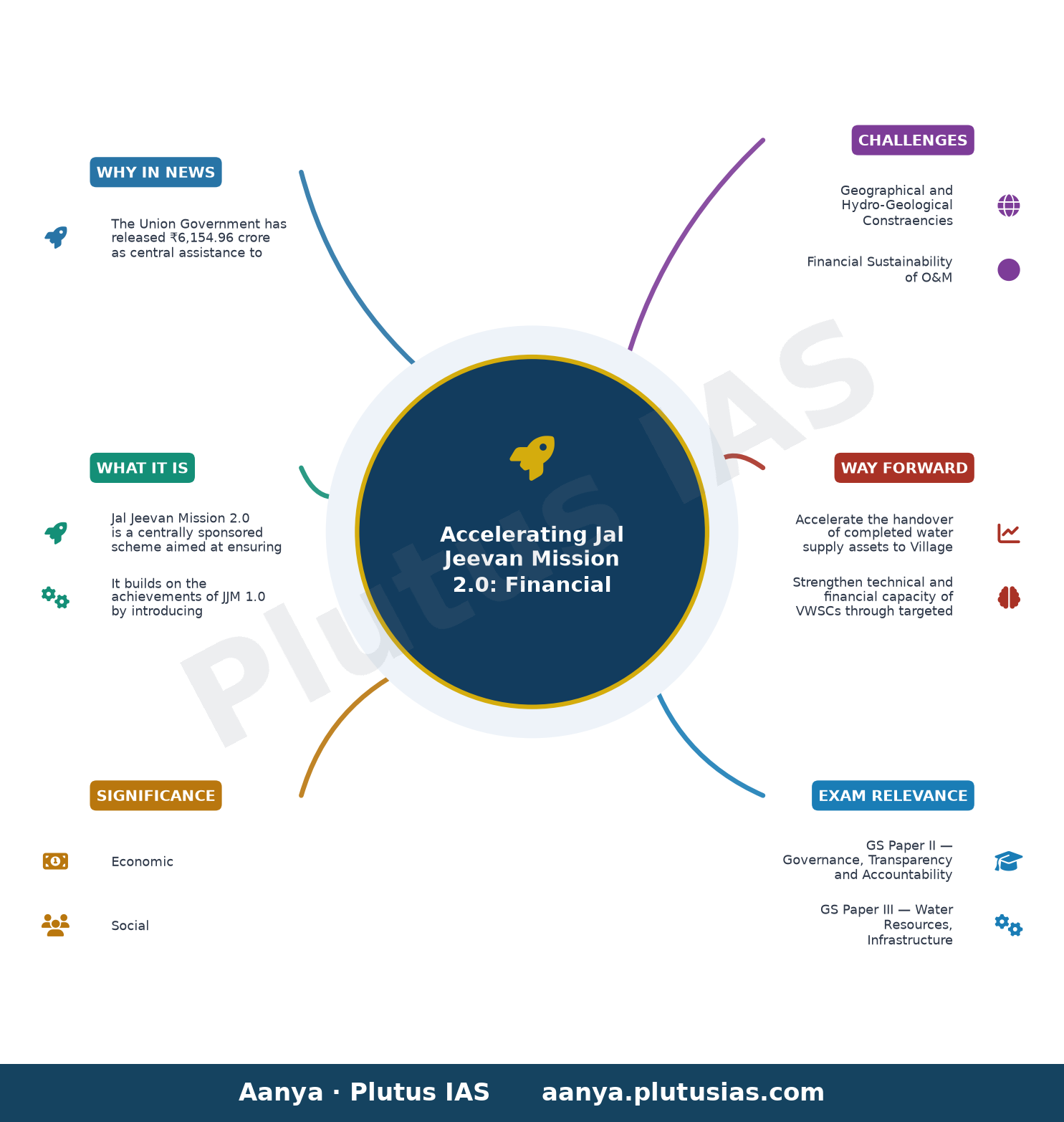
- GS Paper II — Governance, Transparency and Accountability | GS Paper III — Water Resources, Infrastructure Development, and Digital Governance
- Prelims: Jal Jeevan Mission 2.0, SNA Sparsh platform, Village Water and Sanitation Committees (VWSCs), PM Gati Shakti Platform, Sujalam Bharat ID
- Essay: Role of Digital Public Infrastructure in Rural Service Delivery, Sustainable Water Governance: Community Ownership and Long-term Security
Quick Revision: Jal Jeevan Mission 2.0 prioritizes sustainable rural water supply through community-led O&M, digital governance (SNA Sparsh, PM Gati Shakti), and source sustainability, with a ₹8.69 lakh crore outlay and a December 2028 deadline.
Why is this in the news?
The Union Government has released ₹6,154.96 crore as central assistance to states under Jal Jeevan Mission (JJM) 2.0 during 2026–27, including ₹5,289.09 crore as reimbursement to 10 states and ₹865.87 crore via the SNA Sparsh platform to 13 states. This financial infusion marks a critical step in sustaining the mission’s momentum toward universal coverage of safe drinking water in rural India by December 2028. The release follows the Cabinet approval of JJM 2.0 in March 2026, which extends the mission’s timeline and introduces transformative reforms in operation, maintenance, and digital governance.
Background
- Jal Jeevan Mission (JJM) was launched in August 2019 with the objective of providing Functional Household Tap Connection (FHTC) to every rural household by 2024.
- The mission’s Phase 1 (JJM 1.0) achieved significant coverage, with over 14.5 crore households provided tap connections by 2024, but gaps in operation, maintenance, and water quality monitoring persisted.
- To address these gaps, the Union Cabinet approved Jal Jeevan Mission 2.0 in March 2026, extending the mission’s timeline to December 2028 with a total outlay of ₹8.69 lakh crore, including ₹3.59 lakh crore central assistance.
- JJM 2.0 shifts focus from infrastructure creation to sustainable service delivery, emphasizing community ownership, source sustainability, and digital governance through platforms like SNA Sparsh and PM Gati Shakti.
- States leveraged their own resources during the transition period between JJM 1.0 and 2.0 to sustain water supply schemes, ensuring continuity in service delivery.
- The financial outlay for 2026–27 reflects a strategic push to maintain operational momentum and address implementation challenges in states lagging behind.
What is Jal Jeevan Mission 2.0?
- Jal Jeevan Mission 2.0 is a centrally sponsored scheme aimed at ensuring universal access to safe, adequate, and reliable drinking water in rural households by December 2028.
- It builds on the achievements of JJM 1.0 by introducing transformative reforms in operation and maintenance (O&M), water quality monitoring, and community participation.
- The mission emphasizes decentralized governance through Village Water and Sanitation Committees (VWSCs) and Gram Panchayats, ensuring local ownership and accountability.
- A key innovation is the SNA Sparsh platform, which facilitates plan-based fund disbursement, real-time expenditure tracking, and financial auditing for transparency and efficiency.
- Source sustainability and long-term water security are prioritized, with a shift from mere infrastructure provision to ensuring reliable O&M and water quality assurance.
- The mission’s total outlay of ₹8.69 lakh crore includes ₹3.59 lakh crore central assistance, with states required to contribute the remaining amount, fostering shared responsibility in implementation.
Key Features
| Feature | Significance |
|---|---|
| Extension of JJM 2.0 to December 2028 | Ensures sustained focus on universal coverage of rural households with reliable, adequate, and safe drinking water until the target is achieved. |
| Central Assistance of ₹3.59 lakh crore | Provides fiscal impetus to states, reducing financial burden and accelerating implementation of rural water supply schemes. |
| SNÁ Sparsh Platform for Plan-based Releases | Enhances transparency, accountability, and real-time monitoring of funds through digital governance and auditable payment mechanisms. |
| Source Sustainability and Water Quality Monitoring | Shifts focus from infrastructure creation to long-term operational viability, ensuring reliable service delivery beyond construction. |
| Community Ownership via VWSCs and Gram Panchayats | Empowers local institutions for operation, maintenance, and decision-making, fostering grassroots participation and sustainability. |
Why it Matters
Economic
- Reduces healthcare expenditure by preventing waterborne diseases, particularly in rural areas where access to safe water is critical for public health outcomes.
- Boosts rural productivity by ensuring reliable water supply for agriculture, livestock, and small-scale industries, indirectly supporting GDP growth.
- Creates employment opportunities in rural areas through skill development in water infrastructure maintenance, operation, and monitoring.
Social
- Improves quality of life for rural women and girls by reducing drudgery associated with fetching water, thereby enabling greater participation in education and economic activities.
- Enhances dignity and equity by ensuring equitable access to safe drinking water across all socio-economic groups in rural India.
- Strengthens social cohesion through community-led water management, fostering collective responsibility and local governance.
Environmental
- Promotes sustainable water use by integrating source sustainability measures, reducing over-extraction of groundwater and mitigating long-term water scarcity risks.
- Supports climate resilience by incorporating water quality monitoring and adaptive management practices in rural water supply systems.
- Contributes to the achievement of Sustainable Development Goal 6 (Clean Water and Sanitation) by ensuring universal access to safe water in rural areas.
Administrative
- Demonstrates the efficacy of digital governance in public service delivery through real-time fund tracking and transparent auditing mechanisms.
- Sets a precedent for inter-sectoral coordination between ministries (e.g., Jal Shakti, Panchayati Raj, and Rural Development) for holistic rural development.
- Highlights the role of state-level leadership in accelerating mission outcomes, as evidenced by the state-wise fund disbursement model.
Challenges
1. Geographical and Hydro-Geological Constraencies
- High variability in groundwater levels and surface water availability across states necessitates tailored solutions, complicating uniform implementation.
- Regions with acute water scarcity (e.g., parts of Rajasthan, Odisha) require innovative technologies like rainwater harvesting and aquifer recharge, which demand higher initial investments.
UPSC Link: Geography: Water Resources
2. Financial Sustainability of O&M
- Reliance on central funds for operation and maintenance (O&M) post-construction poses a long-term risk if states fail to allocate adequate local resources.
- Inadequate revenue generation models for water supply services in rural areas may deter private or community participation in O&M.
UPSC Link: Economics: Public Finance
3. Technological and Skill Gaps
- Limited technical expertise in rural areas for maintaining advanced water treatment and distribution systems, particularly in remote regions.
- Insufficient training infrastructure for Village Water and Sanitation Committees (VWSCs) to manage digital tools like SNÁ Sparsh effectively.
UPSC Link: Science & Tech: Rural Innovation
4. Community Participation and Behavioral Resistance
- Low awareness among rural communities about the benefits of safe water practices may lead to underutilization of installed infrastructure.
- Caste-based and gender-based disparities in access to decision-making roles within VWSCs can undermine inclusive governance.
UPSC Link: Sociology: Social Inclusion
5. Monitoring and Evaluation Bottlenecks
- Real-time data gaps in tracking water quality and service delivery performance hinder evidence-based policy adjustments.
- Lack of standardized metrics for assessing the long-term impact of JJM 2.0 on health and economic outcomes complicates outcome-based funding models.
UPSC Link: Public Administration: Governance
Challenges — UPSC Perspective
| Issue | Concern |
|---|---|
| State-wise Disparities in Fund Utilization | Variation in administrative capacity and fiscal discipline across states leads to uneven progress in fund disbursement and project execution. |
| Delays in Asset Handover to VWSCs | Formal transfer of completed water supply assets to local bodies is often delayed, postponing community ownership and O&M responsibilities. |
| Digital Divide in Rural Areas | Limited internet connectivity and digital literacy in remote villages impede the effective use of SNÁ Sparsh for monitoring and governance. |
| Water Quality Testing Infrastructure | Inadequate laboratory facilities and trained personnel in rural areas delay detection of contaminants, risking public health. |
| Inter-State Water Disputes | Conflicts over shared water resources (e.g., between Karnataka and Tamil Nadu) may disrupt coordinated implementation of JJM 2.0 projects. |
Government Initiatives — Must-Memorise for Prelims
- Jal Jeevan Mission (JJM) 2.0
- SNÁ Sparsh Platform (integrated with JJM 2.0)
Way Forward
- Accelerate the handover of completed water supply assets to Village Water and Sanitation Committees (VWSCs) to ensure immediate community ownership and O&M responsibilities.
- Strengthen technical and financial capacity of VWSCs through targeted training programs and resource allocation for sustainable O&M.
- Expand digital infrastructure in rural areas to bridge the digital divide, ensuring seamless integration with SNÁ Sparsh for real-time monitoring.
- Institutionalize third-party audits of water quality and service delivery to enhance transparency and accountability in fund utilization.
- Promote public-private partnerships for innovative water solutions in water-scarce regions, leveraging technologies like desalination and wastewater recycling.
- Develop state-specific water security plans that align with local hydro-geological conditions and community needs for long-term resilience.
- Enhance inter-ministerial coordination to address cross-sectoral challenges, such as integrating JJM 2.0 with MGNREGA for water conservation activities.
UPSC Value Addition
Keywords for Mains Answer-Writing
Jal Jeevan Mission 2.0 · Har Ghar Jal · Safe drinking water · SNA Sparsh platform · Village Water and Sanitation Committees · Digital governance in rural water supply · PM Gati Shakti · Geotagging of rural water infrastructure · Community ownership in water management · Long-term water security · Union Budget 2026-27 · Central assistance to states · Sustainable water supply systems · Water quality monitoring · Source sustainability in rural areas
Constitutional & Policy Linkages
- Article 243G (Powers, authority and responsibilities of Panchayats)
- Article 48A (Directive Principles of State Policy: Protection and improvement of environment and safeguarding of forests and wildlife)
- Seventh Schedule (State List: Item 17 – Water supply, irrigation and canals)
Concept Flow
Central Government approves JJM 2.0 (March 2026) → Extends timeline to December 2028 and increases central assistance to ₹3.59 lakh crore → States receive ₹5,289.09 crore and ₹865.87 crore via SNÁ Sparsh for FY 2026-27 → Focus shifts from infrastructure creation to O&M, source sustainability, and digital governance → Community ownership via VWSCs and Gram Panchayats strengthens local governance → Long-term water security and reliable service delivery are ensured through continuous monitoring and adaptive management → Socio-economic benefits (health, productivity, equity) manifest over time
Prelims Practice Questions
Q1. Consider the following statements regarding the Jal Jeevan Mission (JJM) 2.0:
1. JJM 2.0 aims to provide tap water connections to all rural households by December 2028.
2. The mission includes a total outlay of ₹8.69 lakh crore, with ₹3.59 lakh crore as central assistance.
3. The ‘SNA Sparsh’ platform is designed to facilitate real-time monitoring of fund utilisation in rural water supply schemes.
4. JJM 2.0 prioritises infrastructure creation over operational and maintenance aspects of water supply systems.
How many of the above statements are correct?
- Only one
- Only two
- Only three
- All four
Answer: Only three — Statements 1, 2, and 3 are correct. Statement 4 is incorrect because JJM 2.0 shifts focus from infrastructure creation to strengthening operation and maintenance (O&M), community ownership, and digital governance for reliable water supply.
Q2. Assertion (A): The ‘SNA Sparsh’ platform under Jal Jeevan Mission 2.0 enhances transparency and accountability in fund utilisation for rural water supply schemes.
Reason (R): The platform enables real-time tracking of payments, expenditures, and financial progress at the scheme level, ensuring public funds are used efficiently.
Options:
A. Both A and R are true, and R is the correct explanation of A.
B. Both A and R are true, but R is not the correct explanation of A.
C. A is true, but R is false.
D. A is false, but R is true.
Answer: ? — Both the assertion and reason are true, and the reason correctly explains the assertion. The ‘SNA Sparsh’ platform is designed to improve transparency, accountability, and efficiency in fund utilisation through real-time monitoring of payments and expenditures.
Q3. Match the following states with the amount of central funds released to them under Jal Jeevan Mission 2.0 for the financial year 2026-27 (as per the given data):
Column I (State) Column II (Amount in ₹ crore)
A. Uttar Pradesh 1. 2711.52
B. Maharashtra 2. 594.44
C. Karnataka 3. 795.74
D. Odisha 4. 221.44
Options:
A. A-1, B-2, C-3, D-4
B. A-2, B-1, C-4, D-3
C. A-3, B-2, C-1, D-4
D. A-4, B-3, C-2, D-1
- A
- B
- C
- D
Answer: A — The correct match is: A (Uttar Pradesh) – 1 (2711.52), B (Maharashtra) – 2 (594.44), C (Karnataka) – 3 (795.74), D (Odisha) – 4 (221.44).
Mains Practice Question
✍ The Jal Jeevan Mission 2.0 represents a paradigm shift from infrastructure-centric approaches to sustainable, community-driven water supply systems. Critically analyse this transformation with reference to its operational framework, digital governance mechanisms, and the role of Village Water and Sanitation Committees (VWSCs). Also, examine the challenges in ensuring long-term water security under this mission. (15 Marks)
Approach: MODEL-ANSWER SKELETON:
1. **Introduction (2 Marks)**
– Brief background of JJM 1.0 and the need for JJM 2.0 (target: Har Ghar Jal by December 2028).
– Key objectives of JJM 2.0: reliable, adequate, and safe drinking water supply; focus on O&M, community ownership, and digital governance.
2. **Paradigm Shift: From Infrastructure to Sustainability (4 Marks)**
– **Infrastructure-centric approach in JJM 1.0**: Focus on tap connections and pipeline networks.
– **JJM 2.0’s shift**: Emphasis on O&M, source sustainability, water quality monitoring, and community ownership.
– **Role of VWSCs**: Formation, empowerment, and their role in planning, implementation, and maintenance of water supply systems (cite examples from states like Kerala or Maharashtra).
– **Long-term water security**: Integration of rainwater harvesting, groundwater recharge, and conjunctive use of water resources.
3. **Digital Governance and Transparency (4 Marks)**
– **SNA Sparsh platform**: Real-time fund tracking, geotagging of assets (PM Gati Shakti integration), and digital mapping of rural water infrastructure.
– **Jal Seva Assessment**: Community-led evaluation of water service delivery.
– **Accountability and efficiency**: How digital tools reduce leakages, pilferage, and ensure timely fund utilisation (cite data from the press release: ₹865.87 crore released via SNA Sparsh).
4. **Challenges in Ensuring Long-term Water Security (3 Marks)**
– **Geographical and hydro-geological constraints**: Water-scarce regions (e.g., Rajasthan, parts of Odisha) and groundwater depletion.
– **Financial sustainability**: Reliance on central assistance (₹3.59 lakh crore out of ₹8.69 lakh crore) and state budgets; need for cost-recovery models.
– **Community participation**: Ensuring sustained engagement of VWSCs and local bodies in O&M.
– **Climate change**: Increasing frequency of droughts and erratic rainfall impacting source sustainability.
5. **Conclusion (2 Marks)**
– JJM 2.0’s transformative potential in ensuring equitable and sustainable water access.
– Need for adaptive governance, multi-stakeholder collaboration, and integration with other missions (e.g., Atal Mission for Rejuvenation and Urban Transformation).
– Call for periodic reviews and data-driven course corrections to address emerging challenges.
Source: PIB (Press Information Bureau)
Generated by AanyaAi for educational purpose.

- हिमाचल में डिजिटल भुगतान क्रांति: बिलासपुर अव्वल, महिलाओं की भागीदारी 93% तक पहुंची - September 23, 2026
- Himachal Pradesh Leads in Digital Payments: Bilaspur Tops, Women’s Role Rises - September 23, 2026
- केरल लोक सेवा आयोग ने उच्च न्यायालय में दायर किया मामला, सदस्यों के खिलाफ मामला रद्द करने की मांग - September 23, 2026

No Comments