


30 Jul Jal Jeevan Mission: Key Focus on Water Quality Management for Rural Households
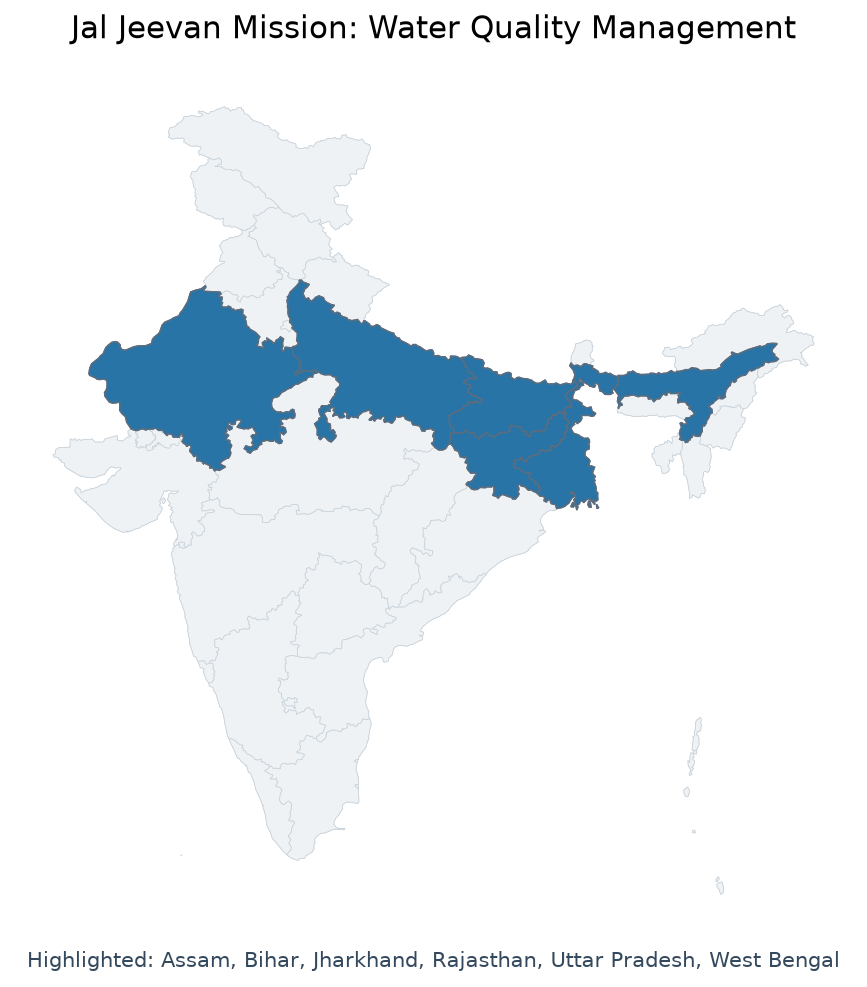
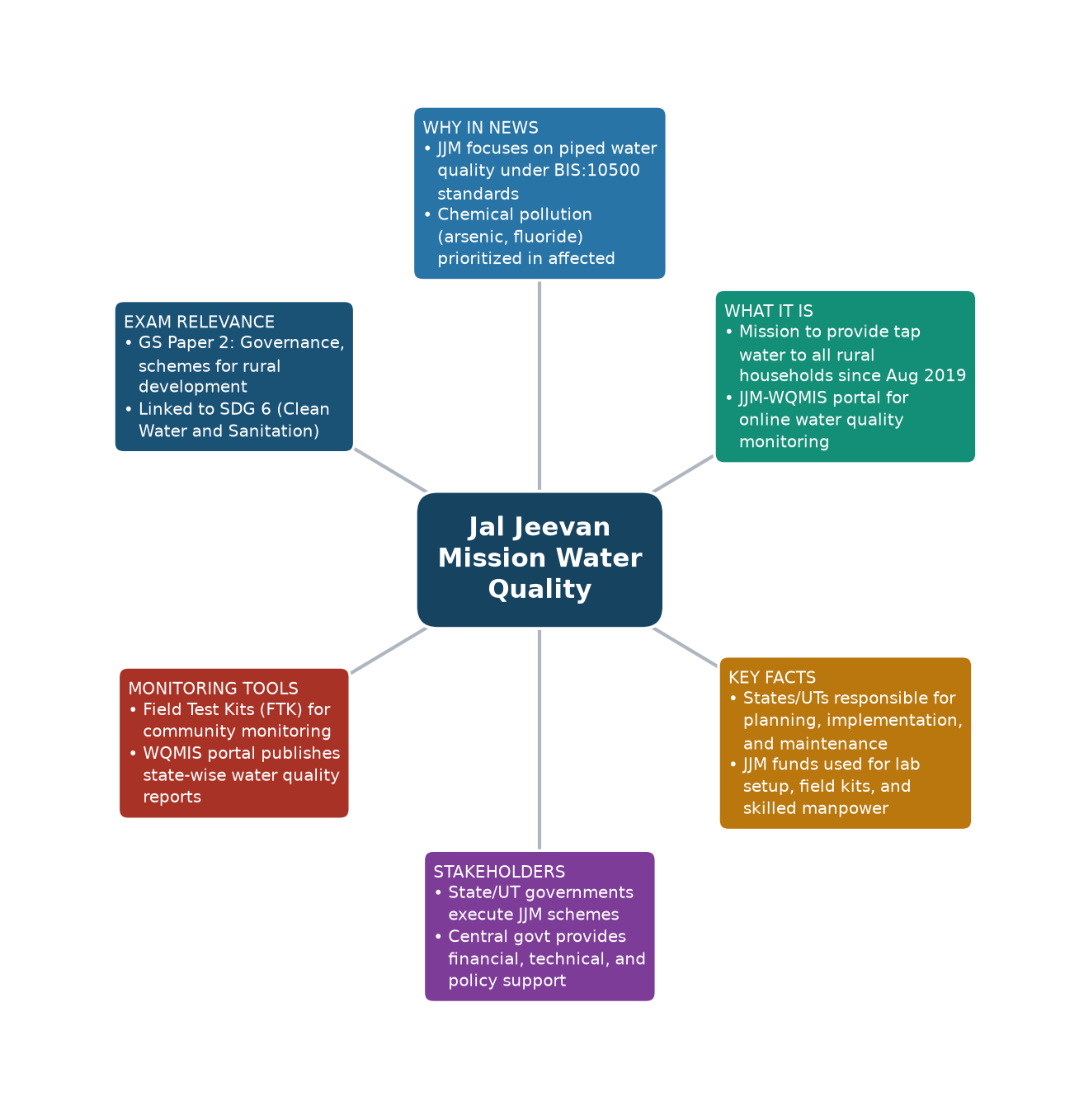
Map & concept mind-map: Jal Jeevan Mission: Water Quality Management
Subject Relevance — Where This Topic Fits
- GS Paper II — Governance, Transparency and Accountability | GS Paper III — Environment, Disaster Management and Water Resources
- Prelims: Jal Jeevan Mission (JJM), BIS 10500 standards, Water Quality Monitoring & Surveillance (WQM&S), Community Water Purification Plants (CWPP), Field Test Kits (FTK), JJM-WQMIS portal, Arsenic and Fluoride contamination, Piped Water Supply Schemes (PWSS)
- Essay: Sustainable Water Management: Balancing Development and Ecological Integrity, Technological Innovations in Public Health Infrastructure: A Case for Rural India
Quick Revision: Under JJM, water quality management is governed by BIS 10500 standards, with states responsible for implementation, supported by digital monitoring (JJM-WQMIS), community testing (FTKs), and targeted interventions for arsenic/fluoride-affected villages.
Why is this in the news?
The Press Information Bureau (PIB), Ministry of Jal Shakti, released a detailed advisory on 30 July 2026 outlining the institutional, technological, and financial framework for managing water quality under the Jal Jeevan Mission (JJM), particularly in rural areas affected by chemical contaminants such as arsenic and fluoride. This directive underscores the need for state-led interventions, including the establishment of community water purification plants, adoption of alternative safe water sources, and utilisation of digital monitoring systems like the JJM-Water Quality Management Information System (WQMIS) to ensure compliance with BIS 10500 standards for piped drinking water supply.
Background
- The Jal Jeevan Mission (JJM), launched in August 2019, aims to provide Functional Household Tap Connection (FHTC) to every rural household by 2024.
- JJM operates under the principle of ‘bottom-up planning’ where states and Union Territories (UTs) are responsible for planning, approval, implementation, operation, and maintenance of water supply schemes, with the central government providing financial, technical, and policy support.
- Rural water supply is a state subject under the Constitution of India (Entry 17 of State List), necessitating decentralised governance and community participation.
- Historical neglect of rural water infrastructure and recurring contamination issues—especially from geogenic sources like arsenic and fluoride—have led to widespread health problems such as fluorosis and arsenicosis in certain regions.
- The Bureau of Indian Standards (BIS) 10500:2012 prescribes permissible limits for various chemical and microbial parameters in drinking water, serving as the benchmark for JJM water quality standards.
- Digital governance tools like the JJM-WQMIS portal have been developed to enhance transparency, real-time monitoring, and data-driven decision-making in water quality management.
What is Water Quality Management under Jal Jeevan Mission?
- JJM’s Water Quality Management (WQM) is a sub-mission focused on ensuring that piped water supplied to rural households meets BIS 10500 standards through systematic monitoring, testing, and corrective actions.
- It mandates priority treatment for settlements affected by chemical contaminants (e.g., arsenic, fluoride) and promotes the use of alternative safe water sources or community water purification plants (CWPPs) where piped supply is delayed or infeasible.
- The framework includes operational guidelines for states to utilise JJM funds for activities such as establishing and strengthening water quality testing laboratories, procurement of Field Test Kits (FTKs), hiring skilled manpower, and conducting community awareness programmes.
- A dedicated online portal—JJM-Water Quality Management Information System (WQMIS)—has been developed to facilitate real-time reporting, monitoring, and public dissemination of water quality data across states and UTs.
- Two handbooks—’Concise Handbook for Monitoring Water Quality of Piped Drinking Water Supply to Rural Households’ (Dec 2024) and ‘Handbook on Water Treatment Technologies’ (Mar 2023)—serve as operational guides for stakeholders, detailing testing protocols, corrective measures, and technology selection criteria.
- States are advised to adopt a combination of water treatment technologies (e.g., reverse osmosis, activated alumina, ion exchange) based on technical-economic feasibility to address local contamination issues.
- Community participation is central, with Field Test Kits (FTKs) enabling local monitoring and fostering ownership, while awareness campaigns educate households on safe water practices and contamination risks.
- The system operates on a ‘source-to-tap’ approach, requiring comprehensive testing at water sources, treatment plants, storage points, and distribution networks to ensure end-to-end quality control.
Key Features
| Feature | Significance |
|---|---|
| Adoption of BIS:10500 standards | Ensures that piped water supplied under JJM meets national drinking water quality benchmarks, safeguarding public health from chemical and microbial contaminants. |
| Priority to chemical-affected habitations | Directs resources to villages with arsenic, fluoride, or other chemical contamination, addressing the most critical water-quality challenges first. |
| Community Water Purification Plants (CWPP) | Temporary but essential solution for arsenic/fluoride-affected areas until piped supply meets JJM standards, ensuring interim access to safe drinking water. |
| JJM-WQMIS Portal | Centralised digital platform for real-time monitoring, reporting, and public dissemination of water-quality data across states and UTs, enhancing transparency and accountability. |
| Handbook for Monitoring Water Quality | Provides standardised protocols for testing water at source, treatment, storage, and distribution points, ensuring compliance with BIS:10500 standards. |
Why it Matters
Public Health Impact
- Prevents waterborne diseases by ensuring chemically and microbially safe drinking water, particularly in arsenic/fluoride-endemic regions.
- Reduces the burden of water-related morbidity, especially among children and vulnerable populations in rural areas.
- Supports the achievement of Sustainable Development Goal 6 (Clean Water and Sanitation) by addressing water quality at the household level.
Governance and Institutional Strengthening
- Enhances decentralised governance by empowering states/UTs to plan, implement, and monitor water-quality initiatives under JJM.
- Promotes inter-sectoral coordination between water, health, and rural development departments for integrated water management.
- Establishes a robust data-driven framework (JJM-WQMIS) for evidence-based policy formulation and public scrutiny.
Technological and Infrastructure Development
- Encourages adoption of appropriate water-treatment technologies tailored to local contamination profiles (e.g., arsenic removal systems).
- Facilitates the establishment and accreditation of water-testing laboratories, improving diagnostic capacity at the grassroots level.
- Supports bulk water transfer and alternative safe sources in severely contaminated areas, ensuring long-term water security.
Socio-Economic Benefits
- Reduces time and effort spent by women and girls in collecting safe water, enabling greater participation in education and livelihood activities.
- Minimises healthcare expenditures related to waterborne illnesses, particularly in low-income rural households.
- Enhances agricultural productivity by providing safe water for irrigation in areas where groundwater contamination affects crop yields.
Challenges
1. Geographical and Hydro-Geological Constraints
- Persistent contamination in groundwater (arsenic, fluoride, nitrate) in specific geological belts (e.g., Gangetic plains, Rajasthan) poses long-term challenges for piped supply.
- Limited availability of safe alternative water sources in arid and semi-arid regions, complicating the planning of piped water schemes.
UPSC Link: Geography: Water Resources (GS Paper 1)
2. Technological and Operational Bottlenecks
- High cost and maintenance requirements of advanced water-treatment technologies (e.g., reverse osmosis, activated alumina) limit scalability in resource-constrained areas.
- Inadequate capacity of local institutions to operate and maintain CWPPs and piped supply systems, leading to system failures.
UPSC Link: Science & Tech: Water Purification (GS Paper 3)
3. Financial and Resource Allocation Issues
- Dependence on centralised funding (JJM) may strain state budgets, particularly in fiscally weaker states, delaying project implementation.
- Underutilisation of allocated funds due to delayed approvals, procurement bottlenecks, or lack of technical expertise at the state level.
UPSC Link: Economy: Public Finance (GS Paper 3)
4. Community Awareness and Behavioural Challenges
- Low awareness among rural communities about water-quality risks and the importance of regular testing, leading to complacency.
- Resistance to adoption of new technologies (e.g., CWPPs) due to cultural preferences or lack of trust in government interventions.
UPSC Link: Social Issues: Public Health (GS Paper 2)
5. Data Gaps and Monitoring Deficiencies
- Incomplete or delayed reporting of water-quality data on JJM-WQMIS, undermining the effectiveness of real-time monitoring.
- Limited laboratory infrastructure in remote areas, resulting in delayed or inaccurate water-quality assessments.
UPSC Link: Governance: E-Governance (GS Paper 2)
Challenges — UPSC Perspective
| Issue | Concern |
|---|---|
| Arsenic contamination in groundwater | Long-term exposure leads to chronic health issues; removal requires high-cost technologies like activated alumina or reverse osmosis. |
| Fluoride contamination in groundwater | Causes skeletal fluorosis; mitigation involves defluoridation plants, which are often underutilised due to maintenance issues. |
| Lack of standardised testing protocols | Inconsistent testing methods across states lead to unreliable data, hampering evidence-based interventions. |
| High operational costs of CWPPs | Community-managed plants often fail due to inadequate funding for consumables, repairs, and skilled personnel. |
| Delayed approvals and fund disbursement | Bureaucratic delays in sanctioning and releasing funds slow down project implementation, particularly in tribal and remote areas. |
Way Forward
- Accelerate the establishment of CWPPs in arsenic/fluoride-affected habitations to ensure interim access to safe water until piped supply is commissioned.
- Strengthen state-level laboratory networks by upgrading infrastructure and providing training to technicians for accurate water-quality testing.
- Promote community-based monitoring through Field Test Kits (FTKs) and awareness campaigns to foster ownership and early detection of contamination.
- Leverage JJM-WQMIS for real-time data analytics to identify high-risk areas and prioritise interventions based on contamination severity.
- Encourage public-private partnerships (PPPs) for the deployment of scalable water-treatment technologies in resource-constrained regions.
- Integrate water-quality monitoring with existing health surveillance systems (e.g., Ayushman Bharat) to track and mitigate waterborne diseases.
- Develop a national-level fund for research and innovation in low-cost, locally adaptable water-treatment solutions tailored to India’s diverse hydro-geological conditions.
UPSC Value Addition
Keywords for Mains Answer-Writing
Jal Jeevan Mission (JJM) · Water Quality Management under JJM · BIS 10500 standards for drinking water · Community Water Purification Plants (CWPP) · Groundwater contamination (Arsenic and Fluoride) · Water Quality Monitoring and Survey (WQM&S) · JJM-Water Quality Management Information System (WQMIS) · Safe drinking water supply in rural households · Role of State Governments in JJM implementation · Piped water supply schemes under JJM
Constitutional & Policy Linkages
- Article 21: Right to Life and Personal Liberty (includes right to safe drinking water).
- Article 47: Duty of the State to improve public health, including provision of safe drinking water.
Concept Flow
Geological contamination (arsenic/fluoride) in groundwater → → Inadequate piped water supply in affected habitations → → Implementation of JJM with BIS:10500 standards → → Establishment of CWPPs for interim safe water access → → Deployment of JJM-WQMIS for real-time monitoring and data dissemination → → State-led planning of piped supply schemes with alternative safe sources → → Ensuring compliance with BIS:10500 standards through handbooks and accredited laboratories
Prelims Practice Questions
Q1. Consider the following statements regarding the Jal Jeevan Mission (JJM):
1. The mission aims to provide piped water supply to every rural household in India.
2. The mission is implemented by the central government with no role for state governments.
3. The Indian Standard (BIS: 10500) is adopted as the benchmark for water quality under JJM.
4. Community Water Purification Plants (CWPP) are mandatory for all villages under JJM.
How many of the above statements are correct?
- Only one
- Only two
- Only three
- All four
Answer: Only three — Statements 1 and 3 are correct as JJM aims for universal piped water supply and adopts BIS: 10500 standards. Statement 2 is incorrect because implementation is a joint responsibility of the central and state governments. Statement 4 is incorrect as CWPPs are recommended only for arsenic and fluoride-affected settlements, not all villages.
Q2. Assertion (A): The Jal Jeevan Mission (JJM) mandates the use of the JJM-Water Quality Management Information System (WQMIS) portal for monitoring water quality in rural households.
Reason (R): The portal provides state-wise public access to water quality test reports and ensures transparency in water supply management under JJM.
In the context of the above two statements, which one of the following is correct?
- Both A and R are true and R is the correct explanation of A
- Both A and R are true but R is not the correct explanation of A
- A is true but R is false
- A is false but R is true
Answer: Both A and R are true and R is the correct explanation of A — Both Assertion (A) and Reason (R) are correct. The JJM-WQMIS portal is indeed mandated for water quality monitoring and provides state-wise public access to test reports, making R the correct explanation of A.
Q3. Match the following initiatives under the Jal Jeevan Mission (JJM) with their respective objectives:
Column I (Initiative) | Column II (Objective)
— | —
A. Community Water Purification Plants (CWPP) | 1. To provide piped water supply to rural households
B. Water Quality Monitoring and Survey (WQM&S) | 2. To test and monitor water quality in rural areas
C. JJM-Water Quality Management Information System (WQMIS) | 3. To establish and strengthen water testing laboratories
D. BIS: 10500 standards | 4. To set benchmarks for safe drinking water quality
Select the correct match:
- A-1, B-2, C-3, D-4
- A-2, B-3, C-4, D-1
- A-3, B-1, C-2, D-4
- A-4, B-2, C-3, D-1
Answer: A-1, B-2, C-3, D-4 — The correct matches are: A (CWPP) with 1 (piped water supply), B (WQM&S) with 2 (testing and monitoring), C (WQMIS) with 3 (establishing laboratories), and D (BIS: 10500) with 4 (quality benchmarks).
Mains Practice Question
✍ The Jal Jeevan Mission (JJM) represents a paradigm shift in India’s approach to ensuring safe drinking water in rural areas. Critically examine the institutional, technological, and financial mechanisms under JJM that address water quality challenges, with particular reference to arsenic and fluoride contamination. Also, assess the role of state governments in the successful implementation of the mission. (15 Marks)
Approach: MODEL-ANSWER SKELETON:
1. **Institutional Framework and Role of State Governments (4 Marks)**
– JJM is a centrally sponsored scheme with implementation primarily vested in state governments and Union Territories (UTs), as drinking water is a State Subject (Entry 17, List II, Seventh Schedule).
– The central government provides financial assistance, policy guidance, and technical support (e.g., via the Department of Drinking Water and Sanitation under the Ministry of Jal Shakti).
– State governments are responsible for planning, approving, implementing, operating, and maintaining piped water supply schemes, including water quality management.
– **Critical Examination**: Challenges such as inter-state coordination, bureaucratic delays, and varying state capacities (e.g., disparities between Kerala and Bihar) can hinder implementation. The 15th Finance Commission’s recommendations for local government funding (e.g., Panchayati Raj Institutions) must be leveraged.
2. **Technological Interventions for Water Quality (5 Marks)**
– **BIS: 10500 Standards**: Adopted as the benchmark for drinking water quality, covering parameters like pH, turbidity, arsenic (<0.01 mg/L), and fluoride (<1.5 mg/L).
– **Community Water Purification Plants (CWPP)**: Established in arsenic and fluoride-affected areas to provide safe drinking water (8–10 litres per person per day) until piped supply is operational.
– **Alternative Safe Water Sources**: States are advised to plan piped supply schemes based on safe sources (e.g., surface water treatment in fluoride-affected Rajasthan or arsenic-safe aquifers in West Bengal).
– **Water Quality Monitoring and Survey (WQM&S)**: Includes setting up/strengthening labs, deploying Field Test Kits (FTKs), and community monitoring. The JJM-Water Quality Management Information System (WQMIS) portal ensures transparency by publishing state-wise water quality reports.
– **Handbooks and Guidelines**: The ‘Concise Handbook for Monitoring Water Quality of Piped Drinking Water Supply to Rural Households’ (2024) and ‘Peyjal Upchar Proudyogiki’ (2023) guide stakeholders on testing protocols and treatment technologies.
– **Critical Examination**: Technological solutions must be context-specific (e.g., low-cost arsenic removal in Bihar vs. fluoride treatment in Gujarat). Over-reliance on CWPPs without addressing source contamination risks sustainability.
3. **Financial and Governance Mechanisms (4 Marks)**
– **Funding**: JJM is funded through the 15th Finance Commission grants, Central assistance (50:50 for general states, 90:10 for Himalayan and NE states), and convergence with other schemes (e.g., MGNREGS for water infrastructure).
– **Monitoring and Accountability**: The WQMIS portal tracks progress, and states must submit quarterly reports. The ‘Jal Jeevan Mission Dashboard’ provides real-time data on coverage and water quality.
– **Critical Examination**: Financial constraints in fiscally weaker states (e.g., Uttar Pradesh) may delay project completion. Corruption and leakages in fund disbursement (e.g., in Odisha) undermine efficiency.
4. **Way Forward (2 Marks)**
– Strengthen state capacities via training programs (e.g., for lab technicians and engineers).
– Promote community ownership through awareness campaigns (e.g., ‘Jal Shakti Abhiyan’).
– Leverage private sector partnerships for technology deployment (e.g., Tata Projects in Maharashtra).
– Ensure convergence with other missions (e.g., Swachh Bharat Mission for sanitation-water linkages).
Source: PIB (Press Information Bureau)
Generated by AanyaAi for educational purpose.

- यूपीएससी के लिए महत्वपूर्ण: 91, 182 और 364 दिन के टी-बिल नीलामी परिणाम - September 23, 2026
- RBI Auction Results: Key Cuts in 91/182/364-Day T-Bill Yields Explained for UPSC - September 23, 2026
- विकलांग सैन्य कैडेटों को पेंशन देने से रोक रही सरकार की नीति: केंद्र ने सुप्रीम कोर्ट में बताया - September 23, 2026

No Comments