


20 Jul JEECUP Round 3 Seat Allotment Result 2026 Out Today: Check Steps & Key Dates
Subject Relevance — Where This Topic Fits
- GS Paper II — Governance, Transparency and Accountability in Public Institutions | GS Paper III — Issues Relating to Development and Management of Social Sector/Services relating to Education
- Prelims: JEECUP, UP Polytechnic e-Counselling, Joint Entrance Examination Council Uttar Pradesh, seat allotment, document verification, provisional admission letter, seat acceptance fee
- Essay: The role of state-level entrance examinations in democratising higher education access, Challenges in technical and vocational education policy implementation in India
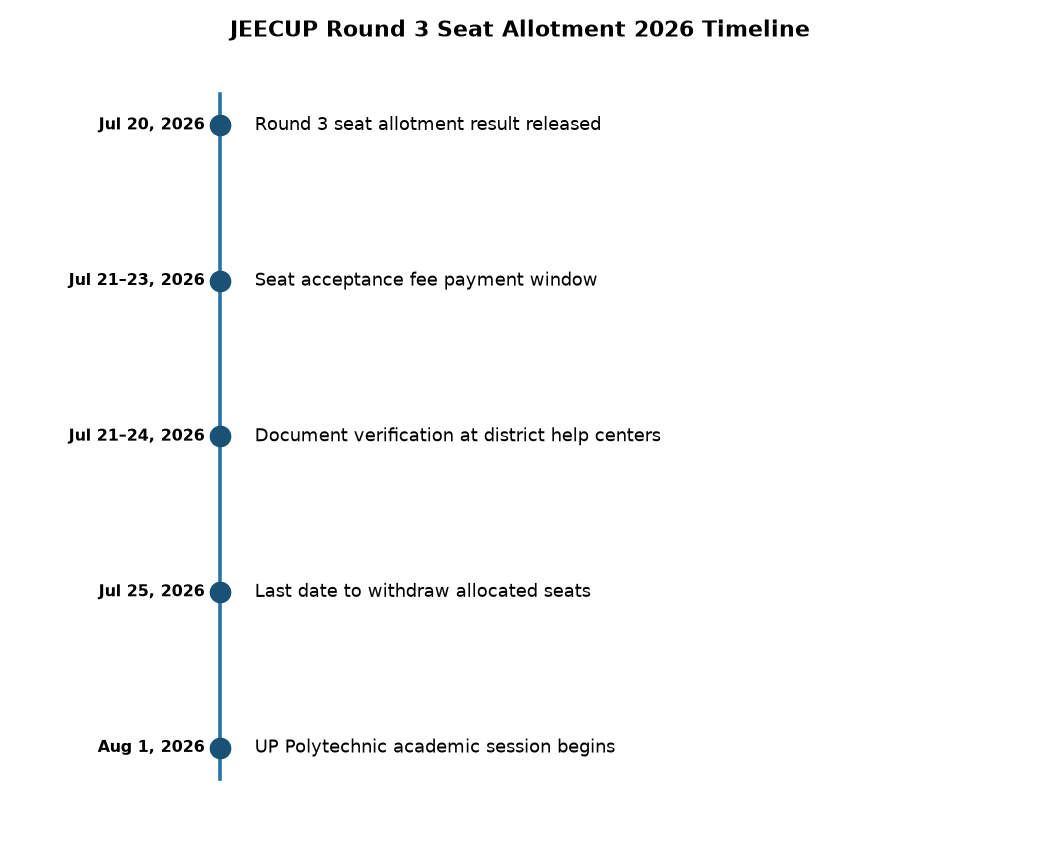
Quick Revision: The JEECUP Round 3 seat allotment result for UP Polytechnic Admissions 2026 will be released today; candidates must pay the seat acceptance fee from 21–23 July 2026 and complete document verification by 24 July 2026 to secure admission before the 1 August 2026 academic session.
Why is this in the news?
The Joint Entrance Examination Council, Uttar Pradesh (JEECUP) is scheduled to release the Round 3 seat allotment results for UP Polytechnic Admissions 2026 on 20 July 2026. This development is significant as it marks a critical stage in the state’s technical education admission cycle, affecting thousands of aspirants seeking diploma courses in polytechnics. The timely completion of counselling rounds ensures alignment with the academic calendar, which commences on 1 August 2026. The process also highlights the operational efficiency of state-level examination bodies in managing large-scale, multi-stage admission systems under time constraints.
Background
- The Joint Entrance Examination Council, Uttar Pradesh (JEECUP), established under the Uttar Pradesh State Government, conducts entrance examinations for admission to diploma courses in polytechnics across the state.
- JEECUP operates under the aegis of the Department of Technical Education, Government of Uttar Pradesh, and is responsible for the entire admission cycle, including counselling and seat allotment.
- The UP Polytechnic e-Counselling process is a multi-round system designed to allocate seats based on merit, reservation categories, and candidate preferences.
- The 2026 admission cycle follows a structured timeline, with Round 1 and Round 2 already concluded, and Round 3 results imminent.
- State-level entrance examinations like JEECUP play a pivotal role in bridging the gap between secondary education and technical vocational training, particularly in states with large youth populations.
- The counselling process incorporates digital platforms for transparency, efficiency, and scalability, reflecting broader trends in public service delivery.
What is the JEECUP Seat Allotment Process?
- The JEECUP seat allotment process is the third stage of the UP Polytechnic e-Counselling 2026, following registration, choice filling, and document verification.
- Candidates who participated in Round 3 counselling are allocated seats based on their merit rank, category, and preferred choices of polytechnic institutes and diploma branches.
- The provisional seat allotment letter, available on the official portal (jeecup.admissions.nic.in), contains critical details such as the allotted institute, course, and admission timeline.
- Seat acceptance involves payment of a non-refundable fee (seat acceptance fee) within the stipulated period to confirm provisional admission; failure to pay results in forfeiture of the seat.
- Document verification is a mandatory in-person step conducted at designated district help centres, where candidates must present original certificates and identity proofs for validation.
- Candidates who wish to withdraw from the allotted seat may do so on 25 July 2026, subject to prescribed procedures and timelines.
- The academic session for UP Polytechnic Colleges is scheduled to commence on 1 August 2026, making the counselling timeline critical for institutional planning and student intake.
- The process exemplifies the integration of digital governance in public service delivery, ensuring transparency, accessibility, and accountability in higher education admissions.
Key Features
| Feature | Significance |
|---|---|
| Round 3 Seat Allotment Result | Enables candidates to verify provisional admission status and institute/course allocation for UP Polytechnic e-Counselling 2026. |
| Online Acceptance Fee Payment | Mandatory step (July 21–23, 2026) to validate provisional admission and proceed to document verification. |
| Document Verification at District Help Centres | Physical verification of credentials at designated centres (till July 24, 2026) to confirm eligibility for academic session commencement. |
| Provisional Allotment Letter | Official document containing allotted institute, diploma branch, and acceptance fee details; required for further admission procedures. |
| Seat Withdrawal Provision | Allows candidates to opt out of allocated seats on July 25, 2026, facilitating reallocation or alternative course choices. |
Why it Matters
Educational Governance
- Demonstrates the structured, multi-stage e-counselling process for technical education admissions under the Uttar Pradesh Joint Entrance Examination Council (JEECUP).
- Highlights the administrative efficiency in managing large-scale polytechnic admissions through digital platforms, reducing manual intervention and errors.
Human Capital Development
- Ensures timely allocation of seats in diploma programmes, aligning with the demand for skilled technicians in UP’s industrial and service sectors.
- Facilitates equitable access to technical education for economically disadvantaged candidates through transparent and merit-based counselling.
Policy Implementation
- Showcases the operationalisation of the National Education Policy (NEP) 2020’s emphasis on digital governance in higher education admissions.
- Reflects the role of state-level councils in implementing centralised counselling mechanisms for technical courses.
Challenges
1. Digital Divide and Accessibility
- Candidates from rural or socio-economically weaker sections may face challenges in accessing online portals due to limited internet connectivity or digital literacy.
- Language barriers in portal navigation could disadvantage non-Hindi-speaking applicants, despite multilingual support.
UPSC Link: GS2: Welfare Schemes for Vulnerable Sections
2. Document Verification Bottlenecks
- Physical verification at district centres may lead to overcrowding or delays, particularly in densely populated districts.
- Discrepancies in submitted documents (e.g., caste certificates, academic records) could result in last-minute rejections, disrupting admission timelines.
UPSC Link: GS2: Government Policies and Interventions
3. Seat Allocation Disputes
- Merit list errors or technical glitches in the allotment system may trigger grievances, necessitating a robust redressal mechanism.
- Candidates opting for seat withdrawal may create vacancies, requiring reallocation to maintain optimal seat utilisation.
UPSC Link: GS2: Transparency and Accountability in Governance
4. Timely Academic Commencement
- Delays in counselling or document verification could compress the academic calendar, affecting the quality of instruction for the 2026–27 batch.
- Coordinating with affiliated polytechnic institutes to align administrative processes with the August 1 commencement date poses logistical challenges.
UPSC Link: GS2: Issues Relating to Development and Management of Social Sector/Services
Challenges — UPSC Perspective
| Issue | Concern |
|---|---|
| Rural Connectivity | Limited internet access and digital literacy hinder online counselling participation. |
| Document Discrepancies | Mismatches in submitted credentials may lead to verification failures and seat cancellations. |
| Counselling Delays | Technical glitches or administrative bottlenecks could disrupt the admission schedule. |
| Seat Vacancy Management | Withdrawals may create unfilled seats, requiring efficient reallocation mechanisms. |
| Institutional Coordination | Ensuring polytechnic institutes are prepared for the influx of students by August 1. |
Way Forward
- Strengthen digital infrastructure in rural districts through targeted awareness campaigns and offline support centres for JEECUP counselling.
- Implement a pre-verification system for documents to minimise discrepancies during the physical verification phase.
- Develop a real-time grievance redressal portal to address seat allocation disputes and technical issues promptly.
- Conduct mock counselling sessions to familiarise candidates with the portal interface and reduce errors in application submission.
- Coordinate with polytechnic institutes to conduct orientation programmes for newly admitted students, ensuring smooth academic transition.
- Monitor seat allotment trends to identify under-enrolled programmes and introduce targeted counselling for such courses.
- Establish a helpline with multilingual support to assist candidates from diverse linguistic backgrounds.
- Collaborate with state agencies to streamline the document verification process, reducing turnaround time at district centres.
UPSC Value Addition
Keywords for Mains Answer-Writing
JEECUP 2026 · UP Polytechnic Admissions · e-Counselling process · Seat allotment mechanism · Document verification in admissions · Seat acceptance fee · Diploma admissions in Uttar Pradesh · Counselling rounds in technical education · Provisional allotment letter · District help centres for admissions
Concept Flow
UP Polytechnic Admissions 2026 → JEECUP e-Counselling Registration → Merit List Preparation → Round 3 Seat Allotment → Online Acceptance Fee Payment → Document Verification → Academic Session Commencement (August 1, 2026). → Digital Governance (NEP 2020) → JEECUP Online Portal → Candidate Authentication → Seat Allocation Algorithm → Provisional Allotment → Physical Verification → Final Admission. → State-Level Technical Education Council (JEECUP) → Policy Implementation → Counselling Schedule → Seat Allocation → Institute Coordination → Student Onboarding. → Merit-Based Allocation → Seat Acceptance → Fee Payment → Document Scrutiny → Verification → Admission Confirmation → Academic Commencement. → Counselling Round 3 → Seat Allotment Result → Candidate Response → Acceptance/Rejection → Withdrawal Option → Reallocation Process → Final Seat Utilisation. → Technical Education Access → Diploma Programmes → Skill Development → Industrial Workforce → Economic Growth (UP’s Sectoral Needs). → E-Governance in Education → Transparency → Reduced Corruption → Equitable Access → Social Inclusion.
Prelims Practice Questions
Q1. Which of the following is NOT a mandatory step for candidates allotted a seat in JEECUP Round 3 seat allotment?
- Payment of seat acceptance fee within stipulated dates
- Physical document verification at district help centres
- Submission of original academic certificates to the allotted institute
- Completion of all counselling formalities before the academic session begins
Answer: Submission of original academic certificates to the allotted institute — While document verification at district help centres is mandatory, submission of original academic certificates to the allotted institute is not explicitly stated as a requirement in the JEECUP counselling process.
Q2. The JEECUP seat allotment result for Round 3 is released by which of the following authorities?
- All India Council for Technical Education (AICTE)
- Joint Entrance Examination Council, Uttar Pradesh (JEECUP)
- Council of Scientific and Industrial Research (CSIR)
- National Testing Agency (NTA)
Answer: Joint Entrance Examination Council, Uttar Pradesh (JEECUP) — The Joint Entrance Examination Council, Uttar Pradesh (JEECUP) is the statutory body responsible for conducting the UP Polytechnic Admissions counselling and seat allotment process.
Q3. Which of the following is the correct sequence of steps in the JEECUP counselling process after seat allotment?
- Payment of seat acceptance fee → Document verification → Withdrawal of seat (if required)
- Document verification → Payment of seat acceptance fee → Withdrawal of seat (if required)
- Withdrawal of seat → Payment of seat acceptance fee → Document verification
- Payment of seat acceptance fee → Withdrawal of seat → Document verification
Answer: Payment of seat acceptance fee → Document verification → Withdrawal of seat (if required) — The standard sequence post-seat allotment is: payment of seat acceptance fee, followed by document verification at district help centres, and finally, the option to withdraw the seat if desired.
Mains Practice Question
✍ Examine the significance of the e-Counselling process in technical education admissions, using the JEECUP 2026 Round 3 seat allotment as a case study. How does this process enhance transparency and accessibility in higher education admissions?
Approach: Begin by defining the e-Counselling process and its objectives in technical education admissions. Analyse the JEECUP 2026 Round 3 seat allotment as a case study, highlighting the role of digital platforms in ensuring transparency. Discuss how the multi-round counselling mechanism facilitates merit-based seat allocation while addressing accessibility concerns for candidates from diverse socio-economic backgrounds. Conclude by evaluating the broader implications of such processes for the democratisation of higher education in India.
Source: Times of India
Generated by AanyaAi for educational purpose.


No Comments