


10 Sep Jharkhand HC Slams Govt Over Rajrappa Temple Funds; Seeks Status Report
✎ The Jharkhand High Court's directive in the temple complex case underscores the judiciary's role in ensuring compliance with constitutional and legal obligations regarding the management and funding of religious heritage sites.
Subject Relevance — Where This Topic Fits
- GS Paper II — Polity and Governance (Judicial Review, Fundamental Rights, State Policy)
Quick Revision: The Jharkhand High Court’s directive in the temple complex case underscores the judiciary’s role in ensuring compliance with constitutional and legal obligations regarding the management and funding of religious heritage sites.
Why is this in the news?
The Jharkhand High Court has directed the state government to submit a detailed status report on the utilisation of funds and compliance with its earlier directives regarding the restoration and development of the temple complex at Rajrappa, Ranchi. The court has raised concerns over the state’s shifting stance on funding sources, questioning the necessity of seeking central funds under the PRASAD Scheme when state resources were previously deemed sufficient.
Background
- The temple complex at Rajrappa, dedicated to Goddess Chhinnamasta, is a significant religious and cultural site in Jharkhand, attracting a large number of pilgrims annually.
- The temple complex has been the subject of judicial intervention due to concerns over inadequate maintenance, lack of basic amenities for pilgrims, and delayed compliance with court directives.
- The case originated from a contempt petition filed by a citizen (Sanjeev Kumar Singh) alleging non-compliance with the High Court’s previous orders for the temple’s restoration and development.
- The Jharkhand High Court, in earlier hearings, had directed the state government to ensure the provision of essential facilities and infrastructure for pilgrims visiting the temple.
- The state government initially informed the court that no financial constraints existed for the temple’s development but later shifted its stance, indicating reliance on central funds under the PRASAD Scheme for the purpose.
- The court’s intervention underscores the constitutional and legal framework governing the management and funding of religious sites, particularly in the context of public welfare and heritage conservation.
What is the temple complex, Rajrappa?
- The temple complex is located at Rajrappa in Ramgarh district, Jharkhand, and is dedicated to Goddess Chhinnamasta, a form of Shakti worshipped in Hindu tradition.
- The temple is a prominent pilgrimage site, particularly during the Navratri festival, and is known for its unique architectural features and religious significance.
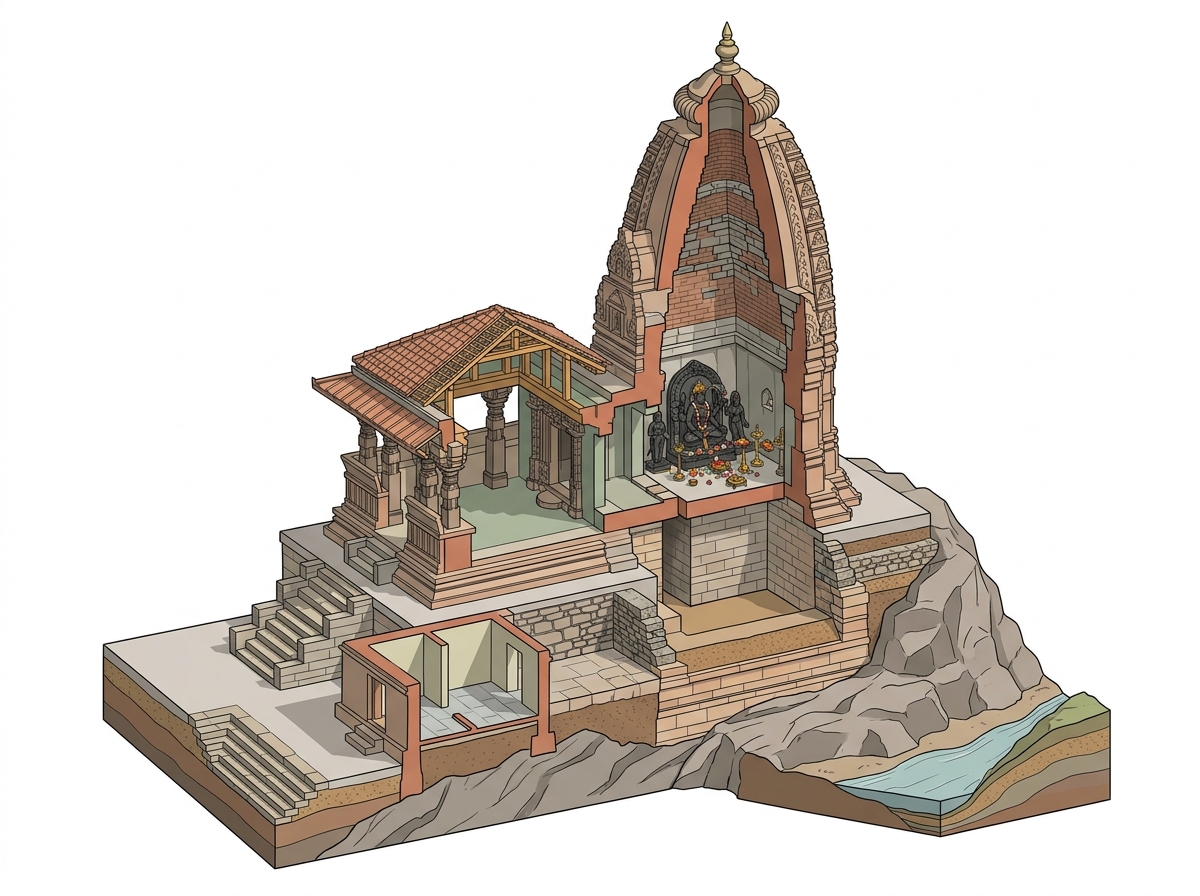
- The complex includes the main temple, surrounding structures, and a natural waterfall, making it a site of both religious and ecological importance.
- The temple complex has historically faced challenges related to maintenance, infrastructure development, and provision of basic amenities for pilgrims.
- The Jharkhand High Court’s directives in this case are rooted in the constitutional provisions ensuring the right to freedom of religion (Article 25) and the state’s duty to promote the welfare of all sections of society (Article 38).
- The PRASAD (Pilgrimage Rejuvenation and Spiritual Augmentation Drive) Scheme, launched by the Ministry of Tourism, Government of India, aims to develop and promote identified pilgrimage destinations across the country.
- The scheme provides central financial assistance for infrastructure development, including roads, water supply, sanitation, and other amenities at pilgrimage sites.
- The court’s scrutiny in this case highlights the balance between state autonomy in managing religious sites and the need for accountability in the utilisation of public funds.
Key Features
| Feature | Significance |
|---|---|
| Judicial Scrutiny of Executive Inaction | Highlights the judiciary’s role in ensuring executive accountability for public welfare projects, particularly in heritage and religious infrastructure. |
| Funding Mechanism for Heritage Sites | Examines the shift from state funding to reliance on centrally sponsored schemes, raising questions on fiscal federalism and resource allocation. |
| Public Interest Litigation (PIL) Mechanism | Demonstrates the use of PIL to enforce constitutional obligations of the state towards religious and cultural heritage preservation. |
| Judicial Directives for Compliance | Showcases the judiciary’s power to issue binding directives for the implementation of its orders, ensuring timely execution of developmental projects. |
| Inter-departmental Coordination | Underscores the necessity of coordination between state departments (e.g., Tourism, Revenue) and local authorities for heritage conservation. |
Why it Matters
Constitutional and Legal
- Reinforces the principle of separation of powers by ensuring judicial oversight over executive actions in matters of public importance.
- Highlights the constitutional obligation of the state under Article 49 to protect every monument or place or object of artistic or historic interest.
- Demonstrates the application of the doctrine of judicial activism in safeguarding cultural and religious heritage for future generations.
Administrative and Governance
- Exposes gaps in inter-departmental coordination and accountability in the execution of heritage conservation projects.
- Raises questions about the efficiency of state-funded mechanisms versus centrally sponsored schemes in heritage development.
- Emphasises the need for transparent and consistent policy frameworks for funding and executing developmental projects at heritage sites.
Cultural and Societal
- Underlines the importance of preserving religious and cultural sites as part of India’s intangible heritage and tourism potential.
- Highlights the role of public participation (via PIL) in ensuring the preservation of sites of religious significance.
- Demonstrates the societal expectation of equitable access to heritage sites with adequate infrastructure for pilgrims and tourists.
Challenges
1. Funding and Resource Allocation
- Inconsistency in the state’s approach to funding, shifting from self-reliance to dependency on centrally sponsored schemes like PRASAD.
- Potential delays in project execution due to bureaucratic hurdles and lack of clear financial commitments.
- Risk of misalignment between state priorities and centrally sponsored schemes, leading to inefficiencies.
UPSC Link: GS-II: Federalism, Centre-State Relations
2. Judicial Enforcement of Executive Orders
- Challenges in ensuring timely compliance with judicial directives, particularly in cases involving multiple stakeholders.
- Judicial overreach concerns if courts assume executive functions in project execution oversight.
- Need for systemic reforms to streamline the enforcement of judicial orders in developmental projects.
UPSC Link: GS-II: Judiciary, Judicial Activism
3. Inter-departmental Coordination
- Lack of synergy between departments such as Tourism, Revenue, and Local Administration in heritage conservation.
- Bureaucratic delays and red tape in obtaining clearances and approvals for developmental activities.
- Need for integrated governance frameworks to ensure seamless project implementation.
UPSC Link: GS-II: Governance, Public Administration
4. Public Participation and PIL Mechanism
- Ensuring that PILs are not misused for extraneous purposes and remain focused on public welfare.
- Balancing judicial activism with the principle of judicial restraint to avoid encroachment on executive domain.
- Need for mechanisms to monitor the impact of PILs on ground-level execution of projects.
UPSC Link: GS-II: Fundamental Rights, PIL
5. Heritage Conservation and Tourism Integration
- Balancing the need for development with the preservation of the site’s cultural and religious sanctity.
- Ensuring that infrastructure development does not compromise the site’s historical integrity.
- Leveraging heritage sites for tourism while maintaining their spiritual and cultural significance.
UPSC Link: GS-I: Indian Culture, Tourism
Challenges — UPSC Perspective
| Issue | Concern |
|---|---|
| Inconsistent Funding Approach | State’s shift from self-funding to reliance on centrally sponsored schemes creates uncertainty in project execution. |
| Judicial Overreach vs. Executive Accountability | Risk of courts assuming executive roles in project oversight, raising separation of powers concerns. |
| Bureaucratic Delays | Red tape and lack of inter-departmental coordination hinder timely completion of developmental projects. |
| Public Trust in PIL Mechanism | Need to ensure PILs are used responsibly and do not become tools for vested interests. |
| Balancing Development and Preservation | Risk of over-commercialisation or infrastructure that compromises the site’s cultural integrity. |
| Resource Allocation for Heritage Sites | Competing priorities within the state budget may lead to underfunding of heritage conservation. |
Government Initiatives — Must-Memorise for Prelims
- PRASAD Scheme (Pilgrimage Rejuvenation and Spiritual Augmentation Drive)
Way Forward
- Conduct a detailed audit of the state’s financial commitments and resource allocation for the Razarappa temple development to ensure transparency.
- Establish a dedicated inter-departmental task force comprising representatives from Tourism, Revenue, and Local Administration for streamlined project execution.
- Develop a clear and consistent policy framework for funding heritage conservation, balancing state and central resources.
- Ensure timely submission of progress reports to the High Court as per judicial directives, with periodic reviews by an independent oversight committee.
- Engage with local stakeholders, including religious bodies and community representatives, to incorporate their inputs in the developmental plan.
- Leverage the PRASAD scheme’s guidelines to align the temple’s development with national standards for pilgrimage infrastructure.
- Implement a grievance redressal mechanism for pilgrims and tourists to address concerns related to facilities and accessibility.
- Conduct a feasibility study to explore public-private partnerships (PPP) for funding and managing the temple’s long-term development.
UPSC Value Addition
Keywords for Mains Answer-Writing
Judicial review of executive actions · Constitutional governance and separation of powers · Public interest litigation (PIL) · Judicial activism vs. judicial restraint · Funding mechanisms for religious and cultural heritage · Contempt of court and compliance with judicial orders · Judicial oversight of government schemes · Constitutional provisions for religious institutions · Judicial process and procedural fairness · Role of High Courts in governance · Contempt jurisdiction under the Contempt of Courts Act, 1971 · Public trust doctrine in heritage conservation
Constitutional & Policy Linkages
- Article 49 (DPSP) – Protection of monuments and places of historic interest
- Article 29 (Cultural and Educational Rights) – Protection of religious and cultural sites
- Article 51A (Fundamental Duties) – Duty to value and preserve the rich heritage of our composite culture
Concept Flow
Public Interest Litigation (PIL) filed by citizen → Judicial intervention for enforcement of prior court orders → State government’s inconsistent funding approach → High Court’s scrutiny of executive inaction → Demand for detailed status report → Next hearing for compliance review
Prelims Practice Questions
Q1. Consider the following statements regarding the jurisdiction of High Courts in India:
1. High Courts can issue writs for the enforcement of Fundamental Rights under Article 226.
2. High Courts can exercise contempt jurisdiction against government officials for non-compliance with their orders.
3. High Courts can directly allocate funds for the development of religious sites.
How many of the above statements are correct?
- Only one
- Only two
- All
- None
Answer: Only two — Statements 1 and 2 are correct. High Courts can issue writs under Article 226 and exercise contempt jurisdiction. Statement 3 is incorrect as High Courts cannot directly allocate funds; they can only direct the executive to do so.
Q2. Assertion (A): The Supreme Court and High Courts in India can suo motu take cognizance of matters involving public interest.
Reason (R): This power is derived from the constitutional mandate under Article 32 and Article 226, which empower the courts to act as guardians of the Constitution.
Options:
A. Both A and R are true, and R is the correct explanation of A.
B. Both A and R are true, but R is not the correct explanation of A.
C. A is true, but R is false.
D. A is false, but R is true.
Answer: ? — Both A and R are true, and R correctly explains A. Article 32 (Supreme Court) and Article 226 (High Courts) empower courts to take suo motu cognizance of public interest matters.
Q3. Match the following pairs related to judicial processes in India:
Column I (Judicial Concept) | Column II (Relevant Provision/Act)
1. Writ jurisdiction of High Courts | A. Contempt of Courts Act, 1971
2. Contempt jurisdiction | B. Article 226 of the Constitution
3. Public Interest Litigation (PIL) | C. Article 32 of the Constitution
4. Fundamental Rights enforcement | D. Code of Civil Procedure, 1908
Options:
1-B, 2-A, 3-D, 4-C
1-B, 2-A, 3-C, 4-D
1-A, 2-B, 3-D, 4-C
1-B, 2-D, 3-A, 4-C
- 1-B, 2-A, 3-D, 4-C
- 1-B, 2-A, 3-C, 4-D
- 1-A, 2-B, 3-D, 4-C
- 1-B, 2-D, 3-A, 4-C
Answer: 1-B, 2-A, 3-D, 4-C — Correct match: 1-B (Article 226), 2-A (Contempt of Courts Act, 1971), 3-D (PIL evolved through judicial innovation), 4-C (Article 32).
Mains Practice Question
✍ The High Court of Jharkhand has recently directed the state government to submit a detailed status report on the compliance with its orders regarding the development of the Rajrappa Temple complex. Critically examine the role of the judiciary in ensuring governance accountability in such cases. Also, analyse the constitutional and legal framework governing the development of religious and cultural heritage sites in India. (15 Marks)
Approach: MODEL-ANSWER SKELETON:
1. **Judicial Role in Governance Accountability** (6 points):
– Explanation of judicial review under Articles 226 and 227 of the Constitution.
– Concept of Public Interest Litigation (PIL) and its evolution (S.P. Gupta v. Union of India, 1982).
– Contempt jurisdiction under the Contempt of Courts Act, 1971, and its role in enforcing judicial orders.
– Judicial activism vs. judicial restraint: balancing separation of powers.
– Case reference: High Court’s suo motu cognizance and direction for status report.
– Impact on executive accountability and transparency.
2. **Constitutional and Legal Framework for Heritage Development** (6 points):
– Constitutional provisions: Articles 25-28 (Freedom of Religion), Article 49 (Protection of monuments), and Article 51A(f) (Fundamental Duty to value and preserve heritage).
– Legal framework: Ancient Monuments and Archaeological Sites and Remains Act, 1958; State-specific heritage laws.
– Role of government agencies: Archaeological Survey of India (ASI), State Archaeology Departments.
– Funding mechanisms: Central/State schemes (e.g., PRASAD Scheme), public-private partnerships.
– Challenges: Balancing religious sentiments with conservation, encroachment, and fund allocation.
3. **Critical Analysis and Way Forward** (3 points):
– Evaluate the effectiveness of judicial intervention in heritage governance.
– Suggest measures for better inter-institutional coordination (Judiciary-Executive-Legislature).
– Highlight the need for long-term policy frameworks over ad-hoc judicial directions.
Source: amarujala.com
Jharkhand PCS (JPSC) — State PCS Practice
Prelims: Recently, the Jharkhand High Court has directed the state government to submit a status report on the development of which of the following religious sites, raising concerns over the government’s fund allocation approach?
- A. Baidyanath Dham, Deoghar
- B. Rararppa Temple Complex, Ramgarh
- C. Jagannath Temple, Ranchi
- D. Sun Temple, Bundu
Answer: B. Rararppa Temple Complex, Ramgarh — The Jharkhand High Court has asked the state government to submit a status report on the development of Rararppa Temple Complex, questioning the government’s fund utilization approach.
Mains: Critically analyze the role of the Jharkhand High Court’s intervention in the development of the Rararppa Temple Complex. How does this case reflect the challenges in balancing religious heritage preservation with state governance and fund management in Jharkhand?
Generated by AanyaAi for educational purpose.
Related guides on our sites
- Current affairs for upsc 2026
- Best PSIR optional coaching for upsc
- Best economics optional coaching for upsc
- Best PSIR optional teacher for upsc

- Jharkhand HC Slams Govt Over Rajrappa Temple Funds; Seeks Status Report - September 10, 2026
- तमिलनाडु में निजी विश्वविद्यालय संशोधन विधेयक: जानिए क्या बदला? - September 10, 2026
- Tamil Nadu’s Private Universities Amendment Bill: A Game-Changer for UPSC 2026 - September 10, 2026

No Comments