


05 Nov Jharkhand HPV Vaccination: Policy & Public Health Governance
✎ HPV vaccination is a critical public health intervention for cervical cancer prevention, requiring a robust evidence-based approach for effective implementation.
Subject Relevance — Where This Topic Fits
- GS Paper II — Governance, Social Justice (Health) | GS Paper III — Science and Technology (Biotechnology, Health)
- Prelims: HPV vaccination, Cervical cancer, Public health initiatives, Epidemiological survey, Disease prevention, Vaccine hesitancy, National Health Policy, Immunization programs
- Essay: Public Health Challenges and Policy Responses in India, The Role of Science and Technology in Addressing Societal Issues
Quick Revision: HPV vaccination is a critical public health intervention for cervical cancer prevention, requiring a robust evidence-based approach for effective implementation.
Why is this in the news?
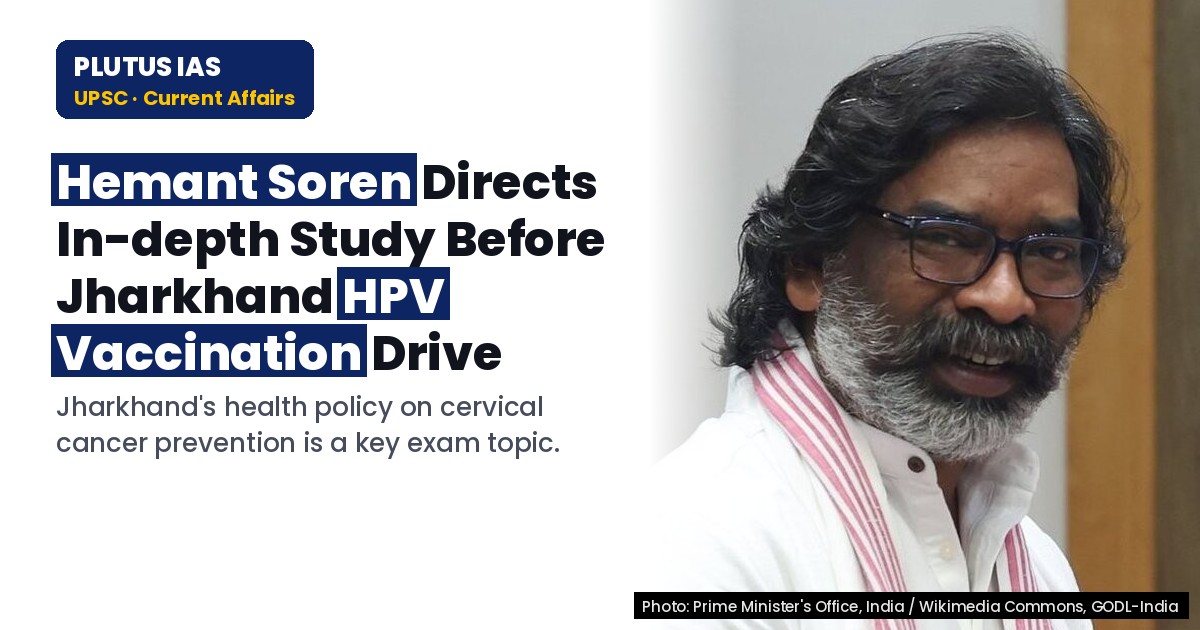
The state of Jharkhand is undertaking a comprehensive study, survey, and expert consultation process before implementing Human Papillomavirus (HPV) vaccination for adolescent girls. This decision follows a detailed review of the state’s health infrastructure, including medical colleges, health insurance schemes, cervical cancer screening, and ambulance services, underscoring a cautious, evidence-based approach to public health interventions.
Background
- Cervical cancer is a significant public health concern in India, being the second most common cancer among women.
- The Human Papillomavirus (HPV) is the primary cause of cervical cancer, with certain high-risk strains responsible for the majority of cases.
- HPV vaccines are highly effective in preventing infection by the HPV types that cause most cervical cancers.
- The World Health Organization (WHO) recommends HPV vaccination as part of a comprehensive strategy to eliminate cervical cancer.
- India’s National Technical Advisory Group on Immunisation (NTAGI) has recommended the introduction of HPV vaccine into the Universal Immunization Programme (UIP).
- Several states in India have initiated pilot projects or comprehensive HPV vaccination programs.
Understanding HPV and Cervical Cancer
- Human Papillomavirus (HPV) is a common viral infection that can be transmitted through sexual contact.
- While most HPV infections are asymptomatic and resolve spontaneously, persistent infection with high-risk HPV types can lead to cellular changes that may progress to cancer.
- Cervical cancer develops in the cells of the cervix, the lower part of the uterus that connects to the vagina.
- Early detection through screening methods like Pap tests and HPV DNA tests is crucial for preventing progression to invasive cancer.
- HPV vaccines work by stimulating the body’s immune system to produce antibodies against specific HPV types, thereby preventing infection.
- The vaccines are most effective when administered before exposure to HPV, typically in pre-adolescent girls.
- In addition to cervical cancer, HPV can also cause other anogenital cancers (e.g., anal, vulvar, vaginal, penile) and oropharyngeal cancers.
- Public health strategies for cervical cancer control typically involve a combination of HPV vaccination, cervical cancer screening, and timely treatment of pre-cancerous lesions and invasive cancer.
Key Features
| Feature | Significance |
|---|---|
| Proposed HPV Vaccination | Aims to prevent cervical cancer among adolescent girls, addressing a significant public health challenge in Jharkhand. |
| Comprehensive Study and Survey | Ensures evidence-based policy formulation by gathering accurate data on cervical cancer prevalence, age groups, stages, and active cases within the state. |
| Expert Committee Formation | Facilitates informed decision-making by incorporating scientific, technical, medical, and safety evaluations from national and international experts. |
| Public Awareness Campaign | Crucial for dispelling misinformation and building public trust, ensuring effective implementation and acceptance of the vaccination program. |
| Strengthening Healthcare Infrastructure | Includes directives to enhance RIMS, medical colleges, health insurance schemes, cervical cancer screening, and ambulance services, indicating a holistic approach to public health. |
Why it Matters
Public Health
- Addresses cervical cancer, a leading cause of cancer-related mortality among women in India, with an estimated prevalence of 13 cases per lakh population in Jharkhand.
- Emphasises a preventive approach through vaccination, potentially reducing disease burden and improving women’s health outcomes.
- Promotes evidence-based public health interventions, ensuring that policies are grounded in scientific data and expert consensus.
Governance and Policy Making
- Illustrates a cautious and systematic approach to policy implementation, prioritising thorough research and expert consultation before launching large-scale health programs.
- Highlights the importance of public engagement and communication in health initiatives, aiming to prevent misinformation and foster community acceptance.
- Reflects the state government’s commitment to strengthening healthcare infrastructure and services, which is vital for effective public health delivery.
Social Welfare
- Focuses on the health and well-being of adolescent girls and women, aligning with broader goals of gender equality and women’s empowerment.
- Aims to reduce the socio-economic burden of cervical cancer on families and the healthcare system, contributing to overall societal welfare.
Challenges
1. Data Collection and Analysis
- Conducting a comprehensive statewide survey to accurately ascertain the incidence, prevalence, and demographic profile of cervical cancer cases can be resource-intensive and complex.
- Ensuring the reliability and validity of collected data, especially in diverse geographical and socio-economic settings, poses a significant challenge.
UPSC Link: Health; Governance
2. Expert Consensus and Ethical Considerations
- Achieving a consensus among diverse medical experts, both national and international, on the optimal strategy for HPV vaccination implementation can be challenging.
- Addressing ethical considerations related to mass vaccination programs, including informed consent and potential side effects, requires careful deliberation.
UPSC Link: Health; Ethics
3. Public Acceptance and Misinformation
- Countering potential misinformation and vaccine hesitancy, which can be exacerbated by social media and lack of accurate information, is crucial for program success.
- Designing and implementing effective public awareness campaigns that resonate with diverse populations and address specific concerns requires strategic communication.
UPSC Link: Social Sector; Communication
4. Infrastructure and Resource Allocation
- Ensuring adequate cold chain facilities, trained healthcare personnel, and logistics for vaccine delivery across the state, especially in remote areas, presents an operational challenge.
- Allocating sufficient financial resources for the vaccination program, including procurement, administration, and monitoring, is essential for its sustainability.
UPSC Link: Health; Resource Mobilization
Challenges — UPSC Perspective
| Issue | Concern |
|---|---|
| Data Accuracy | Ensuring the precision and representativeness of cervical cancer prevalence data collected through statewide surveys. |
| Expert Divergence | Reconciling differing opinions and recommendations from various medical and scientific experts on HPV vaccination strategies. |
| Public Trust | Building and maintaining public confidence in the safety and efficacy of the HPV vaccine amidst potential misinformation. |
| Logistical Hurdles | Establishing robust supply chains, cold chain management, and trained personnel for widespread vaccine delivery in a timely manner. |
| Financial Sustainability | Securing consistent funding for vaccine procurement, administration, and ongoing monitoring of the program. |
Way Forward
- Establish a multi-disciplinary expert committee comprising oncologists, epidemiologists, public health specialists, and ethicists to guide the HPV vaccination strategy.
- Conduct a phased, robust statewide survey to gather granular data on cervical cancer prevalence, risk factors, and demographic distribution.
- Develop a comprehensive communication strategy to disseminate accurate, evidence-based information about HPV vaccination, addressing common myths and concerns.
- Strengthen existing healthcare infrastructure, including primary health centres, to ensure adequate cold chain facilities and trained personnel for vaccine delivery.
- Integrate HPV vaccination with existing adolescent health programs and school health initiatives to maximise reach and acceptance.
- Implement a robust post-vaccination surveillance system to monitor adverse events and assess the long-term efficacy and impact of the program.
- Explore sustainable funding mechanisms, including partnerships with national health programs and international organisations, to ensure the long-term viability of the vaccination initiative.
UPSC Value Addition
Keywords for Mains Answer-Writing
Human Papillomavirus (HPV) · Cervical Cancer · Public Health Policy · Evidence-Based Decision Making · Universal Immunization Programme (UIP) · Preventive Healthcare · Health Infrastructure · Disease Surveillance · Community Engagement · Ethical Considerations in Vaccination
Constitutional & Policy Linkages
- {‘Article 21’: ‘Right to health and life’}
- {‘Article 47’: ‘Duty to improve public health’}
Concept Flow
High cervical cancer burden in state → Proposal for HPV vaccination program → Government mandates comprehensive study and expert consultation → Data collection, analysis, and expert committee recommendations → Informed decision on HPV vaccination implementation → Public awareness campaign and healthcare infrastructure strengthening → Reduced cervical cancer incidence and improved public health
Prelims Practice Questions
Q1. Consider the following statements regarding Human Papillomavirus (HPV) and Cervical Cancer:
1. HPV infection is the primary cause of cervical cancer.
2. HPV vaccines are effective against all types of HPV that can cause cancer.
3. Cervical cancer screening, such as the Pap test, is a crucial secondary prevention strategy.
How many of the above statements are correct?
- Only one
- Only two
- All three
- None
Answer: Only two — Statement 1 is correct: Persistent infection with high-risk HPV types is the primary cause of nearly all cervical cancers. Statement 2 is incorrect: HPV vaccines protect against the most common high-risk HPV types but not all types that can cause cancer. Statement 3 is correct: Regular cervical cancer screening (e.g., Pap test, HPV DNA test) is vital for early detection and prevention.
Q2. Which of the following bodies is responsible for formulating national immunization policies and guidelines in India?
- Indian Council of Medical Research (ICMR)
- National Technical Advisory Group on Immunization (NTAGI)
- Ministry of Health and Family Welfare (MoHFW)
- Central Drugs Standard Control Organization (CDSCO)
Answer: National Technical Advisory Group on Immunization (NTAGI) — The National Technical Advisory Group on Immunization (NTAGI) is the apex advisory body that provides recommendations to the Ministry of Health and Family Welfare (MoHFW) on vaccination policies and strategies for the Universal Immunization Programme (UIP) in India.
Mains Practice Question
✍ Discuss the significance of evidence-based decision-making in the formulation and implementation of public health policies, particularly in the context of large-scale vaccination programmes. Critically examine the challenges involved in ensuring public trust and addressing misinformation during such initiatives. (15 Marks)
Approach: Introduction: Define evidence-based decision-making (EBDM) in public health and its importance. Part 1: Significance of EBDM – discuss its role in ensuring efficacy, safety, resource allocation, and ethical considerations for vaccination programmes (e.g., HPV vaccination). Refer to scientific studies, expert consensus (e.g., WHO, NTAGI guidelines), and data-driven policy formulation. Part 2: Challenges in public trust and misinformation – identify factors eroding trust (e.g., lack of transparency, historical issues, adverse event reporting), and mechanisms of misinformation (e.g., social media, anti-vaccine movements). Critically examine strategies to address these challenges, including robust communication campaigns, community engagement, role of healthcare professionals, and regulatory oversight. Conclusion: Summarize the imperative of EBDM for effective public health outcomes and the continuous effort required to build and maintain public confidence.
Source: amarujala.com
Jharkhand PCS (JPSC) — State PCS Practice
Prelims: Regarding the proposed HPV vaccination program in Jharkhand, what is the initial step announced by the state government under Chief Minister Hemant Soren?
- A. Immediate rollout of the vaccination drive across all districts.
- B. A comprehensive study, survey, and expert consultation.
- C. Prioritizing vaccination for girls aged 9-14 without further assessment.
- D. Seeking financial assistance from the central government before any decision.
Answer: B. A comprehensive study, survey, and expert consultation. — The Jharkhand government has announced that a comprehensive study, survey, and expert opinion will precede any decision on HPV vaccination.
Mains: Discuss the significance of conducting a ‘comprehensive study, survey, and expert consultation’ before implementing a major public health initiative like HPV vaccination in a state like Jharkhand, considering its unique demographic and socio-cultural context.
Generated by AanyaAi for educational purpose.
Related guides on our sites
- Best PSIR optional coaching for upsc
- Best economics optional coaching for upsc
- Best PSIR optional teacher for upsc
- Best teacher of PSIR optional for upsc

- एनसीआर के 4 शहरों में प्रदूषण स्रोत अध्ययन अधूरा: एक गंभीर चुनौती - November 5, 2026
- Aadhar Not Mandatory for Schemes; Voter ID for Payments - November 5, 2026
- नई पंचायती राज योजना: आधार की जगह वोटर ID, आरजेडी ने उठाए सवाल - November 5, 2026

No Comments