


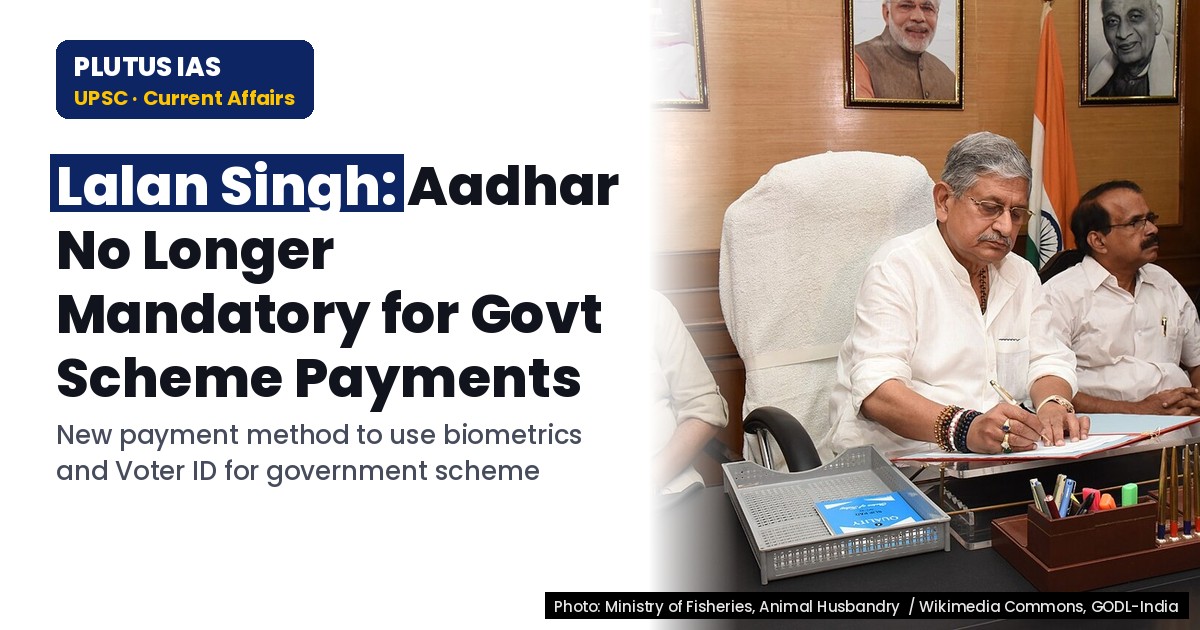
05 Nov Aadhar Not Mandatory for Schemes; Voter ID for Payments
✎ The potential shift from mandatory Aadhaar to biometrics and EPIC for beneficiary payments in certain government schemes aims to enhance accessibility and refine identification mechanisms while maintaining the integrity of Direct…
Subject Relevance — Where This Topic Fits
- GS Paper II — Governance, Welfare Schemes for Vulnerable Sections, Transparency & Accountability | GS Paper III — Indian Economy, DBT, Digital Infrastructure
- Prelims: Aadhaar Act, 2016, Direct Benefit Transfer (DBT), Electoral Photo Identity Card (EPIC), National Livestock Mission, Jan Yojana Abhiyan, Panchayati Raj Institutions
- Essay: The role of digital identity in enhancing governance and service delivery in India, Balancing privacy and efficiency in welfare schemes: A critical analysis
Quick Revision: The potential shift from mandatory Aadhaar to biometrics and EPIC for beneficiary payments in certain government schemes aims to enhance accessibility and refine identification mechanisms while maintaining the integrity of Direct Benefit Transfer (DBT).
Why is this in the news?
A Union Minister recently indicated a potential shift in the primary identification mechanism for Direct Benefit Transfer (DBT) under certain government schemes. The statement suggested a move towards utilising biometrics and Electoral Photo Identity Card (EPIC) numbers, potentially reducing the mandatory reliance on Aadhaar for beneficiary payments in specific schemes, particularly those managed by the Ministry of Fisheries, Animal Husbandry, and Dairying, while acknowledging that the Ministry of Panchayati Raj does not directly transfer funds to beneficiaries.
Background
- The Aadhaar (Targeted Delivery of Financial and Other Subsidies, Benefits and Services) Act, 2016, provides statutory backing for the Aadhaar unique identification number, primarily for ensuring efficient, transparent, and targeted delivery of subsidies, benefits, and services.
- Direct Benefit Transfer (DBT) was launched to reform government delivery systems by re-engineering the existing process in welfare schemes for simpler and faster flow of funds and to ensure accurate targeting of beneficiaries, thereby reducing leakages.
- The Supreme Court, in its 2018 judgment on Aadhaar’s constitutional validity, upheld its use for welfare schemes but restricted its mandatory application in certain areas, emphasising the need for proportionality and privacy safeguards.
- The Electoral Photo Identity Card (EPIC), commonly known as the Voter ID card, is issued by the Election Commission of India and serves as a primary identity document for citizens, particularly for electoral purposes.
- Several government schemes, including the National Livestock Mission’s Entrepreneurship Development Programme, PM-KISAN, Pradhan Mantri Awaas Yojana (Gramin), and various pension schemes, currently mandate Aadhaar-linked bank accounts for beneficiary payments.
- The ongoing discourse reflects a continuous effort to refine beneficiary identification and payment mechanisms to enhance accessibility, prevent exclusion, and ensure robust authentication while addressing concerns related to data privacy and the ease of obtaining identification documents.
What are the key aspects of beneficiary identification in welfare schemes?
- Beneficiary identification is the process of accurately determining eligible individuals or households for government welfare schemes, crucial for effective service delivery and preventing leakages.
- Aadhaar, a 12-digit unique identification number, has been widely adopted as a primary identifier due to its biometric authentication capabilities, aiming to eliminate duplicates and fakes.
- Direct Benefit Transfer (DBT) leverages digital identities and bank accounts to transfer subsidies and benefits directly to beneficiaries, enhancing transparency and reducing intermediaries.
- The Electoral Photo Identity Card (EPIC) serves as a proof of identity and residence, primarily for electoral purposes, and is a widely held document among adult citizens.
- The National Livestock Mission’s Entrepreneurship Development Programme is an example of a scheme where Aadhaar is currently a mandatory requirement for eligible beneficiaries.
- The ‘Jan Yojana Abhiyan’ (People’s Plan Campaign) is an initiative focused on participatory planning at the Gram Panchayat level, aiming to prepare comprehensive Gram Panchayat Development Plans (GPDPs).
- The objective of exploring alternative identification mechanisms is to ensure inclusive access to welfare benefits, particularly for those who may face challenges in obtaining or linking Aadhaar, while maintaining the integrity of the payment system.
- Performance grants for Gram Panchayats are often linked to their ability to generate their own source revenue, promoting self-reliance and fiscal autonomy at the local governance level.
Key Features
| Feature | Significance |
|---|---|
| Proposed Shift from Aadhaar to Voter ID/Biometrics for Beneficiary Payments | Aims to diversify identity verification mechanisms for government scheme disbursements, potentially enhancing accessibility and reducing reliance on a single identification system. |
| Focus on Self-Reliant and Developed Panchayats | Emphasises the need for Gram Panchayats to augment their own-source revenue generation to qualify for performance grants, fostering local financial autonomy and sustainable development. |
| National Workshop on Jan Yojana Abhiyan 2026-27 | Serves as a platform for discussing strategies and initiatives related to decentralised planning and implementation of public welfare schemes at the grassroots level. |
| Mandatory Aadhaar for Specific Schemes | Highlights the current requirement of Aadhaar for certain schemes under the Ministry of Fisheries, Animal Husbandry, and Dairying, such as the National Livestock Mission’s Entrepreneurship Development Programme, indicating existing policy frameworks. |
Why it Matters
Governance and Public Administration
- The proposed shift in payment mechanisms reflects an ongoing evaluation of digital identity systems within public service delivery, aiming to balance efficiency with inclusivity.
- Promoting self-reliant Panchayats aligns with the principles of decentralised governance and fiscal federalism, empowering local bodies to manage their development priorities.
- The discussion on alternative identification methods addresses concerns regarding the universal applicability and potential vulnerabilities associated with a singular identity proof.
Social Justice and Inclusion
- Diversifying payment authentication methods could potentially reduce exclusion errors for beneficiaries who face challenges in obtaining or updating Aadhaar, thereby enhancing access to welfare schemes.
- Ensuring multiple valid identity proofs for scheme benefits can safeguard against technological barriers and administrative hurdles, promoting equitable access for vulnerable populations.
Economic Implications
- Strengthening Gram Panchayats’ own-source revenue generation can lead to more sustainable local development initiatives, reducing dependence on central and state grants.
- Efficient and inclusive disbursement mechanisms for welfare schemes can contribute to poverty alleviation and improved living standards, fostering economic stability at the grassroots.
Challenges
1. Interoperability and Integration
- Integrating Voter ID and biometric systems with existing payment infrastructure requires significant technological upgrades and standardisation across various government departments.
- Ensuring seamless data exchange and authentication between different identity databases presents a complex technical and administrative challenge.
UPSC Link: E-governance, DBT
2. Data Security and Privacy
- Implementing new biometric and identity verification systems necessitates robust data protection protocols to prevent misuse, breaches, and unauthorised access to sensitive personal information.
- Maintaining the integrity and confidentiality of beneficiary data across multiple platforms is crucial for public trust and legal compliance.
UPSC Link: Cybersecurity, Data Protection
3. Beneficiary Awareness and Adoption
- Educating beneficiaries about the new payment authentication methods and ensuring their smooth transition from Aadhaar-based systems requires extensive outreach and support mechanisms.
- Addressing potential resistance or confusion among beneficiaries, especially in remote or less digitally literate areas, is vital for successful implementation.
UPSC Link: Social Welfare Schemes, Digital Literacy
4. Infrastructure and Accessibility
- The widespread availability and reliability of biometric scanning devices and Voter ID verification infrastructure, particularly in rural and remote regions, must be ensured.
- Addressing issues of connectivity and power supply in underserved areas is critical for the effective functioning of new digital payment systems.
UPSC Link: Rural Development, Digital Infrastructure
5. Legal and Regulatory Framework
- Amending existing legal provisions and developing new regulations to accommodate the use of Voter ID and biometrics as primary identification for welfare payments is necessary.
- Ensuring the legal validity and enforceability of these alternative identification methods across all relevant schemes and departments is a prerequisite.
UPSC Link: Government Policies, Law and Governance
Challenges — UPSC Perspective
| Issue | Concern |
|---|---|
| Reliance on Aadhaar for Payments | Potential for exclusion of beneficiaries lacking Aadhaar or facing authentication issues, impacting access to essential welfare schemes. |
| Transition to Alternative IDs | Ensuring a smooth and inclusive transition without disrupting existing payment flows or creating new barriers for beneficiaries. |
| Technological Infrastructure | Availability and reliability of biometric and Voter ID verification systems, especially in remote and underserved areas, to support widespread implementation. |
| Data Security and Privacy | Safeguarding sensitive personal information when integrating multiple identity databases and implementing new authentication protocols. |
| Financial Autonomy of Panchayats | Challenges in enhancing own-source revenue generation for Gram Panchayats to qualify for performance grants, requiring capacity building and policy support. |
Government Initiatives — Must-Memorise for Prelims
- National Livestock Mission Entrepreneurship Development Programme
- Mahatma Gandhi National Rural Employment Guarantee Programme (MGNREGP)
- PM-KISAN (Pradhan Mantri Kisan Samman Nidhi)
- Pradhan Mantri Awas Yojana (Gramin)
- National Social Assistance Programme (Old Age, Widow, Disability Pensions)
Way Forward
- Develop a robust, interoperable digital identity framework that integrates multiple identification documents, including Voter ID and biometrics, to provide flexible authentication options.
- Conduct pilot projects to test the efficacy and inclusivity of alternative payment authentication mechanisms before widespread implementation, gathering feedback from beneficiaries.
- Invest in upgrading digital infrastructure, including biometric devices and reliable internet connectivity, particularly in rural and remote areas, to support new payment systems.
- Launch comprehensive public awareness campaigns and provide extensive support services to educate beneficiaries about new identification and payment procedures, ensuring a smooth transition.
- Strengthen the legal and regulatory framework to officially recognise and govern the use of alternative identification documents for welfare scheme disbursements, ensuring data protection and privacy.
- Implement capacity-building programmes for Gram Panchayats to enhance their financial management skills and explore innovative avenues for own-source revenue generation.
- Establish a grievance redressal mechanism specifically for identity verification and payment-related issues, ensuring timely resolution and preventing beneficiary exclusion.
UPSC Value Addition
Keywords for Mains Answer-Writing
Aadhaar Act 2016 · Direct Benefit Transfer (DBT) · financial inclusion · identity verification · data privacy · electoral photo identity card (EPIC) · National Livestock Mission · Jan Dhan-Aadhaar-Mobile (JAM) trinity · public service delivery · digital governance
Constitutional & Policy Linkages
- {‘article’: ‘Article 40’, ‘note’: ‘Organisation of Village Panchayats’}
- {‘article’: ‘Article 243G’, ‘note’: ‘Powers of Panchayats’}
- {‘article’: ‘Eleventh Schedule’, ‘note’: ‘Panchayat functions’}
Concept Flow
Government identifies need for diversified identity verification in welfare schemes. → Proposal to use Voter ID and biometrics as alternatives to Aadhaar for payments. → National workshop held to discuss implementation strategies and decentralised planning. → Focus on empowering Gram Panchayats through enhanced own-source revenue generation. → Implementation requires technological integration, legal amendments, and beneficiary awareness. → Goal is to enhance inclusivity and efficiency in public service delivery at grassroots.
Prelims Practice Questions
Q1. Consider the following statements regarding the use of Aadhaar in government schemes:
1. The Aadhaar (Targeted Delivery of Financial and Other Subsidies, Benefits and Services) Act, 2016, provides the statutory backing for the use of Aadhaar.
2. Direct Benefit Transfer (DBT) schemes frequently leverage Aadhaar for beneficiary identification and payment processing.
3. The Supreme Court of India has consistently upheld the mandatory use of Aadhaar for all government services without any exceptions.
How many of the above statements are correct?
- Only one
- Only two
- Only three
- None
Answer: Only two — Statement 1 is correct: The Aadhaar Act, 2016, provides the legal framework for Aadhaar’s use in targeted delivery of subsidies, benefits, and services. Statement 2 is correct: DBT schemes extensively use Aadhaar to ensure benefits reach intended beneficiaries directly. Statement 3 is incorrect: The Supreme Court, in its 2018 judgment, declared that Aadhaar is not mandatory for all services and struck down Section 57 of the Aadhaar Act, which allowed private entities to demand Aadhaar.
Q2. Which of the following government schemes typically involves the use of Aadhaar-linked bank accounts for direct benefit transfers?
1. National Livestock Mission
2. Mahatma Gandhi National Rural Employment Guarantee Programme (MGNREGP)
3. Pradhan Mantri Kisan Samman Nidhi (PM-KISAN)
4. Pradhan Mantri Awas Yojana (Gramin)
Select the correct answer using the code given below:
- 1 and 2 only
- 2, 3 and 4 only
- 1, 2, 3 and 4
- 3 and 4 only
Answer: 1, 2, 3 and 4 — All listed schemes—National Livestock Mission, MGNREGP, PM-KISAN, and Pradhan Mantri Awas Yojana (Gramin)—are mentioned in the news as schemes where Aadhaar-linked bank accounts are used for payment to beneficiaries. Therefore, all four are correct.
Mains Practice Question
✍ Critically examine the role of Aadhaar in enhancing the efficiency and transparency of government welfare schemes. Discuss the potential implications of expanding the use of alternative identification documents like the Electoral Photo Identity Card (EPIC) for beneficiary payments. (15 Marks)
Approach: MODEL-ANSWER SKELETON:
1. Introduction: Briefly define Aadhaar and its primary objective in government schemes.
2. Role of Aadhaar in efficiency and transparency:
a. Direct Benefit Transfer (DBT): Explain how Aadhaar facilitates direct transfer, reducing leakages and corruption (e.g., JAM trinity).
b. De-duplication: How Aadhaar helps in identifying and eliminating duplicate beneficiaries.
c. Authentication: Its role in verifying beneficiary identity.
d. Financial Inclusion: Linkage to bank accounts for the unbanked.
3. Challenges and concerns with Aadhaar:
a. Exclusion errors: Issues faced by individuals without Aadhaar or with authentication failures.
b. Data privacy and security: Concerns regarding the centralized database.
c. Mandatory vs. Voluntary: Supreme Court’s stance on its mandatory nature.
4. Implications of expanding alternative IDs (EPIC):
a. Advantages: Potential to reduce exclusion errors, provide alternative verification, address privacy concerns.
b. Challenges: Potential for new forms of fraud, interoperability issues, lack of biometric authentication in EPIC, ensuring robust verification mechanisms.
c. Policy considerations: Need for a comprehensive framework for multiple ID usage, ensuring data security and interoperability.
5. Conclusion: Summarize the balanced perspective on Aadhaar’s utility and the cautious approach required for integrating alternative IDs to ensure effective and inclusive service delivery.
Source: livehindustan.com
Generated by AanyaAi for educational purpose.
Related guides on our sites
- Anthropology VS PSIR
- Best PSIR optional coaching
- Best PSIR optional coaching online
- Best PSIR optional teacher

- Aadhar Not Mandatory for Schemes; Voter ID for Payments - November 5, 2026
- नई पंचायती राज योजना: आधार की जगह वोटर ID, आरजेडी ने उठाए सवाल - November 5, 2026
- Keralam Governor Meets PM: Key Constitutional Roles - November 5, 2026

No Comments