


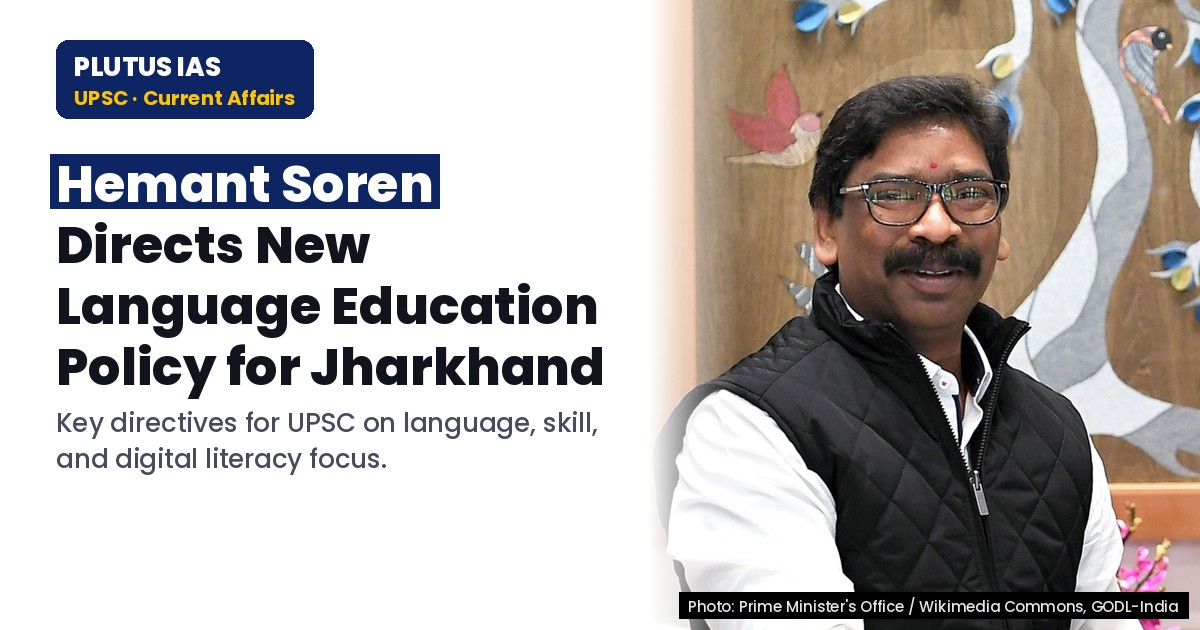
05 Nov Jharkhand’s Language Education Policy: Key for UPSC
✎ Jharkhand's proposed language education policy aims to leverage the state's linguistic diversity by prioritising mother tongue instruction, skill development, and digital literacy to create an inclusive and effective learning…
Subject Relevance — Where This Topic Fits
- GS Paper II — Social Justice (Education, Human Resource Development) | GS Paper I — Indian Society (Diversity, Culture) | GS Paper IV — Ethics (Values in Education)
- Prelims: National Education Policy (NEP) 2020, Multilingualism in education, Mother tongue instruction, Skill development initiatives, Digital literacy, Constitutional provisions for linguistic minorities
- Essay: The role of linguistic diversity in nation-building and educational equity., Balancing tradition and modernity: Integrating local languages with global competencies in education.
Quick Revision: Jharkhand’s proposed language education policy aims to leverage the state’s linguistic diversity by prioritising mother tongue instruction, skill development, and digital literacy to create an inclusive and effective learning environment aligned with NEP 2020 principles.
Why is this in the news?
The Chief Minister of Jharkhand has directed state officials to formulate a comprehensive ‘Jharkhand State Language Education Policy’ that prioritises the state’s linguistic and cultural diversity. The proposed policy aims to integrate mother tongue instruction, foster skill development, and enhance digital literacy among students, ensuring that educational practices are aligned with the unique socio-cultural fabric of the region and prepare students for future challenges.
Background
- India is characterised by immense linguistic diversity, with numerous languages and dialects spoken across its states, including Jharkhand.
- The National Education Policy (NEP) 2020 strongly advocates for education in the mother tongue or local language, especially in the foundational stages, to improve learning outcomes and reduce cognitive load on young learners.
- Studies indicate that learning in one’s mother tongue facilitates better comprehension, critical thinking, and overall academic performance, particularly in early childhood education.
- Many state education systems grapple with the challenge of bridging the gap between home languages and the medium of instruction in schools, often leading to educational disadvantages for students from linguistically diverse backgrounds.
- Skill development and digital literacy are increasingly recognised as crucial components of modern education, essential for enhancing employability and preparing students for the demands of the 21st-century workforce.
- Jharkhand, with its significant tribal population, possesses a rich tapestry of indigenous languages and cultural practices that warrant integration into its educational framework to preserve heritage and promote inclusivity.
Key Principles of Language Education Policy in India
- Multilingualism: The promotion of multilingualism is a cornerstone of India’s education policy, aiming to enable students to be proficient in multiple languages, including their mother tongue, regional language, Hindi, and English.
- Mother Tongue Instruction: Emphasising instruction in the mother tongue or local language, particularly up to Grade 5 and preferably up to Grade 8 and beyond, to enhance conceptual understanding and engagement.
- Three-Language Formula: A policy framework adopted by the Government of India to promote multilingualism, typically involving the study of a modern Indian language (preferably the mother tongue or regional language), Hindi (for non-Hindi speaking states) or another Indian language (for Hindi-speaking states), and English.
- Cultural Preservation: Language education policies often aim to preserve and promote regional and indigenous languages, recognising their role in cultural identity and heritage.
- Skill Development Integration: Modern language policies increasingly integrate skill-based learning, vocational training, and digital literacy to equip students with practical competencies alongside linguistic proficiency.
- Digital Literacy: Fostering digital competence among students is a critical aspect, ensuring they can effectively use digital tools and resources for learning and future employment.
- Inclusive Education: Language policies strive to create an inclusive learning environment where linguistic diversity is valued, and no child is disadvantaged due to their linguistic background.
- Cognitive Benefits: Research indicates that multilingualism can enhance cognitive abilities, including problem-solving, critical thinking, and creativity.
Key Features
| Feature | Significance |
|---|---|
| Mother Tongue-Based Education | Ensures foundational learning is accessible and culturally relevant, reducing cognitive load in early stages. |
| Skill Development | Integrates practical competencies alongside academic knowledge, enhancing employability and holistic development. |
| Digital Literacy | Prepares students for the demands of the modern, technology-driven world, bridging the digital divide. |
| Promotive Multilingualism | Fosters proficiency in multiple languages (mother tongue, Hindi, English) without displacing the primary language, promoting cognitive flexibility. |
| Cultural Integration | Connects education with the state’s rich linguistic and cultural heritage, strengthening identity and community engagement. |
Why it Matters
Social
- Promotes inclusivity by valuing diverse linguistic backgrounds, ensuring no child is disadvantaged due to language barriers in early education.
- Strengthens cultural identity and heritage by integrating local languages and traditions into the educational framework.
- Enhances community participation in education as parents and local communities can better engage with schools operating in familiar languages.
Educational
- Improves learning outcomes, particularly in foundational literacy and numeracy, by leveraging the child’s most familiar language.
- Fosters cognitive development and critical thinking skills through a multilingual approach that builds on existing linguistic competencies.
- Reduces dropout rates in early grades by making the learning environment more accessible and less intimidating for children from diverse linguistic backgrounds.
Economic
- Enhances human capital development by equipping students with relevant skills and digital competencies, making them more competitive in the job market.
- Supports local economies by fostering skills pertinent to regional industries and traditional occupations, potentially reducing rural-urban migration.
- Promotes entrepreneurship by enabling students to articulate ideas and innovate within their cultural and linguistic contexts.
Challenges
1. Teacher Training and Capacity Building
- Ensuring an adequate number of trained teachers proficient in various local languages and equipped with multilingual pedagogical skills.
- Developing comprehensive training modules for existing teachers to adapt to mother tongue-based and multilingual education methodologies.
UPSC Link: GS-II: Education, Human Resources
2. Curriculum and Content Development
- Creating high-quality educational materials, textbooks, and supplementary resources in multiple local languages, aligned with learning objectives.
- Integrating local cultural contexts and knowledge systems into the curriculum while maintaining academic standards and national relevance.
UPSC Link: GS-II: Education, Social Justice
3. Infrastructure and Resource Allocation
- Providing necessary infrastructure, including digital tools and connectivity, to support digital literacy initiatives across all schools.
- Allocating sufficient financial resources for the development, implementation, and continuous evaluation of the multilingual education policy.
UPSC Link: GS-II: Government Policies and Interventions
4. Standardisation and Assessment
- Developing standardised assessment tools that accurately measure learning outcomes across different linguistic mediums.
- Ensuring equitable educational standards and opportunities for students regardless of their medium of instruction.
UPSC Link: GS-II: Education, Social Justice
Challenges — UPSC Perspective
| Issue | Concern |
|---|---|
| Teacher Availability | Scarcity of educators proficient in all local languages, particularly in remote areas. |
| Resource Development | Lack of high-quality, culturally appropriate educational materials in diverse indigenous languages. |
| Digital Divide | Unequal access to digital infrastructure and skills, hindering effective implementation of digital literacy programmes. |
| Policy Implementation | Ensuring consistent and effective execution of the complex multilingual education policy across all educational institutions. |
| Parental Aspirations | Balancing the promotion of mother tongue education with parental desire for English medium instruction for perceived better opportunities. |
Way Forward
- Develop a comprehensive teacher training programme focusing on multilingual pedagogy and digital literacy skills for educators.
- Invest in creating high-quality, culturally relevant educational content and digital resources in all recognised local languages.
- Establish robust monitoring and evaluation mechanisms to assess the effectiveness of the language education policy and make necessary adjustments.
- Foster community engagement and parental awareness campaigns to highlight the benefits of mother tongue-based education and multilingualism.
- Ensure adequate budgetary allocation and infrastructure development to support the implementation of skill development and digital literacy initiatives.
- Promote research and innovation in multilingual education to continuously improve teaching methodologies and learning outcomes.
- Integrate vocational and skill-based training, including traditional sports, into the curriculum from an early stage to foster holistic development.
UPSC Value Addition
Keywords for Mains Answer-Writing
Multilingual education · National Education Policy 2020 · Mother tongue instruction · Linguistic diversity · Skill development · Digital literacy · Inclusive education · Early childhood education · Tribal languages · Cultural preservation
Constitutional & Policy Linkages
- Article 29: Protection of interests of minorities
- Article 350A: Facilities for instruction in mother-tongue at primary stage
Concept Flow
Linguistic Diversity in Jharkhand → Need for Mother Tongue-Based Education → Policy Formulation for Multilingual Education → Integration of Skill Development & Digital Literacy → Enhanced Learning Outcomes & Employability → Preservation of Cultural Heritage → Inclusive and Equitable Education System
Prelims Practice Questions
Q1. Consider the following statements regarding the National Education Policy (NEP) 2020 and language instruction:
1. The NEP 2020 recommends that the medium of instruction till at least Grade 5, but preferably till Grade 8 and beyond, should be the home language/mother tongue/local language/regional language.
2. The policy mandates that no language will be imposed on any student.
3. Sanskrit is to be offered at all levels of school and higher education as an important, enriching option for students, including as a medium of instruction.
How many of the above statements are correct?
- Only one
- Only two
- All three
- None
Answer: All three — Statement 1 is correct: NEP 2020 strongly advocates for mother tongue instruction up to Grade 5, and ideally up to Grade 8. Statement 2 is correct: The policy explicitly states that no language will be imposed on any student. Statement 3 is incorrect: While NEP 2020 promotes Sanskrit, it does not suggest it as a medium of instruction at all levels, but rather as an enriching option.
Q2. Which of the following committees or commissions first recommended the three-language formula in India?
- Kothari Commission (1964-66)
- Radhakrishnan Commission (1948-49)
- Mudaliar Commission (1952-53)
- Sargent Committee (1944)
Answer: Kothari Commission (1964-66) — The Kothari Commission (1964-66) formally recommended the three-language formula, which was subsequently adopted by the National Policy Resolution of 1968. The formula proposed the study of Hindi, English, and a modern Indian language (preferably a South Indian language in Hindi-speaking states, and Hindi in non-Hindi speaking states).
Mains Practice Question
✍ The emphasis on mother tongue-based education and multilingualism is a cornerstone of inclusive education. Discuss the rationale behind promoting education in local languages, particularly in linguistically diverse states like Jharkhand, and evaluate the challenges in its effective implementation. (15 Marks)
Approach: MODEL-ANSWER SKELETON:
1. **Introduction**: Briefly define multilingual education and its significance in diverse contexts.
2. **Rationale for Mother Tongue Education**:
* Cognitive Development: Improved conceptual understanding and critical thinking (UNESCO’s position).
* Cultural Preservation: Connects children to their heritage and identity.
* Reduced Dropout Rates: Enhances engagement and reduces alienation.
* NEP 2020 Recommendations: Specific provisions for mother tongue instruction up to Grade 5/8.
* Constitutional Provisions: Article 350A (facilities for instruction in mother tongue at primary stage).
* Psychological Benefits: Builds confidence and self-esteem.
3. **Specific to Jharkhand**:
* High Linguistic Diversity: Mention tribal languages (e.g., Santhali, Mundari, Ho, Kurukh).
* Bridging the Home-School Language Gap: Addresses the disconnect between home and school environments.
* Promoting Inclusivity: Ensures equitable access to education for all linguistic groups.
4. **Challenges in Implementation**:
* Lack of Qualified Teachers: Scarcity of teachers proficient in local/tribal languages.
* Absence of Standardised Curriculum and Teaching Materials: Development of textbooks and resources in multiple languages.
* Parental Aspirations: Preference for dominant languages (Hindi/English) for perceived better opportunities.
* Financial Constraints: High costs associated with developing multilingual resources and training.
* Logistical Issues: Managing multiple language streams within a single school.
* Assessment Challenges: Developing fair assessment tools across different linguistic mediums.
5. **Conclusion**: Summarise the benefits and suggest a balanced approach for effective implementation, integrating mother tongue instruction with proficiency in other languages for broader opportunities.
Source: amarujala.com
Jharkhand PCS (JPSC) — State PCS Practice
Prelims: मुख्यमंत्री हेमंत सोरेन ने हाल ही में अधिकारियों को निर्देश दिए हैं कि प्रदेश की भाषाई विविधता को नई शिक्षा नीति का आधार बनाया जाए। झारखंड की भाषाई विविधता के संदर्भ में, निम्नलिखित में से कौन सा कथन सही नहीं है?
- संथाली, मुंडारी, हो और खड़िया झारखंड की प्रमुख जनजातीय भाषाएँ हैं।
- नागपुरी, खोरठा, पंचपरगनिया और कुरमाली झारखंड की क्षेत्रीय भाषाएँ हैं।
- झारखंड में केवल जनजातीय भाषाओं को ही शिक्षा के माध्यम के रूप में मान्यता प्राप्त है।
- भाषाई विविधता को शिक्षा नीति का आधार बनाने का उद्देश्य स्थानीय भाषाओं को बढ़ावा देना है।
Answer: झारखंड में केवल जनजातीय भाषाओं को ही शिक्षा के माध्यम के रूप में मान्यता प्राप्त है। — झारखंड में जनजातीय और क्षेत्रीय दोनों भाषाओं को शिक्षा के माध्यम के रूप में मान्यता प्राप्त है, न कि केवल जनजातीय भाषाओं को।
Mains: झारखंड की भाषाई विविधता को शिक्षा नीति का आधार बनाने के मुख्यमंत्री के निर्देश के आलोक में, राज्य में भाषाई विविधता के संरक्षण और संवर्धन के महत्व का विश्लेषण करें तथा इस पहल के संभावित लाभों और चुनौतियों पर प्रकाश डालें।
Generated by AanyaAi for educational purpose.
Related guides on our sites
- Current affairs for upsc 2026
- Best PSIR optional coaching for upsc
- Best PSIR optional teacher for upsc
- Best teacher of PSIR optional for upsc

- यूक्रेन शांति वार्ता से पहले कीव पर रूसी मिसाइल हमले, पाँच घायल - November 7, 2026
- Raksha Mantri Stresses Operational Readiness & Cyber Resilience - November 7, 2026
- तमिलनाडु की ‘வெற்றி’ लैपटॉप योजना: ₹2,000 करोड़ का आवंटन - November 7, 2026

No Comments