


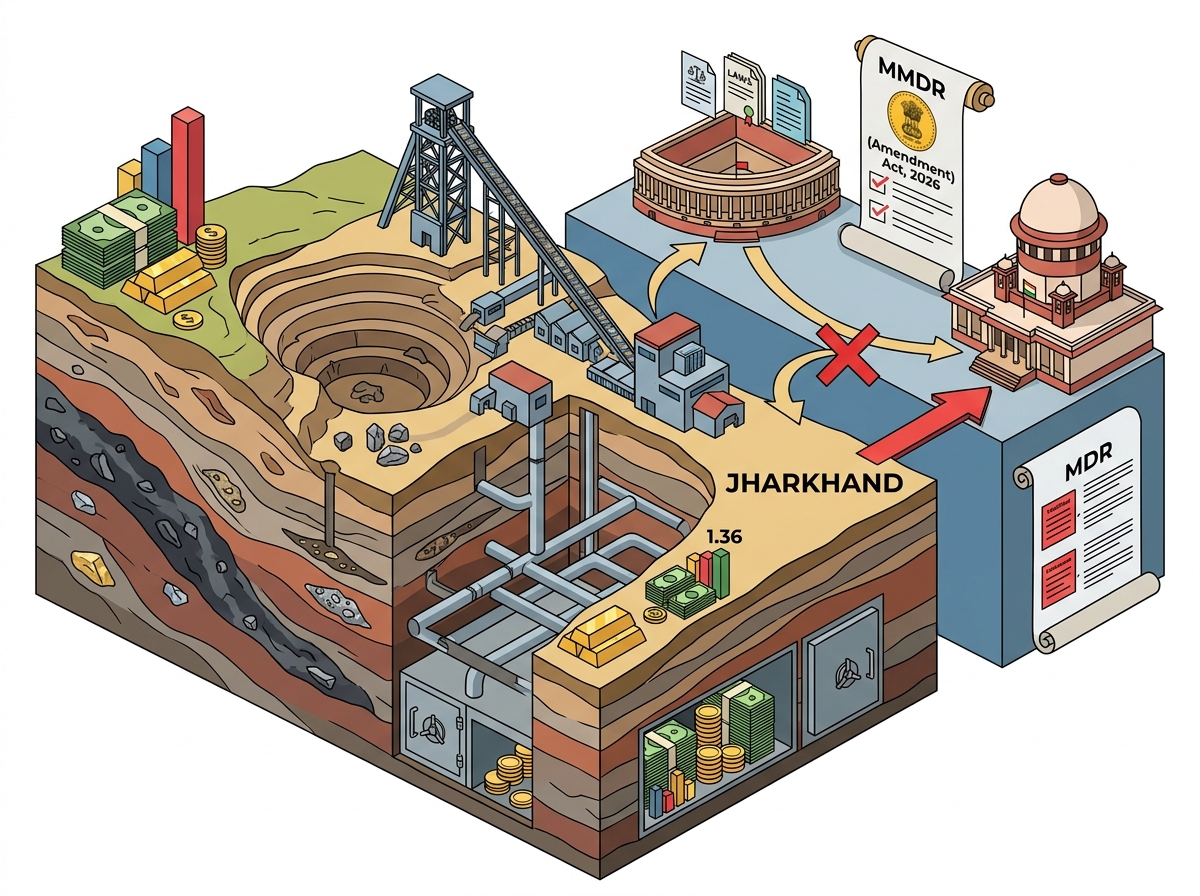
14 Sep Jharkhand’s ₹1.36 Lakh Crore Dues: Supreme Court Battle Over MMDRA Amendment
✎ The MMDR (Amendment) Act, 2026, alters the legal basis for State claims on mineral revenues, necessitating judicial resolution of federal financial disputes under the Constitution.
Subject Relevance — Where This Topic Fits
- GS Paper II — Functions and Responsibilities of the Union and the States, Issues and Challenges Pertaining to the Federal Structure | GS Paper III — Indian Economy and Issues Relating to Planning, Mobilisation of Resources, Growth, Development and Employment, Government Budgeting
- Prelims: MMDR Act, 1957, Royalty and other levies on minerals, Federal financial disputes, Supreme Court’s jurisdiction in inter-state disputes, Union-State financial relations
- Essay: Federalism in India: Balancing Autonomy and Accountability
Quick Revision: The MMDR (Amendment) Act, 2026, alters the legal basis for State claims on mineral revenues, necessitating judicial resolution of federal financial disputes under the Constitution.
Why is this in the news?
The MMDR (Amendment) Act, 2026, recently notified after Presidential assent, has rendered Jharkhand’s claim of ₹1.36 lakh crore in unpaid mineral royalties and other dues legally untenable under the amended provisions. This has triggered a constitutional and legal confrontation, with Jharkhand now approaching the Supreme Court to challenge the amendment’s validity and seek restoration of its financial claim, thereby highlighting the federal tensions in fiscal federalism and mineral resource governance.
Background
- Under the MMDR Act, States are entitled to receive royalties and other levies from mining activities within their jurisdiction, forming a significant component of their non-tax revenue.
- Jharkhand, a mineral-rich state, has historically claimed substantial arrears from the Union government for unpaid royalties and other dues under pre-existing contractual and statutory arrangements.
- The MMDR (Amendment) Act, 2026, introduces changes to the fiscal and regulatory framework governing mineral development, including provisions that alter the liability of the Union government for past dues owed to States.
- The amendment was notified following Presidential assent, thereby acquiring legal force and altering the legal landscape for pending financial claims by States.
- The constitutional validity of such amendments and their impact on inter-governmental financial obligations fall within the purview of judicial review by the Supreme Court.
What is the MMDR (Amendment) Act, 2026?
- The MMDR (Amendment) Act, 2026, is a legislative amendment aimed at modernising the regulatory framework for mineral development and addressing emerging challenges in the sector.
- The amendment introduces provisions that redefine the fiscal obligations of the Union government vis-à-vis States, particularly concerning past dues related to mineral royalties and other levies.
- Key amendments may include changes to the calculation, collection, and distribution of mineral revenues, as well as the legal enforceability of pre-existing financial claims by States.
- The Act empowers the Union government to regulate mineral development more stringently, including through the imposition of new levies or the restructuring of existing revenue-sharing mechanisms.
- The amendment is designed to streamline mineral governance, enhance transparency, and align the legal framework with contemporary economic and environmental priorities.
- The Act applies uniformly across all States, thereby creating a uniform legal regime for mineral development and revenue distribution.
- The amendment’s provisions are prospective in nature but have retrospective implications for pre-existing financial claims, as evidenced by the Jharkhand case.
- The legal validity of the amendment and its impact on inter-governmental financial disputes are subject to judicial scrutiny, particularly under Articles 13, 265, and 293 of the Constitution.
Key Features
| Feature | Significance |
|---|---|
| MMDRA Amendment Act, 2026 | Alters the legal framework governing mineral royalties, fiscal obligations, and inter-governmental financial claims under the Mines and Minerals (Development and Regulation) Act. |
| Presidential Assent | Constitutional validation of the amendment, triggering nationwide enforcement and rendering prior financial claims legally untenable. |
| Financial Claim of ₹1.36 Lakh Crore | Represents Jharkhand’s cumulative demand for unpaid mineral royalties and other statutory dues from the Centre over multiple fiscal years. |
| Supreme Court Intervention | Judicial recourse sought by Jharkhand to challenge the amendment’s validity and restore the financial claim, invoking constitutional remedies. |
| Centre-State Fiscal Dispute | Highlights structural tensions in federal fiscal federalism, particularly in revenue-sharing mechanisms for natural resources. |
Why it Matters
Economic
- The amendment redefines mineral revenue-sharing norms, potentially reducing states’ fiscal autonomy in resource-rich regions like Jharkhand.
- A ₹1.36 lakh crore claim—if upheld—would significantly impact the Centre’s fiscal consolidation efforts and Union Budget allocations.
- Mineral royalties constitute a non-tax revenue stream; legal uncertainty here may deter investment in the mining sector.
Legal-Institutional
- The case exemplifies the judiciary’s role in resolving Centre-State fiscal disputes under the Constitution’s federal structure (Article 262 and 293).
- The Supreme Court’s ruling will set a precedent for interpreting fiscal claims arising from pre-existing contractual or statutory obligations.
- Judicial intervention in fiscal federalism underscores the need for clearer constitutional or legislative delineation of revenue-sharing disputes.
Fiscal Federalism
- The dispute centres on the Centre’s power to amend fiscal obligations via parliamentary legislation, raising questions about unilateral alterations to inter-governmental financial arrangements.
- States’ reliance on mineral revenues for development expenditure faces uncertainty, potentially exacerbating regional fiscal imbalances.
- The case may influence future Centre-State negotiations on resource revenue-sharing formulas, including those under the Goods and Services Tax (GST) regime.
Policy and Governance
- The amendment reflects a broader trend of centralising regulatory and fiscal powers in natural resource governance, aligning with the Centre’s strategic priorities.
- Legal clarity on such disputes is essential for predictable governance, investment planning, and compliance by both Centre and states.
- The outcome may necessitate amendments to the Inter-State River Water Disputes Act or other fiscal dispute resolution mechanisms.
Challenges
1. Legal Ambiguity in Fiscal Federalism
- The Centre’s power to amend fiscal obligations unilaterally under the MMDRA raises questions about the sanctity of inter-governmental financial agreements.
- Lack of a dedicated constitutional mechanism for resolving Centre-State fiscal disputes may lead to prolonged litigation and policy paralysis.
- Judicial precedent from this case could either strengthen Centre’s fiscal authority or reinforce states’ fiscal autonomy, with long-term governance implications.
UPSC Link: GS-II: Federalism, Centre-State Relations (Articles 262, 293)
2. Fiscal Imbalance in Resource-Rich States
- Jharkhand’s claim highlights the fiscal strain on states dependent on mineral revenues, particularly when Centre alters revenue-sharing norms retroactively.
- Uncertainty in royalty regimes may discourage state governments from investing in sustainable mining practices or local development.
- The dispute may exacerbate horizontal fiscal imbalances, as resource-rich states bear the brunt of Centre’s policy changes.
UPSC Link: GS-II: Functions and Responsibilities of the Union and the States
3. Investment Climate and Sectoral Impact
- Legal uncertainty in mineral revenue regimes could deter domestic and foreign investment in the mining sector, affecting GDP growth and employment.
- Mining companies may face retrospective financial liabilities or regulatory instability, increasing compliance costs and operational risks.
- The case underscores the need for stable, predictable fiscal policies in natural resource governance to attract long-term capital.
UPSC Link: GS-III: Investment Models, Mineral Sector Policies
4. Judicial Overreach vs. Legislative Authority
- The Supreme Court’s intervention in a fiscal dispute may be perceived as judicial overreach, encroaching on the legislature’s domain under Article 122.
- Alternatively, judicial review may be justified to uphold constitutional principles of federalism and fiscal equity.
- The case tests the balance between Centre’s regulatory authority and states’ fiscal rights, with implications for separation of powers.
UPSC Link: GS-II: Judiciary, Judicial Review (Articles 122, 136)
5. Policy Coordination Gaps
- The dispute reveals gaps in Centre-State policy coordination, particularly in aligning mineral resource governance with sustainable development goals.
- Absence of a structured dispute resolution mechanism under the Constitution exacerbates conflicts, delaying resolution and policy implementation.
- The case may prompt calls for a constitutional amendment or parliamentary legislation to formalise Centre-State fiscal dispute resolution.
UPSC Link: GS-II: Cooperative Federalism, Inter-State Relations
Challenges — UPSC Perspective
| Issue | Concern |
|---|---|
| Unilateral Amendment of Fiscal Obligations | Centre’s power to alter revenue-sharing norms via parliamentary legislation without state consent. |
| Retrospective Application of Amendments | Legal uncertainty over whether amendments apply to past fiscal claims, affecting states’ financial security. |
| Judicial vs. Legislative Authority | Risk of judicial overreach in fiscal disputes versus Centre’s legislative supremacy in resource governance. |
| Investment Uncertainty in Mining Sector | Potential deterrent to investment due to unstable royalty regimes and legal disputes. |
| Fiscal Imbalance Among States | Resource-rich states bear disproportionate burden of Centre’s policy changes, exacerbating regional disparities. |
| Absence of Dedicated Dispute Resolution Mechanism | Lack of a constitutional or statutory framework for Centre-State fiscal disputes, leading to prolonged litigation. |
Way Forward
- The Union Government should engage in structured consultations with state governments to address concerns over unilateral amendments to fiscal obligations under the MMDRA.
- Parliament may consider enacting a dedicated constitutional or statutory mechanism for resolving Centre-State fiscal disputes, akin to the Inter-State River Water Disputes Act.
- Jharkhand and other resource-rich states should explore alternative revenue streams, such as green mining initiatives or value-added mineral processing, to reduce dependence on royalties.
- The Supreme Court should lay down clear principles for judicial review in Centre-State fiscal disputes, balancing Centre’s regulatory authority with states’ fiscal autonomy.
- The Ministry of Mines should publish a white paper on the impact of MMDRA amendments on mineral revenue-sharing, ensuring transparency and stakeholder input.
- State governments should strengthen their fiscal management frameworks to mitigate risks from Centre’s policy changes, including contingency planning for revenue shortfalls.
- Investors in the mining sector should conduct thorough legal due diligence to assess risks from retrospective amendments and legal disputes.
- Civil society and think tanks should advocate for a federal fiscal framework that aligns Centre-State resource governance with sustainable development goals.
UPSC Value Addition
Keywords for Mains Answer-Writing
MMDRA Amendment Act 2026 · Supreme Court jurisdiction over Centre-State financial disputes · Constitutional validity of financial claims by States against Centre · Inter-State financial adjudication mechanisms · Doctrine of repugnancy under Article 254 · Federalism in India · Centre-State financial relations · Judicial review of legislative amendments · Mineral Royalties and State revenues · Constitutional remedies for fiscal disputes · Separation of Powers · Judicial activism in Centre-State conflicts · Financial federalism in India · Constitutional interpretation of fiscal claims
Constitutional & Policy Linkages
- Article 262: Adjudication of disputes relating to waters of inter-State rivers (analogous principles may apply to fiscal disputes).
- Article 293: Borrowing by states and guarantees by the Government of India (relevant for Centre-State financial relations).
- Article 14: Equality before law (potential challenge to Centre’s unilateral amendments affecting states unequally).
- Article 282: Grants-in-aid to states (relevant for Centre’s financial assistance to states post-dispute resolution).
Concept Flow
Centre introduces amendments to the MMDRA via parliamentary legislation → Presidential assent grants constitutional validity → Amendments alter mineral royalty and fiscal obligations → Jharkhand’s ₹1.36 lakh crore claim becomes legally untenable → Jharkhand challenges the amendment in the Supreme Court → Supreme Court examines Centre’s authority vs. states’ fiscal rights → Judgment sets precedent for Centre-State fiscal disputes → Outcome influences mineral sector investment, Centre-State relations, and fiscal federalism.
Prelims Practice Questions
Q1. Consider the following statements regarding the Mines and Minerals (Development and Regulation) Amendment Act, 2026:
1. The Act seeks to regulate the financial claims of States against the Centre arising from mineral royalties.
2. The Act has been given Presidential assent and is now in force.
3. The Act empowers the Supreme Court to adjudicate disputes between the Centre and States on mineral royalties.
4. The Act is based on the Seventh Schedule, List I (Union List) and List II (State List) of the Constitution.
How many of the above statements are correct?
- Only one
- Only two
- Only three
- All four
Answer: Only three — Statements 1 and 2 are correct as the amendment pertains to mineral royalties and has received Presidential assent. Statement 3 is incorrect because the Supreme Court’s jurisdiction is not directly created by the Act; it arises from constitutional provisions. Statement 4 is correct as mineral royalties fall under the Concurrent List (Seventh Schedule).
Q2. Assertion (A): The President of India, under Article 31C of the Constitution, can withhold assent to a State’s financial claim against the Centre.
Reason (R): The President’s role in financial matters is limited to the executive functions under Article 74 and does not extend to legislative or judicial functions.
- Both A and R are true, and R is the correct explanation of A
- Both A and R are true, but R is not the correct explanation of A
- A is true, but R is false
- A is false, but R is true
Answer: A is false, but R is true — Assertion (A) is false because Article 31C does not empower the President to withhold assent to a State’s financial claim; such matters are adjudicated by courts. Reason (R) is true as the President’s role in financial matters is primarily executive under Article 74.
Mains Practice Question
✍ The Mines and Minerals (Development and Regulation) Amendment Act, 2026, has altered the legal landscape governing Centre-State financial disputes over mineral royalties. In this context, critically examine the constitutional framework governing financial relations between the Centre and the States in India. Also, analyse the implications of such legislative amendments on the doctrine of federalism and the separation of powers. (15 Marks)
Approach: MODEL-ANSWER SKELETON:
1. **Constitutional Framework for Centre-State Financial Relations**:
– Seventh Schedule (Union List, State List, Concurrent List): Mineral royalties fall under the Concurrent List (Entry 23).
– Article 268: Taxes levied and collected by the Union but assigned to the States.
– Article 279A: Goods and Services Tax (GST) Council and its role in fiscal federalism.
– Article 282: Grants-in-aid by the Union to States.
2. **Doctrine of Federalism and Separation of Powers**:
– Federalism in India: Cooperative vs. Competitive federalism.
– Separation of Powers: Legislative (Parliament and State Legislatures), Executive (Centre and States), and Judicial (Supreme Court and High Courts).
– Judicial Review: Supreme Court’s role in adjudicating Centre-State disputes (Article 131, 136, 226, 32).
3. **MMDRA Amendment Act, 2026**:
– Legislative intent: Clarify Centre’s obligations vis-à-vis State claims on mineral royalties.
– Impact on State revenues: Potential reduction in State financial autonomy.
– Legal implications: Does the amendment encroach upon State legislative powers under the Concurrent List?
4. **Judicial Precedents and Doctrinal Analysis**:
– **State of West Bengal v. Union of India (1963)**: Supreme Court’s interpretation of federalism and Centre-State financial relations.
– **S.R. Bommai v. Union of India (1994)**: Federalism as a basic feature of the Constitution.
– **State of Jharkhand v. Union of India (2019)**: Judicial stance on Centre-State financial disputes.
5. **Implications and Balancing Views**:
– **Pro-Centre Argument**: Uniformity in mineral royalty regimes across States to prevent exploitation and ensure equitable resource distribution.
– **Pro-State Argument**: States’ right to claim unpaid royalties as part of their fiscal autonomy and resource ownership.
– **Judicial Role**: Supreme Court as the ultimate arbiter in Centre-State financial disputes.
6. **Conclusion**:
– The amendment reflects a centralising tendency, potentially undermining fiscal federalism.
– The Supreme Court’s intervention will be critical in balancing Centre-State interests while upholding constitutional principles.
Source: amarujala.com
Jharkhand PCS (JPSC) — State PCS Practice
Prelims: As per recent Supreme Court developments, which of the following is the primary legal contention regarding Jharkhand’s outstanding debt of ₹1.36 lakh crore?
- A. Validity of the debt restructuring agreement signed with the RBI
- B. Constitutional validity of the state’s borrowing powers under Article 293
- C. Dispute over the allocation of funds between the Centre and the state
- D. Challenge to the state’s ability to service debt due to resource constraints
Answer: B. Constitutional validity of the state’s borrowing powers under Article 293 — The Supreme Court is examining whether Jharkhand’s borrowing powers under Article 293 of the Constitution were constitutionally exercised, given the state’s outstanding debt.
Mains: Analyze the implications of the Supreme Court’s intervention in Jharkhand’s ₹1.36 lakh crore debt dispute on the state’s fiscal autonomy and federal relations. Discuss the constitutional provisions involved and suggest measures for sustainable debt management in Jharkhand.
Generated by AanyaAi for educational purpose.
Related guides on our sites
- Current affairs for upsc 2026
- Best PSIR optional coaching for upsc
- Best PSIR optional teacher for upsc
- Best teacher of PSIR optional for upsc

- Jharkhand’s ₹1.36 Lakh Crore Dues: Supreme Court Battle Over MMDRA Amendment - September 14, 2026
- गुजरात में स्थापित होंगे भारत के 12 सेमीकंडक्टर संयंत्रों में से 6, जानिए कैसे? - September 14, 2026
- Gujarat to host 6 of India’s 12 semiconductor facilities: Key UPSC insights - September 14, 2026

No Comments