


08 Aug Kannada groups demand action against BCC over Mahajan Commission delay
✎ The Mahajan Commission’s 1967 report, accepted by the Union government, conclusively establishes Belagavi as part of Karnataka, leaving no legal ambiguity for the Belagavi City Corporation to delay a resolution affirming this…
Subject Relevance — Where This Topic Fits
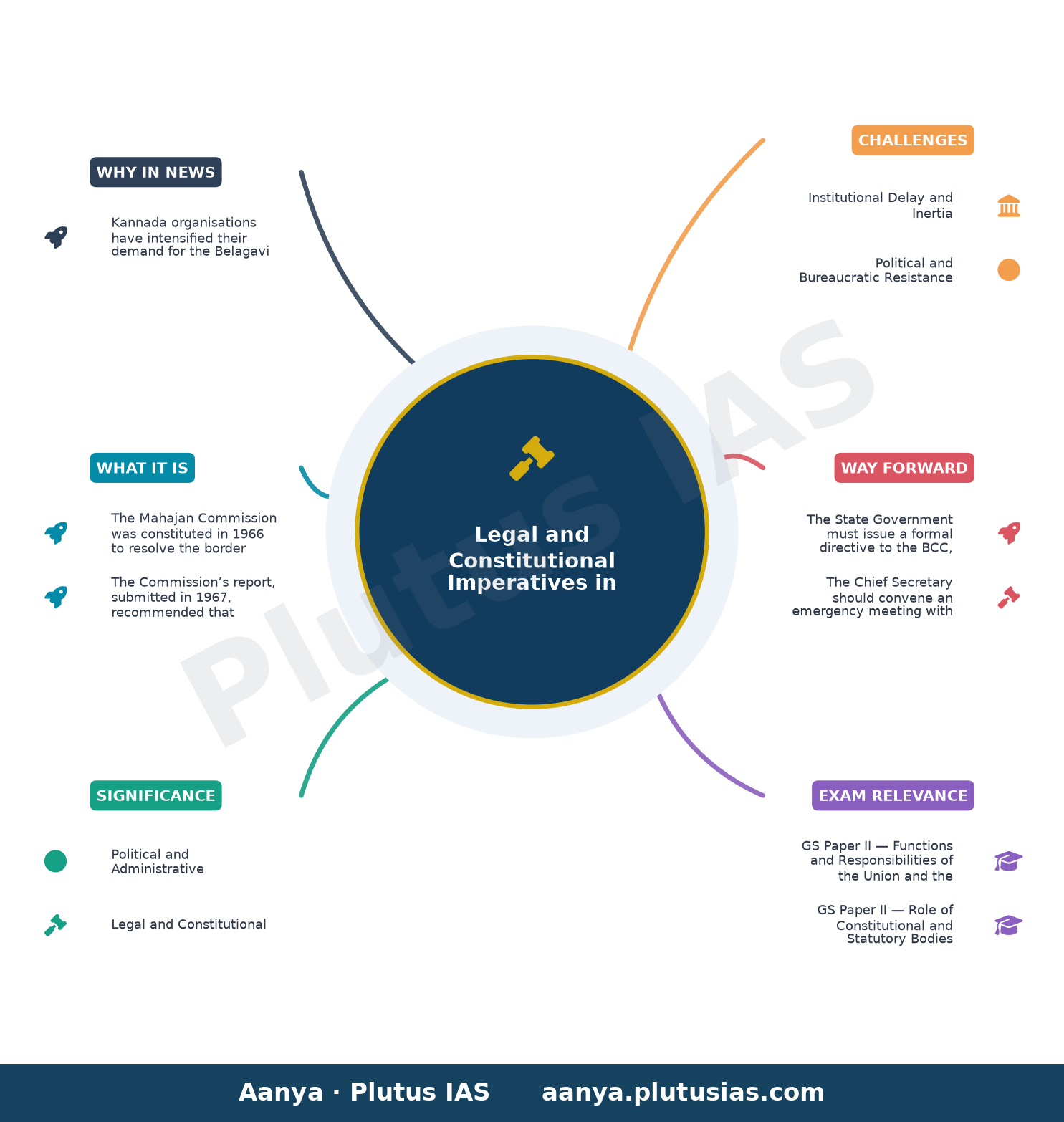
- GS Paper II — Functions and Responsibilities of the Union and the States, Issues and Challenges Pertaining to the Federal Structure | GS Paper II — Role of Constitutional and Statutory Bodies | GS Paper III — Challenges in Governance and Administration
- Prelims: Mahajan Commission, Belagavi border dispute, Article 371-J, Urban Local Bodies (ULBs), Constitutional provisions on inter-state disputes, Karnataka State Border and River Protection Commission
- Essay: Federalism and cooperative governance in India: Lessons from inter-state border disputes, The role of local governance in national integration: A case study of Belagavi
Quick Revision: The Mahajan Commission’s 1967 report, accepted by the Union government, conclusively establishes Belagavi as part of Karnataka, leaving no legal ambiguity for the Belagavi City Corporation to delay a resolution affirming this status.
Why is this in the news?
Kannada organisations have intensified their demand for the Belagavi City Corporation (BCC) to pass a resolution affirming Belagavi as an integral part of Karnataka, citing the Mahajan Commission’s recommendations. The delay in passing this resolution, despite legal opinions confirming its feasibility, has led to protests and arrests, highlighting tensions between local governance and constitutional obligations. The issue underscores the interplay between federalism, local autonomy, and the resolution of inter-state border disputes in India.
Background
- The Belagavi border dispute dates back to the reorganisation of states in 1956 under the States Reorganisation Act, which transferred Belagavi (then Belgaum) from the erstwhile Bombay State to Mysore State (now Karnataka).
- The Mahajan Commission, constituted in 1966 under Justice Mehr Chand Mahajan, was tasked with examining the border dispute between Karnataka and Maharashtra. Its 1967 report recommended that Belagavi remain with Karnataka, a decision accepted by the Government of India.
- The Belagavi City Corporation (BCC), an urban local body, has delayed passing such a resolution despite a member’s proposal in April 2026, citing the need for a legal opinion from the state government.
- The state government has consistently maintained that Belagavi is an integral part of Karnataka, passing resolutions to this effect in the state legislature in the past.
- Protests by Kannada organisations, including arrests of activists, reflect growing frustration over the BCC’s inaction and perceived disregard for constitutional and legal precedents.
What is the Mahajan Commission and its relevance to the Belagavi dispute?
- The Mahajan Commission was constituted in 1966 to resolve the border dispute between Karnataka and Maharashtra, particularly concerning Belagavi, Karwar, and Nipani.
- The Commission’s report, submitted in 1967, recommended that Belagavi remain with Karnataka, citing linguistic and administrative considerations, and was accepted by the Government of India.
- The Commission’s findings are not legally binding but carry significant political and administrative weight, having been endorsed by the Union government and the state legislature of Karnataka.
- The dispute arises from Maharashtra’s claim over Belagavi based on Marathi-speaking majority areas, while Karnataka asserts its linguistic and historical ties to the region.
- The Union government’s acceptance of the Mahajan Commission’s report in 1967 effectively settled the dispute, though local political and administrative bodies may still face challenges in implementing this consensus.
- The issue highlights the role of constitutional bodies and local governance in upholding decisions of higher authorities, particularly in matters of inter-state disputes and federal harmony.
Key Features
| Feature | Significance |
|---|---|
| Mahajan Commission Recommendations | The Justice M.C. Mahajan Commission, constituted in 1966, recommended that Belagavi (then Belgaum) be part of Karnataka, resolving a long-standing border dispute with Maharashtra. Its findings remain a cornerstone of Karnataka’s territorial claim. |
| Belagavi City Corporation (BCC) Resolution Delay | The BCC’s failure to pass a resolution affirming Belagavi’s integral part of Karnataka despite multiple requests and legal opinions underscores institutional inertia and political reluctance, exacerbating regional sentiments. |
| Kannada Organisations’ Protests | The sustained agitation by Kannada organisations, including arrests and demands for administrative action, reflects the socio-political urgency of the issue and the perceived erosion of regional identity. |
| State Government’s Stance | The Karnataka government has consistently upheld the Mahajan Commission’s recommendations, passing legislative resolutions and asserting Belagavi’s status, which strengthens the legal and political position of the demand. |
| Legal Opinions on Resolution | Multiple legal opinions, including from the Chief Secretary and senior advocates like Mohan Kataraki, affirm that there are no legal impediments to passing the resolution, reinforcing the administrative and judicial basis for action. |
Why it Matters
Political and Administrative
- The delay in passing the resolution by the BCC highlights the tension between local governance and state-level political commitments, potentially eroding public trust in democratic institutions.
- The issue serves as a litmus test for the efficacy of state mechanisms in addressing regional grievances and upholding constitutional federalism.
- The Minister’s intervention underscores the need for coordinated action between local bodies and state authorities to resolve inter-state disputes.
Legal and Constitutional
- The Mahajan Commission’s recommendations are legally and constitutionally binding on the state government, as they were accepted and implemented through legislative resolutions.
- The absence of legal hurdles, as confirmed by multiple legal opinions, places an onus on the BCC to act in accordance with the state’s constitutional obligations.
- The issue exemplifies the role of judicial commissions in resolving inter-state disputes, a mechanism enshrined in the Constitution under Article 263.
Socio-Cultural
- Belagavi’s identity as a Karnataka stronghold is deeply tied to Kannada language and culture, making the resolution a symbol of regional pride and linguistic assertion.
- The protests reflect broader anxieties about the dilution of regional identities in the face of inter-state border disputes and administrative delays.
- The involvement of organisations like the central committee of Kannada organisations highlights the mobilisation of civil society in safeguarding constitutional and cultural rights.
Challenges
1. Institutional Delay and Inertia
- The BCC’s repeated failure to pass the resolution despite clear legal and administrative directives demonstrates systemic inefficiency and reluctance to address politically sensitive issues.
- The Mayor’s referral of the matter to the state government for a legal opinion, despite its redundancy, suggests a lack of decisive leadership at the local level.
- The failure to convene meetings or address public grievances in a timely manner risks exacerbating social unrest and eroding democratic accountability.
UPSC Link: GS-II: Role of Local Governance
2. Political and Bureaucratic Resistance
- The delay may stem from political calculations, including the fear of alienating voter bases in border regions or provoking inter-state tensions with Maharashtra.
- Bureaucratic hesitance to take decisive action, even when legally justified, reflects a broader pattern of risk aversion in administrative decision-making.
- The lack of follow-through on the Minister’s assurances risks undermining public confidence in the state’s commitment to resolving the issue.
UPSC Link: GS-II: Centre-State Relations
3. Legal Ambiguity and Public Perception
- Despite clear legal opinions, the repeated referral to legal authorities suggests a perception of ambiguity, which can be exploited to delay action.
- Public protests and arrests indicate a growing disconnect between legal provisions and ground realities, necessitating transparent communication to bridge this gap.
- The demand to supersede the BCC or withhold funds reflects public frustration with institutional inaction and highlights the need for alternative accountability mechanisms.
UPSC Link: GS-II: Judicial Review and Public Interest
4. Inter-State Border Disputes
- The Belagavi issue is part of a larger set of inter-state border disputes, including those with Andhra Pradesh, Tamil Nadu, and Kerala, which require coordinated federal intervention.
- The Mahajan Commission’s recommendations, while accepted by Karnataka, have not been formally ratified by Maharashtra, leaving room for continued contention.
- The lack of a permanent mechanism for resolving such disputes under Article 263 of the Constitution exacerbates administrative delays and political tensions.
UPSC Link: GS-II: Inter-State Relations
5. Regional Identity and Linguistic Assertion
- The issue is deeply tied to the assertion of Kannada linguistic identity, a recurring theme in Karnataka’s political and cultural discourse since the formation of the state in 1956.
- The protests reflect a broader demand for the protection of regional languages and cultures, which are constitutionally guaranteed under Article 350A.
UPSC Link: GS-II: Language and Culture
Challenges — UPSC Perspective
| Issue | Concern |
|---|---|
| BCC’s Failure to Pass Resolution | Institutional inertia and lack of decisive leadership delay the resolution, despite clear legal and administrative directives. |
| Political Calculations | Fear of alienating voter bases or provoking inter-state tensions may deter political actors from taking decisive action. |
| Legal Ambiguity Perception | Repeated referrals to legal authorities, despite clear opinions, create a perception of ambiguity and erode public trust. |
| Inter-State Border Disputes | The unresolved status of the Mahajan Commission’s recommendations with Maharashtra perpetuates administrative delays and political tensions. |
| Regional Identity Assertion | The issue is intertwined with linguistic and cultural identity, requiring sensitive handling to avoid exacerbating regional grievances. |
| Public Frustration and Protests | Institutional inaction has led to sustained protests, arrests, and demands for administrative action, risking social unrest. |
Way Forward
- The State Government must issue a formal directive to the BCC, mandating the passage of the resolution within a stipulated timeframe, citing the Mahajan Commission’s recommendations and legal opinions.
- The Chief Secretary should convene an emergency meeting with the BCC leadership to clarify the legal and administrative obligations, ensuring accountability for delays.
- The Minister for Urban Development should publicly reiterate the state’s commitment to Belagavi’s status, addressing the concerns of Kannada organisations and the public.
- A high-level committee, including representatives from the Kannada organisations, legal experts, and state officials, should be constituted to monitor the resolution’s passage and implementation.
- The state government should explore constitutional remedies, such as referring the matter to the Governor for intervention under Article 239(2) if the BCC continues to delay.
- Legal awareness campaigns should be launched to educate the public on the Mahajan Commission’s recommendations and the state’s constitutional obligations.
- The state should initiate dialogue with Maharashtra to formally ratify the Mahajan Commission’s recommendations, ensuring inter-state consensus and reducing future disputes.
- The BCC should be sensitised to the socio-cultural significance of the resolution, aligning administrative action with the constitutional protection of regional identities.
UPSC Value Addition
Keywords for Mains Answer-Writing
Karnataka-Belagavi border dispute · Mahajan Commission · Belagavi City Corporation (BCC) · Urban Local Bodies (ULBs) · Inter-State border disputes · Article 263 of the Constitution · Karnataka State Border and River Protection Commission · Constitutional provisions for inter-state disputes · Local self-government under 73rd/74th Constitutional Amendments · Executive-legislative interface in State administration
Constitutional & Policy Linkages
- {‘Article 263’: ‘Inter-State Council for dispute resolution’}
- {‘Article 350A’: ‘Provisions for linguistic minorities’}
Concept Flow
1. **Historical Context**: Formation of Karnataka (1956) and the Belagavi border dispute with Maharashtra. → 2. **Commission Formation**: Justice M.C. Mahajan Commission (1966) to resolve the dispute. → 3. **Recommendations**: Commission recommends Belagavi as part of Karnataka; state accepts and implements via legislative resolutions. → 4. **Local Resistance**: BCC’s failure to pass resolution despite state’s stance and legal opinions, leading to protests by Kannada organisations. → 5. **Administrative Delay**: Repeated referrals to legal authorities and lack of decisive action by BCC, exacerbating public frustration. → 6. **Political and Legal Standoff**: State government’s commitment vs. BCC’s inaction, highlighting tensions between local governance and state-level policies. → 7. **Public Mobilisation**: Sustained protests, arrests, and demands for administrative action, reflecting broader socio-cultural grievances.
Prelims Practice Questions
Q1. Consider the following statements regarding the Mahajan Commission and the Belagavi border dispute:
1. The Mahajan Commission was constituted to address the inter-state border dispute between Karnataka and Maharashtra.
2. The Commission’s report on Belagavi categorically stated that the city is an integral part of Karnataka.
3. The 74th Constitutional Amendment Act empowers Urban Local Bodies to resolve inter-state border disputes independently.
How many of the above statements are correct?
- Only one
- Only two
- All three
- None
Answer: Only two — Statement 1 is correct as the Mahajan Commission was indeed constituted to address the inter-state border dispute between Karnataka and Maharashtra. Statement 2 is correct as the Commission’s report affirmed Belagavi’s status as part of Karnataka. Statement 3 is incorrect because the 74th Amendment does not empower ULBs to resolve inter-state border disputes; these fall under the purview of the Union and State governments.
Q2. Assertion (A): The Belagavi City Corporation (BCC) is constitutionally obligated to pass a resolution endorsing the Mahajan Commission’s recommendations.
Reason (R): The State government has already accepted the Mahajan Commission’s report, and there is no legal hurdle to passing such a resolution.
In the context of the above statements, which of the following is correct?
- Both A and R are true, and R is the correct explanation of A
- Both A and R are true, but R is not the correct explanation of A
- A is true, but R is false
- A is false, but R is true
Answer: A is true, but R is false — Assertion (A) is true as the BCC, being an Urban Local Body, is expected to align with the State government’s stance on inter-state border disputes. Reason (R) is also true, as the State government has accepted the Mahajan Commission’s report and there is no legal impediment to passing the resolution. However, R does not directly explain A, as the obligation of the BCC is more administrative than constitutional.
Q3. Match the following constitutional provisions with their correct descriptions:
Column I (Provision)
A. Article 263
B. Article 256
C. 74th Constitutional Amendment Act
D. Article 3
Column II (Description)
1. Empowers the President to constitute Inter-State Councils
2. Deals with the duties of the Union and States to respect each other’s laws
3. Provides for the establishment of Municipalities and their powers
4. Relates to the admission or establishment of new States
Select the correct match:
- A-1, B-2, C-3, D-4
- A-2, B-1, C-4, D-3
- A-3, B-2, C-1, D-4
- A-4, B-3, C-2, D-1
Answer: A-1, B-2, C-3, D-4 — The correct matches are: A (Article 263) – 1 (Inter-State Councils), B (Article 256) – 2 (Duties of Union and States), C (74th Amendment) – 3 (Municipalities), and D (Article 3) – 4 (Admission/establishment of new States).
Mains Practice Question
✍ The State government’s acceptance of the Mahajan Commission’s recommendations on Belagavi’s status as an integral part of Karnataka has not translated into effective executive action at the local level, as evidenced by the Belagavi City Corporation’s (BCC) failure to pass a resolution endorsing these recommendations. Critically examine the constitutional and administrative challenges in resolving inter-state border disputes through Urban Local Bodies (ULBs), with reference to the 74th Constitutional Amendment Act and relevant judicial precedents. (15 Marks)
Approach: MODEL-ANSWER SKELETON:
1. **Constitutional Framework for Inter-State Disputes**:
– Article 263 empowers the President to constitute Inter-State Councils to address inter-state disputes.
– Article 256 obligates States to ensure compliance with Union laws, but does not directly empower ULBs in border disputes.
– The 74th Constitutional Amendment Act (1992) devolves powers to ULBs but does not grant them authority over inter-state disputes.
2. **Role of Urban Local Bodies (ULBs)**:
– ULBs are creatures of State legislation (e.g., Karnataka Municipal Corporations Act, 1976) and derive powers from the State government.
– The 74th Amendment emphasizes decentralization but does not alter the constitutional scheme of inter-state relations.
– The BCC’s failure to pass a resolution reflects a lack of alignment between State policy and local governance, not a constitutional deficiency.
3. **Judicial Precedents and Executive-Legislative Interface**:
– The Supreme Court in *State of Kerala v. State of Tamil Nadu* (2014) held that inter-state disputes are to be resolved through negotiations and political processes, not judicial intervention.
– The Court in *State of West Bengal v. Union of India* (1993) reiterated that the Union government plays a pivotal role in mediating such disputes.
– The executive’s acceptance of the Mahajan Commission’s report is a political decision; its implementation at the local level requires administrative coordination.
4. **Administrative Challenges**:
– Lack of statutory compulsion on ULBs to endorse State government policies on inter-state disputes.
– Potential for political resistance at the local level, as seen in the BCC’s inaction despite protests.
– The need for a mechanism to ensure policy coherence between State and local governments in matters of national importance.
5. **Way Forward**:
– Strengthening Inter-State Councils under Article 263 to facilitate structured dialogue.
– Empowering State governments to issue binding directives to ULBs on matters of inter-state significance.
– Encouraging greater civic participation to align local governance with State policies.
Balance of Views: The issue highlights the tension between decentralization (74th Amendment) and the need for unified State policy in inter-state disputes. While ULBs are autonomous, their actions must align with broader State and national interests.
Source: The Hindu
Generated by AanyaAi for educational purpose.

- विधायकों की चुप्पी को न्यायालय कैसे मान सकता है शून्य? मद्रास हाईकोर्ट का महत्वपूर्ण फैसला - September 23, 2026
- वायुसेना को मिला बड़ा हथियार: ₹811 करोड़ के 160 स्मार्ट एंटी-एयरफील्ड वेपन समझौता - September 23, 2026
- UPSC Exam Alert: Defence Ministry signs ₹811 Crore SAT-SAAW deal for IAF - September 23, 2026

No Comments