


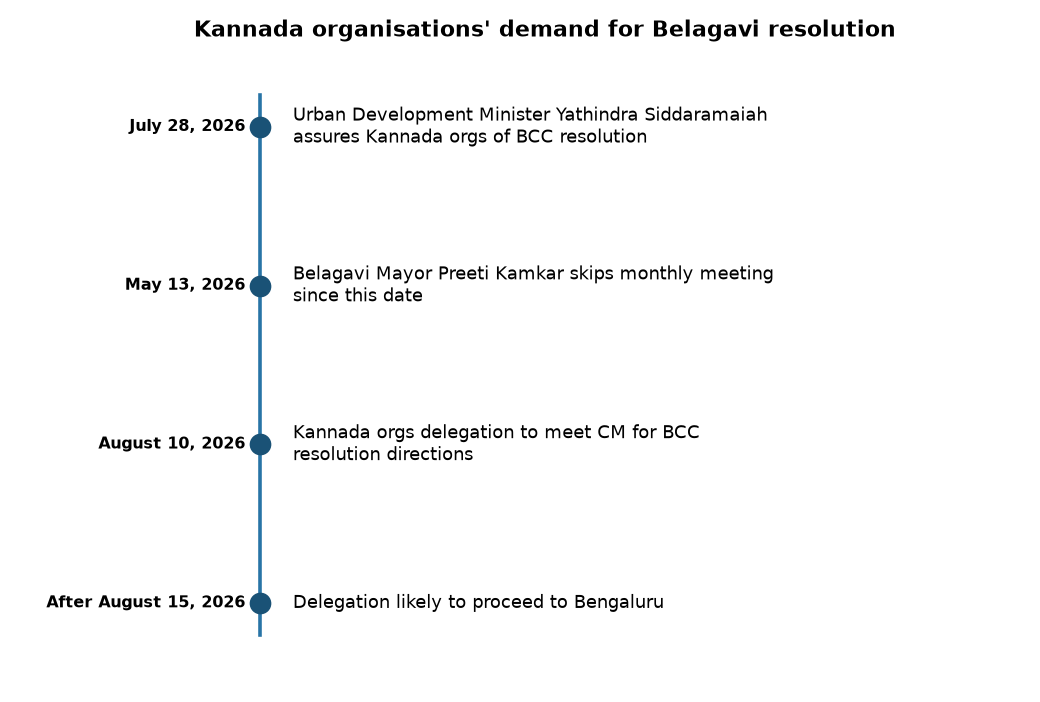
11 Aug Kannada orgs to meet CM over Belagavi’s Mahajan Commission resolution delay
✎ The Mahajan Commission (1966–67) recommended Belagavi’s retention in Karnataka, but its report is not legally binding; disputes are resolved through inter-state negotiations under constitutional provisions.
Subject Relevance — Where This Topic Fits
- GS Paper II — Functions and Responsibilities of the Union and the States | GS Paper II — Devolution of Powers and Finances up to Local Levels and Challenges Therein | GS Paper III — Role of Civil Services in a Democracy
- Prelims: Belagavi boundary dispute, Mahajan Commission, 74th Constitutional Amendment Act, Belagavi City Corporation (BCC), Mayor and Deputy Mayor roles, Urban Local Bodies (ULBs), Constitutional provisions on municipal governance, Karnataka Municipal Corporations Act, 1976
- Essay: Federalism and cooperative governance in India: Challenges and solutions, The role of local self-governance in nation-building
Quick Revision: The Mahajan Commission (1966–67) recommended Belagavi’s retention in Karnataka, but its report is not legally binding; disputes are resolved through inter-state negotiations under constitutional provisions.
Why is this in the news?
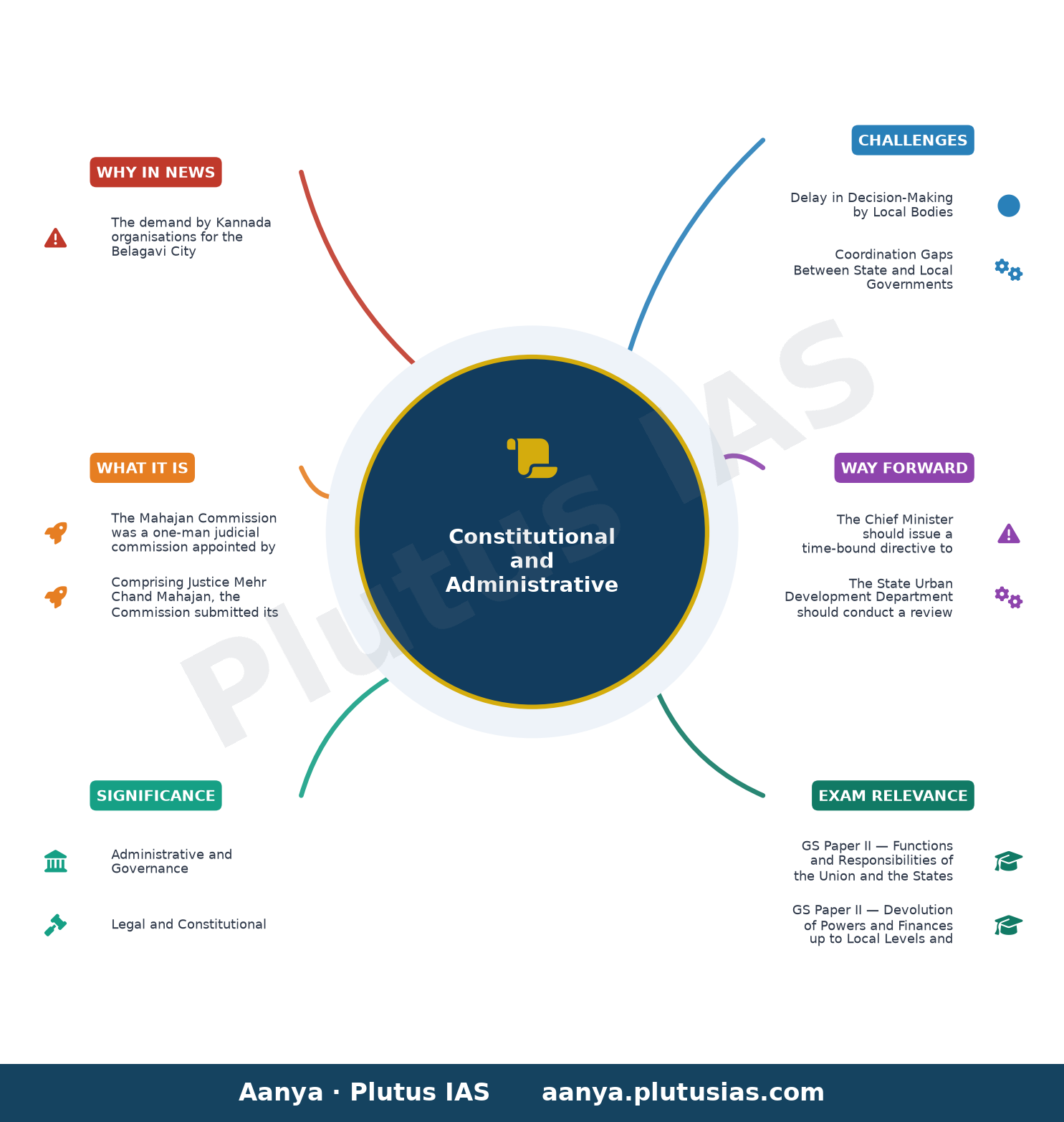
The demand by Kannada organisations for the Belagavi City Corporation (BCC) to pass a resolution affirming Belagavi as an integral part of Karnataka has resurfaced, highlighting the interplay between local governance institutions, state administrative directives, and constitutional provisions governing municipal corporations. This issue underscores the challenges in ensuring timely compliance by urban local bodies (ULBs) with state directives, particularly in matters of territorial integrity and identity.
Background
- The Belagavi (formerly Belgaum) boundary dispute between Karnataka and Maharashtra has historical roots, originating from linguistic reorganisations of states in 1956 and subsequent border adjustments.
- The Mahajan Commission, constituted in 1966 under the chairmanship of Justice Mehr Chand Mahajan, was tasked with resolving inter-state boundary disputes, including that of Belagavi. Its report, submitted in 1967, recommended the transfer of certain areas to Maharashtra while retaining Belagavi within Karnataka.
- The dispute has periodically resurfaced, with political and cultural organisations in Karnataka asserting Belagavi’s integral status within the state, often through protests and demands for formal resolutions by local governance bodies.
- The 74th Constitutional Amendment Act, 1992, empowered urban local bodies (ULBs) like the Belagavi City Corporation (BCC) with greater autonomy and responsibilities, including the formulation of policies on local matters.
- The Karnataka Municipal Corporations Act, 1976, governs the functioning of municipal corporations in the state, including the roles and powers of the Mayor, Deputy Mayor, and the Corporation Council.
- Recent delays by the BCC in passing a resolution affirming Belagavi’s status have led to protests by Kannada organisations, citing non-compliance with state directives and constitutional provisions on local governance.
What is the Mahajan Commission and its relevance to the Belagavi dispute?
- The Mahajan Commission was a one-man judicial commission appointed by the Government of India in 1966 to examine and resolve inter-state boundary disputes, particularly between Karnataka and Maharashtra.
- Comprising Justice Mehr Chand Mahajan, the Commission submitted its report in 1967, recommending that Belagavi (then Belgaum) remain within Karnataka, while certain adjacent areas be transferred to Maharashtra.
- The Commission’s report was not binding but served as a reference point for subsequent negotiations and political settlements between the two states.
- The dispute over Belagavi has persisted due to competing claims based on linguistic identity, historical administrative boundaries, and economic considerations.
- The Mahajan Commission’s recommendations have been periodically invoked by Karnataka’s political and cultural organisations to assert Belagavi’s status as an integral part of the state.
- The demand for a resolution by the BCC reflects the use of local governance institutions as platforms to assert regional identity and political claims within the framework of constitutional governance.
Key Features
| Feature | Significance |
|---|---|
| Belagavi City Corporation (BCC) | The statutory urban local body responsible for governance in Belagavi, with authority to pass resolutions on civic and administrative matters, including assertions of territorial integrity. |
| Mahajan Commission | A judicial or quasi-judicial body constituted to adjudicate inter-state boundary disputes, particularly relevant for Karnataka-Maharashtra border regions like Belagavi. |
| Resolution in favour of territorial integrity | A formal declaration by BCC affirming Belagavi as an integral part of Karnataka, which serves as a political and administrative assertion of state sovereignty. |
| Chief Minister’s directive | Executive authority vested in the Chief Minister to guide or instruct subordinate bodies like BCC, ensuring alignment with state policy on inter-state matters. |
| Protest by Kannada organisations | Collective civic action by linguistic and cultural groups to pressure authorities, reflecting grassroots demand for recognition of regional identity and administrative claims. |
Why it Matters
Administrative and Governance
- Demonstrates the role of urban local bodies (ULBs) in asserting state claims over disputed territories, highlighting the intersection of local governance and inter-state relations.
- Exemplifies the use of executive directives by the state government to ensure policy coherence across administrative tiers, particularly in matters of territorial integrity.
- Underscores the importance of timely decision-making in local bodies to maintain public confidence and address civic grievances related to identity and jurisdiction.
Legal and Constitutional
- Illustrates the interplay between local resolutions and inter-state boundary disputes, where administrative acts may influence or support legal claims.
- Highlights the constitutional framework for local governance (73rd and 74th Amendments) and the authority of ULBs to pass resolutions on matters within their jurisdiction.
Political and Social
- Reflects the mobilisation of linguistic and cultural groups in asserting regional identity, a recurring theme in federal polities with diverse populations.
- Shows the pressure on elected representatives (e.g., Mayor, Deputy Mayor) to respond to public demands, even when such demands intersect with inter-state disputes.
Challenges
1. Delay in Decision-Making by Local Bodies
- Prolonged inaction by BCC in passing the resolution erodes public trust in local governance institutions.
- Delays may embolden external claims or perceptions of administrative weakness, complicating inter-state negotiations.
- Failure to convene mandatory meetings (e.g., since May 13) violates procedural norms and undermines institutional credibility.
UPSC Link: 74th Amendment Act, 1992 (Part IX-A)
2. Coordination Gaps Between State and Local Governments
- Discrepancies between state assurances (e.g., by Urban Development Minister) and ground-level implementation create confusion and frustration among stakeholders.
- Lack of follow-through on Chief Secretary directives indicates systemic gaps in inter-departmental or hierarchical accountability.
UPSC Link: Doctrine of Separation of Powers
3. Balancing Local Autonomy with State Policy
- Local bodies must balance their statutory autonomy with state policy objectives, particularly in sensitive matters like territorial integrity.
- Overriding local reluctance (e.g., Mayor’s inaction) may lead to perceptions of coercion, while passive resistance undermines state directives.
UPSC Link: 73rd and 74th Constitutional Amendments
4. Public Mobilisation and Governance Legitimacy
- Grassroots protests, while democratic, pose challenges to administrative efficiency if they disrupt routine governance or escalate into confrontations.
- Failure to address such mobilisation risks normalising extra-institutional pressure as a tool for policy change.
UPSC Link: Right to Protest vs. Public Order
Challenges — UPSC Perspective
| Issue | Concern |
|---|---|
| Institutional Inertia | BCC’s prolonged failure to act despite directives, undermining governance efficacy. |
| Accountability Vacuum | Absence of consequences for non-compliance with state or constitutional directives. |
| Policy Implementation Gaps | Disconnect between state assurances and local execution. |
| Public Trust Erosion | Perception of administrative indifference to civic demands. |
| Inter-State Implications | Potential escalation of boundary disputes due to unresolved local assertions. |
Way Forward
- The Chief Minister should issue a time-bound directive to BCC, mandating the passage of the resolution within a stipulated period (e.g., 15 days).
- The State Urban Development Department should conduct a review of BCC’s functioning, identifying procedural bottlenecks and recommending corrective measures.
- The Mayor and Deputy Mayor should be held accountable through formal reprimand or disciplinary action for dereliction of duty, as per the Karnataka Municipal Corporations Act, 1976.
- A high-level committee comprising representatives from the state government, BCC, and civil society should be constituted to monitor progress and address grievances.
- Public awareness campaigns should be launched to explain the legal and administrative steps being taken, ensuring transparency and reducing misinformation.
- The state government should engage with the Mahajan Commission proactively, submitting the BCC resolution as evidence to strengthen Karnataka’s position in inter-state negotiations.
- Institutional reforms, such as mandatory quarterly reviews of ULB resolutions, should be explored to prevent future delays in critical matters.
UPSC Value Addition
Keywords for Mains Answer-Writing
Belagavi border dispute · Mahajan Commission · Belagavi City Corporation (BCC) · Karnataka-Karnataka integration · municipal governance · urban local bodies (ULBs) · resolution-making in local bodies · constitutional provisions for local governance · executive-legislative relations at state level · inter-state boundary disputes · Article 243 of the Constitution · 74th Constitutional Amendment Act · Panchayati Raj Institutions · inter-state disputes resolution mechanisms
Constitutional & Policy Linkages
- Article 243W (Powers, Authority and Responsibilities of Municipalities) – Defines the functional domain of urban local bodies.
- Article 243ZD (Committee for District Planning) – Highlights the need for structured governance at the district level.
- Seventh Schedule (State List, Entry 5) – Empowers states to legislate on local governance and municipal administration.
Concept Flow
Civic demand for territorial assertion → Formation of Kannada organisations and protests → BCC’s inaction and procedural lapses → State government’s assurances and directives → Failure of follow-through → Escalation to Chief Minister and Chief Secretary → Public mobilisation and media attention → Renewed pressure for resolution.
Prelims Practice Questions
Q1. Consider the following statements regarding the Mahajan Commission:
1. It was constituted to resolve the inter-state boundary dispute between Karnataka and Maharashtra.
2. The Commission recommended that Belagavi (then Belgaum) should remain with Karnataka.
3. The Commission’s recommendations are binding on the states involved.
How many of the above statements are correct?
- Only one
- Only two
- All three
- None
Answer: Only two — Statement 1 is correct as the Mahajan Commission was indeed constituted to resolve the Karnataka-Maharashtra boundary dispute. Statement 2 is correct as the Commission recommended Belagavi’s inclusion in Karnataka. Statement 3 is incorrect because the Commission’s recommendations are advisory and not binding.
Q2. Assertion (A): The 74th Constitutional Amendment Act (1992) strengthened the autonomy of urban local bodies in India.
Reason (R): The Act mandated the establishment of a three-tier system of urban local governance with regular elections and financial devolution.
- Both A and R are true, and R is the correct explanation of A.
- Both A and R are true, but R is not the correct explanation of A.
- A is true but R is false.
- A is false but R is true.
Answer: Both A and R are true, and R is the correct explanation of A. — Assertion (A) is true as the 74th Amendment Act aimed to decentralise governance and empower urban local bodies. Reason (R) is also true and directly explains the assertion by detailing the structural reforms mandated under the Act.
Mains Practice Question
✍ The demand for the Belagavi City Corporation (BCC) to pass a resolution affirming Belagavi as an integral part of Karnataka reflects broader issues in municipal governance and inter-state boundary disputes. Critically examine the constitutional and institutional frameworks governing such resolutions in urban local bodies, with reference to the 74th Constitutional Amendment Act and the Mahajan Commission. Also, analyse the role of state governments in ensuring compliance with such demands. (15 Marks)
Approach: MODEL-ANSWER SKELETON:
1. **Introduction**: Briefly contextualise the Belagavi dispute and the demand for a BCC resolution, linking it to the broader theme of inter-state boundary disputes and municipal governance.
2. **Constitutional Framework**:
– Discuss the 74th Constitutional Amendment Act (1992) and its provisions for urban local bodies (ULBs), including Article 243 and the establishment of municipal corporations.
– Highlight the role of ULBs in governance, including their powers to pass resolutions and the limitations imposed by state governments.
3. **Institutional Mechanisms**:
– Explain the Mahajan Commission’s role in the Karnataka-Maharashtra boundary dispute and the nature of its recommendations (advisory vs. binding).
– Discuss the constitutional provisions for resolving inter-state disputes (e.g., Article 263, Inter-State Council).
4. **State Government’s Role**:
– Analyse the executive-legislative dynamics in state governance, including the powers of the Chief Minister and the State Urban Development Ministry.
– Examine the mechanisms for ensuring compliance with demands for resolutions, such as directives from higher authorities (e.g., Chief Secretary) and judicial interventions.
5. **Challenges and Criticisms**:
– Discuss the challenges in implementing resolutions in ULBs, including political interference, delays, and lack of accountability.
– Critically evaluate whether the current framework adequately addresses such disputes and the role of ULBs in national integration.
6. **Conclusion**: Summarise the findings and provide a balanced view on the effectiveness of the constitutional and institutional frameworks in resolving such disputes.
Source: The Hindu
Generated by AanyaAi for educational purpose.


No Comments