


10 Sep Karnataka Aerospace Policy 2026-31: ₹60,000 Crore Investment Plan for UPSC
✎ Karnataka’s Aerospace Policy 2026-2031 leverages a **zoned incentive model (30% subsidy in high-focus zones)** and **₹4,000 crore financial support** to attract ₹60,000 crore investment, while institutionalising **public…
Subject Relevance — Where This Topic Fits
- GS Paper II — Government Policies and Interventions for Development in various sectors | GS Paper III — Industrial Policy, Investment Models, and Technology Development
- Prelims: Aerospace Policy, Defence Industrial Corridors, Capital Subsidy Mechanism, Credit Linked Capital Subsidy Scheme (CLCSS), Public Procurement (Preference to Make in India) Order 2017, Startup India Policy, Drone Testing Facility, Artificial Intelligence (AI) Hub, International Arbitration Centre
- Essay: The Role of State Policies in Fostering High-Technology Industries: A Case Study of Karnataka’s Aerospace Policy, Balancing Industrial Growth and Regional Equity: Lessons from Karnataka’s Zonal Incentive Framework
Quick Revision: Karnataka’s Aerospace Policy 2026-2031 leverages a **zoned incentive model (30% subsidy in high-focus zones)** and **₹4,000 crore financial support** to attract ₹60,000 crore investment, while institutionalising **public procurement-led innovation** and **international arbitration** to strengthen the state’s aerospace and defence ecosystem.
Why is this in the news?
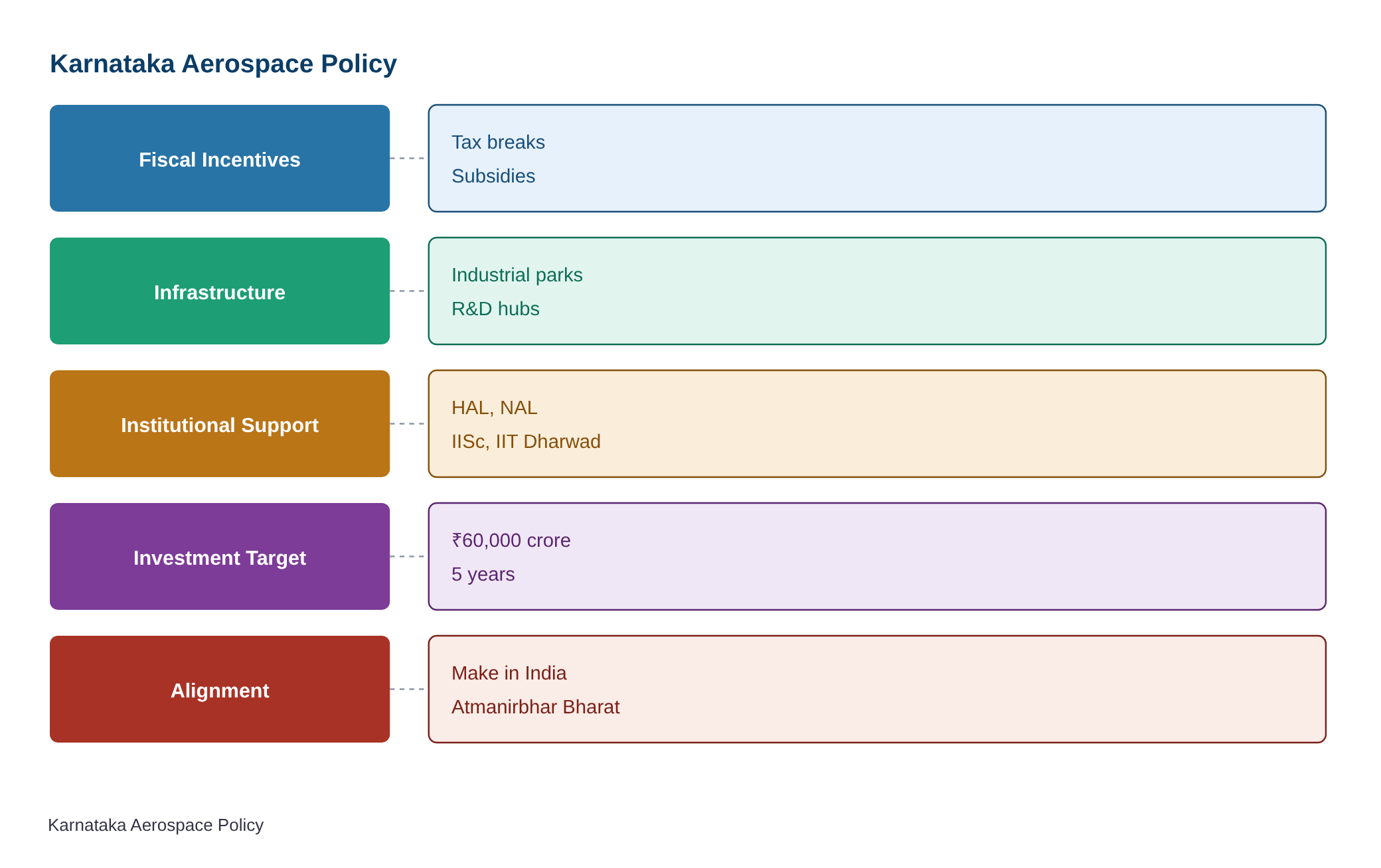
The Karnataka Cabinet’s approval of the Karnataka Aerospace Policy 2026-2031 marks a significant policy intervention aimed at positioning the state as a global hub for aerospace, defence, aviation, and space research and development. With an anticipated investment of ₹60,000 crore over five years, the policy introduces substantial fiscal incentives, institutional support mechanisms, and infrastructure development initiatives, reflecting Karnataka’s strategic vision to leverage its existing industrial base and human capital in high-technology sectors. This development is noteworthy for aspirants as it intersects with broader themes of industrial policy, regional development, and technology-driven growth under the Union Government’s ‘Make in India’ and ‘Atmanirbhar Bharat’ initiatives.
Background
- Karnataka has historically been a leader in India’s aerospace and defence ecosystem, hosting major public sector undertakings (PSUs) such as Hindustan Aeronautics Limited (HAL) in Bengaluru, which is a key supplier to the Indian Air Force and global aerospace majors.
- The state is home to premier research institutions like the Indian Institute of Science (IISc), Indian Institute of Technology (IIT) Dharwad, and the National Aerospace Laboratories (NAL), providing a strong foundation for R&D in aerospace technologies.
- India’s defence and aerospace sector has witnessed rapid growth, driven by increasing defence modernisation, space sector reforms (e.g., the creation of IN-SPACe), and the global shift towards indigenous manufacturing and supply chain localisation.
- The Union Government’s ‘Make in India’ initiative (2014) and ‘Atmanirbhar Bharat’ campaign (2020) have emphasised self-reliance in defence production, with a target of achieving a turnover of ₹1.75 lakh crore in aerospace and defence manufacturing by 2025.
- State-level policies, such as Karnataka’s IT Policy 2020-2025 and the Startup Policy 2026-2030, have laid the groundwork for a conducive ecosystem for technology-driven industries, including aerospace.
- The policy aligns with the Union Government’s Production-Linked Incentive (PLI) schemes for high-technology sectors, including aerospace and defence, which aim to attract investment and reduce import dependence.
What is the Karnataka Aerospace Policy 2026-2031?
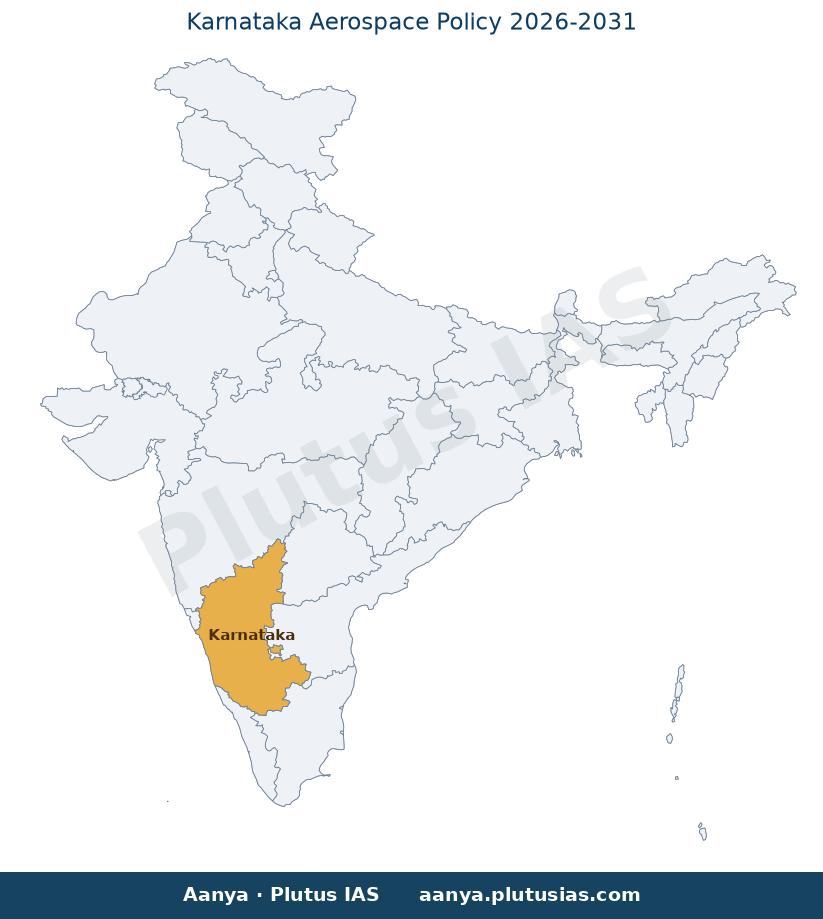
- A five-year strategic policy framework (2026-2031) designed to accelerate the growth of Karnataka’s aerospace, defence, aviation, and space research and development sectors through targeted incentives, infrastructure development, and institutional support.
- The policy introduces a **zoned incentive framework**, classifying regions into **Focus Areas (Zone 1)** and **Non-Focus Areas (Zone 3)**, with differentiated capital subsidies to promote balanced regional development and industrial clustering.
- Capital subsidies have been significantly enhanced: **30% in Zone 1 (high-focus areas)** and **25% in Zone 3 (non-focus areas)**, up from the previous range of 1.75%–2.25% in non-focus areas, to attract large-scale investments.
- The policy includes **credit-linked capital subsidy** and **power subsidy** mechanisms to reduce the cost of capital and operational expenses for investors, particularly in identified **33 focused taluks** across the state.
- A **₹4,000 crore financial outlay** has been earmarked for subsidies, grants, and institutional support, including the establishment of a **drone-based testing facility in Chickballapur (₹42.83 crore)** and an **AI hub (₹35 crore)** to foster innovation in aerospace technologies.
- The policy promotes **public procurement-led innovation** through the ‘government-first initiative’, where the state will adopt emerging technologies developed by startups and MSMEs, aligning with the **Public Procurement (Preference to Make in India) Order 2017**.
- An **International Arbitration Centre (₹16 crore)** will be established in Bengaluru to provide a robust dispute resolution mechanism for aerospace and defence contracts, including online facilities to enhance ease of doing business.
- The policy also integrates with Karnataka’s broader industrial ecosystem by linking aerospace development with the **Textile and Apparel Policy 2026-2031** (which includes silk industries for the first time) and the **Startup Policy 2026-2030**, to create cross-sectoral synergies.
Key Features
| Feature | Significance |
|---|---|
| Aerospace Policy 2026-2031 | Provides a structured framework for investment in aerospace, defence, aviation, and space R&D sectors in Karnataka, aiming to attract ₹60,000 crore over five years. |
| Capital Subsidy Structure | Increases capital subsidy from 1.75-2.25% to 30% in Zone 1 and 25% in Zone 3, incentivizing private sector participation in focus areas. |
| Focused Taluks Identification | 33 taluks identified as investment hubs, eligible for credit-linked capital subsidies, power subsidies, and other incentives to decentralize growth. |
| Drone Testing Facility | India’s first drone-based testing facility at Chickballapur (₹42.83 crore) to support R&D, certification, and commercialization of drone technologies. |
| AI Hub and AI University Precursor | ₹35 crore AI hub at IIIT-Bengaluru to foster innovation, incubation, and modular AI systems, laying groundwork for a future AI University. |
| International Arbitration Centre | Bengaluru’s first International Arbitration Centre (₹16 crore) with online facilities to resolve commercial disputes efficiently, enhancing Karnataka’s business ecosystem. |
Why it Matters
Economic Growth and Investment
- Karnataka’s aerospace policy aligns with the state’s industrial diversification strategy, leveraging its existing aerospace and defence ecosystem (e.g., Hindustan Aeronautics Limited, National Aerospace Laboratories).
- Expected ₹60,000 crore investment over five years can stimulate ancillary industries, create high-skilled employment, and enhance Karnataka’s GDP contribution from the aerospace sector.
- Capital subsidies and targeted incentives reduce the cost of doing business, attracting both domestic and foreign investors in high-technology sectors.
Strategic and Defence Preparedness
- Focus on aerospace and defence sectors supports India’s Atmanirbhar Bharat initiative by promoting indigenous manufacturing and reducing import dependence.
- Drone testing facility and R&D incentives can accelerate the development of unmanned aerial systems, critical for surveillance, logistics, and disaster management.
- Strengthening Karnataka’s aerospace ecosystem contributes to national security by fostering self-reliance in critical aerospace components and technologies.
Technological Advancement and Innovation
- AI hub and drone testing facility position Karnataka as a hub for cutting-edge technologies, fostering collaboration between academia, industry, and startups.
- Innovation-led public procurement and adoption of emerging technologies by the government can drive demand for advanced solutions, accelerating R&D cycles.
- Integration of silk industries into the Textile Policy 2026-2031 highlights Karnataka’s commitment to diversifying high-value manufacturing sectors.
Institutional and Governance Reforms
- Establishment of an International Arbitration Centre enhances Karnataka’s appeal as a business-friendly destination, reducing litigation timelines and improving contract enforcement.
- Structured policies with clear timelines (2026-2031) and measurable outcomes (investment targets, subsidy disbursements) improve governance transparency and accountability.
Challenges
1. Infrastructure Bottlenecks
- Limited availability of specialized infrastructure (e.g., testing facilities, skilled workforce) may hinder the rapid scaling of aerospace and drone industries.
- Reliance on existing industrial clusters (e.g., Bengaluru) could lead to congestion, necessitating decentralized development in identified taluks.
UPSC Link: GS-III: Infrastructure – Challenges and Reforms
2. Skilled Manpower Shortage
- High-technology sectors like aerospace and AI require specialized skills, which may not be readily available in the current workforce.
- Need for collaboration with educational institutions (e.g., IITs, NITs) to design industry-relevant curricula and upskill existing talent.
UPSC Link: GS-III: Human Resource Development
3. Regulatory and Compliance Hurdles
- Complex regulatory frameworks for aerospace, defence, and drone operations may delay project approvals and increase compliance costs.
- Streamlining approval processes for testing facilities, subsidies, and land allocation is critical to attract investors.
UPSC Link: GS-II: Government Policies and Interventions
4. Global Competition
- Karnataka competes with other Indian states (e.g., Tamil Nadu, Maharashtra) and global aerospace hubs (e.g., Singapore, UAE) for investments and talent.
- Sustained policy consistency and ease of doing business will be key to maintaining Karnataka’s competitive edge.
UPSC Link: GS-III: Globalization and its Impact
5. Sustainability and ESG Compliance
- Aerospace and defence industries face scrutiny over environmental and ethical standards, requiring adherence to ESG (Environmental, Social, Governance) norms.
- Investments in green technologies and sustainable manufacturing practices will be essential to meet global benchmarks.
UPSC Link: GS-III: Environment and Sustainable Development
6. Funding and Fiscal Sustainability
- State government’s commitment of ₹4,000 crore in subsidies and financial assistance requires efficient fund utilization to avoid fiscal strain.
- Balancing incentives with revenue generation (e.g., taxes, royalties) will be critical to ensure long-term sustainability of the policy.
UPSC Link: GS-III: Fiscal Policy and Budgeting
Challenges — UPSC Perspective
| Issue | Concern |
|---|---|
| Infrastructure Gaps | Inadequate testing facilities and specialized infrastructure may delay project execution and deter investors. |
| Skill Mismatch | Shortage of high-skilled workforce in aerospace, AI, and drone technologies could limit industry growth. |
| Regulatory Delays | Complex approval processes for aerospace and drone operations may increase project timelines and costs. |
| Global Competition | Competing states and countries with more attractive policies may divert investments away from Karnataka. |
| ESG Compliance | Aerospace and defence sectors face pressure to adopt sustainable practices, requiring significant investment in green technologies. |
| Fiscal Constraints | High subsidy outlays (₹4,000 crore) may strain state finances if revenue generation is not optimized. |
Way Forward
- Constitute a dedicated task force under the Karnataka State Industrial and Infrastructure Development Corporation (KSIIDC) to monitor policy implementation, address bottlenecks, and ensure timely disbursement of subsidies.
- Collaborate with premier educational institutions (e.g., IISc, IITs) to design specialized courses in aerospace engineering, AI, and drone technology, aligning curricula with industry needs.
- Establish a single-window clearance mechanism for aerospace and drone projects to streamline approvals, reduce compliance costs, and accelerate project timelines.
- Develop a comprehensive skill-mapping and upskilling program in partnership with industry associations (e.g., CII, FICCI) to bridge the talent gap in high-technology sectors.
- Create a dedicated R&D fund to support startups and SMEs in aerospace and drone technologies, fostering innovation and commercialization of indigenous solutions.
- Strengthen Karnataka’s aerospace ecosystem by promoting public-private partnerships (PPPs) for infrastructure development, such as testing facilities and industrial parks.
- Enhance ESG compliance by incentivizing aerospace and defence firms to adopt sustainable manufacturing practices, including waste reduction and energy efficiency.
- Leverage Karnataka’s International Arbitration Centre to resolve commercial disputes efficiently, improving investor confidence and contract enforcement.
UPSC Value Addition
Keywords for Mains Answer-Writing
Aerospace Policy · State Industrial Policy · Capital Subsidy · Aerospace and Defence Manufacturing · Regional Development Zones · Startup Policy · Public Procurement · Drone Testing Facility · Artificial Intelligence Hub · International Arbitration Centre · Industrial Corridors · Make in India · Ease of Doing Business · State-Level Incentives · Technology Adoption · Public-Private Partnership
Concept Flow
Identification of aerospace and defence as key growth sectors by Karnataka government → Formulation of Aerospace Policy 2026-2031 with investment incentives → Establishment of focus areas and taluks for decentralized development → Creation of infrastructure (e.g., drone testing facility, AI hub) to support R&D → Attraction of private investment (₹60,000 crore) and skilled workforce → Acceleration of technological innovation and indigenous manufacturing → Enhancement of state’s GDP contribution and strategic preparedness → Long-term sustainable growth with ESG compliance and fiscal sustainability.
Prelims Practice Questions
Q1. Consider the following statements regarding the Karnataka Aerospace Policy 2026-2031:
1. The policy aims to attract ₹60,000 crore investment over five years.
2. Capital subsidy is fixed at 30% in Zone 1 and 25% in Zone 3.
3. The policy includes provisions for a drone-based testing facility in Bengaluru.
4. The policy mandates a minimum 50% local employment in aerospace units.
How many of the above statements are correct?
- Only one
- Only two
- Only three
- All four
Answer: Only three — Statements 1 and 2 are correct as per the policy. Statement 3 is incorrect—the drone-based testing facility is planned in Chickballapur, not Bengaluru. Statement 4 is incorrect—the policy does not mandate a minimum local employment requirement.
Q2. Assertion (A): The Karnataka Aerospace Policy 2026-2031 classifies focus areas and non-focus areas into zones to determine capital subsidy rates.
Reason (R): The policy aims to incentivize investments in specific regions to promote balanced regional development.
In the context of the above two statements, which one of the following is correct?
- Both A and R are true, and R is the correct explanation of A.
- Both A and R are true, but R is not the correct explanation of A.
- A is true, but R is false.
- A is false, but R is true.
Answer: Both A and R are true, and R is the correct explanation of A. — Both Assertion (A) and Reason (R) are true. The policy indeed classifies regions into zones to determine capital subsidy rates, and the rationale is to promote balanced regional development, making R the correct explanation of A.
Q3. Match the following initiatives announced in the Karnataka Cabinet meeting with their respective financial allocations:
Column I (Initiative) | Column II (Allocation)
———————————————–|————————–
A. Drone-based testing facility | 1. ₹16 crore
B. AI hub | 2. ₹42.83 crore
C. International Arbitration Centre | 3. ₹35 crore
D. Financial assistance and subsidies | 4. ₹4,000 crore
Select the correct match:
- A-2, B-3, C-1, D-4
- A-3, B-2, C-1, D-4
- A-2, B-3, C-4, D-1
- A-1, B-2, C-3, D-4
Answer: A-2, B-3, C-1, D-4 — The correct matches are: A (Drone-based testing facility) → ₹42.83 crore, B (AI hub) → ₹35 crore, C (International Arbitration Centre) → ₹16 crore, and D (Financial assistance and subsidies) → ₹4,000 crore.
Mains Practice Question
✍ The Karnataka Aerospace Policy 2026-2031 represents a strategic shift towards fostering high-technology manufacturing and innovation in the aerospace and defence sector. Critically examine the policy’s provisions, including its zonal classification for capital subsidies, financial incentives, and institutional support mechanisms. Also, analyse how such state-level policies can complement the national ‘Make in India’ initiative. (15 Marks)
Approach: MODEL-ANSWER SKELETON:
1. **Introduction (2 Marks)**
– Context: Rising global demand for aerospace and defence manufacturing, India’s push for self-reliance (Atmanirbhar Bharat), and Karnataka’s existing aerospace ecosystem (e.g., Hindustan Aeronautics Limited, ISRO facilities).
– Objective of the policy: To attract ₹60,000 crore investment over five years, create employment, and position Karnataka as a global aerospace hub.
2. **Key Provisions of the Policy (5 Marks)**
– **Zonal Classification and Capital Subsidies**: Explain the classification into focus and non-focus areas with zones 1, 2, and 3. Highlight the increase in capital subsidy from 1.75–2.25% to 30% (Zone 1) and 25% (Zone 3).
– **Financial Incentives**: Credit-linked capital subsidy, power subsidies, and ₹4,000 crore allocation for financial assistance.
– **Institutional Support**: Drone-based testing facility (₹42.83 crore), AI hub (₹35 crore), and International Arbitration Centre (₹16 crore).
– **Focus on Startups**: Government-first initiative, innovation-led public procurement, and adoption of technologies.
3. **Complementarity with National Initiatives (4 Marks)**
– **Make in India**: Aligns with the national programme by promoting domestic manufacturing, reducing import dependence, and enhancing export competitiveness.
– **Atmanirbhar Bharat**: Supports the vision of self-reliance in critical sectors like aerospace and defence.
– **Ease of Doing Business**: State-level incentives reduce bureaucratic hurdles, streamline approvals, and improve investor confidence.
– **Skill Development and R&D**: Partnerships with institutions like IISc, IITs, and ISRO to foster innovation and skill development.
4. **Critical Analysis (3 Marks)**
– **Strengths**: Clear zonal focus, substantial financial incentives, and institutional support for innovation and dispute resolution.
– **Challenges**: Implementation risks (e.g., land acquisition, bureaucratic delays), competition from other states, and ensuring sustainable employment generation.
– **Sustainability**: Long-term viability depends on continuous policy support, global market trends, and Karnataka’s ability to retain talent and investment.
5. **Conclusion (1 Mark)**
– Summarise the policy’s potential to transform Karnataka into an aerospace and defence manufacturing hub while reinforcing India’s self-reliance goals.
Source: The Hindu
Karnataka PCS (KPSC) — State PCS Practice
Prelims: Which of the following is a key objective of Karnataka’s newly approved Aerospace Policy aimed at boosting investments?
- A. To attract ₹60,000 crore investment in the aerospace sector within five years
- B. To establish Karnataka as a global hub for automobile manufacturing
- C. To promote traditional handicrafts and rural industries
- D. To develop coastal tourism infrastructure along Karnataka’s coastline
Answer: A. To attract ₹60,000 crore investment in the aerospace sector within five years — The Karnataka Cabinet approved the Aerospace Policy with the primary goal of attracting ₹60,000 crore in investments within five years to strengthen the state’s aerospace ecosystem.
Mains: Critically analyze the potential socio-economic impacts of Karnataka’s Aerospace Policy on the state’s industrial growth, employment generation, and technological advancement. Support your answer with relevant examples from Karnataka’s existing aerospace ecosystem.
Generated by AanyaAi for educational purpose.
Related guides on our sites
- Current affairs for upsc 2026
- Best PSIR optional coaching for upsc
- Best PSIR optional teacher for upsc
- Best teacher of PSIR optional for upsc

- सीओपी31: जलवायु शिक्षा से कार्रवाई तक का भारत का प्रयास - October 26, 2026
- Northeast Monsoon 2026: Unpredictability & El Niño Impact for UPSC - October 26, 2026
- गंभीर चक्रवात के खतरे से निपटने को तैयार रहें अधिकारी: भूगोल से संबंधित महत्वपूर्ण जानकारी - October 26, 2026

No Comments