


19 Sep Karnataka CM Backs Farmers: Kasturirangan Report & Western Ghats ESA Controversy
✎ The Kasturirangan report proposes declaring 37% of the Western Ghats as Ecologically Sensitive Areas (ESAs), where developmental activities are restricted, while the Forest Rights Act, 2006, recognises the land rights of…
Subject Relevance — Where This Topic Fits
- GS Paper II — Functions and Responsibilities of the Union and the States, Issues and Challenges Pertaining to the Federal Structure | GS Paper III — Conservation, Environmental Pollution and Degradation, Environmental Impact Assessment
- Prelims: Western Ghats, Kasturirangan Report, Ecologically Sensitive Areas (ESA), Forest Rights Act 2006, Forest (Conservation) Act 1980, Scheduled Tribes and Other Traditional Forest Dwellers (Recognition of Forest Rights) Act, 2006
- Essay: Environmental governance and sustainable development: Balancing conservation with livelihood security, Federalism in environmental policy: Centre-state coordination in ecological governance
Quick Revision: The Kasturirangan report proposes declaring 37% of the Western Ghats as Ecologically Sensitive Areas (ESAs), where developmental activities are restricted, while the Forest Rights Act, 2006, recognises the land rights of traditional forest-dwelling communities, creating a potential conflict between conservation and livelihood security.
Why is this in the news?
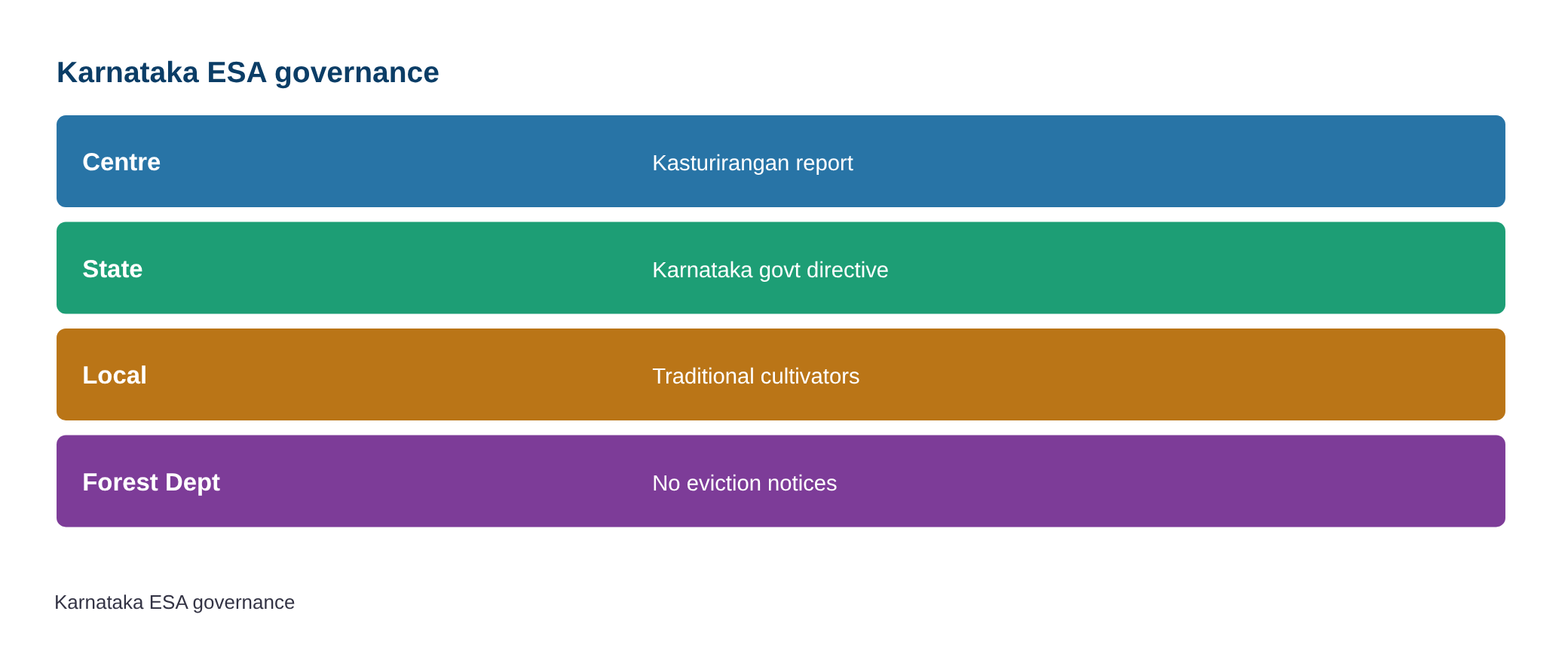
The Chief Minister of Karnataka, in a public consultation held in Tirthahalli on 19 September 2026, directed the Forest Department to refrain from issuing eviction notices to traditional cultivators in the Western Ghats region, citing the Kasturirangan report’s draft notification for declaring Ecologically Sensitive Areas (ESAs). This directive underscores the state’s response to local concerns over livelihood disruptions while navigating the Centre’s conservation agenda, highlighting the intersection of environmental policy, federalism, and tribal rights in India’s governance framework.
Background
- The Western Ghats, a UNESCO World Heritage Site, is a biodiversity hotspot spanning six states including Karnataka, and faces competing demands for conservation and development.
- The Kasturirangan Committee (2013) was constituted by the Union Ministry of Environment, Forest and Climate Change to recommend measures for the protection of the Western Ghats, leading to the identification of Ecologically Sensitive Areas (ESAs) where developmental activities are restricted.
- The draft notification proposing ESAs in Karnataka was met with widespread protests from farming communities, particularly in the Malnad region, over fears of displacement and loss of livelihoods.
- The Forest Rights Act, 2006, recognises the rights of forest-dwelling communities, including traditional cultivators, over forest land, creating a legal framework for their claims and protections.
- Karnataka has historically implemented land reforms, including granting land titles to tenant farmers and ‘bagair hukum’ cultivators, reflecting its commitment to agrarian justice.
- The state government’s directive aligns with its broader policy of engaging stakeholders in environmental governance, as seen in its decision to hold public consultations before finalising its stance on the ESA notification.
What is the Kasturirangan Report and its Implications for the Western Ghats?
- The Kasturirangan Committee, led by Dr. K. Kasturirangan, was constituted in 2013 by the Union Ministry of Environment, Forest and Climate Change to assess the ecological status of the Western Ghats and recommend conservation measures.
- The report identified 37% of the Western Ghats as Ecologically Sensitive Areas (ESAs) where developmental activities such as mining, thermal power plants, and large-scale construction are restricted to protect biodiversity.
- The draft notification for ESAs, issued by the Union Ministry of Environment, Forest and Climate Change, proposes to declare 56,825 sq. km across six states as ESAs, including significant portions in Karnataka.
- The Forest Rights Act, 2006, provides a legal framework for recognising the rights of forest-dwelling communities, including traditional cultivators, over forest land, which may conflict with ESA restrictions.
- The Kasturirangan report’s recommendations have sparked debates between conservationists advocating strict protection and local communities dependent on forest-based livelihoods.
- The Union government’s draft ESA notification is based on the Kasturirangan report’s recommendations and is open to public consultation and state-level feedback.
- The Western Ghats Ecology Expert Panel (WGEEP), chaired by Prof. Madhav Gadgil (2011), had earlier recommended a more stringent 64% of the region as ESAs, leading to divergent policy approaches.
Key Features
| Feature | Significance |
|---|---|
| Kasturirangan Report (2013) | Provides the scientific basis for declaring Ecologically Sensitive Areas (ESAs) in the Western Ghats, recommending land-use restrictions to conserve biodiversity and ecosystem services. |
| Ecologically Sensitive Areas (ESAs) | Designated zones under the Environment Protection Act, 1986, where developmental activities are regulated to prevent ecological degradation. |
| Forest Rights Act, 2006 (FRA) | Recognises the rights of traditional forest dwellers, including cultivators, over forest land occupied for livelihoods, subject to verification of occupation. |
| Public Consultation Process | Constitutional and statutory requirement under the Environment Protection Act to gather stakeholder views before finalising ESA notifications. |
| Traditional Cultivators’ Rights | Historical land-use practices by local communities, often predating forest laws, which require balancing conservation with livelihood security. |
Why it Matters
Ecological Conservation
- The Western Ghats, a UNESCO World Heritage Site, is a global biodiversity hotspot harbouring endemic flora and fauna, including 325 globally threatened species.
- ESAs aim to mitigate threats from unregulated land-use changes, mining, and infrastructure projects that fragment habitats and reduce ecosystem resilience.
- The Kasturirangan report’s recommendations are rooted in the Gadgil Committee’s earlier findings, which highlighted the need for strict conservation measures in fragile ecosystems.
- Conservation of the Western Ghats is critical for maintaining the monsoon regime, water security, and carbon sequestration in peninsular India.
Livelihood Security
- Traditional cultivators in the Malnad region rely on agroforestry systems, including areca nut, cardamom, and coffee cultivation, which are adapted to the Western Ghats’ ecology.
- Restrictions under ESA notifications may limit agricultural expansion, access to forest resources, or land tenure security, disproportionately affecting marginalised communities.
- The Forest Rights Act, 2006, provides a legal framework to reconcile conservation with the rights of forest-dependent populations, though implementation challenges persist.
Governance and Policy Coherence
- The Karnataka government’s directive reflects the tension between conservation policies (ESA notifications) and social justice frameworks (FRA), requiring harmonised implementation.
- Public consultations are a statutory mechanism to ensure democratic participation in environmental governance, as mandated under the Environment Protection Act, 1986.
- State governments play a pivotal role in balancing Centre-state dynamics in environmental policymaking, particularly in federated governance structures.
Legal and Institutional Framework
- The Environment Protection Act, 1986 empowers the Central Government to designate ESAs and regulate activities within them, overriding state laws where necessary.
- The Forest Rights Act, 2006, vests authority in Gram Sabhas to determine and vest forest rights, creating a decentralised mechanism for conflict resolution.
- The Kasturirangan report’s recommendations are advisory; their adoption depends on state compliance and Centre-state coordination.
Challenges
1. Balancing Conservation and Livelihoods
- Traditional cultivators’ rights under the FRA often conflict with ESA restrictions, leading to legal disputes and livelihood disruptions.
- The 75-year occupation requirement under FRA is contentious; reducing it to 25 years, as proposed by the Karnataka CM, may expand eligibility but risks diluting conservation objectives.
- Lack of synchronisation between FRA implementation and ESA notifications creates administrative overlaps and delays in justice delivery.
UPSC Link: GS III: Environment & Biodiversity
2. Scientific vs. Ground Realities
- The Kasturirangan report’s blanket ESA recommendations may not account for micro-level ecological variations or traditional land-use practices.
- Physical surveys, as suggested by stakeholders, are time-consuming and resource-intensive but necessary to reconcile scientific data with ground realities.
- The Kerala-model survey (referenced in the news) involves participatory mapping with local communities, which could improve accuracy but requires political will and funding.
UPSC Link: GS III: Environment & Biodiversity
3. Centre-State Coordination
- ESA notifications are issued by the Centre under the Environment Protection Act, 1986, but implementation depends on state governments, leading to potential friction.
- State governments may resist ESA notifications due to electoral pressures or perceived adverse impacts on local economies, as seen in Karnataka’s stance.
- The absence of a unified national policy on ESAs in the Western Ghats creates inconsistencies in conservation efforts across states.
UPSC Link: GS II: Federalism
4. Legal Ambiguities in FRA Implementation
- The FRA’s ambiguous definition of ‘forest’ (Section 2) leads to disputes over land classification, particularly in revenue forests and private lands.
- Gram Sabhas’ role in vesting rights is often undermined by forest departments’ resistance to decentralisation, delaying FRA benefits to claimants.
- The Karnataka CM’s proposal to reduce the 75-year occupation requirement may face legal challenges under the FRA’s provisions.
UPSC Link: GS II: Governance
5. Public Participation and Trust Deficit
- Historical grievances over forced evictions and lack of transparency in ESA notifications have eroded trust between communities and forest departments.
- Public consultations, while mandated, are often perceived as tokenistic, with decisions already pre-determined by authorities.
- The Karnataka government’s directive to withhold eviction notices is a temporary measure; long-term solutions require structural reforms in governance.
UPSC Link: GS II: Governance
Challenges — UPSC Perspective
| Issue | Concern |
|---|---|
| Overlapping Jurisdictions | Conflict between Centre’s ESA powers (Environment Protection Act) and state’s FRA implementation, leading to administrative paralysis. |
| Occupation Period Discrepancies | FRA’s 75-year requirement vs. proposed 25-year threshold may expand eligibility but risks diluting conservation goals and legal challenges. |
| Scientific Rigor vs. Ground Truth | Kasturirangan report’s blanket recommendations may not align with traditional land-use practices, necessitating participatory surveys. |
| Trust Deficit in Governance | Historical grievances over evictions and lack of transparency in ESA notifications undermine public participation. |
| Resource Constraints | Physical surveys and FRA implementation require significant administrative and financial resources, often lacking in states. |
| Centre-State Friction | State resistance to ESA notifications due to electoral or economic considerations may hinder national conservation goals. |
Government Initiatives — Must-Memorise for Prelims
- Forest Rights Act, 2006 (FRA)
- Environment Protection Act, 1986 (EPA)
- Western Ghats Ecology Expert Panel (WGEEP) Report (Gadgil Committee, 2011)
- Kasturirangan Report (2013) on Western Ghats
Way Forward
- Conduct participatory physical surveys in consultation with Gram Sabhas to map traditional cultivators’ lands and identify ESAs accurately.
- Harmonise FRA implementation with ESA notifications by synchronising Gram Sabha proceedings with forest department verifications.
- Establish a multi-stakeholder committee (Centre, State, local communities, ecologists) to reconcile conservation goals with livelihood security.
- Amend the Environment Protection Act, 1986, to provide clear guidelines for ESA notifications, including micro-level ecological assessments.
- Strengthen Gram Sabhas’ role in FRA implementation through capacity-building and legal support to overcome forest department resistance.
- Pilot the Kerala-model survey in Karnataka’s Malnad region to test its feasibility and scalability for ESA delineation.
- Develop a state-specific action plan for Western Ghats conservation, aligning with the National Mission for a Green India (GIM).
- Enhance transparency in public consultations by publishing draft ESA maps and grievance redressal mechanisms in regional languages.
UPSC Value Addition
Keywords for Mains Answer-Writing
Western Ghats · Kasturirangan Report · Ecologically Sensitive Areas (ESA) · Forest Rights Act, 2006 · Traditional cultivators · Forest Department · Western Ghats Ecology Expert Panel (WGEEP) · Scheduled Tribes and Other Traditional Forest Dwellers (Recognition of Forest Rights) Act · Public consultations · Land rights · Forest encroachment · Western Ghats conservation · Forest governance · Environmental governance · Land survey methodologies · Legislative processes in environmental policy
Concept Flow
Western Ghats’ ecological fragility → Kasturirangan Report recommends ESAs → Centre issues draft ESA notification → State governments face livelihood-security concerns → Public consultations mandated → Traditional cultivators’ rights under FRA invoked → Administrative conflicts arise → Karnataka CM directs Forest Department to withhold evictions → Need for harmonised implementation of FRA and EPA → Multi-stakeholder dialogue for sustainable governance.
Prelims Practice Questions
Q1. Consider the following statements regarding the Kasturirangan Report on the Western Ghats:
1. The Kasturirangan Report was submitted by the Western Ghats Ecology Expert Panel (WGEEP) in 2011.
2. The report recommended the declaration of ecologically sensitive areas (ESAs) across the Western Ghats.
3. The report proposed a blanket ban on all human activities within the Western Ghats region.
How many of the above statements are correct?
- Only one
- Only two
- All three
- None
Answer: Only two — Statement 1 is correct: The Kasturirangan Report was submitted by the Western Ghats Ecology Expert Panel (WGEEP) in 2011. Statement 2 is correct: The report recommended the declaration of ecologically sensitive areas (ESAs) across the Western Ghats. Statement 3 is incorrect: The report did not propose a blanket ban but recommended regulated activities based on ecological sensitivity.
Q2. Assertion (A): The Forest Rights Act, 2006, grants land titles to traditional forest dwellers and cultivators.
Reason (R): The Act aims to correct historical injustices by recognizing the rights of forest-dependent communities over forest land and resources.
Options:
A. Both A and R are true, and R is the correct explanation of A.
B. Both A and R are true, but R is not the correct explanation of A.
C. A is true, but R is false.
D. A is false, but R is true.
Answer: ? — Both Assertion (A) and Reason (R) are true. The Forest Rights Act, 2006, indeed grants land titles to traditional forest dwellers and cultivators, and the Act’s primary objective is to correct historical injustices by recognizing their rights over forest land and resources.
Q3. Match the following committees/panels with their respective reports on the Western Ghats:
Column I (Committee/Panel)
A. Gadgil Committee
B. Kasturirangan Committee
C. Western Ghats Ecology Expert Panel (WGEEP)
Column II (Report)
1. Report on Western Ghats: An Ecological Atlas
2. Report on the Western Ghats Ecology Expert Panel (WGEEP)
3. High-Level Working Group on Western Ghats
Options:
A. A-1, B-3, C-2
B. A-2, B-3, C-1
C. A-3, B-1, C-2
D. A-2, B-1, C-3
Answer: ? — A. Gadgil Committee is associated with the Report on Western Ghats: An Ecological Atlas (2011). B. Kasturirangan Committee is associated with the High-Level Working Group on Western Ghats (2013). C. Western Ghats Ecology Expert Panel (WGEEP) is associated with the Report on the Western Ghats Ecology Expert Panel (WGEEP) (2011).
Mains Practice Question
✍ The Kasturirangan Report’s recommendations for declaring ecologically sensitive areas (ESAs) in the Western Ghats have sparked significant debate between conservation imperatives and the rights of traditional cultivators. Critically examine the ecological, legal, and socio-economic dimensions of this conflict, with particular reference to the Forest Rights Act, 2006, and recent public consultations in Karnataka. (15 Marks)
Approach: MODEL-ANSWER SKELETON:
1. **Ecological Imperatives**:
– Brief on the Western Ghats’ ecological significance (biodiversity hotspot, UNESCO World Heritage Site, water towers of peninsular India).
– Kasturirangan Report’s rationale: need for conservation to mitigate threats (deforestation, climate change, habitat fragmentation).
– ESA framework: restrictions on land-use activities to preserve ecological integrity.
2. **Legal Framework**:
– Forest Rights Act, 2006: Core provisions (Sections 3, 4, 6) recognizing rights of forest-dwelling Scheduled Tribes and other traditional forest dwellers.
– Conflict with ESA declarations: potential dilution of rights under Section 5 (consent of Gram Sabhas) and Section 4(5) (rights not to be affected by subsequent laws unless explicitly stated).
– Recent judicial precedents (e.g., *T.N. Godavarman Thirumulpad* case, *Niyamgiri* judgment) on balancing conservation and tribal rights.
3. **Socio-Economic Dimensions**:
– Traditional cultivators’ dependence on forest land: shifting cultivation (e.g., *Kumri* in Maharashtra/Karnataka), agroforestry, and subsistence livelihoods.
– Karnataka’s public consultations: Chief Minister’s directive to protect traditional cultivators; demands for reduced land claim period under FRA (75 to 25 years); suggestions for Kerala-model surveys.
– State vs. Centre dynamics: federal tensions in environmental governance; role of State Legislative Assemblies in passing resolutions (e.g., Karnataka’s proposed resolution on FRA amendments).
4. **Balancing Approaches**:
– Alternative models: Kerala’s participatory mapping of human habitations within ESAs; Karnataka’s proposal for physical surveys.
– Role of Gram Sabhas: Community-led conservation under FRA and PESA (Panchayats (Extension to Scheduled Areas) Act, 1996).
– Need for integrated policy: harmonizing conservation goals (Wildlife Protection Act, 1972; Biological Diversity Act, 2002) with FRA compliance.
5. **Conclusion**:
– Emphasize the necessity of a nuanced, rights-based conservation model.
– Highlight the importance of inclusive governance (public consultations, Gram Sabha consent) and evidence-based policy (physical surveys, ecological data).
– Stress the need for Centre-State coordination to avoid policy contradictions and ensure sustainable development.
Source: The Hindu
Karnataka PCS (KPSC) — State PCS Practice
Prelims: In the context of the Kasturirangan report and Karnataka’s forest conservation policies, what action has the Karnataka Chief Minister instructed the Forest Department regarding traditional cultivators?
- To issue eviction notices to traditional cultivators without delay
- To refrain from issuing eviction notices to traditional cultivators
- To prioritize eviction notices for traditional cultivators over other forest dwellers
- To delegate eviction decisions to local panchayats
Answer: To refrain from issuing eviction notices to traditional cultivators — The Karnataka CM instructed the Forest Department not to issue eviction notices to traditional cultivators, aligning with concerns raised about the Kasturirangan report’s impact on local livelihoods.
Mains: Analyze the implications of the Kasturirangan report on forest conservation in Karnataka, particularly in the context of traditional cultivators. How does the Chief Minister’s directive reflect a balance between conservation goals and socio-economic realities? Provide a critical assessment with relevant examples from Karnataka.
Generated by AanyaAi for educational purpose.
Related guides on our sites
- Best PSIR optional coaching for upsc
- Best economics optional coaching for upsc
- Best PSIR optional teacher for upsc
- Best teacher of PSIR optional for upsc

- यूपी हाईकोर्ट ने स्कूल बस सुरक्षा पर दिया सख्त आदेश, डीएम को 1 माह में रिपोर्ट देने का निर्देश - September 22, 2026
- UP High Court Directs DM & Chief Secretary on School Vehicle Safety: Key Facts for UPSC/PCS - September 22, 2026
- पेरियार टाइगर रिजर्व में 6 नई प्रजातियाँ खोजी गईं, जानिए क्या हैं विशेषताएँ - September 22, 2026

No Comments