


08 Aug Karnataka Groups Demand Action Against BCC Over Mahajan Commission Delay
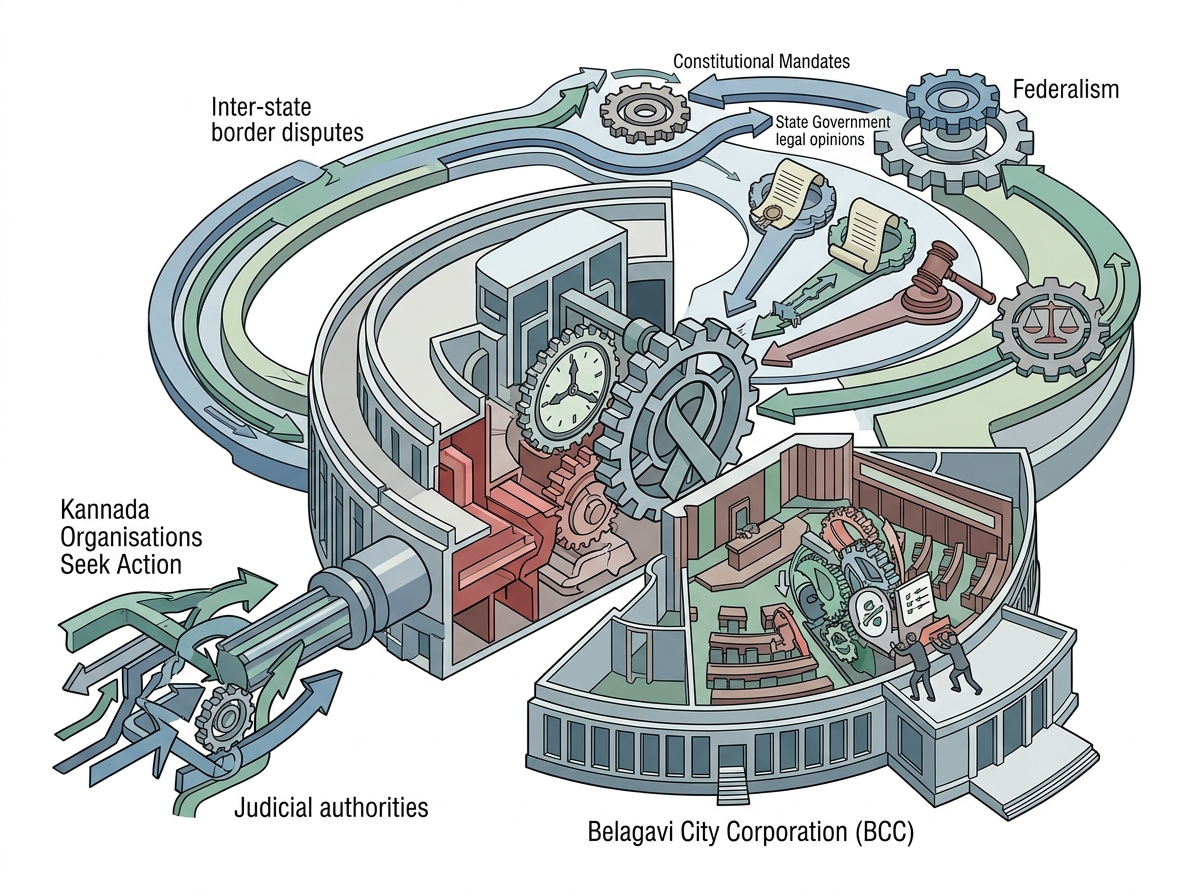
Belagavi City CorporationState governmentJudicial authorities✎ The Mahajan Commission (1967) affirmed Belagavi as an integral part of Karnataka; local bodies like the BCC must align with constitutional and judicial mandates in such matters.
Subject Relevance — Where This Topic Fits
- GS Paper II — Polity and Governance (Local Governance, Constitutional Provisions) | GS Paper II — Polity and Governance (Inter-State Relations and Federalism) | GS Paper II — Polity and Governance (Role of Judiciary in Resolving Inter-State Disputes) | GS Paper IV — Ethics, Integrity and Aptitude (Accountability of Public Institutions)
- Prelims: Mahajan Commission, Inter-State Water Disputes Act, 1956, Article 263 of the Constitution, Urban Local Bodies (ULBs), Karnataka State Border and River Protection Commission, Constitutional provisions on inter-state disputes, Role of State Legislature in border disputes, Supreme Court’s advisory jurisdiction
- Essay: Federalism and Cooperative Governance in India: Lessons from Inter-State Border Disputes, Role of Institutions in Upholding Constitutional Integrity: A Case Study of the Belagavi Border Issue
Quick Revision: The Mahajan Commission (1967) affirmed Belagavi as an integral part of Karnataka; local bodies like the BCC must align with constitutional and judicial mandates in such matters.
Why is this in the news?
The delay by the Belagavi City Corporation (BCC) in passing a resolution affirming the Mahajan Commission’s recommendations—affirming Belagavi as an integral part of Karnataka—has reignited political and legal debates over federalism, local governance, and the resolution of inter-state border disputes. The refusal of the BCC to act despite clear legal opinions from the State government and judicial authorities has raised concerns about institutional accountability, the supremacy of constitutional mandates, and the mechanisms available to enforce administrative compliance in matters of inter-state territorial integrity.
Background
- The Mahajan Commission, constituted in 1966, was tasked with resolving the border dispute between Karnataka and Maharashtra, particularly concerning Belagavi (then Belgaum), which was a part of the erstwhile Bombay Presidency.
- The Commission submitted its report in 1967, recommending that Belagavi be retained within Karnataka, citing linguistic and administrative grounds. This recommendation was accepted by the Government of Karnataka and the State Legislature.
- The dispute resurfaced periodically, with Maharashtra staking claim to parts of Karnataka, including Belagavi, based on historical and administrative arguments.
- The Karnataka State Border and River Protection Commission, chaired by Justice Nagamohan Das, has consistently affirmed that Belagavi is an integral part of Karnataka, with no legal impediments to passing a resolution to this effect.
- The Belagavi City Corporation (BCC), an urban local body under the Karnataka Municipal Corporations Act, 1976, has been reluctant to pass a resolution affirming the Mahajan Commission’s recommendations, despite repeated requests from Kannada organisations and legal opinions from the State government.
- The delay has led to protests by Kannada organisations, including arrests of activists, and demands for the supersession of the BCC or the withholding of funds until the resolution is passed.
What is the Mahajan Commission, and why does its resolution matter?
- The Mahajan Commission, formally known as the **Mahajan Committee on the Belagavi Border Dispute**, was constituted to resolve the territorial dispute between Karnataka and Maharashtra over Belagavi and other border areas.
- The Commission submitted its report in 1967, recommending that Belagavi be retained within Karnataka, primarily on linguistic and administrative grounds, as the majority of the population spoke Kannada.
- The Commission’s recommendations were accepted by the Government of Karnataka and the State Legislature.
- The dispute is not merely territorial but also linguistic and cultural, as Belagavi has been a historical centre of Kannada culture and administration. The Mahajan Commission’s report is a critical legal and constitutional document that affirms Karnataka’s claim over Belagavi.
- The delay by the BCC in passing a resolution affirming the Commission’s recommendations raises questions about the role of urban local bodies in upholding constitutional and legal mandates, particularly in matters concerning inter-state territorial integrity.
- The Constitution of India, under **Article 263**, empowers the President to establish an Inter-State Council to resolve disputes between States.
- The reluctance of the BCC to act also highlights the broader issue of **institutional accountability** in local governance, where elected representatives may prioritise political considerations over constitutional and legal obligations.
Key Features
| Feature | Significance |
|---|---|
| Mahajan Commission Recommendations | Establishes the constitutional and legal position that Belagavi is an integral part of Karnataka, resolving historical border disputes. |
| Belagavi City Corporation (BCC) Resolution | A formal administrative act by the local body to endorse the Mahajan Commission’s findings, reinforcing state sovereignty over the region. |
| State Government’s Legal Opinion | Provides clarity on the absence of legal impediments to passing the resolution, removing bureaucratic excuses for delay. |
| Protests by Kannada Organisations | Exerts democratic pressure on the BCC and state government to uphold constitutional and administrative integrity. |
| Supreme Court Advocate’s Opinion | Adds judicial weight to the argument that the resolution is legally permissible and administratively necessary. |
Why it Matters
Administrative and Governance
- Demonstrates the role of local self-government (Article 243W) in upholding state sovereignty and constitutional directives.
- Highlights the obligation of urban local bodies to align administrative actions with state and national policies.
- Exposes systemic delays in governance, where legal clarity exists but implementation falters due to bureaucratic inertia.
Legal and Constitutional
- Reaffirms the supremacy of the Mahajan Commission’s findings, which were accepted by the Karnataka State Legislature.
- Emphasises the principle that administrative resolutions must reflect constitutional and judicial positions.
- Underscores the duty of local bodies to act in consonance with state government policies, as per the 74th Constitutional Amendment Act.
Political and Social
- Showcases the role of regional organisations in safeguarding linguistic and cultural identity through constitutional means.
- Illustrates the tension between local autonomy and state directives, a recurring theme in federal governance.
- Highlights the importance of public participation in ensuring accountability of elected representatives and administrative bodies.
Challenges
1. Bureaucratic Delay and Inaction
- The BCC’s failure to pass the resolution despite clear legal and administrative directives.
- Indifference of the Mayor in convening meetings or addressing public grievances.
- Systemic delays in governance that undermine constitutional and statutory obligations.
UPSC Link: 74th Constitutional Amendment Act
2. Legal Ambiguity (Perceived)
- The Mayor’s reference to the State government for a legal opinion, despite the absence of any legal hurdle.
- Confusion among local officials regarding the enforceability of Mahajan Commission recommendations.
- Need for repeated clarifications from higher authorities to resolve administrative inertia.
UPSC Link: Article 243W
3. Public Trust and Accountability
- Erosion of public confidence in local governance due to repeated failures to act on clear directives.
- Arrests of protestors during demonstrations, indicating a breakdown in communication between citizens and administration.
- Demands for supersession of the BCC or withdrawal of funds as punitive measures for non-compliance.
UPSC Link: Right to Constitutional Remedies
4. Federalism and Local Autonomy
- Tension between the autonomy of urban local bodies and the state government’s directives.
- Need for a balance between local representation and adherence to state policies.
- Potential for similar disputes in other regions with historical border complexities.
UPSC Link: Federal Structure of India
Challenges — UPSC Perspective
| Issue | Concern |
|---|---|
| Delay in Resolution | Undermines administrative efficiency and public trust in governance. |
| Perceived Legal Ambiguity | Leads to bureaucratic procrastination and unnecessary delays. |
| Public Protests and Arrests | Indicates a breakdown in democratic engagement and administrative responsiveness. |
| Mayor’s Inaction | Reflects a lack of leadership and accountability in local governance. |
| State Government’s Role | Highlights the need for proactive intervention to ensure compliance with constitutional directives. |
| Funding Cuts as Punitive Measure | Raises questions about the appropriateness of financial penalties for administrative non-compliance. |
Way Forward
- The State Government should issue a formal directive to the BCC, mandating the passage of the resolution within a stipulated timeframe.
- The Mayor of Belagavi should be held accountable for the delay and directed to convene an emergency meeting of the BCC.
- Legal and administrative workshops should be organised for local body officials to clarify their roles and obligations under the 74th Constitutional Amendment Act.
- Public consultations should be held to address grievances and restore trust in local governance mechanisms.
- The State Government should consider superseding the BCC if it continues to defy directives, in accordance with the provisions of the Karnataka Municipal Corporations Act.
- A monitoring committee should be constituted to oversee the implementation of the resolution and report progress to the State Government.
- Citizen awareness campaigns should be launched to educate the public on their rights and the legal status of Belagavi as part of Karnataka.
- The State Government should engage with Kannada organisations to address their concerns and ensure inclusive governance.
UPSC Value Addition
Keywords for Mains Answer-Writing
Karnataka-Belagavi border dispute · Mahajan Commission · Belagavi City Corporation (BCC) · Article 243U of the Constitution · State legislature resolutions on border disputes · Urban local bodies and constitutional obligations · Inter-State border commissions · Karnataka State Border and River Protection Commission · Doctrine of pith and substance · Constitutional morality · Federalism in India · Local self-government under 73rd/74th Amendments · Judicial review of executive actions · Constitutional status of resolutions passed by local bodies · Inter-State disputes and Centre-State relations
Concept Flow
Historical border dispute between Karnataka and Maharashtra (pre-Mahajan Commission) → Formation of the Mahajan Commission (1966) → Commission submits report affirming Belagavi as part of Karnataka → State Legislature endorses recommendations → BCC introduces resolution to endorse findings → Resolution delayed due to bureaucratic inertia → Kannada organisations protest and demand action → State Government issues legal opinion affirming no impediments → BCC continues to delay → Public pressure mounts → State Government consults experts and considers administrative remedies → Resolution remains pending, highlighting governance challenges.
Prelims Practice Questions
Q1. Consider the following statements regarding the Mahajan Commission and Belagavi:
1. The Mahajan Commission was constituted to resolve the Karnataka-Maharashtra border dispute.
2. The Commission recommended that Belagavi be an integral part of Karnataka.
3. The recommendations of the Commission are binding on the State governments.
4. The State government of Karnataka has passed resolutions in the legislature endorsing the Commission’s recommendations.
How many of the above statements are correct?
- Only one
- Only two
- Only three
- All four
Answer: Only three — Statements 1, 2, and 4 are correct. Statement 3 is incorrect as the recommendations of the Mahajan Commission are not legally binding; they are advisory in nature.
Q2. Assertion (A): The Belagavi City Corporation (BCC) is constitutionally obligated to pass resolutions endorsing the Mahajan Commission’s recommendations.
Reason (R): The 74th Constitutional Amendment Act, 1992, empowers urban local bodies to perform functions as specified in the 12th Schedule, including matters related to local governance and administration.
Options:
A. Both A and R are true, and R is the correct explanation of A.
B. Both A and R are true, but R is not the correct explanation of A.
C. A is true, but R is false.
D. A is false, but R is true.
Answer: ? — Assertion (A) is true as the BCC, being an urban local body, is expected to align its actions with state policies, including resolutions endorsing the Mahajan Commission’s recommendations. Reason (R) is true as the 74th Amendment empowers urban local bodies, but it does not explicitly mandate the passing of specific resolutions. Thus, R is not the correct explanation of A.
Q3. Which of the following Articles of the Indian Constitution empowers the State legislature to pass resolutions on matters of inter-State disputes?
- Article 131
- Article 246
- Article 243U
- Article 262
Answer: Article 243U — Article 243U empowers the State legislature to pass resolutions on matters within its jurisdiction, including those related to local governance. While Article 131 deals with disputes between the Government of India and States, Article 262 pertains to the adjudication of inter-State water disputes.
Mains Practice Question
✍ The refusal of the Belagavi City Corporation (BCC) to pass a resolution endorsing the Mahajan Commission’s recommendations on Belagavi’s status as an integral part of Karnataka raises critical questions about the constitutional obligations of urban local bodies and the role of State governments in resolving inter-State disputes. Critically examine the legal and constitutional dimensions of this issue, with particular reference to the doctrine of federalism and the 74th Constitutional Amendment Act. Also, analyse the implications of such delays for inter-State relations and local self-governance. (15 Marks)
Approach: MODEL-ANSWER SKELETON:
1. **Context and Background (2 Marks)**
– Briefly outline the Karnataka-Maharashtra border dispute and the role of the Mahajan Commission (1966).
– State the Commission’s recommendation that Belagavi be part of Karnataka and the State legislature’s endorsement.
2. **Constitutional and Legal Framework (5 Marks)**
– **Article 243U**: Powers and functions of urban local bodies; obligation to align with State policies.
– **Doctrine of Federalism**: Distribution of powers between Centre and States (Article 246); cooperative federalism in resolving inter-State disputes.
– **Role of State Government**: Power to issue directives to local bodies under Article 243ZD(3) or through executive instructions.
– **Judicial Precedents**: Reference to cases like *State of West Bengal v. Kesoram Industries* (2004) on the binding nature of State policies on local bodies.
3. **Constitutional Morality and Obligations (4 Marks)**
– **Constitutional Morality**: Emphasis on the spirit of the Constitution, including the 74th Amendment’s goal of empowering local self-governance.
– **Obligation of Urban Local Bodies**: Whether passing such resolutions is a statutory or moral obligation.
– **Doctrine of Pith and Substance**: Application to determine if the matter falls within the jurisdiction of the BCC.
4. **Implications of Delays (4 Marks)**
– **Inter-State Relations**: Potential erosion of trust and cooperation between States; impact on Centre-State relations.
– **Local Self-Governance**: Undermining the credibility of urban local bodies and their role in democratic governance.
– **Precedent for Other Disputes**: Risk of similar delays in other inter-State border disputes (e.g., Haryana-Punjab, Assam-Arunachal Pradesh).
– **Public Perception and Protests**: Escalation of protests and law-and-order issues, as seen in Belagavi.
5. **Conclusion (1 Mark)**
– Summarise the need for timely resolution to uphold constitutional values, federalism, and local governance.
Source: The Hindu
Generated by AanyaAi for educational purpose.

- विधायकों की चुप्पी को न्यायालय कैसे मान सकता है शून्य? मद्रास हाईकोर्ट का महत्वपूर्ण फैसला - September 23, 2026
- वायुसेना को मिला बड़ा हथियार: ₹811 करोड़ के 160 स्मार्ट एंटी-एयरफील्ड वेपन समझौता - September 23, 2026
- UPSC Exam Alert: Defence Ministry signs ₹811 Crore SAT-SAAW deal for IAF - September 23, 2026

No Comments