


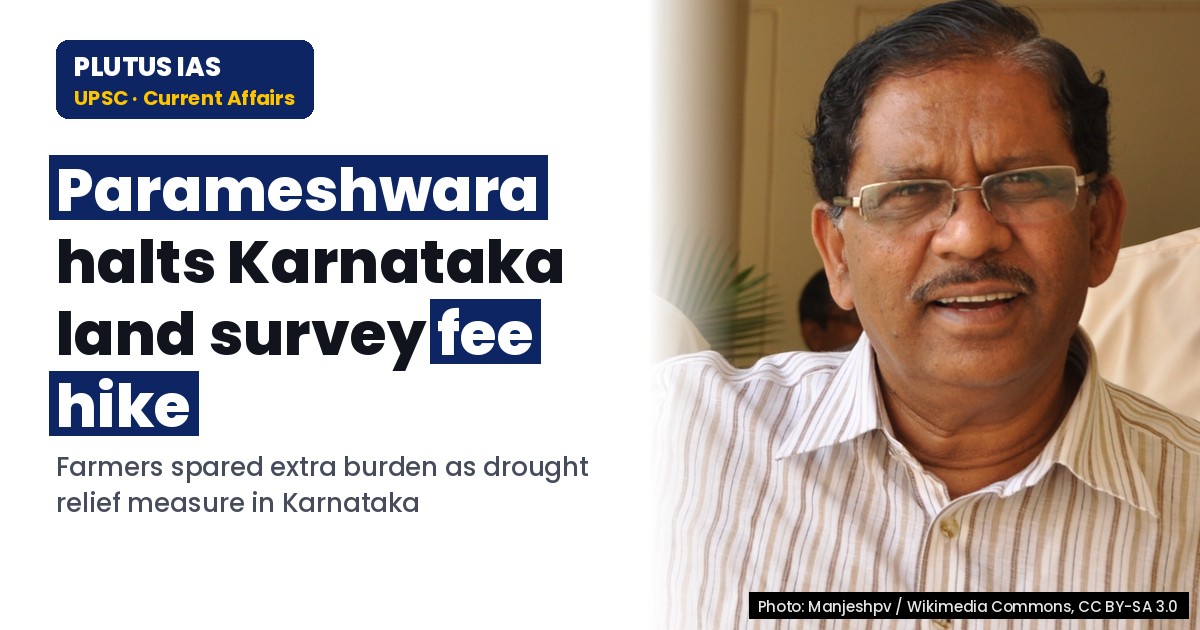
05 Oct Karnataka Halts Farm Land Survey Fee Hike Amid Drought Concerns
✎ The Mojini system is Karnataka’s digital land records platform under the State Land Records Modernisation Programme, designed to enhance transparency and efficiency in land administration, with fee structures subject to periodic…
Subject Relevance — Where This Topic Fits
- GS Paper II — Governance, Transparency and Accountability | GS Paper III — Land Reforms and Agricultural Economics
- Prelims: Mojini system, Revenue Department fee structure, Land survey applications, State Land Records Modernisation Programme (SLRM), Karnataka Revenue Act, 1964
- Essay: Agrarian distress and policy responsiveness, Balancing fiscal sustainability with equitable governance in land administration
Quick Revision: The Mojini system is Karnataka’s digital land records platform under the State Land Records Modernisation Programme, designed to enhance transparency and efficiency in land administration, with fee structures subject to periodic revisions and administrative recalibrations.
Why is this in the news?
The Karnataka government has temporarily suspended the revised fee hike for land survey applications under the Mojini system, citing severe drought conditions and the need to protect farmers’ interests. This decision reflects a governance responsiveness mechanism where public service charges are recalibrated in response to socio-economic exigencies, particularly in the agricultural sector.
Background
- The Mojini system, implemented by the Karnataka Department of Survey, Settlement and Land Records, is an integrated digital platform for land records management, aimed at reducing delays and improving transparency in land-related transactions.
- Karnataka has been a pioneer in land record digitisation, with the Mojini system being a key component of the State Land Records Modernisation Programme (SLRM), a centrally sponsored scheme under the Digital India Land Records Modernisation Programme (DILRMP).
- Agrarian distress in Karnataka, exacerbated by recurring droughts and erratic monsoons, has heightened the sensitivity of land administration policies toward farmer welfare.
- Public criticism of fee hikes in revenue services has been a recurring theme, with stakeholders arguing that such increases disproportionately burden small and marginal farmers.
- The State government’s decision to withhold the revised fee underscores the interplay between fiscal policy, administrative efficiency, and social equity in land governance.
What is the Mojini system?
- The Mojini system is a web-based, end-to-end digital platform developed by the Karnataka government for the management of land records, including mutation, survey, and settlement operations.
- It integrates multiple revenue and survey functions, enabling online submission of land survey applications, real-time tracking of status, and automated generation of records.
- The system aims to eliminate manual processes, reduce corruption, and enhance transparency in land administration, aligning with the objectives of the Digital India Land Records Modernisation Programme (DILRMP).
- Key services offered under Mojini include mutation of land records, issuance of certified copies of land records, and processing of survey applications.
- The platform is governed by the Karnataka Land Revenue Act, 1964, and the Karnataka Survey and Boundaries Act, 1961, which provide the legal framework for land records management.
- The system employs Geographic Information System (GIS) technology to map land parcels, ensuring accuracy and reducing disputes over land boundaries.
- The fee structure for services under Mojini is prescribed by the State government and is subject to periodic revisions based on administrative costs and inflation.
- The temporary suspension of the revised fee hike highlights the system’s responsiveness to socio-economic conditions, particularly in the agricultural sector.
Key Features
| Feature | Significance |
|---|---|
| Mojini System | A digital platform administered by the Department of Survey, Settlement and Land Records for land survey applications, aimed at streamlining and modernising land record management in Karnataka. |
| Revised Fee Structure | Proposed increase in fees for land survey services under the Mojini system, intended to reflect market costs and improve service delivery efficiency. |
| Temporary Withholding | Decision to suspend the revised fee structure from October 1, 2026, in response to public criticism and drought conditions affecting farmers. |
| Revenue Department Services | Includes land survey, settlement, and land record-related services, critical for land ownership verification and dispute resolution. |
| Drought Mitigation Context | The decision to withhold the fee hike is framed within Karnataka’s ongoing drought situation, prioritising farmer relief over administrative revenue generation. |
Why it Matters
Economic
- The fee hike suspension reflects a balance between administrative cost recovery and socio-economic equity, particularly for marginal farmers who rely on land surveys for legal and financial transactions.
- Revenue generation from land services is a key component of state finances, but its imposition must align with agricultural distress to avoid exacerbating rural economic strain.
- The decision underscores the role of land records in agricultural credit access, as updated surveys are often prerequisites for bank loans and insurance claims.
Institutional
- The Mojini system represents Karnataka’s digital transformation in land governance, aimed at reducing delays and corruption in land record management.
- The temporary reversal highlights the need for stakeholder consultations before policy implementation, particularly in governance reforms affecting rural populations.
- The Revenue Department’s responsiveness to public feedback demonstrates adaptive governance, though long-term policy stability remains a concern.
Legal-Administrative
- Land survey fees are governed by state-specific rules under the Karnataka Land Revenue Act, 1964, and the Karnataka Survey and Boundaries Act, 1961, which mandate fee structures for survey services.
- The decision to withhold the fee hike may require formal notification or executive order to ensure legal validity and avoid procedural ambiguities.
Agrarian
- Farmers’ access to land records is critical for dispute resolution, land title clarity, and availing government schemes such as crop insurance or loan waivers.
- The drought situation in Karnataka exacerbates the financial burden on farmers, making fee increases for essential services politically and socially sensitive.
Challenges
1. Equity vs. Cost Recovery
- Balancing the need for revenue generation with the socio-economic vulnerability of farmers, particularly during drought conditions.
- Ensuring that fee structures do not disproportionately burden small and marginal farmers who form the majority of landholders in Karnataka.
UPSC Link: Land Reforms in India
2. Digital Governance Gaps
- The Mojini system, while modernising land records, may face challenges in accessibility for farmers in remote or digitally illiterate areas.
- Ensuring seamless integration with existing land record systems and avoiding duplication of efforts between digital and manual processes.
UPSC Link: Digital India Land Records Modernisation Programme
3. Policy Reversal and Stability
- Frequent policy reversals can erode public trust in government initiatives and create uncertainty for stakeholders relying on stable administrative processes.
- The need for a consultative framework to assess the impact of fee revisions before implementation.
UPSC Link: Administrative Reforms in India
4. Drought-Induced Fiscal Constraints
- The state’s revenue base may be strained due to drought, limiting its ability to absorb the loss from withheld fees without impacting other essential services.
- Prioritising drought relief over administrative revenue may set a precedent for future policy decisions in similar crises.
UPSC Link: Agricultural Drought Management
5. Legal and Procedural Ambiguities
- The temporary nature of the withholding decision may lead to legal ambiguities regarding the validity of pending applications or refunds for excess fees paid.
- Ensuring that the suspension does not violate contractual or statutory obligations tied to the revised fee structure.
UPSC Link: Land Revenue Laws in India
Challenges — UPSC Perspective
| Issue | Concern |
|---|---|
| Revenue Loss | Temporary suspension of fee hike may reduce state revenue from land services, impacting budgetary allocations for other sectors. |
| Stakeholder Consultation | Inadequate pre-implementation consultations with farmers, surveyors, and legal experts may lead to policy misalignment. |
| Digital Divide | Limited access to the Mojini system in rural areas may exclude small farmers from benefiting from modernised land records. |
| Policy Precedent | Frequent reversals in fee structures may discourage long-term investment in land governance infrastructure. |
| Legal Validity | The temporary suspension may face challenges if not formalised through executive orders or notifications. |
| Drought Impact | Prolonged drought may necessitate further fee waivers or subsidies, straining state finances further. |
Way Forward
- Conduct a comprehensive impact assessment of the revised fee structure on farmers, surveyors, and the Revenue Department to inform future policy decisions.
- Initiate stakeholder consultations with farmer associations, legal experts, and digital governance specialists to refine the Mojini system’s fee policy.
- Strengthen digital literacy programmes in rural Karnataka to ensure equitable access to the Mojini system and other e-governance platforms.
- Explore alternative revenue models for land services, such as cross-subsidisation or performance-based fees, to reduce reliance on direct charges.
- Establish a transparent mechanism for grievance redressal related to land survey fees and service delays to build public trust.
- Align the fee policy with Karnataka’s drought management strategy to ensure that relief measures are integrated with administrative reforms.
- Document the decision-making process for the fee suspension to provide clarity on future policy reversals and maintain institutional credibility.
UPSC Value Addition
Keywords for Mains Answer-Writing
land records digitisation · Mojini system · Revenue Department reforms · land survey fee structure · agricultural distress and governance · land records modernisation · survey and settlement administration · public service fee rationalisation · State Revenue Administration · drought relief and policy measures · land governance in India · digital land records ecosystem
Constitutional & Policy Linkages
- Article 300A: Right to Property (protection against arbitrary fee imposition)
Concept Flow
Drought conditions in Karnataka → Increased pressure on farmers → Proposal for revised land survey fees → Public criticism and Revenue Department review → Temporary suspension of fee hike → Re-evaluation of policy impact → Stakeholder consultations → Long-term fee policy formulation.
Prelims Practice Questions
Q1. Consider the following statements regarding the Mojini system in Karnataka:
1. It is a digital platform for land records management under the Department of Survey, Settlement and Land Records.
2. The system facilitates online applications for land survey services.
3. The fee for services under Mojini was recently revised and subsequently put on hold due to agricultural distress.
How many of the above statements are correct?
- Only one
- Only two
- All three
- None
Answer: All three — Statements 1 and 2 are correct as the Mojini system is Karnataka’s digital land records platform enabling online survey applications. Statement 3 is also correct—the fee revision was implemented on October 1, 2026, and later put on hold. Thus, two statements are correct.
Q2. Assertion (A): The Mojini system is a flagship initiative under the Digital India Land Records Modernisation Programme (DILRMP).
Reason (R): DILRMP aims to digitise and modernise land records to reduce litigation and improve transparency in land governance.
Options:
A. Both A and R are true, and R is the correct explanation of A.
B. Both A and R are true, but R is NOT the correct explanation of A.
C. A is true, but R is false.
D. A is false, but R is true.
Answer: ? — Assertion (A) is true: Mojini is Karnataka’s implementation of DILRMP. Reason (R) is also true and correctly explains A, as DILRMP’s core objective is digitisation and modernisation of land records to reduce disputes and enhance transparency.
Q3. Which of the following is NOT a component of the Digital India Land Records Modernisation Programme (DILRMP)?
A. Computerisation of land records
B. Digitisation of cadastral maps
C. Implementation of the National Land Use Policy
D. Survey/re-survey using modern technology
- A
- B
- C
- D
Answer: C — The National Land Use Policy is not a component of DILRMP. DILRMP focuses on computerisation, digitisation of maps, and modern survey techniques, but does not include a standalone land use policy.
Mains Practice Question
✍ The State government’s decision to temporarily withhold the revised fee for land survey services under the Mojini system reflects tensions between revenue administration reforms and agricultural distress. Critically examine the challenges in land governance in India and the role of digital platforms like Mojini in addressing them. (15 Marks)
Approach: MODEL-ANSWER SKELETON:
1. **Context**: Define land governance challenges in India—fragmented records, litigation, lack of transparency, and farmer distress. Cite data on land disputes (e.g., ~66% of civil cases in India are land-related) and their economic impact.
2. **Mojini System**: Explain its features—digital land records, online survey applications, and integration with DILRMP. Highlight its role in reducing manual errors and speeding up services.
3. **Revenue Administration Reforms**: Discuss the rationale for fee revisions—cost recovery, sustainability of digitisation, and service upgradation. Contrast with the need for farmer-centric policies during droughts.
4. **Balancing Act**: Analyse the tension between fiscal sustainability and social equity. Reference the constitutional duty of the State under Article 39(b) (Directive Principles) to ensure equitable access to resources.
5. **Way Forward**: Suggest measures—progressive fee structures, subsidies for small farmers, and grievance redressal mechanisms. Mention the role of Gram Sabhas and local institutions in participatory governance.
6. **Conclusion**: Emphasise that digital land governance must align with social justice, not merely fiscal efficiency.
Source: The Hindu
Generated by AanyaAi for educational purpose.
Related guides on our sites
- Best PSIR optional coaching for upsc
- Best economics optional coaching for upsc
- Best PSIR optional teacher for upsc
- Best teacher of PSIR optional for upsc

- Karnataka Halts Farm Land Survey Fee Hike Amid Drought Concerns - October 5, 2026
- न्यायमूर्ति पी. सैम कोशी बने तेलंगाना उच्च न्यायालय के कार्यवाहक मुख्य न्यायाधीश - October 5, 2026
- Andhra HC Rejects Relaxation in Environmental Norms for Vizag Data Centre - October 5, 2026

No Comments