


03 Sep Karnataka HC Raises Concerns Over Tunnel Road Projects & Hebbal Lake Water Flow
✎ The Karnataka High Court’s intervention in the tunnel road projects highlights the necessity of integrating environmental safeguards (Wetland Rules, 2017; EIA Notification, 2006) and geological conservation (GSI’s National…
Subject Relevance — Where This Topic Fits
- GS Paper II — Governance, Constitution and Polity (Judicial Review and PILs) | GS Paper III — Environment and Ecology (Conservation of Natural Resources, Impact Assessment) | GS Paper III — Infrastructure Development and Environmental Concerns
- Prelims: Public Interest Litigation (PIL), Geological Survey of India (GSI), National Geological Monuments, Environmental Impact Assessment (EIA), Wetland Conservation Rules, 2017, Peninsular Gneiss, Hebbal Lake, Lal Bagh, Bangalore Development Authority (BDA)
- Essay: Balancing Development and Environmental Conservation: A Case Study of Bengaluru’s Infrastructure Projects, Judicial Activism in Environmental Governance: Safeguarding Natural Heritage
Quick Revision: The Karnataka High Court’s intervention in the tunnel road projects highlights the necessity of integrating environmental safeguards (Wetland Rules, 2017; EIA Notification, 2006) and geological conservation (GSI’s National Geological Monuments) into urban infrastructure planning to ensure sustainable development.
Why is this in the news?
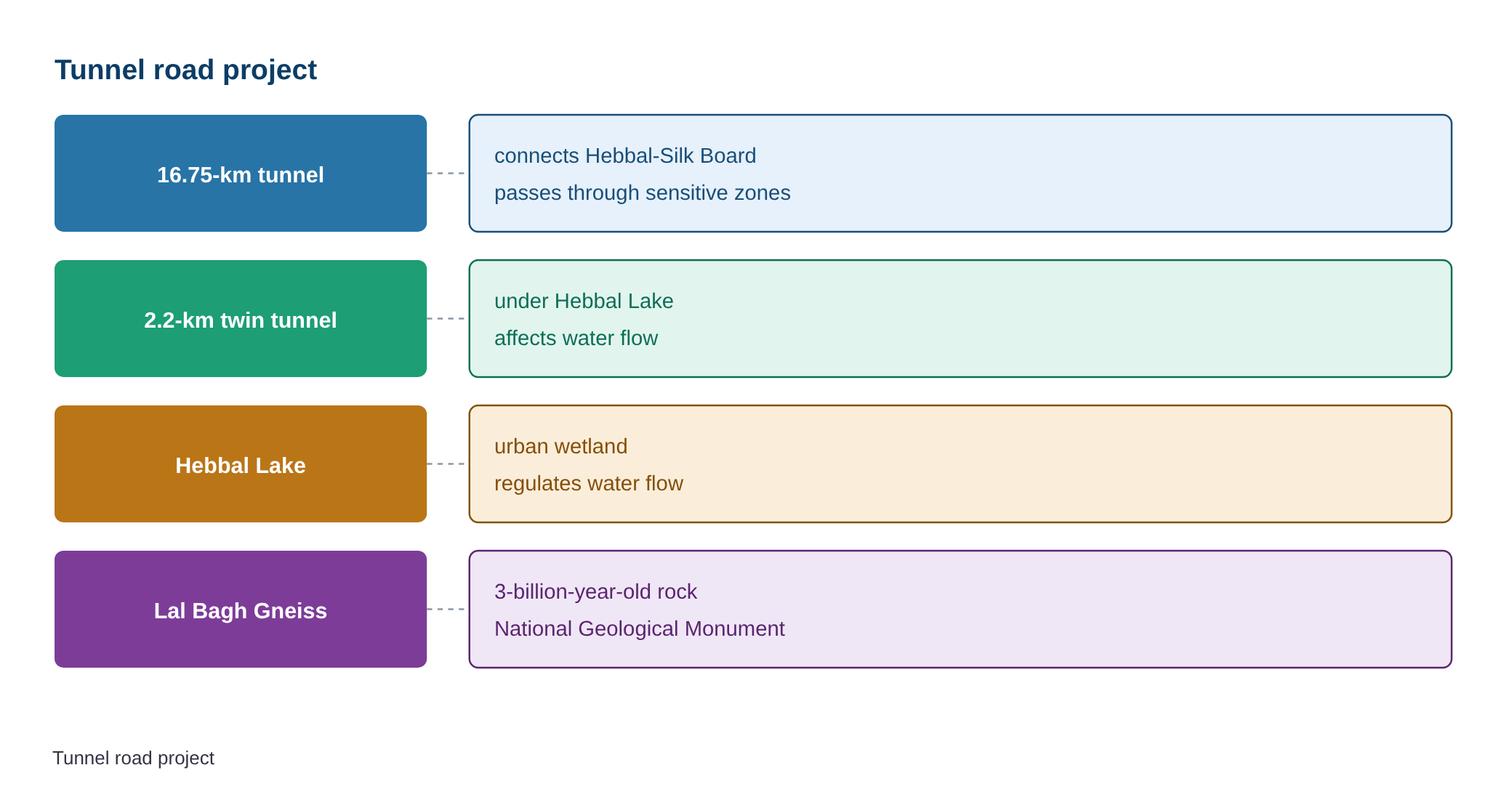
The Karnataka High Court has directed the state government to submit a Geological Survey of India (GSI) report on the impact of the 16.75-km tunnel road project on the 3-billion-year-old Peninsular Gneiss in Lal Bagh, a National Geological Monument, and to arrange a presentation by engineers to address concerns regarding the inflow and outflow of water to Hebbal Lake due to the construction of a 2.2-km twin tunnel. This judicial intervention underscores the intersection of infrastructure development, geological conservation, and wetland protection in urban planning.
Background
- The proposed 16.75-km tunnel road project in Bengaluru aims to connect Hebbal and Silk Board junctions, passing through ecologically sensitive zones including Hebbal Lake and Lal Bagh.
- Hebbal Lake is a vital urban wetland that regulates water flow, supports biodiversity, and serves as a flood mitigation measure in Bengaluru’s rapidly urbanising landscape.
- Lal Bagh, a historic botanical garden, contains the 3-billion-year-old Peninsular Gneiss, designated as a National Geological Monument by the Geological Survey of India (GSI) in 2016, highlighting its geological significance.
- Public Interest Litigations (PILs) have been filed challenging the legality of the tunnel projects, citing potential violations of environmental laws, including the Wetland (Conservation and Management) Rules, 2017, and the Environmental Impact Assessment (EIA) Notification, 2006.
- The Karnataka High Court’s suo motu intervention reflects the judiciary’s role in ensuring compliance with environmental safeguards and constitutional provisions such as Article 21 (Right to Life) and Article 48A (Protection and Improvement of Environment).
- Urban infrastructure projects in Bengaluru have historically faced scrutiny for their environmental impact, necessitating robust regulatory frameworks and judicial oversight.
Key Aspects of the Tunnel Road Projects and Legal Concerns
- The 16.75-km tunnel road project is part of Bengaluru’s broader infrastructure push to alleviate traffic congestion, with an estimated cost of ₹12,500 crore.
- The project includes a 2.2-km twin tunnel from Hebbal junction to the Karnataka Veterinary, Animal, and Fisheries University (KVAFSU), raising concerns over its alignment with Hebbal Lake’s water flow dynamics.
- Hebbal Lake, a man-made wetland spread over 75 hectares, is a critical component of Bengaluru’s drainage system and supports diverse flora and fauna, including migratory birds.
- The Peninsular Gneiss in Lal Bagh, dating back to the Archaean Eon, is one of the oldest rock formations in India, providing insights into Earth’s geological history and serving as an educational resource.
- Environmental Impact Assessments (EIAs) for the project must comply with the EIA Notification, 2006, and the Wetland (Conservation and Management) Rules, 2017, which mandate no net loss of wetland area and preservation of ecological functions.
- The PILs argue that the projects violate the ‘Precautionary Principle’ and ‘Polluter Pays Principle’, as they risk altering natural water flows, encroaching on wetland buffers, and damaging geological heritage.
- The Karnataka High Court’s directive to the Advocate General to arrange a presentation by engineers reflects the judiciary’s emphasis on evidence-based governance and transparency in infrastructure projects.
Key Features
| Feature | Significance |
|---|---|
| Tunnel road project (16.75 km, Hebbal-Silk Board) | Intended to decongest Bengaluru’s traffic by providing an elevated expressway corridor; raises environmental and geological concerns due to its length and urban footprint. |
| Short transitory twin tunnel (2.2 km, Hebbal-KVAFSU) | Part of the larger project, designed to facilitate local traffic movement; intersects Hebbal lake’s buffer zone, triggering hydrological and ecological scrutiny. |
| GSI report on Peninsular Gneiss (Lal Bagh) | Lal Bagh’s geological formation is a 3-billion-year-old National Geological Monument; any infrastructure impact necessitates expert geological assessment to preserve heritage and stability. |
| Hebbai lake water flow management | Hebbai lake is a critical urban waterbody; tunnel construction risks disrupting natural inflow/outflow, potentially altering hydrological balance and ecosystem services. |
| Karnataka High Court directions | Judicial oversight ensures adherence to environmental laws, geological safety, and public interest; directions mandate expert presentations and reports to address concerns raised in PILs. |
Why it Matters
Environmental and Ecological
- Urban infrastructure projects in Bengaluru often intersect with sensitive ecosystems like Hebbal lake, necessitating rigorous environmental impact assessments to prevent irreversible damage.
- Lal Bagh’s Peninsular Gneiss, a geological heritage site, requires protection under the Geological Survey of India’s monument designation, mandating compliance with conservation norms.
- Disruption of natural water flow to Hebbal lake could alter local microclimates, biodiversity, and groundwater recharge, impacting urban resilience and ecological services.
Urban Planning and Governance
- Bengaluru’s rapid urbanisation demands integrated infrastructure planning to balance mobility needs with environmental and geological constraints.
- Judicial interventions in PILs highlight the role of the judiciary in ensuring accountability and transparency in urban governance, particularly for projects with potential public harm.
- Public participation in infrastructure decisions, as seen in PILs, underscores the need for inclusive planning processes to address citizen concerns.
Legal and Institutional
- The Geological Survey of India’s role in designating and protecting geological monuments ensures scientific oversight in infrastructure projects affecting such sites.
- The Karnataka High Court’s directives exemplify the judiciary’s function in interpreting environmental laws and enforcing compliance with statutory safeguards.
- Advocate General’s involvement in arranging expert presentations reflects the state’s obligation to provide evidence-based responses to judicial queries.
Challenges
1. Environmental Impact Assessment (EIA) Gaps
- Potential inadequacies in EIA reports may fail to capture cumulative impacts of tunnel construction on Hebbal lake’s hydrology and Lal Bagh’s geological stability.
- Lack of real-time monitoring mechanisms to assess ongoing environmental changes during and post-construction phases.
- Difficulty in quantifying long-term ecological and geological risks due to limited baseline data on urban ecosystems.
UPSC Link: GS Paper 3: Environmental Impact Assessment
2. Geological Heritage Conservation
- Ensuring that infrastructure projects do not compromise the integrity of designated geological monuments, such as the Peninsular Gneiss in Lal Bagh.
- Balancing developmental needs with the preservation of geological heritage, which may require alternative routing or design modifications.
- Inadequate enforcement of conservation guidelines by state agencies, leading to potential violations.
UPSC Link: GS Paper 1: Conservation of Natural Resources
3. Urban Hydrology Disruption
- Risk of altering natural water flow paths to Hebbal lake due to tunnel construction, potentially leading to waterlogging, reduced groundwater recharge, or ecosystem degradation.
- Insufficient hydrological studies to model the impact of tunneling on surface and subsurface water dynamics in Bengaluru’s urban context.
- Lack of integrated water management policies to mitigate adverse effects on urban waterbodies.
UPSC Link: GS Paper 3: Water Resources and Management
4. Judicial Oversight and Compliance
- Ensuring timely submission of expert reports (e.g., GSI findings) and engineer presentations to address judicial concerns within stipulated timelines.
- Potential delays in project execution due to prolonged legal scrutiny, affecting urban mobility goals.
- Need for clear guidelines on the role of judiciary in balancing developmental imperatives with environmental and geological safeguards.
UPSC Link: GS Paper 2: Judiciary and Constitutional Framework
5. Public Participation and Transparency
- Addressing citizen concerns raised through PILs while ensuring that public participation is constructive and not obstructive to legitimate developmental projects.
- Lack of accessible platforms for real-time public engagement in infrastructure planning processes.
- Ensuring that expert opinions and government responses are communicated transparently to stakeholders.
UPSC Link: GS Paper 4: Ethics in Governance
Challenges — UPSC Perspective
| Issue | Concern |
|---|---|
| Inadequate EIA for tunneling | Failure to assess cumulative hydrological and geological impacts of the project. |
| Geological monument at risk | Potential damage to Lal Bagh’s Peninsular Gneiss due to tunneling activities. |
| Disruption of Hebbal lake’s water flow | Alteration of natural inflow/outflow, risking ecosystem services and urban water security. |
| Delayed judicial compliance | Risk of project delays due to prolonged litigation and expert report submissions. |
| Lack of public trust | Perceived opacity in project planning and execution, fueling citizen opposition. |
| Insufficient hydrological data | Gap in baseline data to model and mitigate water flow disruptions. |
Way Forward
- Conduct a comprehensive Environmental Impact Assessment (EIA) with real-time hydrological and geological monitoring to quantify risks to Hebbal lake and Lal Bagh’s Peninsular Gneiss.
- Ensure strict adherence to the Geological Survey of India’s guidelines for projects impacting National Geological Monuments, including alternative routing or design modifications if necessary.
- Establish a multi-stakeholder committee comprising engineers, hydrologists, geologists, and environmentalists to oversee project implementation and address public concerns.
- Develop a transparent public consultation framework to incorporate citizen feedback into infrastructure planning, ensuring accountability and trust.
- Implement adaptive management strategies, including contingency plans for water flow disruptions, to mitigate adverse ecological impacts during and post-construction.
- Strengthen enforcement mechanisms for environmental and geological safeguards, with periodic audits by independent experts.
- Integrate urban hydrology studies into Bengaluru’s Master Plan to ensure that infrastructure projects align with long-term water resource management goals.
UPSC Value Addition
Keywords for Mains Answer-Writing
Urban infrastructure governance · Tunnel road projects · Environmental impact assessment · Hebbai lake conservation · Geological monuments · Peninsular Gneiss · National Geological Monuments · Public Interest Litigation (PIL) · Judicial oversight in infrastructure · Sustainable urban development · Lal Bagh conservation · Geological Survey of India (GSI)
Constitutional & Policy Linkages
- [‘Article 21’, ‘Right to a healthy environment’]
- [‘Article 48A’, ‘Protection and improvement of environment’]
- [‘Article 51A(g)’, ‘Fundamental duty to protect natural environment’]
Concept Flow
Urban congestion in Bengaluru necessitates infrastructure projects like tunnel roads for mobility. → Proposal for 16.75-km tunnel road and 2.2-km transitory tunnel triggers environmental and geological concerns. → Hebbai lake’s hydrology and Lal Bagh’s Peninsular Gneiss are identified as vulnerable to project impacts. → Public Interest Litigations (PILs) challenge the project’s legality, citing EIA gaps and conservation violations. → Karnataka High Court directs submission of GSI report and engineer presentations to assess risks. → Judicial oversight ensures compliance with environmental and geological safeguards, balancing development with conservation. → Outcome hinges on rigorous EIA, transparent governance, and adaptive management to mitigate identified risks.
Prelims Practice Questions
Q1. Consider the following statements regarding the Geological Survey of India (GSI):
1. GSI is responsible for the declaration of National Geological Monuments in India.
2. The Peninsular Gneiss in Lal Bagh, Bengaluru, has been declared a National Geological Monument by the GSI.
3. GSI functions under the administrative control of the Ministry of Environment, Forest and Climate Change.
How many of the above statements are correct?
- Only one
- Only two
- All three
- None
Answer: All three — Statements 1 and 2 are correct. GSI declares National Geological Monuments, and the Peninsular Gneiss in Lal Bagh is one such monument. Statement 3 is incorrect as GSI functions under the Ministry of Mines, not the Ministry of Environment.
Q2. Assertion (A): The High Court of Karnataka directed the submission of the Geological Survey of India (GSI) report on the impact of the tunnel road project on the Peninsular Gneiss in Lal Bagh.
Reason (R): The Peninsular Gneiss in Lal Bagh has been declared a National Geological Monument by the GSI.
In the context of the above two statements, which one of the following is correct?
- Both A and R are true, and R is the correct explanation of A.
- Both A and R are true, but R is not the correct explanation of A.
- A is true, but R is false.
- A is false, but R is true.
Answer: Both A and R are true, but R is not the correct explanation of A. — Both the assertion and reason are true. The High Court’s directive to submit the GSI report stems from the monument status of the Peninsular Gneiss in Lal Bagh, as declared by the GSI. The reason correctly explains the assertion.
Q3. Which of the following is NOT a function of the Geological Survey of India (GSI)?
- Declaration of National Geological Monuments
- Assessment of environmental impact of infrastructure projects
- Mapping of geological resources
- Conducting geological surveys and studies
Answer: Assessment of environmental impact of infrastructure projects — The assessment of environmental impact of infrastructure projects is not a function of the GSI. GSI’s primary functions include geological mapping, resource assessment, and declaration of geological monuments. Environmental impact assessments are typically conducted by other agencies such as the Ministry of Environment, Forest and Climate Change.
Mains Practice Question
✍ The construction of large-scale infrastructure projects in urban areas often necessitates balancing developmental imperatives with environmental and geological conservation. In this context, critically examine the role of judicial oversight in ensuring sustainable urban development, with particular reference to the recent directives issued by the Karnataka High Court in the tunnel road projects case. (15 Marks)
Approach: MODEL-ANSWER SKELETON:
1. **Introduction (2 marks)**: Define the concept of judicial oversight in infrastructure governance and its significance in balancing development and conservation. Mention the constitutional basis (Art. 226, 32, and the doctrine of sustainable development).
2. **Background of the Case (3 marks)**: Briefly outline the facts of the Karnataka High Court case involving the tunnel road projects near Hebbal Lake and Lal Bagh. Highlight the key concerns raised: impact on Hebbal Lake’s water flow and the Peninsular Gneiss monument in Lal Bagh.
3. **Judicial Directives and Their Legal Basis (4 marks)**: Discuss the specific directives issued by the Karnataka High Court, such as the demand for a presentation by engineers on water flow measures and the submission of the GSI report. Link these directives to the principles of environmental justice, precautionary principle (Vellore Citizens Welfare Forum v. Union of India, 1996), and the public trust doctrine.
4. **Role of Judicial Oversight (4 marks)**: Analyze the role of the judiciary in ensuring sustainable urban development. Discuss how judicial intervention can act as a check on executive actions, ensure compliance with environmental laws (e.g., EIA Notification, 2006), and uphold the rights of citizens and future generations. Cite relevant cases such as MC Mehta v. Union of India (1986) and the NGT’s role.
5. **Challenges and Criticisms (2 marks)**: Briefly discuss the challenges faced by the judiciary in balancing development and conservation, such as the lack of technical expertise, delays in project execution, and potential conflicts with executive policies. Acknowledge criticisms of judicial activism vs. judicial restraint in infrastructure governance.
6. **Conclusion (2 marks)**: Summarize the importance of judicial oversight in sustainable urban development and suggest measures to enhance its effectiveness, such as capacity building for courts in handling technical matters and strengthening multi-stakeholder consultations.
Source: The Hindu
Karnataka PCS (KPSC) — State PCS Practice
Prelims: Which of the following is the primary concern raised by the Karnataka High Court regarding the proposed tunnel road projects near Hebbal Lake?
- A. Disruption of underground water flow and potential flooding
- B. Damage to the Lal Bagh monument due to vibrations
- C. Increased traffic congestion in the city
- D. Violation of environmental clearance norms
Answer: A. Disruption of underground water flow and potential flooding — The Karnataka High Court sought a presentation on Hebbal Lake’s water flow to assess potential disruptions caused by the tunnel road projects.
Mains: Examine the environmental and heritage conservation challenges posed by the proposed tunnel road projects in Bengaluru, with specific reference to Hebbal Lake and Lal Bagh. Suggest measures to mitigate these concerns while ensuring sustainable urban development.
Generated by AanyaAi for educational purpose.
Related guides on our sites
- Best economics services coaching
- Anthropology VS PSIR
- Best PSIR optional coaching
- Best PSIR optional coaching online

- India-Australia AUSTRAHIND 2026 Exercise: Key Highlights for UPSC & State PCS - October 22, 2026
- एससीओ बैठक में भारत का आतंकवाद विरोध: क्षेत्रीय सहयोग पर जोर - October 22, 2026
- SEC Directs Strict SC Order Compliance for Andhra ULB Polls - October 22, 2026

No Comments